
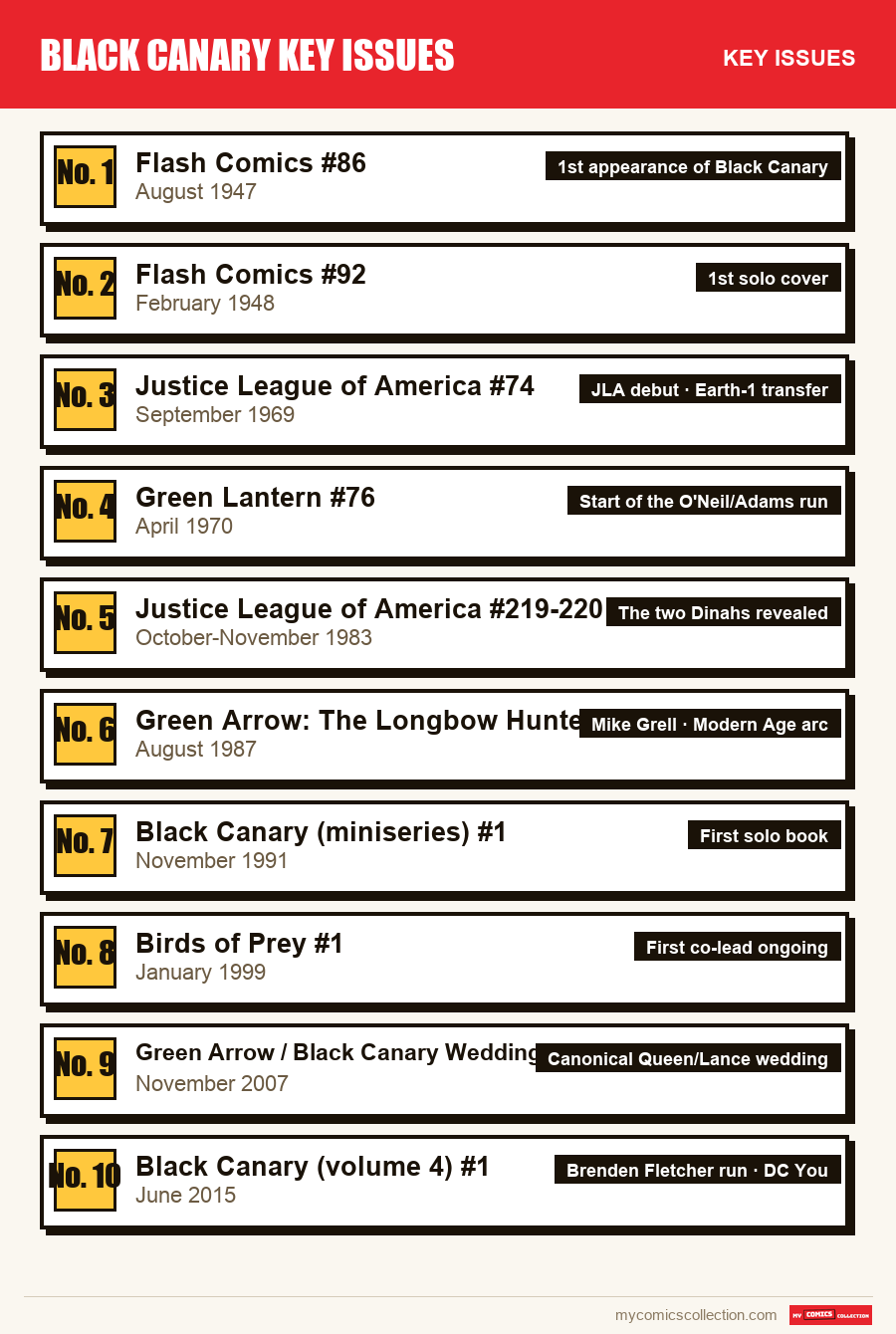
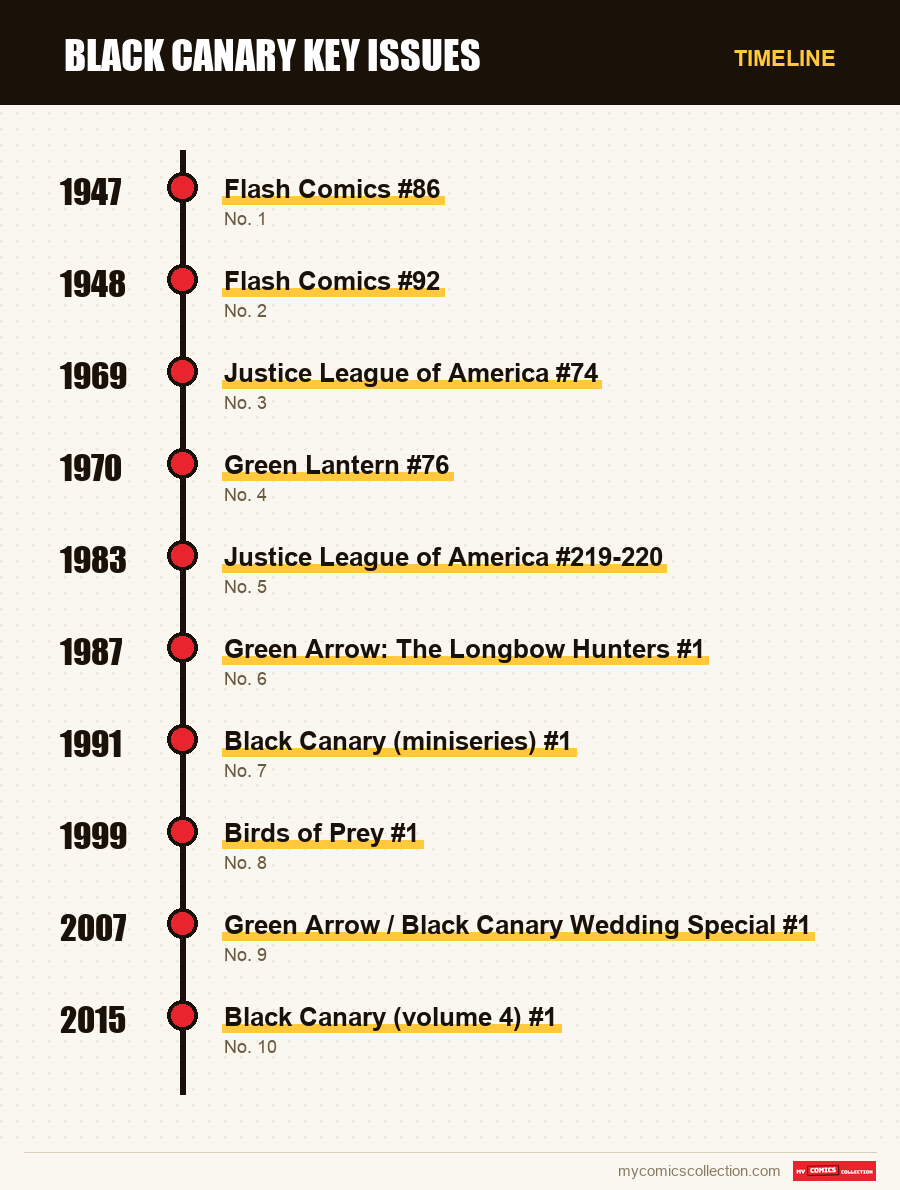
The key issues of Black Canary are Flash Comics #86 (August 1947), her first appearance by Robert Kanigher and Carmine Infantino, Flash Comics #92 (February 1948), her first solo cover, Justice League of America #74 (September 1969), which moves her from Earth-2 to Earth-1, and Green Lantern #76 (April 1970), the start of Denny O'Neil and Neal Adams's run.
Black Canary spans seventy-five years of unbroken DC publishing history, making her one of the most consistently published Golden Age heroines in the entire catalog. From Flash Comics #86 in August 1947 to the 2015 volume 4 solo series, the character racks up scarce first appearances, cult runs from the likes of Denny O'Neil and Chuck Dixon, and pivotal issues such as her Earth-2 to Earth-1 migration in Justice League of America #74. This guide rounds up the top 10 Black Canary key issues a serious collector should target, with editorial context, thematic badges, and indicative value ranges by CGC grade. For the full biographical background, see the history of Black Canary.
Black Canary in comics history
Black Canary is one of the very few Golden Age heroines never to suffer a long publishing absence. Created by Robert Kanigher and Carmine Infantino in Flash Comics #86 in August 1947, Dinah Drake debuted as a backup story in the Johnny Thunder feature, which she ended up replacing outright by Flash Comics #92 (February 1948). That swift commercial rise was exceptional for a heroine of the era and stands as the character's first historical milestone.
Her publishing career then organized around three pillars. The first: the Justice Society of America, which she joined in 1948, followed by the Justice League of America starting in September 1969 in Justice League of America #74, the issue that locks in her Earth-2 to Earth-1 transfer and plants Dinah in modern continuity. The second: the cult Green Lantern/Green Arrow run (1970-1972) by Denny O'Neil and Neal Adams, where she exists as an active partner rather than a passive love interest. The third: Birds of Prey, launched in 1996 and then as an ongoing in 1999, which gave her her first modern solo continuity alongside Oracle.
For the collector, the appeal rests on three combined factors: the scarcity of Golden Age issues, an editorial footprint stretching across eight decades, and steady media exposure through Arrow (2012-2020) on CW, Birds of Prey (2020) on the big screen, and the HBO Max solo series that was announced and then canceled in 2022. Every announcement or release triggers a measurable move in the value of Flash Comics #86 and Birds of Prey #1. For the background on the founding title, see the history of Flash Comics.
Top 10 Black Canary key issues
The selection below ranks issues by historical importance and scarcity rather than by raw value. The ranges are indicative and fluctuate with adaptation announcements and major public auction appearances.
Flash Comics #86
The founding issue. Robert Kanigher and Carmine Infantino introduce Dinah Drake in a backup story within the Johnny Thunder feature. She debuts without her Canary Cry, as a masked burglar revealed to be a crimefighter. The fragile Golden Age paper stock, the limited postwar print run, and the issue's historical standing make it one of the rarest DC comics to find in high grade.
Flash Comics #92
Six months after her debut, Black Canary takes the cover of Flash Comics and supplants Johnny Thunder atop the contents page. The character's commercial birth certificate as a headlining heroine and a Golden Age marker highly sought after by completists. Values have been climbing since 2017, especially above CGC 8.0.
Justice League of America #74
A pivotal issue. After Larry Lance's death on Earth-2, Black Canary migrates to Earth-1 and officially joins the Justice League. The issue bridges the Golden Age and the Silver Age, and plants Dinah in modern continuity for the next fifty years. In strong demand among classic JLA completists, with values rising since 2020.
Green Lantern #76
One of the most important comics of the 1970s. Denny O'Neil and Neal Adams launch what would become Green Lantern/Green Arrow, with Black Canary present from the outset alongside Oliver Queen. The run tackles racism, addiction, and American politics, and lays the groundwork for the Green Arrow/Black Canary relationship. Values stay high across all years.
Justice League of America #219-220
A two-parter revealing that the modern Black Canary is Dinah Laurel Lance, daughter of the original Dinah Drake. This retcon resolves the age inconsistency of the Golden Age character who joined the JLA in 1969 and underpins the entire pre-Crisis continuity. Sought after by fans of the Gerry Conway era, and affordable in high grade.
Green Arrow: The Longbow Hunters #1
A Mike Grell miniseries that recasts Green Arrow as an urban vigilante in Seattle and places Black Canary at the heart of a traumatic arc. The story marks the character permanently and shapes the tone of future Birds of Prey series. Print runs were decent for the time, but CGC 9.8 copies have been in demand since the TV announcements of the 2010s.
Black Canary (miniseries) #1
The very first solo Black Canary miniseries, by Sarah Byam and Trevor Von Eeden. Four issues that mark the character's editorial emancipation beyond the Green Arrow pairing. Limited early-1990s print runs, with an active secondary market for high grades. Affordable as a raw copy, with a clear premium from CGC 9.6 up.
Birds of Prey #1
The launch of the Birds of Prey ongoing series by Chuck Dixon. The first issue where Black Canary shares top billing on an ongoing alongside Oracle. The reference issue for the franchise up to the 2020 film adaptation with Jurnee Smollett. Print runs were decent, but early-printing copies carry notable premiums in CGC 9.8.
Green Arrow / Black Canary Wedding Special #1
The canonical wedding of Oliver Queen and Dinah Lance, written by Judd Winick. It makes official a couple in place since 1969 and is the editorial event that opens the Green Arrow / Black Canary series. Three variant covers exist, including a sought-after Adam Hughes cover. To dig into the Green Arrow context, see our Green Arrow key issues guide.
Black Canary (volume 4) #1
The first issue of volume 4, launched during the DC You era. Brenden Fletcher and Annie Wu put Dinah at the helm of an indie rock band, blending adventure with a music tour. An accessible modern issue, with a clear premium on the B and C variants by Jenny Frison and Cliff Chiang. Print runs are scarce on the high ratios.
Collecting this series?
Track what you own, what you are missing and what your collection is worth. 7 day trial.
Start my trial →The essential Black Canary story arcs
Five runs frame the Black Canary mythology and serve as the recommended entry points for a collector looking to go beyond single key issues.
Green Lantern / Green Arrow
The cornerstone run by Denny O'Neil and Neal Adams (1970-1972) establishes the Green Arrow/Black Canary relationship as one of DC's most enduring. Dinah exists here as an active partner, which sets the template for the next fifty years. Required reading to understand the Bronze Age character.
The Longbow Hunters
A 1987 Mike Grell miniseries that toughens the tone and tips Black Canary into the Modern Age. A hard, controversial, foundational arc. A direct influence on everything that follows, from Birds of Prey to the CW storylines. A three-issue format to complete in singles.
Birds of Prey (Chuck Dixon)
The foundational Chuck Dixon run (1999-2003) builds the Oracle/Black Canary duo into one of DC's strongest female dynamics. Forty-six issues to collect for the densest Black Canary continuity of the modern era.
Birds of Prey (Gail Simone)
Gail Simone's run widens the cast (Huntress, Lady Blackhawk) and carries the franchise to its critical peak. The run where Black Canary asserts her role as operational leader against Oracle's coordination. Essential reading to round out Dixon.
Black Canary volume 4
The Brenden Fletcher and Annie Wu run (2015-2016) in 12 issues. The most immediate modern read, free of heavy continuity. A rock-tour concept with a distinct visual treatment. A short format ideal for a collector who wants a complete arc without a multi-series commitment.
To follow these arcs spanning several series and dozens of issues, use the collection tracking feature in My Comics Collection, build your custom lists, and map your progress arc by arc.
How My Comics Collection manages your Black Canary collection
Collecting Black Canary means navigating fragile Golden Age books, modern ongoing runs, and team-book appearances scattered across six decades of Justice League, Justice Society, Birds of Prey, and Green Arrow. My Comics Collection imports every volume from a worldwide comics catalog, automatically flags your missing issues, manages your CGC-graded copies with individual valuations, and estimates the total value of your Black Canary collection, updated daily.