Number 59 is the last one of only one of the two series. In the catalog record, Big Boss 1970 counts 59 booklets with no gap and ends at 59, dated 1983. Big Boss 1960 runs there from 46 to 70: its 59, dated 1961, is a middle issue. Two objects therefore carry the same number, twenty-two years apart. On a list of missing issues, the number alone designates nothing: you need the series and the year.
You have a "Big Boss 59" on your list, or in your hands, and you want to know whether it closes a collection. The answer depends on the series it comes from: 59 closes the 1970 record, not the 1960 one.
As always on this guide, only verified information (creators, numbers, dates) is stated as fact; the analysis is ours, with no reproduction of any panel or protected dialogue.

The 59 of 1983: the end of the 1970 series record
The Big Boss 1970 record, published by Arédit-Artima, lists 59 entries, numbered from 1 to 59, with no missing number and no duplicate. Its last booklet is therefore 59, dated 1983, and it is the only one in the record to carry that year: the five preceding ones (54 to 58) are all dated 1982. A number alone in its year, after a series that lined up four to six a year from 1971 to 1982, has the look of an ending.
The story title of 59 is "L'homme de l'île des robots". No writer is recorded; the credited artists are Bob Brown, Sheldon Moldoff and Joe Maneely. This absence of writing credit is not peculiar to the last number: nine booklets out of the 59 in the record have no writer, about 15%, and three of the last six (54, 55 and 59) are in that situation.
The 59 of 1961: a middle issue of the 1960 series
In the Big Boss 1960 record, 59 is not a boundary. The record counts 25 numbers, from 46 to 70, and 59 sits roughly at its center: eleven numbers follow it. Its story title is "Sidéral", credited to Jack Miller alone for the writing, with Dick Dillin, Bruno Premiani and Joe Certa on art.
Its date is a single year: 1961. This is the case for most of the record, since only four booklets out of 25 (64, 65, 66 and 70) carry a month. Thirteen booklets are dated 1961, from 52 to 64, which keeps you from placing 59 more precisely than within that year. The immediate neighbors are 58, "Une arme de guerre humaine", then 60, "S.O.S.": the record gives neither of them more than a title and names.
Two record endings of different natures
Each record has its own ending. For the 1970 series, the end is inside the record: 59 lines for 59 numbers, the series reads from 1 to 59. For the 1960 series, the end of the record is 70, dated July 1962, eleven ranks after 59.
A record is not the series, and two precautions apply. First, the 59 of 1983 is the last of the record: the catalog does not say that the publisher decided to stop there, nor that no booklet followed outside this record. Second, the 1960 record starts at 46: it says nothing about numbers 1 to 45, and 70 is not thereby proven to be the last. In both cases, write "last of the record" in your notes, not "last of the series".
Do you collect this series?
Track what you own, what you are missing and what your collection is worth. 7-day trial.
Start my trial →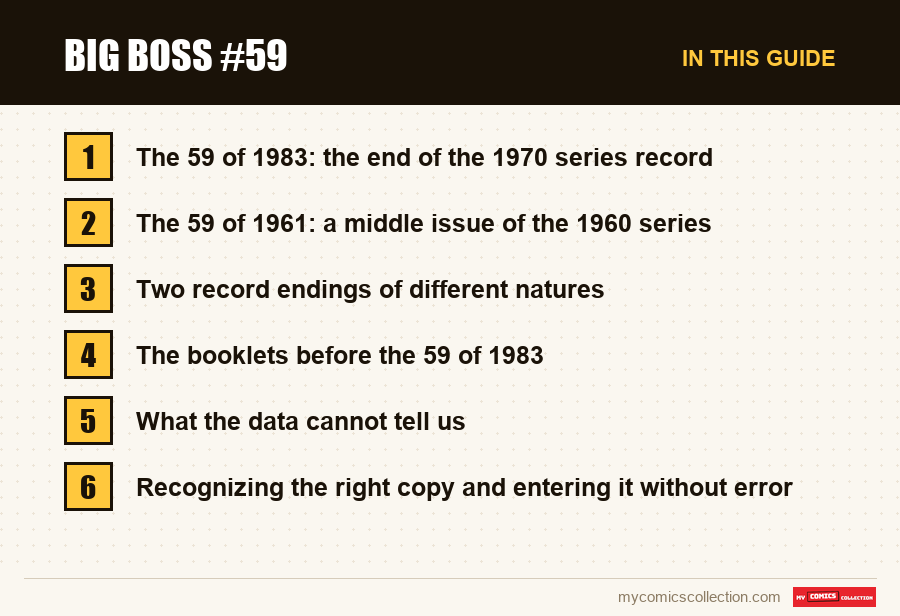
The booklets before the 59 of 1983
The three numbers that precede the end of the 1970 series each carry a single writer's name. Number 56, "Le cavalier fantôme", is credited to Jack Miller. Number 57, "L'homme dragon", and number 58, "La femme au masque de fer", are both credited to Jack Kirby. Number 59 therefore breaks with those three: it is a number with no writer recorded, after three numbers that have one.
Two anomalies earlier in the record deserve a look before you enter it on a list. Number 50 bears the same title as number 1, give or take an exclamation mark, with the same three artists: it looks like a reprint, without the record saying so, nine numbers before the end. And two lines, 35 and 52, have no title, no writer and no artist: these are booklets whose content the catalog does not know, not empty booklets.
What the data cannot tell us
The record gives only one story title per booklet, and credits at the level of the booklet, not the episode. "Sidéral" or "L'homme de l'île des robots" are therefore only the title chosen to designate the number. Nothing allows us to write that this story is the most important in the issue, nor that it corresponds to a particular American booklet, nor that it is a first French publication.
The same caution applies to titles that repeat from one series to another. "Banque interplanétaire" is the title of number 61 of 1961 as well as of number 32 of the 1970 series, but the recorded credits are not the same: that is not enough to claim it is the same story, and the record does not allow a ruling.
Recognizing the right copy and entering it without error
The two series overlap on numbers 46 to 59, that is fourteen numbers that exist in both records. A list noting "Big Boss 52" or "Big Boss 59" therefore has two possible candidates, separated by twenty years or more. Always note the trio series, number, year: "Big Boss, 1970 series, No. 59, 1983" and "Big Boss, 1960 series, No. 59, 1961" are two separate lines.
On the object, look for what truly distinguishes them: the date read on the copy, the story title, the layout of the cover. The catalog does not say where these clues sit on each booklet: the check is done with the copy in hand, not on the record card. What is certain is that the 1970 record contains no 60: if a listing offers a "Big Boss 60" without a year, it is the 1960 record that is concerned, since it alone reaches that number in the catalog.
Frequently asked questions
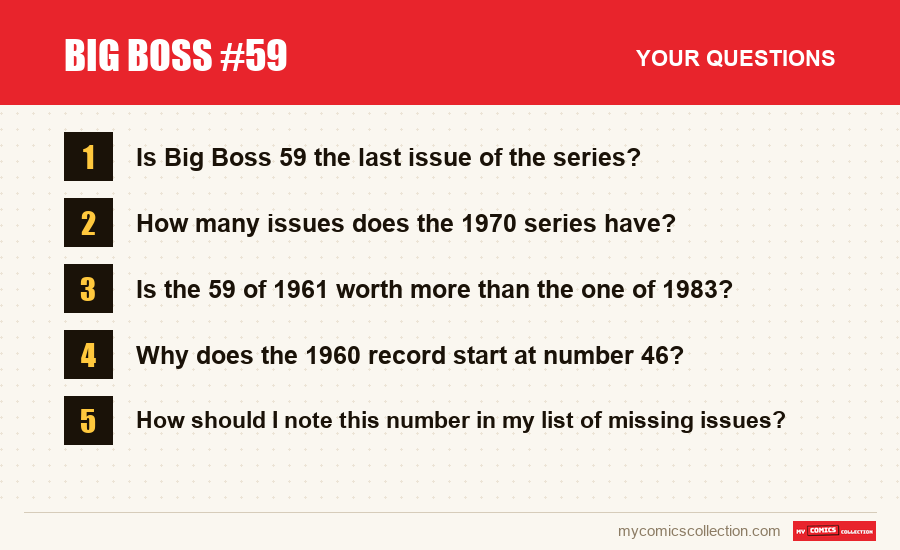
It depends on the series. For Big Boss 1970, it is the last number of the record, dated 1983. For Big Boss 1960, the record continues up to 70, dated July 1962. You must therefore first identify the series, and only then talk about an ending.
The record counts 59, numbered from 1 to 59 with no gaps. That is the catalog's count, not a claim about everything the publisher may have released. If your list stops before 59, you are missing booklets from this record.
The data does not say so, and this guide gives no prices. What matters is condition, completeness and the offer of the moment. The catalog does not allow us to quantify the gap between the two.
The catalog does not explain it. Numbers 1 to 45 are filed under another title in the catalog, "Big Boy", from 1956 to 1960, and the catalog does not say whether it is one and the same title. Do not conclude that the series started at 46, and do not rely on this record for numbers 1 to 45.
Write the series, the number and the year together: "1970 series, No. 59, 1983" or "1960 series, No. 59, 1961". Add the catalog's story title as a reference, noting that it does not summarize the booklet. Check these clues on the copy before buying.