
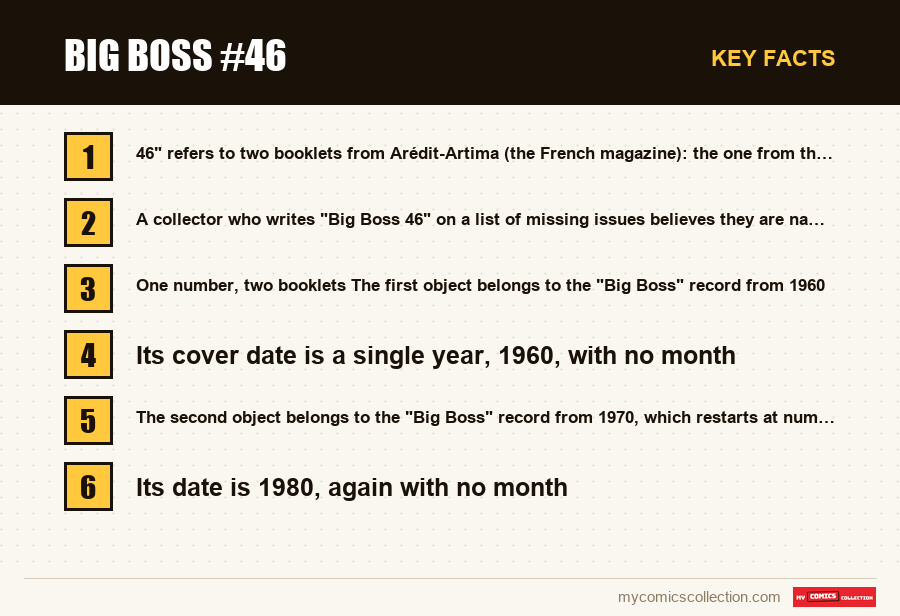
In the catalog, "Big Boss No. 46" refers to two booklets from Arédit-Artima (the French magazine): the one from the 1960 series, titled "La ville martienne des U.S.A." and dated 1960, and the one from the series restarted at 1 in 1970, titled "Le secret de l'homme de bronze" and dated 1980. Twenty years separate them. The cover date and the story title are enough to tell them apart.
A collector who writes "Big Boss 46" on a list of missing issues believes they are naming one object. They are naming two, and the catalog files them in two series sharing the same name. This page exists so that you do not buy the wrong one, or so that you know which one you already own.
As always on this guide, only verified information (creators, numbers, dates) is stated as fact; the analysis is ours, with no reproduction of any panel or protected dialogue.
One number, two booklets
The first object belongs to the "Big Boss" record from 1960. Its story is titled "La ville martienne des U.S.A.", and the catalog credits it with three writers (Otto Binder, Jack Miller, John Broome) and three artists (Amilcar Ruben Moreira, Jim Mooney, Joe Certa). Its cover date is a single year, 1960, with no month.
The second object belongs to the "Big Boss" record from 1970, which restarts at number 1. Its story is titled "Le secret de l'homme de bronze", with Jack Miller and Gardner Fox on writing, and George Roussos, Bill Ely and Mike Sekowsky on art. Its date is 1980, again with no month.
The two booklets therefore share the same publisher, the same magazine title and the same number, but neither the same content nor the same decade. It is a collision of counters, not a duplicate: the catalog signals no link between the two booklets.
Does the 1960 record really start at 46?
The question arises because a record starting at 46 looks like a truncated one. The catalog answers differently: the neighboring title "Big Boy", from the same publisher, counts forty-five numbers, from 1 to 45, from October 1956 to June 1960, with no gap in the record.
The 1960 "Big Boss" then takes number 46 and runs to 70, that is twenty-five contiguous numbers, the last one dated July 1962.
What the data allows us to state: numbers 1 to 70 each exist once across these two records, and the dates follow one another. What it does not allow: saying that booklet 46 bears the name "Big Boss" on its cover rather than "Big Boy", or that a change of title took place at that point. The catalog simply files the numbers into two series; the reason for the split is not given.
Practical conclusion: the 1960 record is not truncated in the sense that numbers would be missing, since the lower numbers are filed under the other title. On the other hand, anyone searching for "the number 1 of Big Boss" will find the one from 1970, and not a number located before 46 in the 1960 series.
A twenty-year gap between the two booklets
The second series starts in 1970, ten years after the first, but its counter restarts at 1: the two booklets are dated 1960 and 1980. It takes forty-five numbers for it to reach number 46. The record dates those forty-five numbers from 1970 to 1980.
That says something about the rhythm. The 1970 series spreads its fifty-nine numbers over fourteen calendar years, barely more than four a year on average. The 1960 series lines up twenty-five in three years.
A given number therefore does not have the same depth in time in the two series, and that is what makes the identification error so easy: a number 46 "from the end" for one is a number 46 "from the beginning" for the other.
Recognizing which one you are holding
Three clues, from most reliable to least reliable. First the printed date: 1960 or 1980, the gap is large enough to leave no hesitation, provided the booklet carries a legible date. The catalog gives only the year for these two numbers; if your copy shows none, move on to the next clues.
Next, the story title in the catalog: "La ville martienne des U.S.A." for 1960, "Le secret de l'homme de bronze" for 1980. The catalog gives only one title per booklet and does not say where it sits within the booklet. An absence of match therefore proves nothing, a match confirms.
Finally, the credits. Moreira, Mooney and Certa sign the 1960 46; Roussos, Ely and Sekowsky the 1980 one. But the credits are recorded at the level of the booklet, not the episode, and Jack Miller appears on both: one shared name settles nothing, three names do. Always prefer the combination of date and title.
Do you collect this series?
Track what you own, what you are missing and what your collection is worth. 7-day trial.
Start my trial →
Immediate neighbors
On the 1960 side, the three numbers before 46 are filed under "Big Boy": "Etrange prisonnier de la Terre" (April 1960), "Captif du super-robot" (May) and "L'homme-volcan" (June). The 46 is therefore the first booklet filed under the other title.
The next three are "L'énigme de l'île hasard", "Mystère de la mer magique !" and "Nous fûmes captifs de la déesse d'or", all dated 1960. The 46 thus opens a run of six numbers dated the same year; the 52 moves on to 1961.
On the 1970 side, the three preceding numbers are dated 1979, then 1980.
After the 46 come "Le cerveau pirate" and "Allô... futur appelle présent", then the 49, the only one of these neighbors to carry a month, December 1980. In this series, the 46 therefore belongs to a 1980 that groups numbers 45 to 49.
What these two neighborhoods have in common: no neighboring title resembles either of the two 46s. If you hold a booklet whose story title appears above at a different number, you have another issue, not a variant of the 46.
What this page cannot say
It does not say what the booklet contains beyond the recorded title, nor whether the recorded story is a first French publication. It does not link either of the two numbers to an American booklet: the credits name creators, they do not establish a correspondence.
It does not say either that story titles are a reliable criterion across the whole collection. For instance, the title "J'ai traqué l'animal de la forêt de Montrouge" appears as number 2 in Big Boy, and as numbers 1 and 50 in the 1970 series; "Banque interplanétaire" is the title of number 61 of 1960 and of number 32 of 1970. Titles repeat from one series to another.
For the 46, the two titles are different, but do not generalize: at another number, two booklets from different periods may carry the same title.
Entering it without error in a list of missing issues
A line reading "Big Boss 46" is ambiguous; two separate lines are not. Write "Big Boss 1960, No. 46" and "Big Boss 1970, No. 46", with the year of the series, not just that of the booklet, since the 1970 series receives numbers dated up to 1983. Add the story title as a note so you can check on arrival.
The same precaution applies to all numbers from 46 to 59: fourteen numbers exist in both series, each with its two booklets. If your list of missing issues is built by number alone, these fourteen lines must be split in two before any search. Numbers 60 to 70 do not have this problem in the record, since the 1970 series stops at 59.
This pairing of series and year is what prevents you from recording the same object twice, or from believing you own a copy you do not have.
Conclusion
Number 46 of Big Boss is first of all a nomenclature trap. The 1960 record does not start at 46 by accident: it continues the forty-five numbers filed under "Big Boy". The 1970 record starts again at 1, and its 46 falls twenty years later. The date, the story title and the series are enough to separate them; the number alone is not.
Frequently asked questions
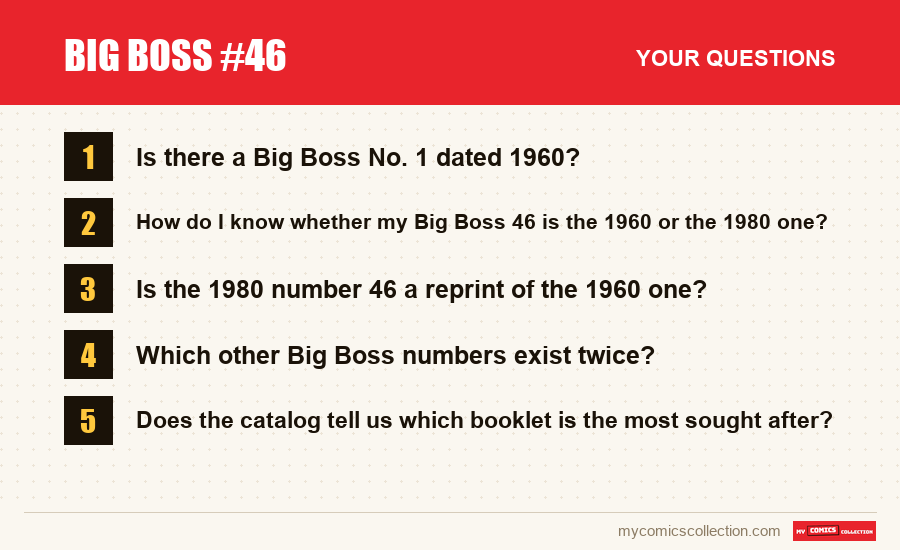
Not in the record: the 1960 series starts at number 46 there. Numbers 1 to 45 are filed under the neighboring title "Big Boy", from 1956 to 1960. The catalog's number 1 of "Big Boss" is the one from the 1970 series.
Look for the printed date, then the story title: "La ville martienne des U.S.A." for 1960, "Le secret de l'homme de bronze" for 1980. A creator name shared by both is not enough to conclude.
The catalog does not say so, and the two booklets carry different titles and credits. Nothing allows us to treat them as the same content. Check the copy rather than assume.
All numbers from 46 to 59, that is fourteen numbers, exist in both series according to the record. Beyond 59, the 1970 series stops, and numbers 60 to 70 exist only in the 1960 series.
No. It describes objects, not demand. The scarcity of a copy depends on its condition and on the market at the time, and it is measured by comparing actual sales, not by reading a list of numbers.