
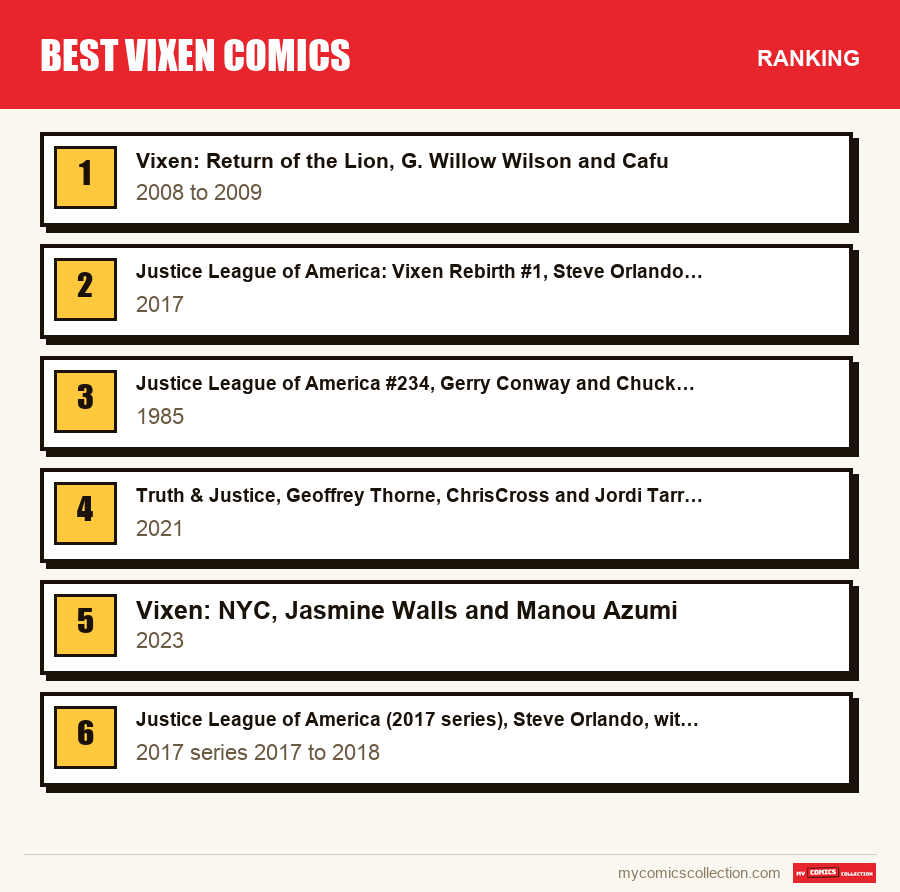
To find the best Vixen (Mari McCabe) comics, start with Vixen: Return of the Lion (2008 to 2009), by G. Willow Wilson and Cafu, then the one-shot Justice League of America: Vixen Rebirth #1, published in 2017 and written by Steve Orlando and Jody Houser, with art by Jamal Campbell. Then go back to Justice League of America #234 (1985), by Gerry Conway and Chuck Patton, and to her debut in Action Comics #521 (July 1981). Round it out with Vixen: NYC, by Jasmine Walls.
Vixen is one of DC's heroines with the most uneven publishing history: a solo series canceled before it ever existed, a long career as a team member, then a handful of stories that finally put her at the center. The challenge for a reader is spotting those rare stories where she carries the plot. We picked six, ranked from the most convincing to the most contextual.
As always in this guide, we only state verified facts (creators, issue numbers, dates); the analysis is our own, with no reproduction of protected art or dialogue.
Her first appearance
Vixen debuts in Action Comics #521, dated July 1981, in a Superman story. Gerry Conway writes, Bob Oksner draws, and the young woman lends Superman a hand in stopping a poacher. For a collector, it is the starting piece of any shelf devoted to the character, especially since this issue belongs to the Superman series and so also sits among the Man of Steel's issues.
The story of her creation is more winding than her entrance. A solo series, The Vixen #1, was planned before DC's 1978 publishing crisis and was canceled; its content was printed in Cancelled Comic Cavalcade, a tiny print run meant to protect the publisher's rights, with Bob Oksner on art. Don't look there for an everyday read: that item mainly interests the historian and the hunter of oddities, not the reader who wants to follow the character.
1: Vixen: Return of the Lion, G. Willow Wilson and Cafu (2008 to 2009)
A five-issue miniseries whose chapters are titled "Predators," "Prey," "Sanctuary," "Risen" and "Idols." Mari McCabe returns to Africa after learning that her mother's killer is still at large, and discovers in the village her family's tie to the Tantu totem. G. Willow Wilson gives the character a personal mission here, and Cafu draws the whole thing.
It is the best entry point because Vixen fills the whole frame: her motivations, her past, her relationship to family legacy. The series builds on the revelations of the Justice League of America of the time, but reads fine without having followed it. It suits the adventure comics reader as well as anyone who wants a short, complete story. Five issues are enough, and the trade paperback collects the whole run.
2: Justice League of America: Vixen Rebirth #1, Steve Orlando, Jody Houser and Jamal Campbell (2017)
This one-shot, dated March 2017, retells Mari McCabe's origin on the eve of the launch of a new Justice League of America. Steve Orlando and Jody Houser write it, Jamal Campbell draws it, and the main cover is by Ivan Reis. The story reintroduces Vixen to the readers of the day, with no prior knowledge required, and sets up her role in the series that follows.
It fits the reader in a hurry: a single, accessible issue that explains who she is before showing her in action with a team. The collected editions group it with other introductory issues under the title The Road to Rebirth. If you can only buy one modern story, read it before any other, then move on to the 2008 miniseries for depth.
3: Justice League of America #234, Gerry Conway and Chuck Patton (1985)
This issue is dated January 1985; Gerry Conway writes it and Chuck Patton draws it. Vixen is front and center: she catches up with and captures a car driven by three terrorists working for Red Dawn, a group led by her uncle, General Mustapha Maksai. Together with the next issue, it also opens the conflict over the Tantu totem, which Maksai ends up taking from her. It fits into the "Rebirth" storyline, which runs from #233 to #236 (December 1984 to March 1985) and establishes the so-called Detroit lineup.
It is for the collector of the period and for the reader who wants to see Vixen in a leading role before her solo stories. Take it as an issue to read within the run of four chapters, since it assumes you know the reason for the team's fresh start. The chronology of this era of the team is covered in our reading path dedicated to the Justice League. Issues #233 to #236 are often found together, which makes buying them as a lot easier.
4: Truth & Justice, Geoffrey Thorne, ChrisCross and Jordi Tarragona (2021)
This DC digital anthology, launched on January 8, 2021 and then released as a forty-page print edition on February 16, opens with a Vixen story. Geoffrey Thorne writes it, ChrisCross and Jordi Tarragona draw it. Mari McCabe teams up with Doctor Mist and Impala, of the Global Guardians, to take on an ancient deity that has possessed the body of a scientist who was studying magical objects.
There is nothing to know before opening these pages: the adventure is quick, and its register, an ancient entity taking hold of a man of science, recalls the mythological side that the 2008 miniseries tackled differently. It will be most useful to someone building a complete shelf for the character. If you are short on time, place it after the first two entries in this ranking.
Do you collect this series?
Track what you own, what you are missing and what your collection is worth. 7-day trial.
Start my trial →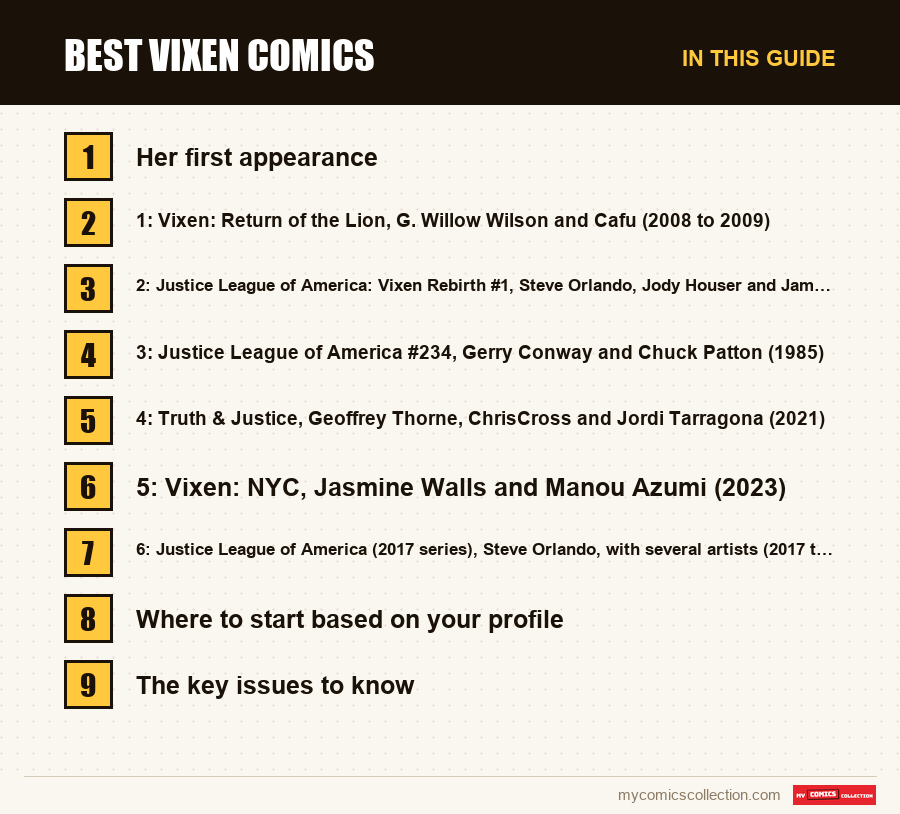
5: Vixen: NYC, Jasmine Walls and Manou Azumi (2023)
Born as a vertical comic on Webtoon, this series was collected in print volumes starting in August 2023. Jasmine Walls writes it, and Manou Azumi is the lead artist. Each volume gathers a run of episodes first published online, and the series has several. It imagines Mari McCabe as a first-year student in New York, dealing with animal powers.
The tone is younger and lighter than the previous entries; the Justice League universe is not a prerequisite. Readers who met Mari McCabe on screen or elsewhere will find an easy way in, and those who finished Wilson's miniseries will see a variation on its theme. Look for the volumes one by one, checking the episode range printed on the back of each.
6: Justice League of America (2017 series), Steve Orlando, with several artists (2017 to 2018)
Let's be clear about her role: here, Vixen is not the sole headliner, she is one of the members of the team assembled in this series, from #1 (April 2017) to #29 (June 2018). The series is driven by Steve Orlando. The collected editions are titled The Extremists, Curse of the Kingbutcher, Panic in the Microverse, Surgical Strike and Deadly Fable. Vixen's role there is that of a teammate among others: she shares the pages with the rest of the lineup and does not lead the main plot.
This read is for the super-team reader who wants to see her operate in the middle of a group, after reading Vixen Rebirth #1. It is less relevant if you want a story centered on her: pick it in sixth place, as a follow-up and not a starting point. For an overview of the franchise's teams, lean on the history of the Justice League.
Where to start based on your profile
If you want a complete story centered on her, start with Return of the Lion. If you prefer a brief, modern introduction, read Vixen Rebirth #1, then the 2017 team series. The reader of vertical comics or lighter formats will head to Vixen: NYC. The DC history buff will read #234, the 1984 to 1985 "Rebirth" arc of the Justice League, then the 1981 debut.
To build a Vixen shelf, start from Action Comics #521, add the four issues #233 to #236 of Justice League of America, then the 2008 miniseries. Anyone interested in the 1980s and 1990s will follow Vixen into Suicide Squad, where she reappears many times. For Black Canary readers, the Black Canary hub lets you cross-reference the teams where they meet.
The key issues to know
The first appearance is Action Comics #521 (July 1981). Justice League of America #233 to #236 (December 1984 to March 1985) cover her time in the Detroit Justice League, and #261 (April 1987), the last issue of the series, marks its end: Steel and Vibe die there and J'onn J'onzz disbands the team. Among the useful appearances, Justice League of America #251 to #254 (1986) show her captured with Batman by Despero, who has made Gotham his battlefield: she remains one team member among others there, with the lead role going to the villain and to the resolution led by Batman and Vibe.
In John Ostrander's Suicide Squad, she appears from #11 (March 1988) to #58 (October 1991), her first mission with the team, against the trafficker Cujo, filling #11 and #12, drawn by Luke McDonnell. In the 1989 Animal Man, written by Grant Morrison and drawn by Chas Truog, she is a guest for a few issues and shares billing with Buddy Baker, the title's hero; the writer appears among the Grant Morrison articles. In the 2006 Justice League of America, she is a team member from #1 (October 2006), first under Brad Meltzer's pen, then under Dwayne McDuffie's.
To rank these issues, go by role: the first appearance and the stories where she carries the plot weigh more than the team roles, which are mostly bought for the run as a whole. A regular series was announced by DC in July 2026, written by Stephanie Williams and drawn by Khary Randolph, with no confirmed release date to this day: wait for the first issues before adding them to your list.
Frequently asked questions
Vixen first appears in Action Comics #521, dated July 1981, in a Superman story written by Gerry Conway and drawn by Bob Oksner. She helps the hero stop a poacher. A solo series planned in 1978 had been canceled before publication.
Start with Vixen: Return of the Lion, a five-issue miniseries by G. Willow Wilson and Cafu, in which Mari McCabe returns to Africa. It reads fine without knowing the Justice League and puts the character at the center. For a shorter introduction, Justice League of America: Vixen Rebirth #1 (2017) fits in a single issue.
The miniseries is written by G. Willow Wilson and drawn by Cafu. It runs five issues, dated December 2008 to April 2009, and Mari McCabe returns to Africa in search of her mother's killer. She also discovers her family's tie to the Tantu totem.
Yes, several times. Her first stint with the team begins with the Detroit lineup, established by the "Rebirth" arc (Justice League of America #233 to #236, 1984 to 1985). She then rejoins the League in the 2006 relaunch, and again in the 2017 to 2018 series led by Steve Orlando.
Not yet at the time of writing: DC announced in July 2026 a series written by Stephanie Williams and drawn by Khary Randolph, with no confirmed release date. Until then, she has had the 2008 miniseries, a one-shot in 2017 and digital stories.
Do you own Action Comics #521 or an issue from the Detroit Justice League? Have its condition assessed before deciding whether to keep or sell it.
Estimate my comic