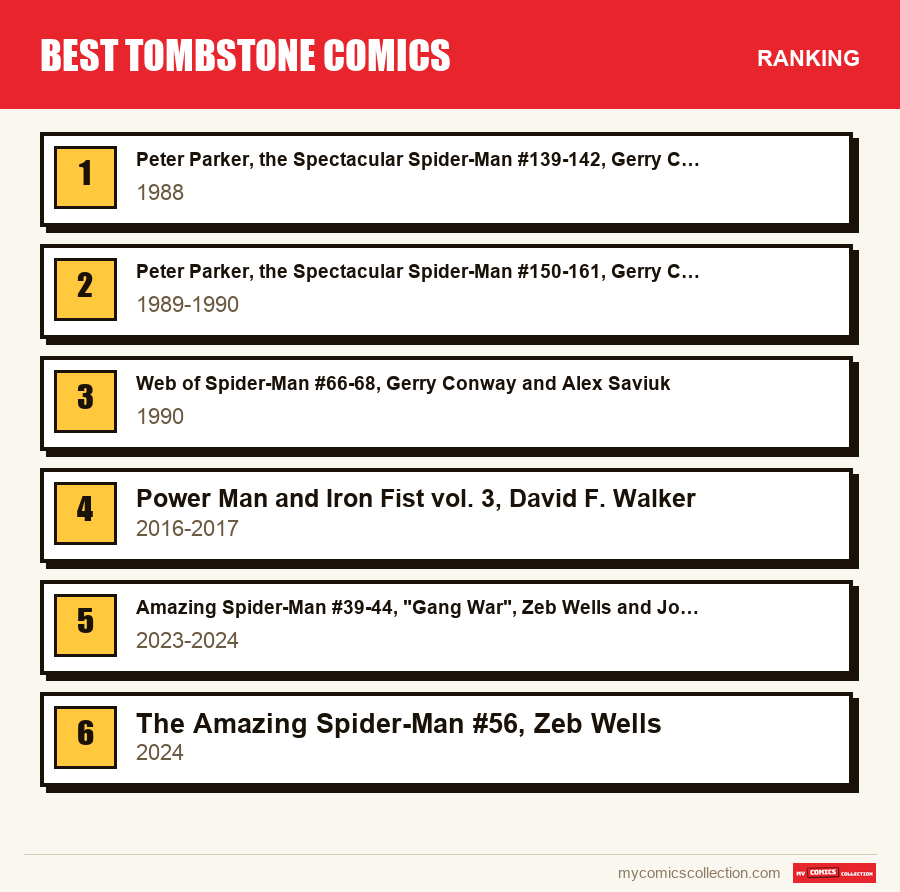
The best Tombstone comics start with Peter Parker, the Spectacular Spider-Man #139-142 (1988), written by Gerry Conway and drawn by Sal Buscema, where Lonnie Lincoln surfaces from Robbie Robertson's past. Read #150-161 next, then Web of Spider-Man #66-68 (1990), which give him his superhuman strength. For modern reading, finish with Zeb Wells's Gang War in 2023 and 2024.
Tombstone is an albino enforcer from Harlem, with a square-cut face, who worked for the Kingpin for a long time before going after his job. His strength comes less from his filed teeth than from a secret he has held over Robbie Robertson since their teenage years. Six reads are ranked below, from the 1988 storyline to the 2024 crown, each with the kind of reader it suits.
As always in this guide, only verified facts (creators, issue numbers, dates) are stated as fact; the analysis is our own, with no reproduction of protected artwork or dialogue.
His first appearance
The character was born in Web of Spider-Man #36, cover-dated March 1988. Gerry Conway, who was writing the series at the time, dreamed him up with Alex Saviuk, who drew his look. Conway has said he chose the name first: he then gave the character albinism and squared-off features that evoke a headstone, and asked Saviuk to build the design around those two things. The stated intention was to focus on supporting characters and to end up with a ruthless gangster in the vein of Hammerhead.
The character quickly moved into Peter Parker, the Spectacular Spider-Man, which Conway had been writing since #137 in April 1988. That is where his story gains depth, because the writer ties him to an established Daily Bugle character, the editor-in-chief Joseph "Robbie" Robertson. That origin link makes all the difference between Tombstone and the series' anonymous henchmen: he comes out of the past of someone you already know.
For the boss he served, our piece on Kingpin's first appearance sets the scene Tombstone operates in. This guide sticks to the character's own stories.
1: Peter Parker, the Spectacular Spider-Man #139-142, Gerry Conway and Sal Buscema (1988)
This storyline, which starts at #139, tells Tombstone's origin and the secret that binds him to Robbie Robertson. Lonnie Lincoln, born in Harlem, became a feared schoolyard racketeer; when Robertson, then in charge of the school paper, wanted to publish an exposé on him, he scared him off with threats. Later, Robertson watched Lincoln kill a man and kept quiet for more than twenty years. In #142, Spider-Man fights Tombstone in Atlanta, after which the criminal is sent to prison in Philadelphia.
What this storyline gives the character is his engine: the threat comes not from a power but from moral pressure on an honest man. Tombstone is still just a killer with a striking physique, and it is the relationship with Robertson that gives weight to each of his appearances. Sal Buscema draws the issues.
Who is this entry for? Readers who want to understand why this villain matters to Robertson, fans of late Bronze Age comics, and collectors looking for the key issues. How should you read it? In order starting at #139. A 2016 collection, Spider-Man: Tombstone Vol. 1, gathers #137-150 of this series and reads well as a continuous run.
2: Peter Parker, the Spectacular Spider-Man #150-161, Gerry Conway and Sal Buscema (1989-1990)
After the Atlanta storyline, the series picks the Robertson-Tombstone thread back up. In #150, titled "Guilty!", Robertson is convicted for hiding a crime he witnessed, while the Kingpin has arranged for the justice system to serve Tombstone's interests. In #161, from 1990, Robertson is pardoned; Tombstone, annoyed by the pardon, wants to kill him with his own hands, while Hobgoblin considers eliminating him to win favor with the crime bosses and Puma steps in alongside Spider-Man.
What this run gives you is duration. For more than a year, the series keeps asking the same question: how long can a man hold out without talking? The story also shows Tombstone in his own world, among the prison, the Kingpin and the other gangs, rather than as a passing opponent. It has its slow stretches, like any plot stretched over many months, but it gives the character a continuity that few villains of his generation enjoyed.
Who is this entry for? Patient readers who enjoy long-range plots, and anyone who wants to gauge how important Robertson is in the Spider-Man universe. How should you read it? After entry 1, keeping the issue list handy: the issues that matter are spread out. Our Spider-Man reading guide helps you find neighboring issues from the same period.
3: Web of Spider-Man #66-68, Gerry Conway and Alex Saviuk (1990)
In this 1990 storyline, whose #68 is titled "Tombstone Territory", Robertson's grudge reaches a violent conclusion. Robertson shoots Tombstone in a factory and locks him in a chamber filled with an experimental gas, and that gas turns the criminal into an almost indestructible opponent with superhuman strength. The event moves the character from feared killer to a physical threat on a super-hero scale.
The consequence is twofold. It explains why Tombstone can now fight Spider-Man on equal terms, but it also forces a different reading of him: he owes to Robertson the very thing that makes him so dangerous, an ironic detail the series does not fail to exploit. Alex Saviuk, who had drawn Tombstone in his early days, returns to the character he helped create.
Who is this entry for? Readers who want the source of his powers and collectors of the Web of Spider-Man series. How should you read it? As three issues, after entries 1 and 2, which explain the context. You can read it on its own if all you want is the origin of his strength.
4: Power Man and Iron Fist vol. 3, David F. Walker (2016-2017)
In this series, Tombstone is neither the hero nor the main antagonist, but one Harlem gang boss among others. He assembles a crew with Grim and Reaper, learns from Mr. Fish that Black Cat's gang is expanding, then sees Alex Wilder turn against him. In #14, dated March 8, 2017, David F. Walker, with Sanford Greene on art, shows him rescuing Mr. Fish with the help of Black Talon.
This entry is worth it for the way it reuses the character: he is no longer someone else's enforcer but a neighborhood boss with his own allies and debts. It remains a supplementary read, however, since the heart of the story belongs to Luke Cage and Iron Fist.
Who is this entry for? Street-level Marvel readers, fans of Harlem stories, and anyone who wants to see Tombstone outside the Spider-Man series. How should you read it? In the series, from #2 for his crew, through #14. Don't take it as a way into the character: it assumes you already know his past.
Do you collect this series?
Track what you own, what you are missing and what your collection is worth. 7-day trial.
Start my trial →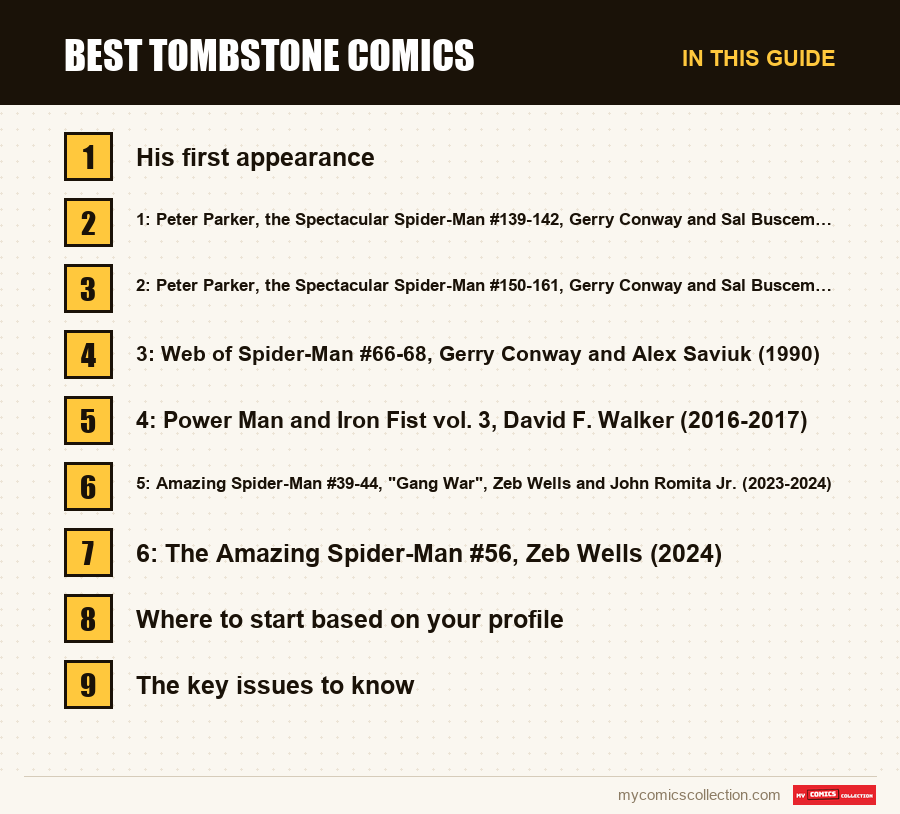
5: Amazing Spider-Man #39-44, "Gang War", Zeb Wells and John Romita Jr. (2023-2024)
Opening in December 2023 with #39, after the Gang War: First Strike issue, this story is triggered at the wedding of Janice Lincoln, his daughter known as Lady Beetle, and Randy Robertson: the killer Shotgun shoots Tombstone, which sets off a turf war. Zeb Wells writes the series, John Romita Jr. draws with Scott Hanna on inks. Tombstone teams up with Spider-Man and She-Hulk, then his forces pull back during the final fight against the Maggia.
What these six issues give the character is a pivotal role. A major story of the series revolves around him, and he appears as a player in the underworld rather than an executor of someone else's orders. The collection Amazing Spider-Man by Zeb Wells Vol. 9: Gang War gathers the opening one-shot and #39-44, published in May 2024.
Who is this entry for? Today's readers, those who follow Zeb Wells, and those who want a complete event. How should you read it? In the collection, or in issue order, starting with the opening one-shot. No prior knowledge is required beyond the general idea of the character.
6: The Amazing Spider-Man #56, Zeb Wells (2024)
This August 2024 issue, which also carries the legacy number 950, concludes the path begun by the gang war. Zeb Wells writes Tombstone as New York's new Kingpin. The character, who spent years in another man's service, now occupies the seat of the man he served.
The appeal of this issue is that it closes a cycle. Tombstone is no longer Robertson's opponent or the Kingpin's enforcer: he rules, with the ambitions and enemies that come with it. To measure what that title means, see our pages on the best Kingpin story arcs and on the Kingpin key issues.
Who is this entry for? Anyone who read Gang War and wants to know what comes next, and collectors of anniversary issues. How should you read it? Right after the event, in the series. It makes sense without the 1980s, but means more if you have read at least the Atlanta storyline.
Where to start based on your profile
You want to understand who Tombstone is: read Spectacular Spider-Man #139-142, then the 2016 collection.
You like long plots and moral dilemmas: #150-161 of the same series, with the question of Robertson's secret.
You are looking for the origin of his strength: Web of Spider-Man #66-68.
You like neighborhood stories: David F. Walker's series devoted to Luke Cage and Iron Fist, from #2.
You follow Spider-Man today: Gang War in the collection, then #56 from 2024.
You collect Spider-Man's adversaries: Vulture offers another trajectory of a villain who became a full-fledged figure in his own right.
The key issues to know
The collecting list follows the character's life. Web of Spider-Man #36 (March 1988) is his first appearance. Spectacular Spider-Man #139 tells of his link to Robertson and #142 of his defeat in Atlanta. Web of Spider-Man #66-68 (1990) give him his powers. Amazing Spider-Man #39 (December 2023) opens Gang War, and #56 (August 2024) crowns it.
For the 1988 to 1990 issues, grading focuses on the corners and the spine, which wear first; ask for clear photographs of those areas and check that the issue belongs to the original series. To set some reference points, our free estimate tool helps you place a copy.
Finally, tell the recent issues from the old ones. For Gang War and #56, look at the cover and the exact printing you are buying, because there are many variant editions. For the 1988 to 1990 issues, what counts is original copies in good condition.
Frequently asked questions
His first appearance is Web of Spider-Man #36, cover-dated March 1988. He was created by Gerry Conway on script and Alex Saviuk on art. He then became a regular in Peter Parker, the Spectacular Spider-Man, also written by Conway at the time.
The two men have known each other since their teenage years. Lonnie Lincoln ran a racket among students and threatened Robertson to bury an article about him. Later, Robertson saw him commit a murder and kept quiet for more than twenty years, which fuels the 1988 to 1990 storylines.
He owes it to an experimental gas, in Web of Spider-Man #66-68 (1990). Robertson shoots him in a factory and locks him in a chamber filled with that gas, which makes him almost indestructible. Before that story, he was a fearsome killer with no powers.
Yes, in The Amazing Spider-Man #56 from August 2024, written by Zeb Wells, he becomes New York's new Kingpin. This development follows the Gang War event of December 2023, in which he is shot by Shotgun and then teams up with Spider-Man and She-Hulk.
The collection Spider-Man: Tombstone Vol. 1, published in 2016, gathers issues #137-150 of Peter Parker, the Spectacular Spider-Man and an annual. For modern reading, pick up Amazing Spider-Man by Zeb Wells Vol. 9: Gang War, which collects the opening one-shot and #39-44.
Do you own a copy of Web of Spider-Man #36 or 1988 issues of Spectacular Spider-Man? Get its condition and resale value estimated.
Estimate my comic