
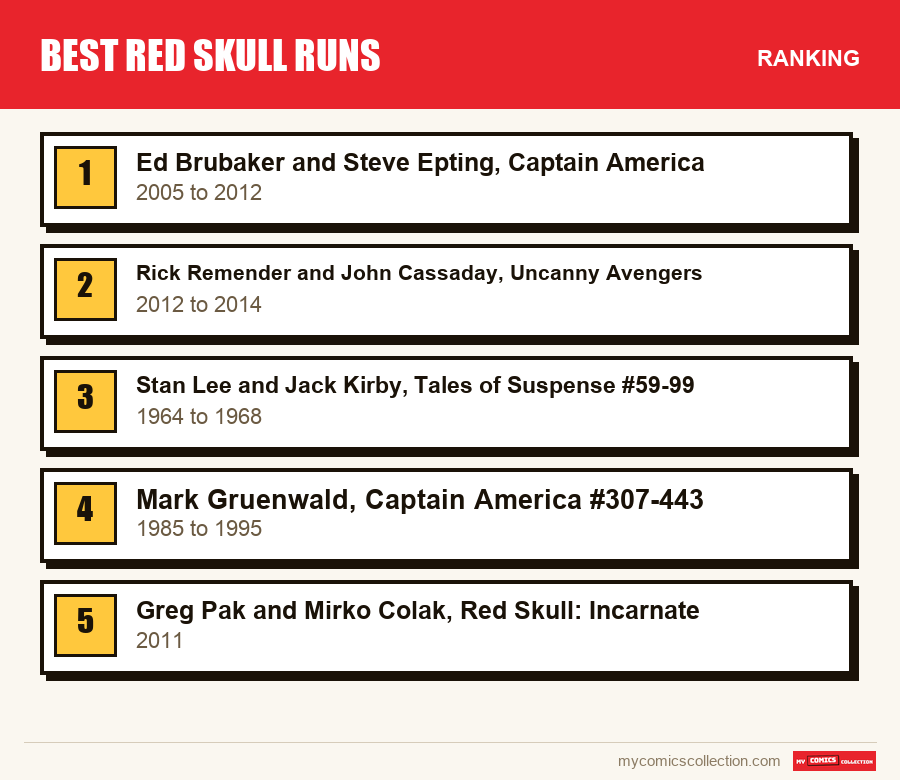
The best Red Skull run is Ed Brubaker and Steve Epting's Captain America, starting in January 2005. Next come Rick Remender and John Cassaday's Uncanny Avengers (2012), Stan Lee and Jack Kirby's episodes in Tales of Suspense (1964 to 1968), Mark Gruenwald's 137 issues and Greg Pak's Red Skull: Incarnate miniseries (2011). Here is each cycle, its format and its place in a collection.
Johann Schmidt poses a ranking problem few other characters run into: he has never headlined a regular series that lasts, and his best moments sit in his enemies' titles. A "Red Skull" run is therefore not a collection under his name, but a period when a writer handed him the engine of the plot. Our selection keeps five reading blocks where the mask runs the story, even when the hero stays on the cover.
As always in this guide, we state only verified facts (creators, issue numbers, dates); the analysis is our own, with no reproduction of protected artwork or dialogue.
How we ranked these runs
The sorting came down to a single question: who, on these pages, makes the decisions? When the Red Skull is merely a swastika-draped backdrop in front of which Steve Rogers fights, the cycle drops out of the ranking. When his plans structure three, ten or a hundred issues, it gets in. We then separated the candidates by ease of access: a reader should be able to open the first volume without having read the previous decade.
Rank does not measure market value. The most sought-after issue on this list belongs to the oldest cycle, not the most accomplished. At the end of the article, a separate part covers buying, after the reading choice. For the character's origin and the question of his first appearance, a dedicated piece already exists: our analysis of the Red Skull's first appearance; we do not rehash it here.
Top 1: Ed Brubaker and Steve Epting, Captain America (2005 to 2012)
The fifth Captain America series launches in January 2005 under Ed Brubaker's pen, with Steve Epting on art, then Mike Perkins and Butch Guice over the years. The cycle runs through 2012 counting the return to the historic numbering. The Red Skull does not win here through strength: Brubaker shows him as a conductor whose pawns (former Soviet agents, relics of the Second World War, a Russian general converted to his views) advance in the shadows while the hero does not yet grasp the game being played. Issue 25, dated March 2007, remains the milestone every reader remembers, and the Winter Soldier thread gives the cycle its backbone.
The appeal of this cycle: it restores seriousness to a character whose mask had looked, for decades, like a B-movie caricature. Brubaker puts him in a contemporary espionage register, with alliances being negotiated, laboratories changing hands and delayed betrayals. The construction is slow: revelations are spread over dozens of issues, and the pleasure comes from that patience.
It is for those who like crime thrillers: no prior knowledge is required, and the first issue is enough to grasp the stakes. For collecting, two routes. The original issues of the fifth series are common for the most part, and turn up in coherent lots. The French collected editions from Panini Comics cover the period in successive volumes; check their order in the catalog before buying any series. Our Winter Soldier ranking details the other half of the same cycle.
Top 2: Rick Remender and John Cassaday, Uncanny Avengers (2012 to 2014)
Launched in the fall of 2012 in the wake of the Marvel NOW! initiative, Uncanny Avengers brings Avengers and X-Men together under a single banner. Rick Remender writes the series; John Cassaday draws the first four issues before handing off. The red thread of the opening is a Red Skull who seizes powers that do not belong to him, with a boldness of scripting the previous decade would not have dared: the World War II killer becomes a telepathic adversary, which changes the nature of the threat.
The cycle continues in 2014 with the Axis event, which Remender writes and Jim Cheung draws. The central idea (a moral inversion that strikes heroes and villains alike) pushes the Red Skull into a role he had never held at this scale, that of a threat reaching beyond the borders of his usual espionage plots. This slice of the run is the most spectacular on the list, but also the most dependent on context: Axis assumes you know the teams involved.
This cycle suits anyone who enjoys big crossovers and is not afraid of a dense universe. To prepare, our guide Rick Remender, where to start places these series within the writer's body of work. For collectors, these issues are recent and plentiful, so nothing is scarce; only the first issue of each series keeps a little weight, with its variant covers. In collected form, the series volumes follow publication order.
Top 3: Stan Lee and Jack Kirby, Tales of Suspense #59-99 (1964 to 1968)
Before getting his own series, Captain America occupies half of Tales of Suspense: a short story, alternating with Iron Man's, starting with issue 59 (November 1964). The serial ends at issue 99 (1968), when the magazine becomes Captain America. Stan Lee writes, Jack Kirby draws most of it. In this tight format, the modern-era Red Skull goes back into service and, in issues 79 to 81 (1966), he seizes a Cosmic Cube created by AIM. The power he finds there pushes him into a threat of a very different caliber from the mere Nazi in uniform.
This run counts because it fashions the version of the character that every later writer will take up: the Cube as an object of desire, the boundless ambition, the tone of an enemy who believes himself superior by nature. The style is that of the 1960s: explicit narration, abundant dialogue, action cut into episodes of under twenty pages. Readers who do not care for that style can read these stories in a collected edition, more practical than buying single issues.
Collecting is another matter entirely. The Tales of Suspense of this period belong to the Silver Age: highly sought after, expensive, with a price that follows condition first: between a mediocre copy and a near-perfect one, the gap in value becomes enormous. Issue 79, the one with the first Cube, concentrates the demand. Our key Red Skull issues detail its place in the hierarchy.
Do you collect this series?
Track what you own, what you're missing and what your collection is worth. 7-day trial.
Start my trial →
Top 4: Mark Gruenwald, Captain America #307-443 (1985 to 1995)
Mark Gruenwald writes Captain America for ten years, from 1985 to 1995, which is 137 issues in a row from number 307 to number 443. It is one of the longest stretches by a single writer on the character, and the Red Skull returns in it as a background adversary rather than as the villain of an isolated arc. Several artists follow one another, which gives the cycle a more uneven look than the previous three.
What Gruenwald brings to the Skull is long-term thinking. Where Lee and Kirby fashion a myth and Brubaker modernizes it, Gruenwald builds a continuity in which the Skull's actions have consequences, from one arc to the next, over a decade. Readers who like long-haul serials will find enough to fill a year of reading; those who want a compact story will pass.
For collecting, this is the patient collector's ideal terrain: most of the mid-run issues are common, and their individual value stays modest, except for a few pivotal numbers that concentrate demand. Buying coherent lots, from issue 307 to 443, is the best way to get a complete run without overpaying. Collected editions exist too, but they mostly cover the best-known arcs.
Top 5: Greg Pak and Mirko Colak, Red Skull: Incarnate (2011)
In 2011, Greg Pak on script and Mirko Colak on art produce Red Skull: Incarnate, five issues. It is one of the rare stories to place Johann Schmidt at the center of every page, and to look at what comes before the mask. The angle is one of formation: how a young man in interwar Germany becomes the figure Steve Rogers faces in 1941.
It counts because it fills a gap: few reads let the character speak without the hero opposite. The result is uncomfortable, which is intended, and it suits readers already familiar with the character who want to understand his workings. To collect it, five issues are enough, and the series has been bundled into a collected edition. The issues are not rare; the scarcity lies rather in the availability of the bound volume, which varies with reprints.
Which one to start with, depending on your profile
You're discovering the character and like espionage: open the Ed Brubaker and Steve Epting run. No prior knowledge is needed, and the rest of the cycle follows naturally.
You like crossovers and shared universes: pick up Rick Remender's Uncanny Avengers, starting with John Cassaday's first four issues, then Axis if the whole thing appeals.
You want to understand the myth's origins: read the Lee and Kirby episodes in Tales of Suspense, preferably in a collected edition, before moving to the modern versions.
You have time and love long serials: commit to Mark Gruenwald's 137 issues, in chunks of ten to twenty.
You already know the story and want a fresh angle: Greg Pak's Red Skull: Incarnate, five issues, offers a different view of the character. For an overview of the whole journey, the Red Skull reading guide lays out a complete order.
What these runs are worth as a collection
The value of these five blocks reads in ratios, not amounts. At the top, the Tales of Suspense issues: it is the only cycle on the list where the price gap between a mediocre copy and a very well-preserved one is counted in multiples. At the other end, Gruenwald's and Remender's issues are abundant, and a common copy costs a fraction of the price of a Silver Age book. Brubaker sits in the middle: issue 1 of the fifth series and issue 25 are sought after, the rest turn up without difficulty.
Two methods avoid valuation errors. First, value by issue and not by series: a "complete Gruenwald" lot mixes common issues with a few landmarks, and each piece is measured separately. The second reflex: compare completed sales, not posted listings, since for the Silver Age the asking price drifts further from the price actually paid. To refine, the free estimate page gives a starting point per issue.
One last point: a collected edition is a reading purchase, not a collecting one. It does not replace the original issue on value, but it lets you read without handling a fragile copy. Many collectors split the two uses: original issues for the shelf, bound volumes for reading.

Frequently asked questions
Ed Brubaker and Steve Epting's run on Captain America, starting in January 2005. It requires no prior knowledge, sets up a credible Red Skull in a contemporary espionage story and stretches over several years. It is the best starting point before exploring the older or more specialized cycles.
No, only miniseries: the best known is Red Skull: Incarnate, five issues written by Greg Pak in 2011. He has never headlined a regular series for long, which explains why his best stories are found in the Captain America titles and in teams like the Avengers.
Not if the goal is reading. The Stan Lee and Jack Kirby episodes are available in collected editions, far more comfortable and less costly. The original issues are a collecting project: they are fragile, and their price depends heavily on condition.
That depends on your patience. His 137 issues, from 307 to 443, form a ten-year serial in which the Red Skull comes back regularly. For targeted reading, you are better off choosing a few arcs and reading the rest in lots. For a collection, it is an affordable run to complete bit by bit.
Panini Comics publishes Marvel comics in France, and several of these cycles exist in bound volumes, but not all of them, nor in the same format. The Brubaker-era and Remender episodes are the easiest to find; for Gruenwald and Tales of Suspense, check volume by volume in the catalog before buying.
Do you own an issue of Tales of Suspense, Captain America or Uncanny Avengers? Get a starting point for its value.
Estimate my comic