
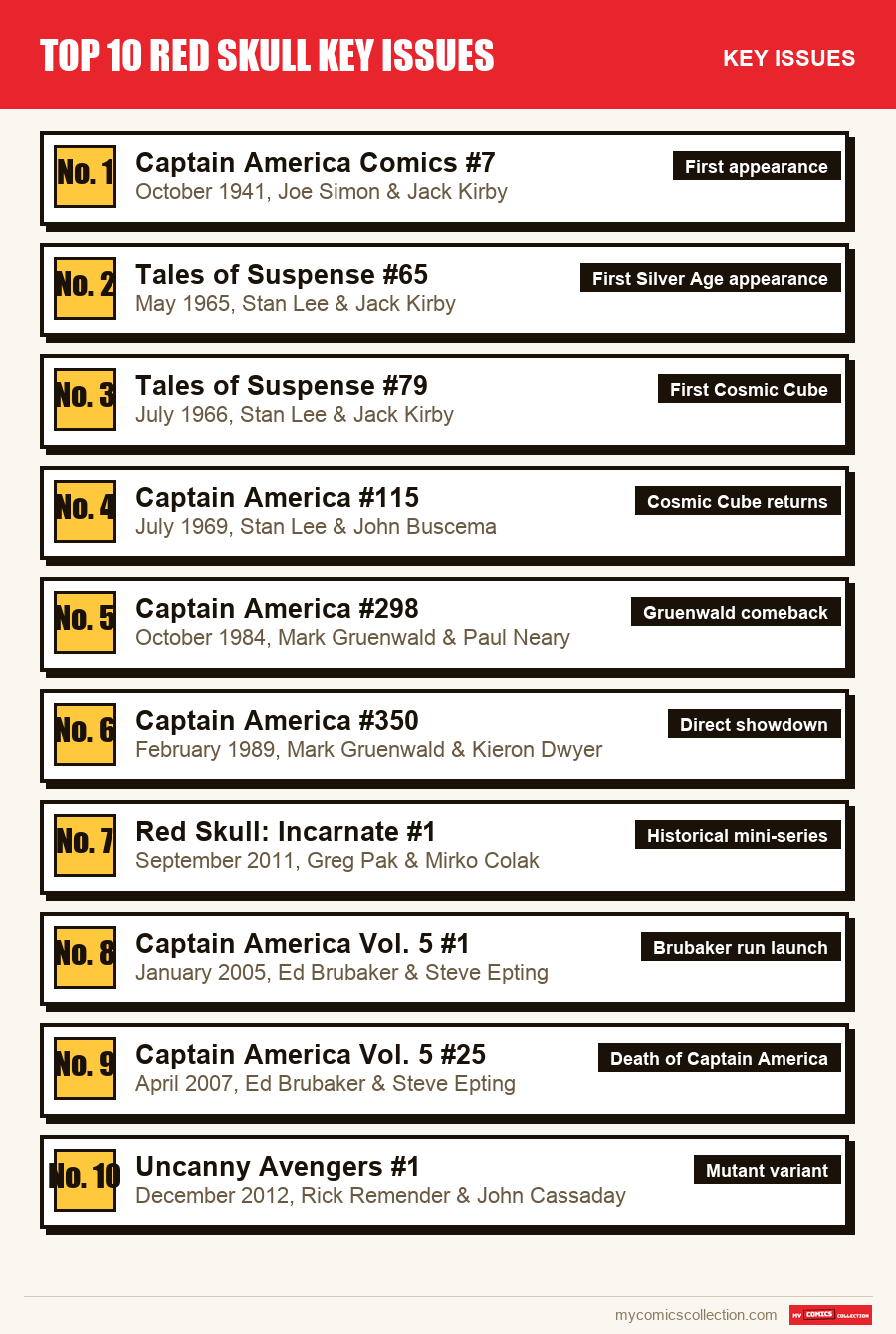
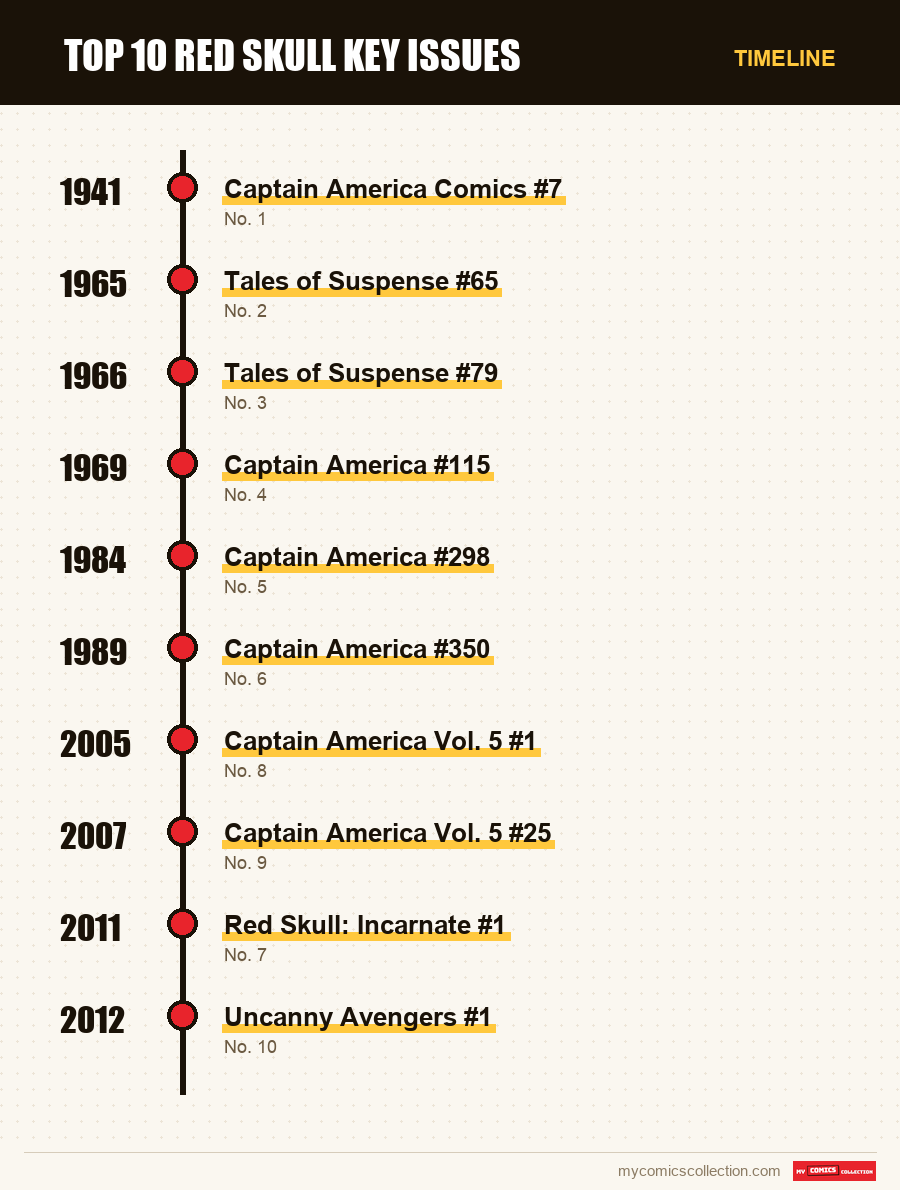
The Red Skull key issues to know first are Captain America Comics #7 (October 1941, first appearance), Tales of Suspense #65 (May 1965, return to modern continuity) and Tales of Suspense #79 (July 1966, first Cosmic Cube). On the modern side, Captain America vol. 5 #1 (2005) and #25 (the death of Steve Rogers, 2007) are the most accessible entry points.
Johann Schmidt has crossed more than 80 years of Marvel continuity without ever holding a lasting solo title, which makes the hunt for Red Skull key issues especially structured: everything runs through the Captain America titles, a few spotlight minis and a handful of Hydra crossovers. This guide rounds up the ten issues to target first, from the Golden Age Timely era to the Brubaker run, with indicative price ranges in CGC grade and the story beats that explain their market value. Whether your collection is aimed at the modern run or the full 1941-2017 historical sweep, these ten issues form the backbone of a coherent portfolio built around Marvel Comics' Nazi villain.
Red Skull in comics history
Created by Joe Simon and Jack Kirby at the height of World War II, the Red Skull first appeared in Captain America Comics #7 (October 1941) at Timely Comics, the future Marvel. The character was designed as the structural antagonist to Steve Rogers, launched six months earlier, and embodied the Nazi threat in the pulp format of the era. The version reintroduced by Stan Lee and Kirby in Tales of Suspense #65 (May 1965) established the character's modern mythology, revealing that he had survived in suspended animation since 1945.
His editorial footprint is massive: more than 1,500 appearances across all titles according to comics databases. The Steve Englehart (1972-1975), Roger Stern/John Byrne (1980-1981), Mark Gruenwald (1985-1995), Ed Brubaker (2005-2012) and Rick Remender (Uncanny Avengers, 2012-2014) runs built the character's narrative depth around four recurring motifs: Hydra, the Cosmic Cube, consciousness transfers and his generational conflict with his daughter Sin. On the collector side, interest surged from 2011 onward with Hugo Weaving's portrayal in Captain America: The First Avenger, then with every MCU release tied to the Soul Stone (Infinity War , Endgame). The CGC databases document a steady climb in values for Captain America Comics #7 and Tales of Suspense #65 since 2014, with measurable spikes around each film event.
Top 10 Red Skull key issues
Captain America Comics #7
The historic first appearance of the Red Skull, in his Golden Age version published by Timely Comics. A landmark issue of the 1940-1945 segment, extremely rare in high grade because of the newsprint and the wartime print run. Copies graded CGC 5.0 and above are nearly impossible to find in documented sales, making it one of the toughest pieces to acquire for any serious Marvel collector.
Tales of Suspense #65
The Red Skull's reintroduction into modern continuity, twenty-four years after his Golden Age debut. Stan Lee explains his return through a state of suspended animation since 1945. Every Brubaker, Spencer, Remender and Englehart arc traces back to this pivotal issue. Market demand has been on a documented rise since 2014, driven by the MCU's impact on the Soul Stone and on the Schmidt character.
Tales of Suspense #79
The first arc in which the Red Skull seizes the Cosmic Cube, an artifact capable of rewriting reality. The starting point of a mythology that would shape nearly every major Cap-Schmidt arc, all the way to Secret Empire in 2017. A Silver Age issue whose scarcity in high grade remains moderate, making it a reasonable goal for a methodical collector.
Captain America #115
The Red Skull uses the Cosmic Cube to swap bodies with Steve Rogers, kicking off the long series of "mirror" arcs between the two characters. A pivotal issue of the late Stan Lee era, sought after by fans of the late-1960s Captain America run. Copies in CGC 9.4 and above remain rare given the typical preservation of the period.
Captain America #298
In the Gruenwald run, the Red Skull returns in a rejuvenated form after a consciousness transfer into a clone. A pivotal issue of the late Bronze Age, often undervalued relative to its importance for the character's narrative continuity. A solid scarcity-to-price ratio for a collector looking to complete a coherent run around the Schmidt mythology.
Captain America #350
The conclusion of the "Bloodstone Hunt" arc and a direct Cap vs. Schmidt duel in a double-sized anniversary issue with a memorable cover. A quality benchmark of the Gruenwald run, available in a low range for a beginner. A great entry point into the modern Red Skull collection without committing a big budget to Silver or Golden Age material.
Red Skull: Incarnate #1
A spotlight mini-series by Greg Pak that revisits Johann Schmidt's youth in pre-Nazi Germany, with a demanding historical tone. An important issue for understanding the character's psychological makeup, and the only mini devoted entirely to the Red Skull. Sought after by completists of the modern run.
Captain America Vol. 5 #1
The opening of the Brubaker/Epting run, considered the definitive modern benchmark for Captain America. The Red Skull is its central engine, making it the must-have entry point for anyone looking to collect Schmidt in his contemporary form. An issue that's still attainable in CGC 9.8 despite a value rising steadily since 2014.
Captain America Vol. 5 #25
The Red Skull orchestrates the assassination of Steve Rogers on the steps of the federal courthouse. A global editorial event, covered by mainstream press in both the U.S. and Europe, that propelled Schmidt to the rank of a top-tier Marvel villain in the 2000s. An issue that's already historic, with a value tracked by the CGC databases since its release and climbing steadily on first printings.
Uncanny Avengers #1
The kickoff of the Remender run, in which the Red Skull takes Charles Xavier's brain after his death and becomes a top-tier mutant threat. The narrative foundation leading up to the AXIS event (2014). A relevant issue for collectors who want to cover the 2010s Schmidt alongside the Brubaker run.
Collecting this series?
Track what you own, what you are missing and what your collection is worth. 7 day trial.
Start my trial →The essential Red Skull story arcs
Four main arcs frame any reading of Schmidt and deserve to be collected in order. "The Madbomb" (Captain America #193-200, Jack Kirby, 1976) lays out a social-disintegration conspiracy in the United States in which the Red Skull indirectly pulls the strings. This late Kirby arc remains a Bronze Age touchstone, with a stable value and the graphic quality unique to the final Kirby Marvel era. For a collector, it's the logical gateway to the Hydra arcs of the following decades.
"The Bloodstone Hunt" (Captain America #357-362, Mark Gruenwald & Kieron Dwyer, 1989) delivers a globe-spanning treasure hunt between Cap and Schmidt, complete with proxy allies and the narrative tension typical of the Gruenwald run. The arc wraps up on the anniversary issue #350, which sits at number six in our top 10. For Copper Age fans, it's an affordable run, still available as single issues from most dealers.
The Brubaker run (Captain America vol. 5 #1-50, 2005-2012) remains the definitive modern benchmark. Schmidt orchestrates the assassination of Steve Rogers (issue #25), transfers his consciousness into the body of Aleksander Lukin, then into a new clone. This arc redefines the character as a geopolitical threat and makes the ideal entry point for a collector looking to understand the Red Skull in his contemporary form. Available in omnibus and as single issues, with a value rising steadily since 2014.
Finally, "Secret Empire" (Nick Spencer & Steve McNiven, 2017) pushes the Cosmic Cube idea to its extreme by rewriting Steve Rogers as a Hydra agent under Schmidt's influence. The global Marvel event of 2017, the arc polarized readers, which has stabilized the value of issues #0, #1 and #10 without any speculative blow-up. A strong price-to-narrative-importance ratio for a newer collector.
How My Comics Collection manages your Red Skull collection
With no recurring solo title, a Red Skull collection spreads across four decades of Captain America, several Hydra crossovers and one dedicated mini-series. My Comics Collection catalogs every volume of the Captain America franchise since 1941, identifies the missing Schmidt key issues, tracks eBay values, updated daily, and values the entire portfolio. The built-in catalog of 1,000+ Marvel/DC/Image series covers the character's full journey, from Timely Comics to the Remender run.