
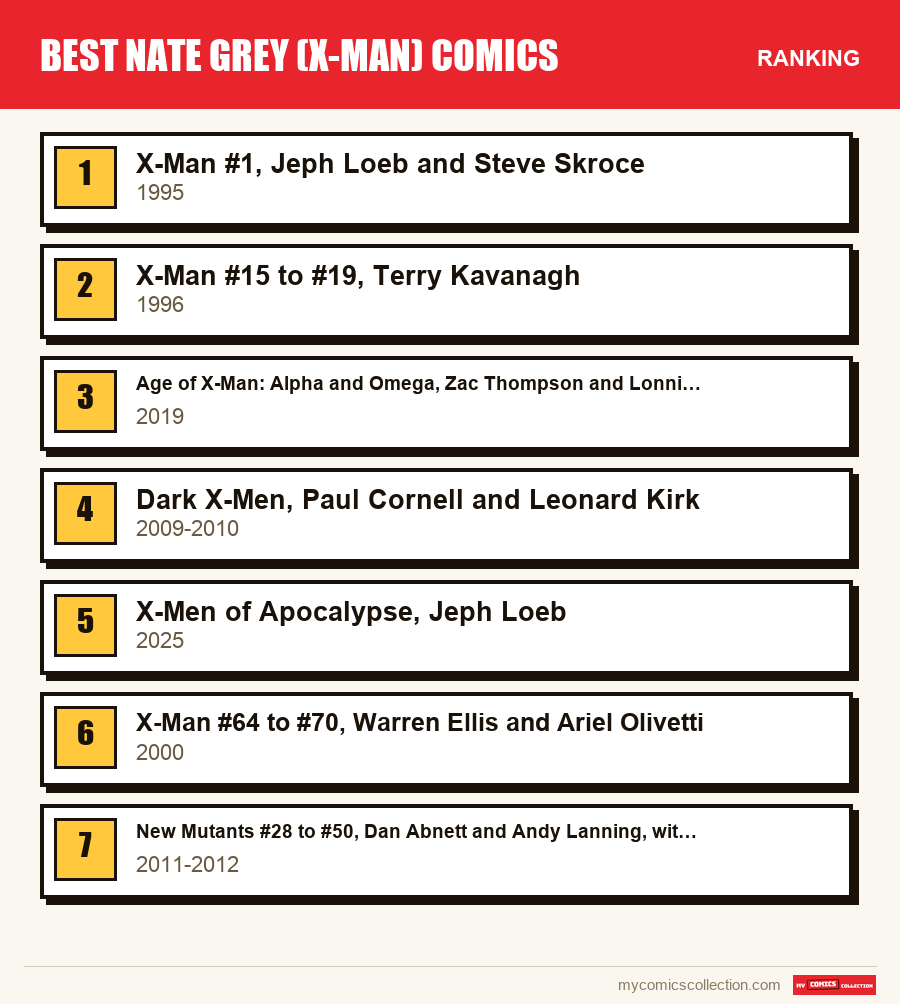
The best Nate Grey comics to read start with X-Man #1 (March 1995) by Jeph Loeb and Steve Skroce, followed by issues #15 to #19 by Terry Kavanagh, where he crosses paths with the Onslaught event. Move on to Age of X-Man (2019) by Zac Thompson and Lonnie Nadler, which puts him in charge of an entire world, and save Dark X-Men (2010) by Paul Cornell for his return to mainline Marvel continuity.
Nate Grey comes from a world that no longer exists: the Age of Apocalypse reality, where Apocalypse conquered North America. His parentage is more lab than home, which makes him hard to shelve. His career rests on only a few series of his own, broken up by long absences and appearances in team books. Between the 1995 series and Jeph Loeb's return in 2025, seven stories put him at the center; for each one, we say what it changes for Nate, who should read it, and in what order to open it.
As always in this guide, we only state verified facts (creators, issue numbers, dates); the analysis is our own, with no reproduction of protected artwork or dialogue.
His First Appearance
Nate Grey first appears in X-Man #1, cover-dated March 1995. The character and the series are the work of Jeph Loeb on script and Steve Skroce on art. The context matters as much as the issue: X-Man launched during Age of Apocalypse, the 1995 event that replaced the usual mutant titles with books set in a parallel reality, and it took the place of Cable there.
In that reality, Earth-295, Mister Sinister built Nate from the genetic material of Scott Summers and Jean Grey. The boy has staggering psionic power, able to reshape matter and build pockets of reality. Cyclops frees him, Forge trains him, and these opening chapters set the traits that shape everything after: an overpowered teenager raised in war who doesn't always know where his gifts should stop.
The series, conceived as a short project for the length of the event, found an audience and became a regular ongoing of seventy-five issues running through 2001. For collectors, the March 1995 #1 is the entry point. Be careful not to confuse it with the other first issues born of the event, many of which carry similar titles; the guide to Age of Apocalypse first issues helps tell them apart on a shelf.
1: X-Man #1, Jeph Loeb and Steve Skroce (1995)
This is the most direct way in, written by the character's own creator. Jeph Loeb writes #1, Steve Skroce draws it, and the series never leaves Nate's side. The issue sets up a boy discovering the world in the middle of a conflict he didn't choose, which gives the read the energy of a coming-of-age novel.
What this entry gives Nate is a sharp starting identity: the lab-built weapon that refuses to serve. This first volume suits anyone who wants to know why Nate survived his home world, as well as fans of Skroce's nervous, kinetic linework. How to read it: start with #1, read a few issues to get the tone, then decide whether to continue. Issue #1 requires no prior knowledge, but the event's background sheds light on some scenes; the Apocalypse crossovers rundown sums it up.
2: X-Man #15 to #19, Terry Kavanagh (1996)
These five issues put Nate in contact with the Onslaught event, which was then shaking every Marvel series. Terry Kavanagh is writing the book at this point. Issues #15 to #17 are filed under the Prelude to Onslaught label in collected editions, while #18 and #19 join the volumes of the event itself.
The turning point to note is a change of name: shortly before this stretch, Nate starts being called X-Man, with no explanation. What this entry gives him is a place in a story bigger than his own series. It suits readers who enjoy big event machinery and want to see how a character imported from another reality fits into a shared story. How to read it: in publication order, #15 through #19, without trying to read the whole event; the series alone is enough to understand Nate's place. If the 1990s interest you as an era, the X-Men reading guide places this episode in the franchise timeline.
3: Age of X-Man: Alpha and Omega, Zac Thompson and Lonnie Nadler (2019)
In 2019, Marvel revived the name of the 1995 event for Age of X-Man, a story that puts Nate Grey at the head of a utopia. Zac Thompson and Lonnie Nadler, who had already written Cable in 2017, wrote the two one-shots that bookend the whole thing: Alpha (art by Ramon Rosanas) and Omega (Simone Buonfantino). In between, several five-issue miniseries explore the world Nate built, including The Marvelous X-Men by the same two writers.
The setup comes from Uncanny X-Men, whose issues #1 to #10 of 2018-2019, by Ed Brisson, Kelly Thompson, and Matthew Rosenberg, carry the subtitle X-Men Disassembled: the story ends with most of the mutants being moved into a reality Nate created. Omega then brings them back to their own, and Jonathan Hickman's Dawn of X era takes over.
What this entry gives Nate is responsibility: he is no longer a lost teenager but a world-builder whose benevolence is open to debate. It suits the contemporary reader, anyone discovering the character who prefers to start with a recent story. How to read it: Alpha, The Marvelous X-Men, and Omega form the trunk; the other miniseries can be read à la carte, depending on which character draws you. For the collection, note that the one-shots, Alpha first among them, are the easiest landmarks to shelve.
4: Dark X-Men, Paul Cornell and Leonard Kirk (2009-2010)
Dark X-Men is a five-issue miniseries published from January to May 2010. Paul Cornell writes it, Leonard Kirk draws it, and it belongs to the Dark Reign era, when Norman Osborn runs America's security services. The four-member team brings together Dark Beast, Mimic, Mystique, who no longer impersonates Charles Xavier, and Weapon Omega, a.k.a. Michael Pointer. Nate Grey is not part of it: it is in this miniseries that he resurfaces. A three-issue series, Dark X-Men: The Beginning (September-October 2009), serves as a prologue and brings together several writers; Nate is not the through-line there.
What the series gives him is a reappearance. Nate returns to the main universe, and it is the four-mutant team in Osborn's orbit that crosses his path, far from the hero role you might expect. It suits readers who like dark moods and teams of villains in disguise. How to read it: go straight to the miniseries, skipping the prologue, keeping in mind that it assumes a minimal knowledge of Dark Reign, which a few lines of context are enough to cover.
Do you collect this series?
Track what you own, what you are missing and what your collection is worth. 7-day trial.
Start my trial →
5: X-Men of Apocalypse, Jeph Loeb (2025)
Thirty years after creating the event, Jeph Loeb returns to the helm for a six-part sequel: an Alpha issue, a four-issue miniseries launched in November 2025, then an Omega issue. The premise: the Age of Apocalypse X-Men, Nate among them, arrive in the main universe to protect their own timeline and clash with the local X-Men.
Nate's role is that of a man between two worlds, since he has lived in the main universe ever since leaving his own and has been both ally and adversary there. This is an entry to rank lower, since he shares the spotlight with other Age of Apocalypse figures, but it has the advantage of bringing back Loeb, who created the character. It suits the nostalgic reader and anyone who wants a recent story that reads without much preparation. How to read it: in order, from Alpha to Omega, after the 1995 series if you have the patience, before it if you prefer current events.
6: X-Man #64 to #70, Warren Ellis and Ariel Olivetti (2000)
In 2000, sales on the series were sagging, and Marvel handed it to Warren Ellis as part of the Revolution initiative. Starting with #64, Nate takes the name Shaman, and Ariel Olivetti draws Ellis's issues. The new direction didn't win readers over: the series was canceled at #75, in 2001.
What this entry gives Nate is a reinvention, with a different name and direction, which makes these issues a thing apart in his bibliography. It suits Ellis readers, collectors hunting for final issues, and anyone interested in relaunches that failed. How to read it: separately, after the previous entries, as an epilogue to the regular series rather than a way in.
7: New Mutants #28 to #50, Dan Abnett and Andy Lanning, with Various Artists (2011-2012)
From 2011 to 2012, Dan Abnett and Andy Lanning write New Mutants (third series) starting with #25. Nate Grey joins the team in #28, "Family Therapy" (September 2011, art by Michael Ryan): the New Mutants pull him from the clutches of Sugar Man, an old enemy who came, like him, from Age of Apocalypse, and he then stays with the group through #50. Blink joins them in #45. Several artists share the pencils, among them Leandro Fernández and David López.
His role is that of the team's most powerful member, taken in and then folded in: past #28, which centers on his rescue, he becomes one member among others, and the interest of the entry lies in the place he finds in a group after his return. The entry suits anyone who wants to follow his trajectory between Dark X-Men and Age of X-Man. How to read it: as a reader already attached to New Mutants; if not, skip it.
Where to Start Based on Your Profile
You're new to the character. Pick up Age of X-Man: Alpha, then The Marvelous X-Men and Omega. It is the best-signposted recent story, and it opens with an explanation that is enough for a beginner.
You like series debuts. Start from X-Man #1, then read a few Kavanagh issues. The history of Apocalypse places the founding event in the longer timeline.
You like big events. X-Man #15 to #19, then X-Men of Apocalypse. Two eras, two ways of tying Nate into a story bigger than he is.
You prefer dark stories. Cornell's Dark X-Men gives you a quiet return for Nate, in contact with a shadow team.
You collect. Hunt for X-Man #1, then the turning-point issues listed below, judging each single issue on its actual condition.
The Key Issues to Know
The landmarks below rest on creators and dates, with no reference to market value.
- X-Man #1 (March 1995). His first appearance, by Jeph Loeb and Steve Skroce.
- X-Man #15 to #19 (1996). The Onslaught period, by Terry Kavanagh.
- X-Man Annual '96 and X-Man/Hulk '98. Two special issues to look for to complete the series.
- X-Man #64 (2000). Warren Ellis's overhaul, with Nate renamed Shaman.
- Dark X-Men (January to May 2010). His reappearance in the main universe, by Paul Cornell and Leonard Kirk.
- New Mutants #28 (September 2011). Nate's arrival on the Abnett and Lanning team.
- Age of X-Man: Alpha (2019). The opening of Nate's utopia, by Zac Thompson and Lonnie Nadler.
- X-Men of Apocalypse (2025). Loeb's return to his own character.
Shelving method: sort Nate by world rather than by date. One shelf for the home reality (the 1995 series), one for the main universe (Kavanagh, Cornell, New Mutants), and one for the utopias (Age of X-Man). That way you separate the single issues where Nate leads the story from those where he supports a team. For his link to the other replacement character of the same era, the Cable reading guide gives the point of comparison.
Frequently Asked Questions
Nate Grey first appears in X-Man #1, cover-dated March 1995, with Jeph Loeb on script and Steve Skroce on art. The series launched during the Age of Apocalypse event to take the place of Cable, then became a regular ongoing that ran through 2001.
In the Age of Apocalypse reality, Mister Sinister conceived him from the genetic material of Scott Summers and Jean Grey. So it is a lab connection, not an ordinary parentage. He comes from an alternate world and settled in the main universe afterward.
No. X-Man #1 can be read on its own, since the story introduces the world and the character as it goes. Reading the original event enriches the experience, but it isn't essential to enjoy the series' opening issues.
Age of X-Man: Alpha, The Marvelous X-Men, and Omega, written by Zac Thompson and Lonnie Nadler in 2019, form the most recent and best-signposted set. They tell the story of the world Nate built, without requiring long preparation.
Sales sagged in 2000, and Warren Ellis overhauled the series starting with #64, with Nate renamed Shaman, as part of the Revolution initiative. The new direction didn't win readers over, and the series ended at #75 in 2001.
Do you own a 1995 X-Man #1 or an Age of Apocalypse issue? Get it appraised before you shelve it.
Appraise my comic