
The best Multiple Man comics start with the Madrox miniseries (2004-2005) by Peter David and Pablo Raimondi, which sets up Jamie Madrox as a detective in New York. Follow it with the third volume of X-Factor (2006-2013), also by Peter David, then go back to X-Factor #71 (1991) and his debut in Giant-Size Fantastic Four #4 (February 1975). For a recent read, pick up Matthew Rosenberg's Multiple Man (2018).
Jamie Madrox creates copies of himself at the slightest shock, and each copy lives its own life before returning to him. A power like that produces stories about identity more than combat, and that is what makes the character richer than a simple second-tier hero. Six reads are ranked below: from the 2004 detective miniseries to the giant-size issue of 1975, each one is placed within the character's path.
As always in this guide, only verified information (creators, issues, dates) is stated as fact; the analysis is ours, with no reproduction of protected pages or dialogue.

His first appearance
Madrox is born in Giant-Size Fantastic Four #4, cover-dated February 1975, with a story titled "Madrox the Multiple Man!" Len Wein and Chris Claremont write the script, John Buscema draws. As is often the case in this giant-size series, the issue is filled out with older reprinted material.
The plot shows Ben Grimm meeting a stranger in a strange suit on the subway tracks. Every blow Ben lands creates new duplicates, which end up overwhelming him. Jamie is introduced as a mutant whose late parents had built a suit to contain his copies, a suit that is malfunctioning. Charles Xavier steps in, Reed Richards repairs the equipment, and Xavier takes Jamie under his wing.
For collectors, remember that this issue is a single issue of the Bronze Age Giant-Size line, and that its appeal lies less in any feat of arms than in the first image of a character whose destiny will widen much later. The other entries below are stories where Madrox is the central character, or a full teammate, with that role specified each time.
1: Madrox, Peter David and Pablo Raimondi (2004-2005)
This five-issue miniseries ran from November 2004 to March 2005, under the Marvel Knights banner. Peter David writes, Pablo Raimondi draws. This is where Jamie, settled in New York, opens a detective agency, which appears under the name XXX Investigations as early as issue #1. Madrox is the hero in the full sense here, far from a mere teammate role.
The contribution of this entry is turning a spectacular power into a detective's tool: a reabsorbed copy brings its memories and knowledge back to the original. With Madrox, the character stops being a team extra and becomes the center of a series.
It suits the reader who likes crime stories against a super-powered backdrop, and the one looking for a short way in. Look for the trade paperback Madrox: Multiple Choice, which collects the five issues. Our page on Peter David places this series within the whole of his work.
2: X-Factor, Peter David and several artists (2006-2013)
The third volume of the series, launched in 2006, directly extends the agency from the miniseries: the team of investigators becomes X-Factor Investigations, in the wake of House of M and Decimation. Peter David writes the entire series, with several artists. After issue #50, the numbering picks up the first volume's count at issue #200, and the series ends at issue #262, in 2013.
Madrox is its central character, surrounded by Wolfsbane and Strong Guy, in the New York neighborhood known as Mutant Town. The theme of copies sent to live elsewhere reaches its full scope here: some go off to learn a trade or follow another path, and what they learn can flow back to the original. The trade paperback X-Factor: The Many Lives of Madrox, which collects issues #13 to 17 of this volume, carries the theme in its title.
It is the peak for anyone who loves long-running series, with subplots that echo each other. Read it by trade paperbacks, in order, without skipping a volume: relationships between characters accumulate. To place this period against the others, see the ranking of the best X-Factor runs.
3: They Keep Killing Madrox, Peter David and several artists (2012)
In this arc, set in the X-Factor series numbered as a continuation of the first volume, Madrox is impaled by Bloodbath in issue #227, then sent through several alternate Earths before getting home. He then marries Layla Miller. Peter David writes, with several artists over the course of the issues.
The arc pushes the theme of copies toward the ordeal of the body: the character is killed, then flung far from home. It gives Madrox a journey in the strictest sense, and a marriage that durably changes his team life.
It is aimed at the reader already settled into the series' 2000s run, because it assumes you know Layla Miller and the agency. Read it after entries 1 and 2; in trade paperback if possible, since the numbering resumed at 200 is easier to follow by volumes.
4: X-Factor, Peter David, Larry Stroman and several artists (1991-1993)
Peter David takes over the first volume with issue #70, in 1991. Madrox joins the second team, put together by Valerie Cooper as a U.S. government strike force, after the destruction of Muir Island and the defeat of the Shadow King. Larry Stroman draws the first issues of this period, then Jae Lee takes over for a few episodes: the look changes a lot from one block to the next.
Here Madrox is a full teammate, not a solo hero, but he holds a central role from the start: in the team's earliest days, one of his copies is shot dead, and he discovers that he cannot reabsorb a dead copy. This discovery gives the character a gravity he did not have until then.
It is aimed at the reader of the 1990s who wants to see the origin of Peter David's approach. Read the start, issues #70 to 75, then choose according to your taste in art. The first issue of the series, dated 1986, is covered in our profile of X-Factor #1.
Do you collect this series?
Track what you own, what you are missing and what your collection is worth. 7-day trial.
Start my trial →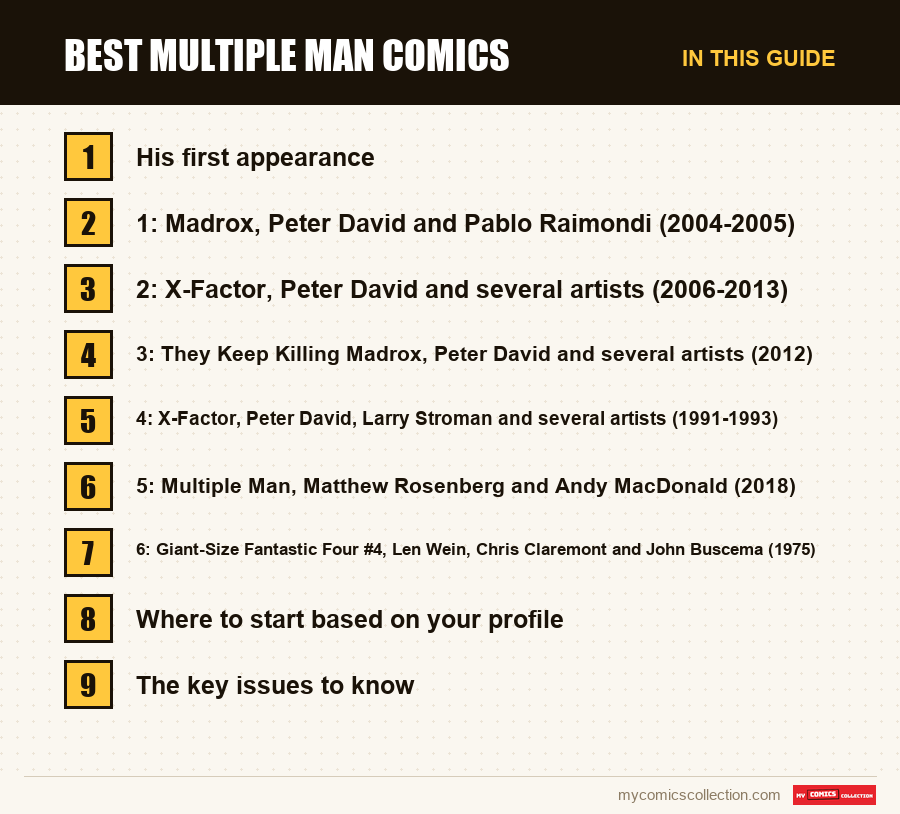
5: Multiple Man, Matthew Rosenberg and Andy MacDonald (2018)
This five-issue miniseries, announced in February 2018, is written by Matthew Rosenberg and drawn by Andy MacDonald. A duplicate of Jamie is found locked up in a bunker on Muir Island and brought to the X-Men, which revives the question of which Jamie is the original. The trade paperback Multiple Man: It All Makes Sense in the End came out in December 2018.
The series takes the power seriously: which of the copies is the real Jamie, and what is a double worth if he wants to take the original's place? It gives the character the dark mirror of the detective agency, and his most unsettling version. It suits the reader who wants a short story, wrapped up in five issues, without having read Peter David's series.
Read it after understanding how the copies work, for example after the 2004 miniseries. The five issues are easy to find in trade paperback.
6: Giant-Size Fantastic Four #4, Len Wein, Chris Claremont and John Buscema (1975)
As a story, "Madrox the Multiple Man!" is the oldest on this list, and it is a meeting with the Fantastic Four more than a Madrox adventure. Jamie is an unwilling adversary here: the team faces a threat that is not really one, and the solution comes through repaired equipment and a welcome from Xavier.
Its contribution to the character is his definition: a young man whose power is an accident of birth, and whose parents had tried to contain him. The story sets the stage that later writers will exploit. It is aimed at the reader who likes going back to the source and appreciates the Bronze Age tradition of giant-size issues.
To read it, get hold of the single issue or a reprint from the period. Fans of Reed Richards's team will find context in our Fantastic Four reading guide.
Where to start based on your profile
To jump in with no preparation, read 2004's Madrox, then The Many Lives of Madrox. If you love the 1990s, open Peter David's X-Factor #70 to 75, and keep in mind that Stroman and Lee do not draw at all like Raimondi.
The reader looking for a brief, dark story will take Rosenberg's Multiple Man. The one who cares about the continuity of the detective and his team will follow the third volume of X-Factor through issue #262. The Bronze Age collector, finally, will turn to the 1975 giant-size issue and pick one single issue per period rather than aim for completeness. Our X-Men reading guide places these series within the whole mutant family.
The key issues to know
Giant-Size Fantastic Four #4 (February 1975) is the first appearance, with a script by Len Wein and Chris Claremont and art by John Buscema. The Fallen Angels miniseries (1987), written by Jo Duffy, marks a turning point, since Jamie joins the Fallen Angels team alongside Sunspot and Warlock; he is a teammate, not the hero. X-Factor #71 (1991) installs him in the second team, where he loses a duplicate shot dead.
Madrox #1 (November 2004) opens the agency, and X-Factor volume 3 #1 (2006) launches the series. Issue #227 (2012) contains the impalement by Bloodbath. The Chaos War crossover (2010) places him among the heroes Hercules gathers against Amatsu-Mikaboshi, and Death of X (2016) sees Jamie and his copies die from the Terrigen mist. The Multiple Man miniseries (2018) is the last major milestone.
Our method is the same for all these milestones: first find the first appearance and the relaunch issue, then a reading trade paperback. Compare sold listings for copies in the same condition, and read your copy's credits page before trusting the label.
Frequently asked questions
In Giant-Size Fantastic Four #4, cover-dated February 1975, with the story "Madrox the Multiple Man!" Len Wein and Chris Claremont write the script, John Buscema draws. Jamie faces the Fantastic Four there before Charles Xavier takes him in.
The five-issue Madrox miniseries (2004-2005) by Peter David and Pablo Raimondi. It presents the power, sets up the detective agency and reads on its own. It is collected in the trade paperback Madrox: Multiple Choice, and leads naturally to the third volume of X-Factor.
For the third volume, yes: Peter David builds plots that stretch across several trade paperbacks. After issue #50, the numbering resumes at 200 and the series runs to #262. For the 1990s volume or the 2018 miniseries, you can instead read each set separately.
Jamie creates a copy, called a dupe, every time he takes a shock. When the original reabsorbs a copy, he also gets back its memories, knowledge and skills. This is the principle Peter David exploits by sending his dupes off to learn a trade or live another life before reabsorbing them.
Yes, the 2018 Multiple Man miniseries, five issues, written by Matthew Rosenberg and drawn by Andy MacDonald. It was collected in December 2018 as It All Makes Sense in the End. A duplicate of Jamie regains his freedom there after being locked in a bunker on Muir Island.
Do you own Giant-Size Fantastic Four #4 or an issue of Peter David's X-Factor? Get a ballpark value before you decide.
Estimate my comic