
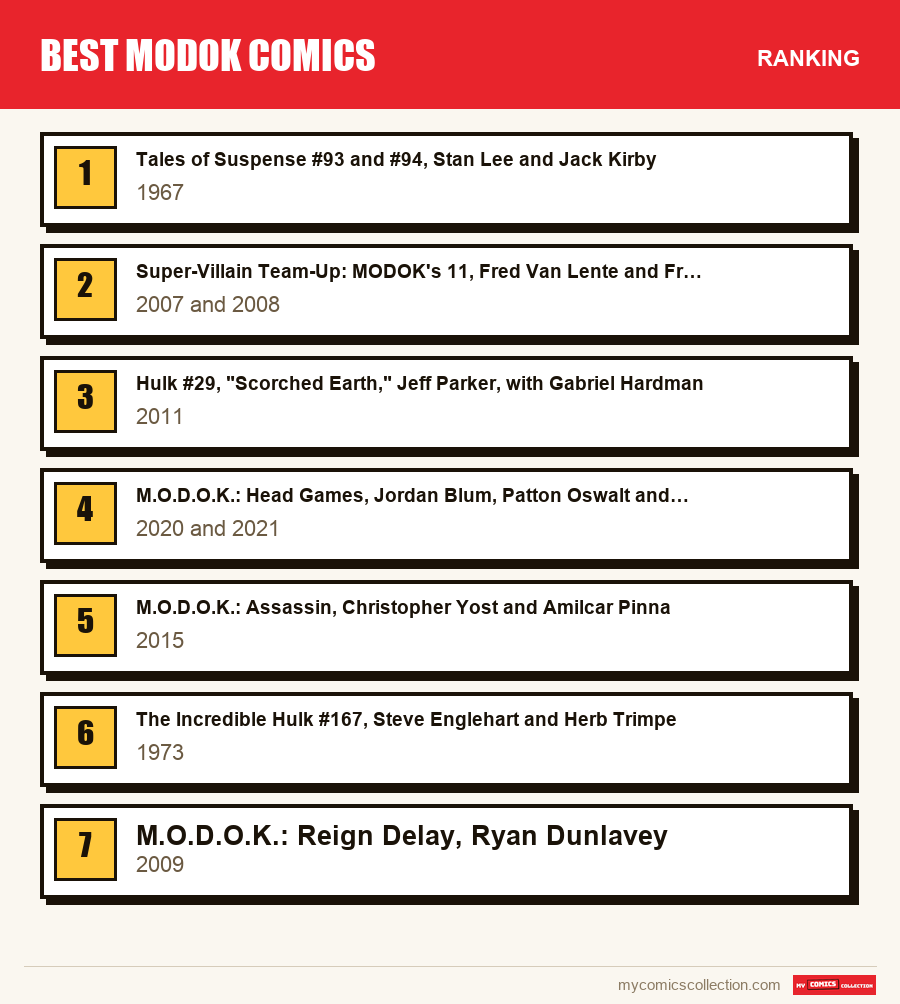
MODOK is born in Tales of Suspense #93 and #94 (September and October 1967), by Stan Lee and Jack Kirby, in the Captain America episodes. For the best MODOK comics, start with those two issues, then move on to Super-Villain Team-Up: MODOK's 11 by Fred Van Lente and Francis Portela, Jeff Parker's Hulk #29 (2011) and M.O.D.O.K.: Head Games by Jordan Blum, Patton Oswalt and Scott Hepburn.
MODOK is an oversized head on a floating chair, a scientific-organization brain turned monster and army commander. He is both menacing and ridiculous, and his best stories play both registers. This guide ranks seven reads, from 1967 to 2021, and says for each what it brings and who it suits.
As always in this guide, only verified facts (creators, issue numbers, dates) are stated as fact; the analysis is our own, with no reproduction of protected art or dialogue.
His first appearance
MODOK settles into Tales of Suspense, where the Captain America episodes alternate with those of Iron Man. He appears in #93, dated September 1967, in the story titled "Into the Jaws of A.I.M.!", and takes his full place in #94, dated October 1967, titled "If This Be... MODOK!". Stan Lee and Jack Kirby are the creators, and Kirby handles the pencils on #94. The criminal organization A.I.M. (Advanced Idea Mechanics) provides the setting: MODOK came out of its labs, under the name George Tarleton.
These two issues are the obvious entry point for a collector, and they are worth hunting down together. Faced with a 1967 issue, scrutinize the spine, the corners and the grain of the paper, insist on sharp views of the interior, and watch for restoration: a re-glued cover gives itself away under raking light. The context of the period is detailed in the history of Captain America in comics.
1: Tales of Suspense #93 and #94, Stan Lee and Jack Kirby (1967)
The two-parter is the character's birth. On the page, the character fits in one image: a being whose body is no more than a support for a swollen brain. Jack Kirby's art in #94 gives the skull a mass that crushes everything else in the panel, and it is that silhouette later creators will pick up. The context matters too: the hero of the story is Captain America, and MODOK comes out of A.I.M.'s labs, which explains why the organization stays tied to him in most of the stories that follow.
What these two issues bring: the matrix. Everything that comes later, from the serious to the grotesque, flows from this silhouette and its relationship to A.I.M. They suit the Silver Age reader and the collector who wants to understand where the character draws his visual power. If you'd rather not pay for the single issue, the trade paperbacks of the Captain America stories of this period collect the episode.
2: Super-Villain Team-Up: MODOK's 11, Fred Van Lente and Francis Portela (2007 and 2008)
In five issues, the series is scripted by Fred Van Lente and illustrated by Francis Portela; Eric Powell does the cover of #1. It takes the form of a heist, in the manner of the film Ocean's Eleven: MODOK assembles eleven super-criminals for a high-risk job. It came out at the end of 2007 and the start of 2008, with a trade paperback in February 2008.
What it brings to the character: humor as the engine. MODOK is no longer just a warlord, he is a vain team leader, and the miniseries draws funny situations from that without betraying his menace. It suits anyone who wants a complete, light adventure, accessible without knowing Captain America, Hulk or Iron Man. It is an excellent way in for the reader who discovers the character through his offbeat version. The five issues read in publication order, and the 2008 trade paperback collects them: no need to chase single issues, except for the pleasure of Eric Powell's cover on #1.
3: Hulk #29, "Scorched Earth," Jeff Parker, with Gabriel Hardman (2011)
The 2008 Hulk series passes to Jeff Parker and Gabriel Hardman starting with #25 (September 2010). Issue #29 closes the "Scorched Earth" arc: Bruce Banner discovers there that MODOK has set off the procedure known as "Scorched Earth." It is in this issue that MODOK Superior appears, a cloned successor designed by Jeff Parker, who takes the place of the original MODOK after Amadeus Cho gives George Tarleton back his human appearance.
What this read brings: a renewal. The character is no longer a fixed figure, he can be replaced, which opens another kind of story. It suits the Hulk reader more than the Captain America one. The 2008 series reads better if you already know Red Hulk and Amadeus Cho, because #29 leans on that framework. For what follows, including MODOK Superior in #37, you have to keep going in the series, and the roadmap devoted to Hulk sheds light on this stretch.
4: M.O.D.O.K.: Head Games, Jordan Blum, Patton Oswalt and Scott Hepburn (2020 and 2021)
A four-issue miniseries, published from December 2020 to April 2021, written by Jordan Blum and Patton Oswalt and drawn by Scott Hepburn, with a cover by Cully Hamner. It accompanies the animated series M.O.D.O.K. from the same writers and tells of a MODOK confronting his own ego and the mess he has made of his life.
What it brings to the character: an inner life. MODOK is confronted with himself there, whereas older stories mostly showed him in action. It suits anyone who already knows the animated series and wants its print continuation, and more broadly the reader who likes dark humor. The May 2021 trade paperback lets you read it without chasing single issues. If you've never seen the animated series, the miniseries is still readable, because it tells its story from A to Z in four issues.
Do you collect this series?
Track what you own, what you are missing and what your collection is worth. 7-day trial.
Start my trial →
5: M.O.D.O.K.: Assassin, Christopher Yost and Amilcar Pinna (2015)
This five-issue miniseries, tied to the 2015 Secret Wars event, is written by Christopher Yost and drawn by Amilcar Pinna, with a cover by David Lafuente. It places MODOK in the world of Battleworld, where he works as a mercenary. The setting changes the nature of the character: outside the usual continuity, he has no lab and no organization to run.
It brings the character a version in an unusual setting, cut off from the usual continuity. It suits anyone who already knows Secret Wars and wants to see a supporting character take center stage there; for everyone else, the earlier titles come first. The trade paperback, published in January 2016, spares you from gathering the five single issues one by one.
6: The Incredible Hulk #167, Steve Englehart and Herb Trimpe (1973)
Dated September 1973, this issue pits MODOK against Hulk, with a script by Steve Englehart and art by Herb Trimpe. MODOK pays a visit to Betty and, through his mental powers, amplifies the hatred she bears toward Hulk; Hulk then goes after his robotic body. Here, MODOK is an adversary of the issue, not the center of an arc.
What this read brings: proof that the character works outside Captain America, as early as the seventies. It suits the Bronze Age Hulk collector, who is not necessarily looking for a major story, but an issue that fits with his series. The historical overview of Hulk places this title over the long run.
7: M.O.D.O.K.: Reign Delay, Ryan Dunlavey (2009)
This one-shot, dated November 2009, is credited to Ryan Dunlavey, who is both writer and artist. It fits in a single issue, which makes it a short read. It is ranked last because it replaces none of the earlier reads.
It suits the reader who has already gone through the earlier titles and wants to complete the list. It is a completist's purchase more than a must-read.
Where to start based on your profile
A simple reading order comes down to four steps. First Tales of Suspense #93 and #94 for the character's birth; then MODOK's 11 to see what comedy makes of him; then Hulk #29 for the shift to the clone MODOK Superior; finally Head Games for the most recent version. The 2015 and 2009 titles read separately and impose no order.
The reader who wants to understand the origin will open Tales of Suspense #93 and #94. The one who prefers a complete, funny story will pick MODOK's 11. The Hulk reader will go straight to Hulk #29, and whoever comes from the animated series will take Head Games.
If you collect, start with the trade paperbacks and save the single issues for two or three specific ones: the 1967 appearance, then an issue from the era you like. The Captain America reading guide helps you find the episodes of the period where MODOK appears.
The key issues to know
Before you buy, a useful clarification: MODOK Superior is a different character from MODOK, and his issues are not valued on the same footing as those from 1967. The original's first appearance remains the benchmark; Superior's appearances, more recent, belong to a different market.
The landmarks are grouped by era. 1967: Tales of Suspense #93 and #94. Late sixties and early seventies: Captain America #117 to #120 (1969), then Sub-Mariner vol. 2 #47 to #49 (March to May 1972) and The Incredible Hulk vol. 2 #167 to #170 (September to December 1973). Seventies: Iron Man #74 and #75 (May and June 1975), then Ms. Marvel in 1977.
Nineties and two-thousands: the "Taking A.I.M." arc in The Avengers #386 to #388 and Captain America #440 and #441 (1995), Ms. Marvel vol. 2 #14 to #17 (June to September 2007), then Hulk #29 (2011) for MODOK Superior. To place them in the market, compare completed sales of the same issue at comparable grade, set aside extreme values and watch the trend rather than a single case. A mere background-panel appearance is not priced like a real MODOK story.
Frequently asked questions
MODOK appears in Tales of Suspense #93 (September 1967) and takes his full place in #94 (October 1967), in the Captain America episodes. His creators are Stan Lee and Jack Kirby, the latter on the art of #94. For a first approach, look for the two issues together.
For the origin, Tales of Suspense #93 and #94. For a complete, accessible story, Super-Villain Team-Up: MODOK's 11, a five-issue miniseries by Fred Van Lente and Francis Portela. For a recent adventure, M.O.D.O.K.: Head Games (2020 and 2021), in four issues.
MODOK Superior is a clone who replaces the original MODOK in the 2008 Hulk series. He is created by Jeff Parker and appears in #29, after Amadeus Cho gives George Tarleton back his human appearance. He also shows up in #37, if you want to keep reading.
Yes: the miniseries M.O.D.O.K.: Head Games, written by Jordan Blum and Patton Oswalt and drawn by Scott Hepburn, accompanies the animated series M.O.D.O.K. by the same two writers. It runs from December 2020 to April 2021, in four issues.
Not for the recent miniseries, which read on their own. For the 1967 appearance, however, know that the setting is that of the Captain America episodes published in Tales of Suspense; the guides listed at the top of the article help you there.
Do you own a 1967 Tales of Suspense or another issue with MODOK? Get it appraised after checking its condition.
Appraise my comic