
The best Longshot comics start with his 1985-1986 six-issue miniseries by Ann Nocenti and Art Adams, which is his first appearance. Follow it with Chris Claremont's X-Men years, through Uncanny X-Men #248, then Peter David's X-Factor from #35 (November 2008). Finish with Longshot Saves the Marvel Universe (2013), the miniseries by Christopher Hastings and Jacopo Camagni.
An artificial being born in a dimension ruled by Mojo, amnesiac, and blessed with a luck that his own intentions can turn for or against him: Longshot is a late-1980s character with a short but dense bibliography. This guide ranks six reads where he is front and center, or where we spell out exactly what role he plays.
As always in this guide, only verified facts (creators, issue numbers, dates) are stated as fact. The analysis is ours, with no reproduction of protected pages or dialogue.

His first appearance
Longshot first appears in Longshot #1, cover-dated September 1985, the opening issue of a six-part miniseries that runs through February 1986. Ann Nocenti writes and Art Adams draws: the series was a major piece of work for both of them. Whilce Portacio inks the series, with Brent Anderson on #1.
The issue sets up the essentials: a man with no memory who has fallen into our world, with a gift for acrobatics, an ability to bend probability, and an innocence his pursuers turn into a weakness. Nocenti is credited with Mojo and Spiral, the two figures who hunt him all the way to Earth. Rita, a human stuntwoman who takes him in, was designed by Adams after Nocenti herself.
For a collector, this issue is valuable for its double signature: a writer whose later work at Marvel you will keep following, and an artist whose style shaped the early 1990s. To place him within the mutant saga, see our history of the X-Men in comics: Longshot comes in through the team's side door without being an original member.
1: Longshot #1-6, Ann Nocenti, Art Adams and Whilce Portacio (1985-1986)
This is the essential read. Ann Nocenti builds a character around luck and probability: his powers work when his intentions are pure and turn against him when they are not. He is presented as a being made by genetic engineering in the Mojoverse, a dimension ruled by Mojo. His kind are held in servitude there, until a revolt gives him his gift of luck.
What the series gives the character: everything. The origin, the amnesia (his name comes from those who marvel at his luck), the bond with Rita, the threat of Mojo and Spiral, and a final return to the home dimension to free his people. Who it is for: fans of adventures with a baffling logic, where irony drives the plot. How to read it: in one sitting, accepting some abrupt jumps from scene to scene.
Our overall take is nuanced: critics of the day praised the series, but some current readers find the story less clear than its reputation, with scene jumps and uneven narration. Adams's art, for its part, gets more confident with every issue. The complete series was collected as the trade paperback X-Men: Longshot (2008).
2: Uncanny X-Men Annual #10 through #248, Chris Claremont and several artists (late 1980s)
Longshot joins the X-Men in Uncanny X-Men Annual #10, written by Claremont and drawn by Adams. His time on the team runs through Uncanny X-Men #248 (September 1989), again under Claremont, with Jim Lee on pencils. There are many artists across these issues, so visual continuity is not the selling point.
To be clear about his role: he is a member of a large team, not the hero of every issue. This stage is in the ranking because it gives the character a place in the main X-Men story for several years and develops his relationship with Dazzler, also a team member at the time.
Who it is for: readers of the Claremont era who like following a supporting player over the long haul. How to read it: as a sequel to the 1985 miniseries, continuing through #248, drawn by Jim Lee. As for which single issues to shelve first, the key issues of Uncanny X-Men sort that out.
3: Longshot (Fools), J. M. DeMatteis and Michael Zulli (late 1990s)
This one-shot is written by J. M. DeMatteis and drawn by Michael Zulli. Stripped of his innocence and his luck, Longshot ends up stranded in Kansas, chased by a monstrous creature. He befriends a child who ends up hurt, and a group of patients at a psychiatric facility helps him regain his confidence.
What this story adds: a dreamier, gentler take on the character, far from the 1980s action. Regained faith, rather than fear, settles the ending. It is for those who prefer poetry and self-contained stories. How to read it: on its own, after the 1985 miniseries.
For a collector, this one-shot is a singular object: a format apart, a creative team outside the big mutant titles, and a story that closes in on itself.
4: X-Factor (vol. 3) #35 to the end of the series, Peter David and several artists (2008-2013)
Longshot arrives in X-Factor at #35 (November 2008), with Peter David writing him. He stays until the series is cancelled in 2013. The artists change over the course of the run; the selling point is the continuity of the writing.
To be clear about his role: he belongs to a team whose every issue he does not headline, in an ensemble story written by Peter David. What the run gives the character: a continuous presence from 2008 to 2013. Who it is for: readers who like ensemble books and long-running threads. How to read it: straight through from #35, or starting from our page on the best runs of X-Factor, which places this series among the others.
For the collector, the series is followed closely for another reason: a collection run by a single writer over the stated period is easy to complete. See also our page on Peter David to place this work within his overall output.
Do you collect this series?
Track what you own, what you are missing and what your collection is worth. 7-day trial.
Start my trial →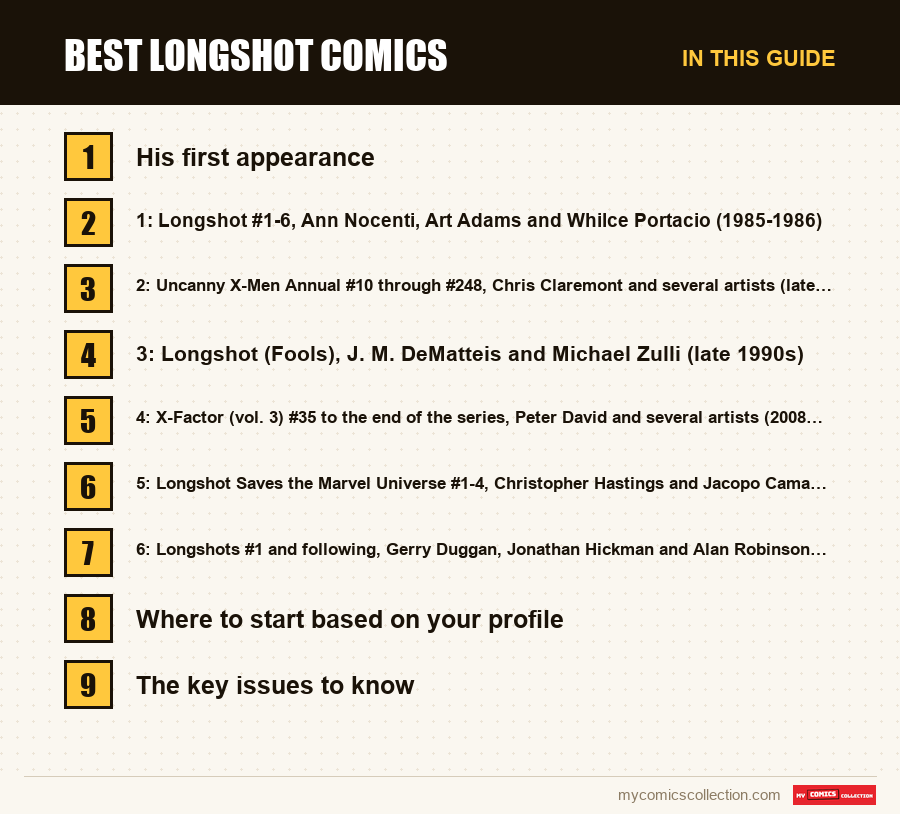
5: Longshot Saves the Marvel Universe #1-4, Christopher Hastings and Jacopo Camagni (2013)
This four-issue miniseries, launched in November 2013, is written by Christopher Hastings and drawn by Jacopo Camagni. Its title announces the tone: Longshot cuts across the Marvel Universe in a light register, very far from the 1985 series. The trade paperback came out in June 2014.
What it offers: a humorous version of the character that plays his luck for laughs. It will appeal to readers already familiar with the Marvel Universe and fond of irony. How to read it: after the original miniseries, to gauge the difference in tone between the two.
It is also the easiest miniseries on the list to find. It is recent, runs four issues, and is quickly completed: a good test if you want to check your taste for the character before hunting down the 1980s single issues.
6: Longshots #1 and following, Gerry Duggan, Jonathan Hickman and Alan Robinson (2025-2026)
The Longshots series, tied to the Age of Revelation event, is written by Gerry Duggan and Jonathan Hickman with Alan Robinson on art; #1 carries a December 2025 cover date. Mojo launches a new show starring Bishop, Hellcat, Kraven, Rhino and Wonder Man. To be clear about his role: despite the title, Longshot is not the lead. He appears in the background, in a possible future where he refuses to headline Mojo's new show without a raise, which Mojo ends up granting.
What the series offers: the satirical side of the character, closer to television than to combat. Who it is for: readers following the current X-Men books, especially since Hickman's return. How to read it: from #1, keeping in mind that the story imagines a possible future tied to Age of Revelation. To place the writer, see our page on Jonathan Hickman and our analysis of his return to the X-Men.
Where to start based on your profile
You are new to the character. Read the 1985-1986 six-issue miniseries: everything is there, from the origin to the mission. If the style feels dated, try Longshot Saves the Marvel Universe (2013) first, which is lighter.
You read Claremont's X-Men. Start from Uncanny X-Men Annual #10 and continue through #248 to follow Longshot on the team, alongside Dazzler.
You like ensemble books. Pick Peter David's X-Factor from #35: Longshot is one of the pillars of a team living through varied plots.
You like offbeat stories. Try Longshot: Fools, a poetic one-shot that reads without any preparation.
You follow current events. Pick up Longshots (2025), which leans on Mojo, and read it knowing it is a possible future.
The key issues to know
To collect Longshot without spreading yourself thin, keep these markers in mind, sorted by role: birth, team turning point, rereads.
- Longshot #1 (September 1985): the first appearance, by Nocenti and Adams.
- Longshot #6 (February 1986): the end of the original miniseries.
- Uncanny X-Men Annual #10: his entry into the X-Men, by Claremont and Adams.
- Uncanny X-Men #248 (September 1989): his last issue on the team, by Claremont and Jim Lee.
- Longshot (Fools), a one-shot by DeMatteis and Zulli.
- X-Factor (vol. 3) #35 (November 2008): his arrival on Peter David's team.
- Longshot Saves the Marvel Universe #1 (November 2013): the miniseries by Hastings and Camagni.
- Longshots #1 (2025): the series by Duggan, Hickman and Robinson.
When buying, aim first for the 1985 #1, which holds the historical interest, and compare several listings of the same issue. On a 1985 comic, examine the corners, spine and staples; also make sure all six issues of the series are there before paying for a lot.
If you care more about reading than collecting, the trade paperbacks cover the essentials. Keep the original single issues for the numbers where Adams draws: those matter most to a fan of the era.

Frequently asked questions
In Longshot #1, cover-dated September 1985, the first issue of a six-part miniseries written by Ann Nocenti and drawn by Art Adams, with Whilce Portacio on inks. The series ends in February 1986 with #6.
He was: he joins the team in Uncanny X-Men Annual #10, written by Chris Claremont, and stays through #248 (September 1989). He is not an original member of the team and later had other assignments, notably in X-Factor.
He manipulates probability, a gift that works when his intentions are pure and turns against him when they are not. He is also an acrobat, capable of healing, and gifted with psychometry. These gifts come from his artificial origin in the Mojoverse.
Peter David writes him in X-Factor from #35 (November 2008). Christopher Hastings wrote Longshot Saves the Marvel Universe (2013), drawn by Jacopo Camagni. Gerry Duggan and Jonathan Hickman write Longshots, drawn by Alan Robinson (2025).
Yes. The complete series was collected in 2008 as X-Men: Longshot, which gathers all six issues. For your collection, compare the trade paperback with the original single issue, which keeps the historical appeal of the first printing.
Do you own a 1985 Longshot #1 or an Uncanny X-Men from the Claremont era? An estimate will tell you where it stands.
Estimate my comic