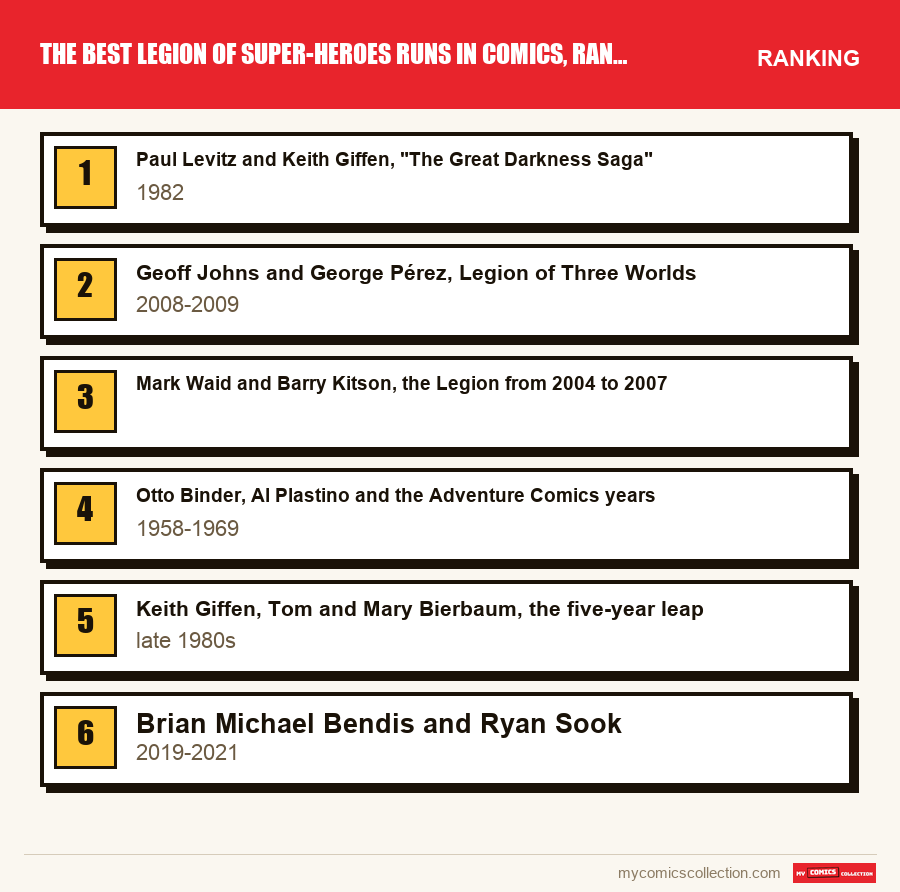
The best Legion of Super-Heroes run is "The Great Darkness Saga" by Paul Levitz and Keith Giffen, published in Legion of Super-Heroes #290 to #294 in 1982. Behind it: Legion of Three Worlds, by Geoff Johns and George Pérez (2008-2009); the reboot by Mark Waid and Barry Kitson (2004-2007); the foundations laid between 1958 and 1969; the five-year leap of the late 1980s; and finally Brian Michael Bendis (2019-2021).
Ranking the Legion is unlike any other list: the team does not have one run, it has six that do not tell the same story. A reader who asks for "the best run" is really getting the answer to a different question, the one about where to jump in. So we sorted by readability with no prerequisites and by place in the title's memory, leaving aside anything that is merely a middle chapter.
As always in this guide, only verified information (creators, issue numbers, dates) is stated as fact; the analysis is our own, with no reproduction of protected art or dialogue.
How to read a ranking with no single series
The title has changed homes many times: the Legion is born in Adventure Comics #247 (April 1958), the work of Otto Binder and Al Plastino, then moves between Action Comics and Superboy, and ends up in a dozen successive series. Our map of the continuities details this geography; here we keep only six sets, each judged on what a reader can get out of it alone.
The rank says nothing about the recommended reading order, and even less about the market value of a single issue. Two sets on this list read very well in collected form and are of almost no interest as loose issues; another is exactly the opposite. We specify this each time.
Top 1: Paul Levitz and Keith Giffen, "The Great Darkness Saga" (1982)
Five issues of Legion of Super-Heroes, #290 to #294 (August to December 1982), with Larry Mahlstedt on inks. Paul Levitz writes, Keith Giffen draws. In the thirtieth century, the adversary is Darkseid, which is the point of pride of this saga: the Legion faces an evil that is anything but local, with dozens of members mobilized without the thread getting lost. Brainiac 5 plays a central role, which our ranking of Brainiac runs notes in its fourth place.
It comes first because it brings together what the team does best: an outsized cast, stakes that climb issue after issue, and an ending that requires no knowledge of what precedes it. Giffen adopts a tight layout, strongly influenced by the 1980s, which gives the story a density rare for a monthly.
It is aimed at the reader ready to accept thirty or so unfamiliar costumes, since the saga presents each Legionnaire in action rather than through a profile sheet. To collect it, the five single issues form a coherent block of the late Bronze Age; you can find them one by one, but the English-language collected edition has existed for several decades and remains the most comfortable way to read. To our knowledge, no dedicated French edition appears in the French-language publisher's active catalog, which makes buying in the original language unavoidable.
Top 2: Geoff Johns and George Pérez, Legion of Three Worlds (2008-2009)
Final Crisis: Legion of Three Worlds runs five issues published from August 2008 to September 2009. Geoff Johns writes, George Pérez draws. The premise is simple to state and dizzying to read: three versions of the team, from three different continuities, must meet and coordinate against a common danger. Pérez, a recognized specialist in pages teeming with characters, finds a playground to match.
It counts because it serves as a bridge. Nothing else in the team's catalog was designed to explain to a newcomer why several Legions coexist. Just before, Action Comics #858 to #864 by Johns and Frank set the stage by bringing back the historic team; better to read them first, though it is not an obligation.
It is aimed at the reader already familiar with the DC universe of the late 2000s, who knows what a reality crisis is. On the collecting side, the single issues still circulate without difficulty, but the simplest option is French: a softcover collection of 376 pages, released on September 12, 2025, gathers Action Comics #858 to #864 and the complete five-issue series, in Thomas Davier's translation. It is the only entry point to the Legion available in French today.
Top 3: Mark Waid and Barry Kitson, the Legion from 2004 to 2007
After a special issue pairing the Teen Titans and the Legion in November 2004, a fifth volume opens with Mark Waid on script and Barry Kitson on art. This version starts from zero: the Legionnaires first form a youth movement, with its own culture and codes, well before being an intervention force. Over the fifty or so issues, the Supergirl and the Legion of Super-Heroes label covers part of the journey, from #16 until the return of the old name at #37.
It takes third place because the project is the most ambitious in narrative terms, but also the most dated in its reception: part of the public demanded the return of the historic Legion, which the following period did grant. Waid's work on the characters' voices remains hard to dispute.
It is aimed at those who prefer a team written for today's reader, with no forty years of baggage. In collecting, everything comes down to tracking: three titles, one thread, and name changes that trap the hunter of loose issues. We advise aiming for one complete series at a time, and checking the volume before buying.
Top 4: Otto Binder, Al Plastino and the Adventure Comics years (1958-1969)
The birth in Adventure Comics #247 (April 1958) stages three teenagers from the future who come to ask Superboy to join them. The team's return in Adventure Comics #267, in December 1959, sets the formula. Then, in the 1960s, readers ask for more and the writers add member after member, until the Legion takes over the title. Jim Shooter, still a teenager, is among the writers of the period, and the follow-through extends to Adventure Comics #380 (May 1969).
This block is fourth because it counts for history more than for reading pleasure: the plots are those of the Silver Age, naive and serialized, and the cast never stops shifting. It shows how a twenty-page idea became an institution.
It is aimed at the collector of historical pieces, and at that reader alone. These single issues demand patience: most are worn by time, and several Legionnaire introductions sit in issues whose cover never mentions the team. Our article on key issues places them one by one; a collected edition or a black-and-white reprint is more than enough for anyone who only wants to read.
Do you collect this series?
Track what you own, what you're missing and what your collection is worth. 7-day trial.
Start my trial →
Top 5: Keith Giffen, Tom and Mary Bierbaum, the five-year leap (late 1980s)
In the late 1980s, the team makes a five-year leap into its own future. Keith Giffen and the couple Tom and Mary Bierbaum sign this period, and the tone darkens markedly: the Legion has scattered, the world it protected has changed, and old comrades have to find each other again. Giffen's art, more angular than in 1982, embraces this break.
The choice of fifth place comes down to difficulty of access: the whole relies on a minimal knowledge of the earlier Legion and first rewards the readers who followed it. Yet for anyone who already knows the first entry on our list, it is the most coherent and most mature follow-up.
It is aimed at the adult reader, used to the darker stories of the period. To collect, favor the fourth volume of the series, which runs until its issue 61 (September 1994) and the Zero Hour event: the numbering there is relatively stable and the print run ordinary. Two series of the period overlap, which means you must check title and volume before buying.
Top 6: Brian Michael Bendis and Ryan Sook (2019-2021)
A two-issue prologue, Legion of Super-Heroes: Millennium (September and October 2019), opens the way to twelve issues by Brian Michael Bendis and Ryan Sook, from November 2019 to January 2021. It is the eighth volume of the title, and the last version before the September 2026 relaunch. Ryan Sook gives the team a polished look and Bendis, a veteran of Ultimate Spider-Man, brings his taste for dialogue.
It closes the ranking because the series is short and the comparison with the four previous ranks does not favor it. It counts all the same: it fits in a single season of reading.
It is aimed at the reader who has never opened an issue of the Legion and wants a compact, recent volume that is easy to find. For a recent issue, the market value is not settled: nothing yet says whether these twelve single issues will gain value, and what will move it will mostly be the lifespan of the new series launched in 2026 by Joshua Williamson and Hayden Sherman, far more than the series itself.
Which one to start with, depending on your profile
If you are discovering the Legion and read little, start with Legion of Three Worlds and its Action Comics prelude, the only set available in French. If you want the best standalone story, read The Great Darkness Saga, then the Waid and Kitson version to gauge the distance between two ways of writing the same team.
If you already read Brainiac, go through the dedicated hub and add the 1982 saga, which carries Brainiac 5 far from Superman. If you like group artists, follow George Pérez: our ranking of Teen Titans runs shows what his line did for another DC team. If you collect single issues above all, the fourth on the ranking is your territory, and the others are fine in collected form.
What these runs are worth as collectibles
The value of a Legion run does not follow its rank. The 1982 saga is a block of five issues in a common format: its single issues are gathered without trouble, and the premium comes from condition, not scarcity. The Adventure Comics years, by contrast, hold the historical pieces: the team's first appearance, the 1959 return, the member introduction issues. The historical weight of the title sits in that one block.
Our method: start from the median of completed sales for a given issue, in the exact condition you are aiming for, then set aside poorly described lots. On the recent sets, avoid betting on a rise: no film has ever carried the Legion, so no adaptation supports its market value. Tracking issue by issue above all avoids duplicates between overlapping series, which is the real danger of this title. To estimate a specific single issue, use our free tool.
Frequently asked questions
The Great Darkness Saga, by Paul Levitz and Keith Giffen, in Legion of Super-Heroes #290 to #294 (1982). The Great Darkness Saga (Levitz and Giffen, Legion of Super-Heroes #290 to #294, 1982) pits Darkseid against thirty or so Legionnaires. No prerequisite is needed, hence its double status as the title's peak and a good starting story.
With Final Crisis: Legion of Three Worlds, by Geoff Johns and George Pérez, along with the Action Comics run that precedes it. This story was designed to explain the coexistence of several versions of the team, and it has existed in French since September 2025.
To our knowledge, no dedicated French edition appears in the active catalog. The saga is read in English, in a collected edition or in separate single issues. The only living French volume of the Legion is the one that brings together Action Comics and Legion of Three Worlds.
Because the team lived in Adventure Comics, Action Comics and Superboy before having a title of its own, then in nine successive volumes. Some restart at 1, others pick up an existing number, and two series have sometimes been published in parallel: always check the volume.
No. The first issue, by Joshua Williamson and Hayden Sherman, dates from September 2, 2026. An ongoing series cannot be judged yet; we will add it to this ranking once its first arc is complete.
Did you find an Adventure Comics or a Legion of Super-Heroes in a box? Evaluate it before putting it away.
Estimate my comic