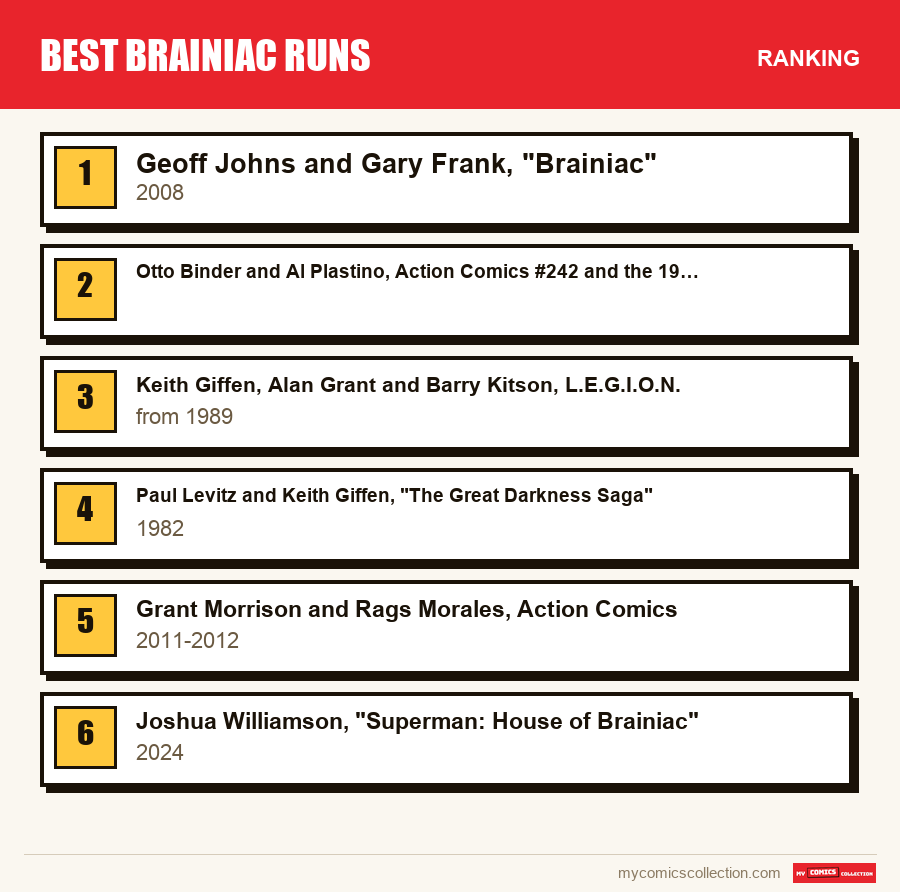
The best Brainiac run is "Brainiac" by Geoff Johns and Gary Frank, published in Action Comics #866 to #870 in 2008, ahead of the founding debuts of 1958 to 1964 and the L.E.G.I.O.N. series launched in 1989. This ranking covers six picks, from the Silver Age to the 2024 offensive, with the recommended format for each: collected edition for reading, original single issue for the historic pieces.
Brainiac has never held a series under his own name for any length of time. The collector of worlds moves from title to title, changes bodies every decade and sometimes leaves the spotlight to his descendants. Ranking his best runs therefore means choosing the moments when the Coluan lineage truly sits at the center of the story, whatever series number it appears in.
As always in this guide, only verified facts (creators, issues, dates) are stated as fact; the analysis is our own, with no reproduction of protected art or dialogue.
Our grid: which version of Brainiac, and how much weight in the story
Brainiac piles up identities: a greenish-skinned alien of the 1950s, the living computer of Colu after 1964, a circus mentalist named Milton Fine in Byrne's reboot, a tentacled entity in Grant Morrison's hands. To keep the ranking readable, each pick was judged on the role of the Coluan lineage in the plot, on how well the story stands alone for a reader who has read nothing before, and on what later writers borrowed from it. Single issues are set aside; the 1958 debuts enter as a founding block.
The rank says nothing about market price. The most expensive of the single issues on the list belongs to the second pick, not the first; we come back to this at the end of the article.
Top 1: Geoff Johns and Gary Frank, "Brainiac" (2008)
Five issues of Action Comics, #866 through #870, that take up a simple question: what if every Brainiac met so far was only a probe? Facing Superman at last stands the original, a navigator who shrinks entire cities; the bottle city of Kandor, the former capital of Krypton, becomes a stake again. Gary Frank gives the character a look that is both old-fashioned and modern, which feeds the adaptations that follow.
It comes first because it ticks all three boxes: the collector of worlds is the subject, the story reads without baggage, and the New Krypton saga, which will occupy the Superman line from 2008, flows directly from it. No prerequisites: a reader who has never opened a Superman comic can dive in. To collect it, the arc's collected edition is enough for reading; the five single issues are easy to gather, with an opening issue, #866, that serves as a landmark for fans of recent milestones. Our Geoff Johns reading path shows where this story sits in the writer's body of work.
Top 2: Otto Binder and Al Plastino, Action Comics #242 and the 1964 reboot
Action Comics #242, dated July 1958, gives birth to Brainiac; the same story reveals Kandor under its glass dome. The story is that of an invader who collects cities to carry them off in reduced scale; Otto Binder writes, Al Plastino draws. With Superman #167 (1964), the origin changes: Brainiac becomes a machine built by the Computer Tyrants of Colu, and Lex Luthor teams up with him for the first time. Between the two, Action Comics #276 (1961) introduces Brainiac 5, a heroic descendant and member of the Legion of Super-Heroes.
This block matters because it fixes the whole vocabulary of the character: the collecting, the miniaturization, the Coluan lineage, the partnership with Luthor that our ranking of the best Lex Luthor runs crosses in turn. It is for the reader ready for the pace and naivety of the Silver Age, or for the one who wants to understand where each motif he will meet later comes from.
On the collecting side, this is the most demanding part. The cover of Action Comics #242 is dominated by a dark background that shows rubbing, which makes high grades rare; restoration is a question to ask before any purchase. To read without that constraint, period anthologies gather these stories. The details of the first appearance are in our entry on Brainiac's first appearance.
Top 3: Keith Giffen, Alan Grant and Barry Kitson, L.E.G.I.O.N. (from 1989)
At the center, Vril Dox II, Brainiac's son, builds a galaxy-wide police force. His lineage passed on the father's calculating mind, but he uses it to enforce order, at the price of methods whose morality is very relative. Keith Giffen and Alan Grant write, Barry Kitson draws; the series begins in 1989, and we don't pin down its last issue, since sources differ on how to divide its various versions.
It lands third because it proves that the Coluan motif can carry an entire series without Superman. Brainiac's son becomes a warlord, a manipulator and sometimes a sympathetic protagonist, which widens the myth well beyond the duel with Kal-El. It is for the team science fiction reader, comfortable with dry humor and galactic politics, and less for the one looking for a classic duel between the hero and his adversary.
For collecting, a long series takes patience; collected editions and omnibuses make the journey practical. In single issues, the set is plentiful with no expensive piece to track, which makes it a pleasant completion project.
Do you collect this series?
Track what you own, what you're missing and what your collection is worth. 7-day trial.
Start my trial →Top 4: Paul Levitz and Keith Giffen, "The Great Darkness Saga" (1982)
The Great Darkness Saga fills Legion of Super-Heroes #290 to #294 in 1982. The adversary is Darkseid, not Brainiac; but the Coluan lineage is the pivot, since Brainiac 5 leads the investigation and carries part of the stakes. Paul Levitz writes, Keith Giffen draws, and together they sustain a story of rare density for a monthly title.
It matters because it shows the heroic version of Coluan intelligence: the brilliance that elsewhere serves to conquer is here put in the service of others, with the weight of lineage. It is for the reader who knows or accepts the Legion, its dozens of members and its codes; it is less accessible than the first pick on the list. We put it fourth because Brainiac is not the sole subject.
In single issues, it is a block of five numbers, a common 1980s format. Period collected editions make it comfortable to read. Count it among the fine pieces of the era for anyone building a Legion collection.
Top 5: Grant Morrison and Rags Morales, Action Comics (2011-2012)
At the 2011 relaunch, Grant Morrison writes the debut of a younger Superman, drawn by Rags Morales. Brainiac returns there as a threat of cosmic scale, in the form of a tentacled entity that reduces Metropolis itself to the status of a specimen. The story reactivates the idea of the collector, but folds it into a hero who hasn't yet learned everything.
It matters for its visual and conceptual reinvention, noticeably stranger than the Johns and Frank version. It is for a reader who can handle the writer's dense narrative structures; our Grant Morrison reading path helps place this series. We give no precise issue numbers for Brainiac's involvement, since the series numbering was relaunched several times.
The collected edition is the logical format, because the chapters interleave with other plots. The first issues of the 2011 series are common in single-issue form; only the variant covers deserve a note in an inventory.
Top 6: Joshua Williamson, "Superman: House of Brainiac" (2024)
The 2024 crossover, driven by Joshua Williamson across the Superman line, launches Brainiac into a galaxy-scale offensive against Superman's inner circle. It is the contemporary version of the character, the one a recent reader will discover.
It closes the list because its impact is still to be measured: there isn't enough hindsight to say what later writers will keep from it. It is for the reader who wants current Brainiac and is willing to follow several series, or to wait for the collected edition. As with any recent issue, the market price is not settled: what will move it is how long the enthusiasm lasts and successive print runs, and we put forward no variant cover ratio for lack of certainty. The major Superman crossovers offer a basis for comparison.
Which one to start with, depending on your profile
You're discovering Brainiac. Open the Johns and Frank collected edition, then move on to New Krypton to see what the arc sets off.
You like the Silver Age. Action Comics #242, Superman #167 and Action Comics #276 form a trilogy of foundations, in anthology form if your budget prefers.
You prefer team science fiction. L.E.G.I.O.N. then The Great Darkness Saga show you the Coluan lineage far from Superman.
You want modern strangeness. Morrison and Morales's Superman precedes Williamson's offensive.
You're unsure about format. Our guide hardcovers or single issues details the cases where each format makes sense.
What these runs are worth in a collection
Value reads as a set of ratios. The first pits age against print run: the pieces of 1958 and 1964 are worth their scarcity in high grade, the sets from 1989 to 2012 their completeness, and those of 2008 and 2024 almost solely their reading. The second ratio pits grade against original condition: on Action Comics #242, the gap between a worn copy and a sharp one is far greater than on any modern issue.
Estimation method: always cross-check a copy against completed sales of the same grade, and never compare a restored copy with an unrestored one. For 2024, expect several months before a market takes shape. Our Brainiac key issues list the milestones involved, and the estimator gives you a starting point for yours.
Frequently asked questions
The "Brainiac" story by Geoff Johns and Gary Frank, published in Action Comics #866 to #870 in 2008. It is complete, requires no prior reading and redefines the character as the original behind all the earlier probes. It continues naturally into the New Krypton saga, within the Superman line.
No, never for any length of time. The character lives in the Superman series, DC crossovers and team titles where his Coluan lineage takes over, for example L.E.G.I.O.N., devoted to Vril Dox II, or the Legion of Super-Heroes, where Brainiac 5 operates. That is why this ranking talks about reading picks.
Brainiac is Superman's adversary, first seen in Action Comics #242 in 1958. Querl Dox, a.k.a. Brainiac 5, descends from the villain and fights alongside the Legion in the 30th century; his first appearance dates from Action Comics #276, in 1961. Same Coluan intelligence, opposite sides.
It isn't essential, but the series sheds light on Brainiac's lineage by following his son Vril Dox II far from Superman. It suits the reader who has already read Johns and Frank and wants to see how the Coluan motif can carry a team story without the traditional duel.
No market price has formed yet for a 2024 issue. Three things will move it: how long the enthusiasm lasts, reprints and any variant covers. Read it in collected form for pleasure, and keep your speculative purchases for pieces with a documented market history.
Do you have a copy of an Action Comics from the Brainiac period, from 1958 to 2008? Compare it with sales of the same grade before making any decision.
Estimate my comic