The best Jackal comics start with The Amazing Spider-Man #147 to #149 (1975), where Gerry Conway and Ross Andru unmask Miles Warren and his clones. Continue with the 1994-1996 Clone Saga, Spider-Island (2011), and Dan Slott and Christos Gage's Dead No More: The Clone Conspiracy (2016-2017). For his debut key issue, look to Amazing Spider-Man #129, cover-dated February 1974.
The Jackal does not strike through strength: he strikes through biology. A professor of Peter Parker's before he was a criminal, Miles Warren turned an academic's grief into a machine for making doubles, and every generation of Spider-Man writers has ended up returning to his laboratory. This guide ranks six reads, from the 1975 loop to the 2016-2017 clone saga, so you know where to start and what to hunt for in single issues.
As always in this guide, we state only verified facts (creators, issue numbers, dates); the analysis is our own, with no reproduction of protected art or dialogue.
His first appearance
The character is born in two stages. Miles Warren precedes his masked double by eight years: The Amazing Spider-Man #31 (December 1965) shows him as a teacher, under Steve Ditko's art and Stan Lee's pen, with nothing that hints at a criminal. The mask, for its part, is born in issue #129 of the same series, in February 1974, with Gerry Conway on script and Ross Andru on art. That issue also introduces the Punisher, hence very strong demand; our guide to the value of Amazing Spider-Man #129 covers that side.
For a reader who cares about the Jackal rather than the Punisher, this issue reads like a calling card: a masked manipulator who does not act himself, but pays someone else to go after Spider-Man. The identity of the man behind the mask stays hidden for a long time. It is only revealed in the summer and fall of 1975, in the issues that tell the first clone story, and that is what gives the character his true dimension.
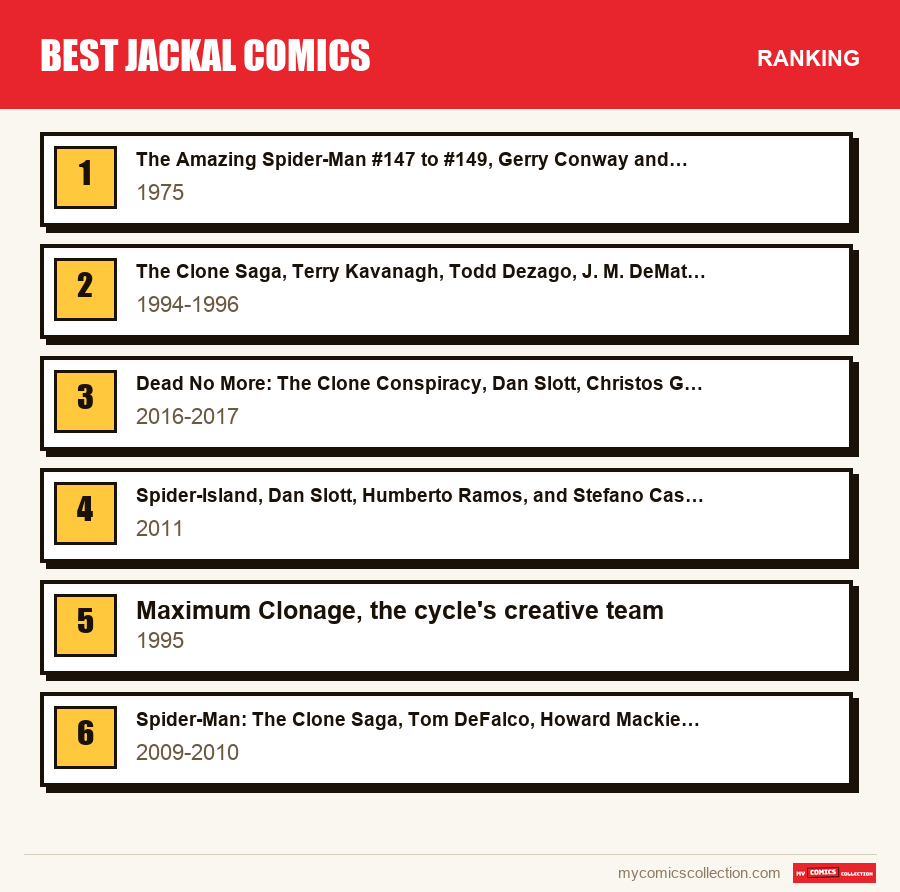
1: The Amazing Spider-Man #147 to #149, Gerry Conway and Ross Andru (1975)
This is the founding text. Gerry Conway, who had killed Gwen Stacy in Amazing Spider-Man #121, imagines here what becomes of a man who outlives her and looks for someone to blame. The clone arc runs from August to October 1975; issue #149, dated October, is drawn inside by Ross Andru, with a Gil Kane pencil cover. Miles Warren, Peter Parker and Gwen's biology professor, appears there as the Jackal. He has had a replica of Gwen made, he kidnaps Spider-Man and Ned Leeds, and he stages a final showdown at Shea Stadium, where Spider-Man finds himself facing a double of himself, while Ned is tied to a bomb.
What this arc brings to the character is considerable: it moves him from the run-of-the-mill thug to the methodical avenger, driven by a grief he transfers onto the hero. It also raises the question that will haunt decades of stories: which of the two Peters is the original? At the end of issue #149, Peter himself wonders. The story suits any Spider-Man reader, since it requires no prior reading apart from issue #121 for context, and it reads in three single issues. To read it without chasing the originals, turn to the collections devoted to the Conway and Andru cycle, which reprint these issues in order.
2: The Clone Saga, Terry Kavanagh, Todd Dezago, J. M. DeMatteis, Tom DeFalco, and others (1994-1996)
Twenty years later, the Jackal returns to the spotlight with a long and much-debated cycle. The clone appears at the end of The Spectacular Spider-Man #216 (September 1994), written by Tom DeFalco and Todd Dezago, then Web of Spider-Man #117 (October 1994) officially launches the saga, which ends in Spider-Man #75 (December 1996) with the "Revelations" episode. Terry Kavanagh proposed the clone idea, J. M. DeMatteis developed the plot, Todd Dezago and Howard Mackie wrote part of it, and the editors in charge were Tom DeFalco, Bob Budiansky, and Bob Harras. The episodes are spread across the Amazing, Spectacular, Web of, and Spider-Man titles, which advance the plot side by side.
The Jackal serves as a driving force there: The Amazing Spider-Man #394, dated October 1994, marks the return of the real Miles Warren, and the saga then establishes that the Jackal who died at Shea Stadium in 1975 was himself only a clone. This twist gives the saga its real subject for an attentive reader: the Jackal is less a character than an idea, that of an original who can be replaced. Get the collections instead: twenty-seven months of crossed releases are hard to follow in single issues. It suits the patient reader, and our guide to the Clone Saga key issues gives the order.
3: Dead No More: The Clone Conspiracy, Dan Slott, Christos Gage, and Jim Cheung (2016-2017)
This is the read that puts the Jackal most clearly at the center. Dan Slott and Christos Gage write, Jim Cheung draws the main series, with R. B. Silva, Giuseppe Camuncoli, Jamal Campbell, and Irene Strychalski on some episodes. The Clone Conspiracy runs five issues, dated December 2016 to April 2017, preceded by The Amazing Spider-Man (volume 4) #16 to #19 and accompanied by tie-ins: The Amazing Spider-Man #20 to #24, Prowler (volume 2) #1 to #5, and Silk (volume 2) #14 to #17, then the one-shot Omega.
The Jackal offers Spider-Man's enemies the chance to bring back their dead as clones; the series features Rhino, the Lizard, Doctor Octopus, and an Electro. Miles Warren is the mind behind the cloning process, and the story focuses on what that promise costs those who accept it. We reveal neither the identity of the man under the mask nor the outcome, since the series rests on those surprises. It suits the modern reader who knows the broad strokes of the Clone Saga, and it reads best after the 1975 arc and after the 1990s saga, whose vocabulary it reuses.
4: Spider-Island, Dan Slott, Humberto Ramos, and Stefano Caselli (2011)
The 2011 event makes the Jackal its architect. Dan Slott writes, with Humberto Ramos and Stefano Caselli on art. The main plot runs from The Amazing Spider-Man #666 to #673, after companion stories titled "Infested" that ran in issues #659, #660, and #662 to #665. The Jackal's experiments, first shown in those backups, spread spider powers across Manhattan; he recruits criminals with those powers and supplies them with Spider-Man outfits. He works for a mysterious backer, the Spider-Queen, and the story ends up shedding light on what he really is.
What Spider-Island brings to the character is scale: the Jackal no longer threatens a hero or a neighborhood, but an entire city. The story suits those who want to see the character in a large-scale spectacle rather than an intimate drama. Expect many tie-ins, among them Venom (volume 2) #6 to #8 and several miniseries, but the core reads in the parent series. Our page on Dan Slott places this period within his work.
Do you collect this series?
Track what you own, what you are missing and what your collection is worth. 7-day trial.
Start my trial →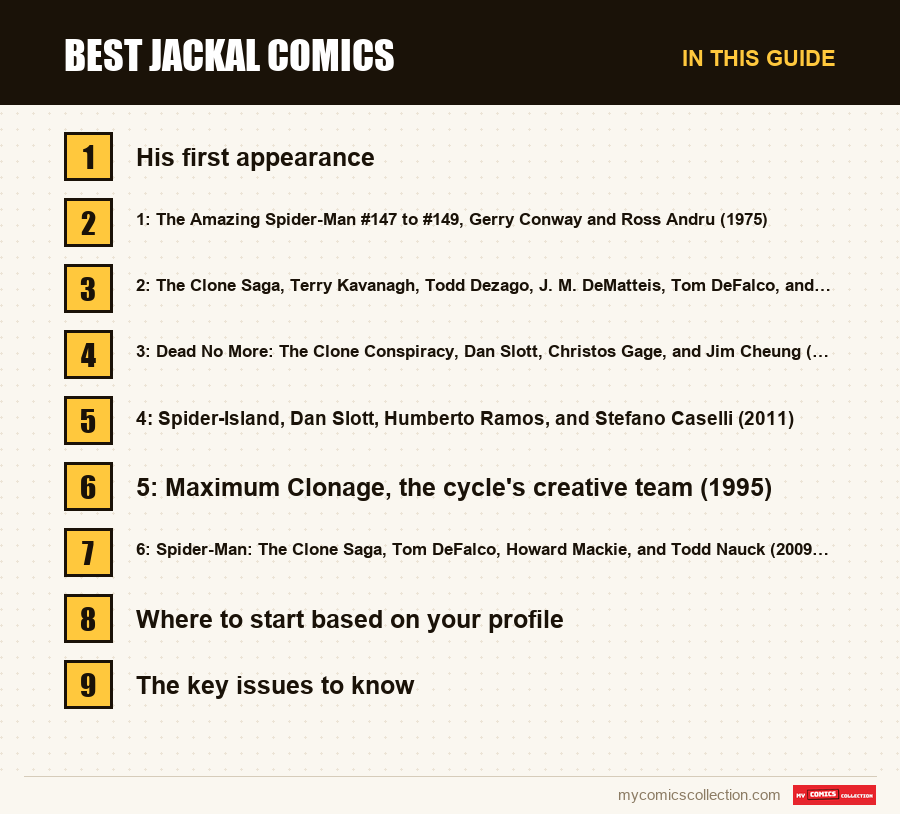
5: Maximum Clonage, the cycle's creative team (1995)
In the middle of the Clone Saga, one sub-event deserves its own entry. Bob Budiansky, then editor in chief of the Spider-Man line, commissioned Maximum Clonage by borrowing the spread-out structure of the Age of Apocalypse crossover, with new clones introduced in nearly every issue. The cycle brings together Spider-Man: Maximum Clonage Alpha #1, Maximum Clonage Omega #1, as well as chapters in The Amazing Spider-Man #404, Web of Spider-Man #127, Spider-Man #61, and The Spectacular Spider-Man #227. It is written by many hands, those of the team that carries the whole saga. Around the same time came the one-shot Spider-Man: The Jackal Files #1, which reads on the margins of the cycle.
For a collector, the cycle's appeal lies in how it is divided: The Jackal Files is a one-shot devoted to the character, and it reads like a dossier rather than a chapter. To read it without hunting down every single issue, the Epic Collection volume that gathers Maximum Clonage spares you the chase for scattered issues. The cycle suits those who have already read the general saga and want to linger on the moment the cloning project changes scale.
6: Spider-Man: The Clone Saga, Tom DeFalco, Howard Mackie, and Todd Nauck (2009-2010)
The 2009 miniseries is a retelling by two men who had taken part in the original cycle. Tom DeFalco and Howard Mackie write, Todd Nauck draws. The collection, titled Spider-Man: The Real Clone Saga, came out in June 2010. The aim is clear: to take the 1994-1996 material as its architects would have wanted to tell it, without the editorial padding that weighed down the original.
This read comes last because it assumes you know the starting version. It interests readers curious to see how the Jackal and his clones play out in one short volume, and collectors completing a shelf devoted to the cycle. It brings no new key issue to collect, but it serves as a counterpoint to the 1994 saga.
Where to start based on your profile
If you are new to the character, start with The Amazing Spider-Man #147 to #149: three issues, a beginning, a middle, and an end. You get the complete Jackal there, with his motive and his downfall, without having to know thirty years of continuity. If you feel like going further, follow up with Dead No More: The Clone Conspiracy, which reads almost like a spiritual sequel.
If you collect single issues, look first at The Amazing Spider-Man #129 and #31, then at Web of Spider-Man #117. Issue #129 draws its demand from the Punisher as much as from the Jackal; issue #31, from Professor Warren; #117, from the start of the Clone Saga. Three single issues, three reasons to buy: the reason for the demand should guide your choice of grade.
If you like clone sagas, read the 1994 Clone Saga first in collected form, then Maximum Clonage, then the 2009 retelling. If you prefer recent events, start from Spider-Island for the scale, then move to The Clone Conspiracy for the intimate side. Keep in mind the difference in method between the eras: 1975 plays the reveal of an identity, 2016 the scope of a cloning enterprise.
The key issues to know
The list follows publication order, not value. The Amazing Spider-Man #31 (December 1965) is the appearance of Miles Warren as a professor, by Stan Lee and Steve Ditko. The Amazing Spider-Man #129 (February 1974) is that of the Jackal, by Gerry Conway and Ross Andru, and of the Punisher. For the reveal of Miles Warren and the battle at Shea Stadium, keep the #147 to #149 sequence of Amazing Spider-Man, from August to October 1975.
The Spectacular Spider-Man #216 (September 1994) shows the clone, and Web of Spider-Man #117 (October 1994) officially opens the saga. The Amazing Spider-Man #394 (October 1994) marks the return of the real Jackal to the heart of the saga. The Amazing Spider-Man #666 opens Spider-Island in 2011, and The Clone Conspiracy #1 (December 2016) opens the 2016-2017 cycle.
To price a copy, do not look for an absolute benchmark: take condition as the main variable, compare sold listings of issues at the same grade, and separate the demand tied to the Punisher in issue #129 from that tied to the character. Our Spider-Man key issues page helps place these single issues in the whole.
Frequently asked questions
The Jackal is the criminal identity of Miles Warren, biology professor of Peter Parker and Gwen Stacy. He creates clones, including a replica of Gwen and a double of Spider-Man. His role expanded after 1975, and several sagas rest on his cloning work, from the Clone Saga to The Clone Conspiracy.
Look for The Amazing Spider-Man #129 for the mask (February 1974, Conway and Andru). The face of Miles Warren, a mere teacher, is found as early as #31 (December 1965, Lee and Ditko). Both count for a collector, each for its own reason.
No. The 1975 arc, The Amazing Spider-Man #147 to #149, is enough to understand the character. The 1994-1996 Clone Saga spreads across four series and more than two years; read it in collected form, for the saga itself rather than for the Jackal, who is only one of its driving forces.
The Jackal created Ben Reilly, a clone of Peter Parker. Ben opens the Clone Saga in his Scarlet Spider costume with Web of Spider-Man #117, dated October 1994. The key issues of Ben Reilly and Kaine are detailed in the guide linked above.
For scale, Dan Slott's Spider-Island (2011); for the intimate side, Dan Slott and Christos Gage's Dead No More: The Clone Conspiracy (2016-2017), which puts the Jackal at the center of five main issues and many tie-ins. Both read after the 1975 arc.
Do you have an Amazing Spider-Man #129 or a Clone Saga issue in hand? Get an estimate before deciding whether to keep it or sell it.
Estimate my comic