
The best Deathlok comics start with Astonishing Tales #25 (August 1974), where Rich Buckler and Doug Moench launch Luther Manning. From there, move to the 1990 Deathlok miniseries, which introduces Michael Collins under Dwayne McDuffie and Gregory Wright. Continue with the 1991 ongoing series, the 1999 Deathlok series about Jack Truman, and the 2014 series about Henry Hayes. Each era has its own Deathlok.
A cyborg whose brain lives inside a machine body, with a computer that comments on his every move: the premise dates to 1974, but it has served five creative teams and at least four different bearers of the same name. As a result, the "Deathlok" label does not describe a single continuity. This guide ranks six reads so you can pick your entry point by era and by the character who interests you.
As always in this guide, only verified information (creators, issues, dates) is stated as fact; the analysis is ours, with no reproduction of protected pages or dialogue.
His first appearance
Luther Manning, the first Deathlok, debuts in Astonishing Tales #25, cover-dated August 1974. Rich Buckler is the creator: he supplied the concept, the story plan and the art. Doug Moench wrote the script for the early issues. The issue presents a soldier turned into a cyborg in a war-torn future, and his antagonist, Major Simon Ryker, demands super-soldiers.
The storytelling device is this issue's great find: Manning's human voice and the machine's voice argue in the caption boxes, like two speakers locked inside the same skull. Later writers will keep this mechanic, even when they change heroes.
What to remember as a collector: issue #25 is the historic gateway to the whole name, and it belongs to Bronze Age output, as our page on the ages of comics explains. Copies live mostly by their condition, because the staples and paper of the period age poorly.
For this ranking, one rule: we only include stories where a Deathlok is the center of the narrative. Guest spots in team books or crossovers are mentioned further down in their proper place, without being ranked.
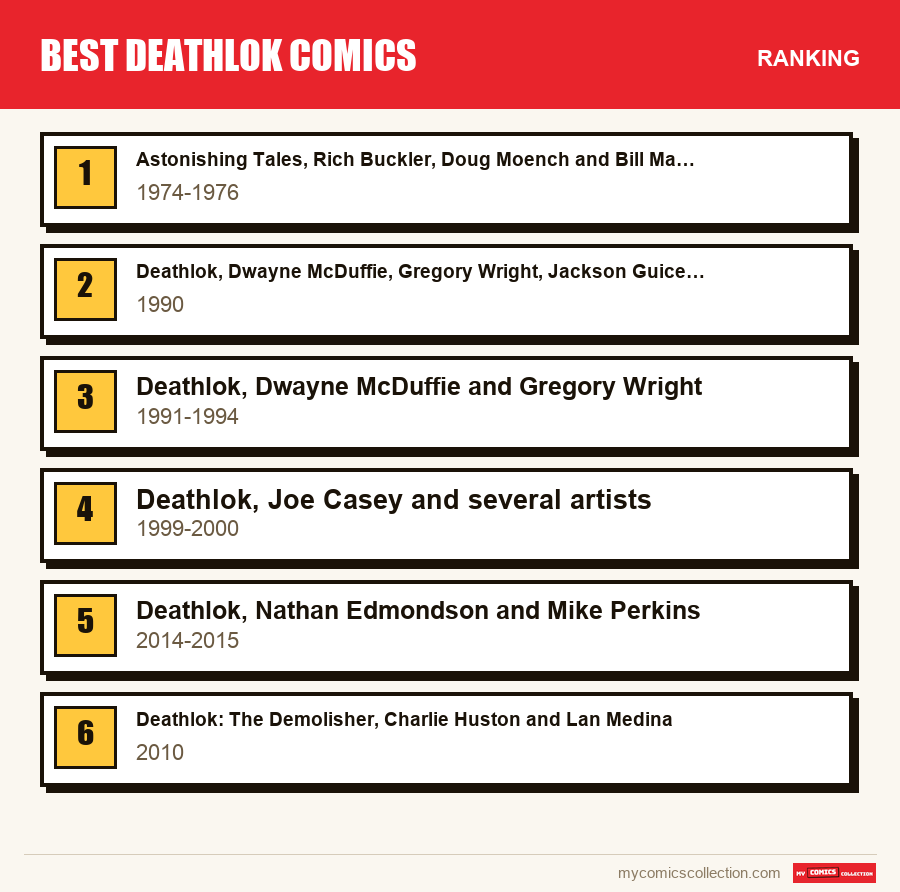
1: Astonishing Tales, Rich Buckler, Doug Moench and Bill Mantlo (1974-1976)
Luther Manning's series runs in Astonishing Tales #25 to 28, then #30 to 36, from August 1974 to July 1976, with issue #29 not part of the series. Buckler conceives and draws, Moench writes at the start, and Bill Mantlo takes over the script for the end of the series, through issue #36. The interrupted story finds its conclusion in Marvel Spotlight #33, dated April 1977.
What these issues set for every Deathlok to come is a framework: a soldier brought back to life in a machine body, a future war, and the constant quarrel with the computer that pilots him. Manning is nicknamed the Demolisher here, and the nickname will follow him.
It is aimed at the reader who loves the Bronze Age, with its dense narration and spectacular covers. To read it, favor the collected edition Marvel Masterworks: Deathlok, which gathers the Astonishing Tales issues and several nearby appearances, rather than chasing ten scattered single issues.
2: Deathlok, Dwayne McDuffie, Gregory Wright, Jackson Guice and Denys Cowan (1990)
This four-issue miniseries, dated July to October 1990, introduces another man under the armor: Michael Collins, a Philadelphia professor and pacifist who works for Cybertek, the cybernetics arm of Roxxon. Dwayne McDuffie and Gregory Wright write it. Jackson Guice, co-creator of Collins, and Denys Cowan handle the art.
The plot choice is bold: Collins's brain is placed in the cyborg body of John Kelly on Harlan Ryker's initiative, and he ends up installing in the machine an order that forbids it to kill. This is no longer a sacrificed soldier, but a civilian who refuses the violence grafted onto him. The miniseries was reprinted in 1991 under the title Deathlok Special.
If you could only read one, it would be this: it is short, self-contained, and readable without knowing anything about 1974. Look for the trade paperback Deathlok: The Living Nightmare of Michael Collins, which collects the four issues.
3: Deathlok, Dwayne McDuffie and Gregory Wright (1991-1994)
The ongoing series extends the miniseries with 34 issues, from July 1991 to April 1994, plus Annuals in 1992 and 1993. McDuffie and Wright share the writing, sometimes together, sometimes each alone: McDuffie focuses on Collins's character, Wright on his place in the wider Marvel universe, which gives the series two tones that answer each other poorly.
The series piles on guest stars, among them the X-Men, the Fantastic Four and Ghost Rider. Issues #28 and #29 tie into the Infinity Crusade crossover, and the moment that most interests a collector is the return of Luther Manning in the final stretch, through issue #34.
It suits the reader who enjoyed the miniseries and wants to see the character as an ongoing series, digressions included. Read the first third, up to the guest stars, then jump to the end of the series, through issue #34, for Manning's return.
4: Deathlok, Joe Casey and several artists (1999-2000)
The 1999 Deathlok series runs eleven issues, from September 1999 to June 2000, and features neither Manning nor Collins. Jack Truman, a former S.H.I.E.L.D. agent, holds the title role; Joe Casey and José Ladrönn had introduced him under his civilian name in Cable #59, dated August 1998. Casey writes the series, and Leonardo Manco is among its artists.
This entry is the furthest from the previous two: espionage replaces war, and the hero comes out of a mission to capture Cable that nearly cost him his life.
It is aimed at the reader who likes Marvel spy thrillers from the turn of the 2000s, and at the one who follows characters tied to Cable. Read it in one go: the eleven issues form a whole, and the trade paperback Deathlok: Rage Against the Machine adds the Cable issues that set it up.
Do you collect this series?
Track what you own, what you are missing and what your collection is worth. 7-day trial.
Start my trial →
5: Deathlok, Nathan Edmondson and Mike Perkins (2014-2015)
Henry Hayes is born in Original Sins #1 (June 2014), by Nathan Edmondson and Mike Perkins, before getting his own series in fall 2014, running ten issues. Edmondson writes it and Perkins draws it. This is a contemporary espionage Deathlok, closer to a nervy action film than to the war science fiction of 1974.
The series has the advantage of being readable with no prior knowledge: the character introduces himself along the way, and the ten issues are split across two trade paperbacks, Control. Alt. Delete. (issues #1 to 5, with Original Sins #1) and Man Versus Machine (issues #6 to 10).
It suits the reader who discovers the name through the screen and wants a recent, short thread. Read the two volumes in order; the first sets up the premise, the second puts it under strain.
6: Deathlok: The Demolisher, Charlie Huston and Lan Medina (2010)
The Marvel Knights Deathlok series, seven issues published in 2010, is written by Charlie Huston and drawn by Lan Medina. It puts Luther Manning back on stage, but in a near future where war is a television spectacle, and Manning once again becomes the soldier who is sacrificed on camera.
It is a reinterpretation and not a sequel: it does not continue the story of the 1970s. Its interest is the satire of sports entertainment, which takes up the theme of the expendable soldier and moves it to television. The tone is more caustic than in Astonishing Tales, and the result divides readers.
Reserve it for the reader who already knows the character's origin and enjoys cynical reinterpretations. The trade paperback Deathlok: The Demolisher collects all seven issues.
Where to start based on your profile
For an entry with no preparation, start with the 1990 miniseries, short and complete. If you prefer sources, first read the collected edition of the 1974 issues, then come back to Collins: you will see what McDuffie and Wright changed by making the hero a civilian rather than a colonel.
The reader drawn to espionage will head for Jack Truman, then Henry Hayes, two series with no link between them. The one looking for satire will take Huston's version. As for the Bronze Age collector, they will concentrate on the 1974 to 1977 issues and on the Captain America #286 to 288 crossover, dated October to December 1983.
A word on guest appearances: in Uncanny X-Force #5 to 7, the Deathlok Nation arc, Deathloks are the team's adversaries rather than the heroes; we therefore left it out of the ranking, but our page on X-Force places it within Rick Remender's series.
The key issues to know
The list follows the logic of one turning point per character. Astonishing Tales #25 (August 1974) gives us Luther Manning. It is followed by Marvel Team-Up #46 (June 1976), where Manning crosses paths with Spider-Man, and by Marvel Spotlight #33 (April 1977), which wraps up the Astonishing Tales serial. Captain America issues #286 to 288 (October to December 1983) form the main thread of the 1980s.
For Collins, Deathlok #1 of 1990 (July 1990) is the entry point, and the 1991 series saves its last issues for Manning's return. For Truman, look for Cable #59 (August 1998), then Deathlok #1 of September 1999. For Hayes, Original Sins #1 (June 2014) opens the door before the series. Another figure, Rebecca Ryker, known as Death Locket, is born in Avengers Arena, a series by Dennis Hopeless and Kev Walker.
Our buying method is consistent: for each character, one first appearance, one relaunch single issue and one reading trade paperback. Avoid hunting down every guest-appearance issue. Compare several copies of the same issue, check the condition of the staple and the period paper, and only settle on sold listings of comparable single issues.

Frequently asked questions
The first is Luther Manning, who appeared in Astonishing Tales #25, cover-dated August 1974, created by Rich Buckler with Doug Moench on the script. He is presented as a soldier turned into a cyborg in a war-torn future. Every later bearer takes up his name, but not his personal story.
The four-issue 1990 Deathlok miniseries by Dwayne McDuffie and Gregory Wright, with Jackson Guice and Denys Cowan on art. It stars Michael Collins, reads on its own and requires no prior knowledge of the 1974 version. A trade paperback collects it under the title The Living Nightmare of Michael Collins.
At least four main bearers: Luther Manning (1974), Michael Collins (1990), Jack Truman (1998-1999) and Henry Hayes (2014). Other characters carry the name or the armor, like Death Locket, but these four each have their own series. Each belongs to a distinct period and creative team.
No, because these series do not form a single continuity. The stories of Manning, Collins, Truman and Hayes can be read separately. Only the 1991 series links two of them, with Manning's return in its last issues. Pick one character, read his series, then move on to the next.
The most iconic is Astonishing Tales #25 (August 1974), the first appearance of Luther Manning. Next come Deathlok #1 of 1990 for Collins and Cable #59 of 1998 for Truman. For each, start from condition and from sold listings of comparable single issues, never from an asking price.
Do you own Astonishing Tales #25 or the 1990 Deathlok miniseries? Get a ballpark value before you decide.
Estimate my comic