
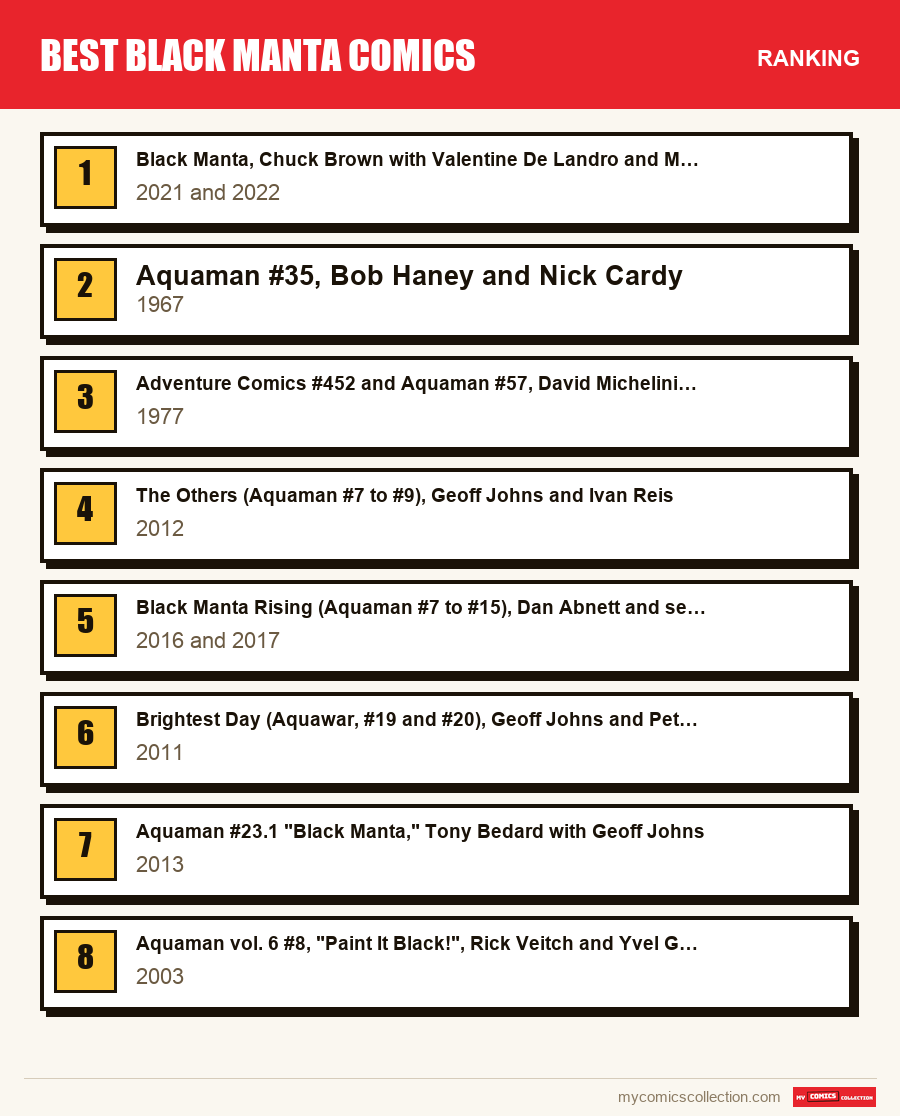
To find the best Black Manta comics, start with Chuck Brown's Black Manta miniseries (2021 and 2022), which puts him at the center of the story, then go back to Aquaman #35 (1967), his first appearance by Bob Haney and Nick Cardy. Follow with Adventure Comics #452 (1977), the darkest chapter of his early years, then Geoff Johns and Ivan Reis's The Others arc (2012) and Dan Abnett's Black Manta Rising (2016 and 2017).
Black Manta is one of those villains whose strength comes less from the costume than from sheer stubbornness. A full helmet, a dark suit, and above all a grudge that runs through sixty years of comics: he hates Aquaman, and every generation of writers has gone looking for what feeds that hatred. The stories that give him the most room are not always the ones where he hits hardest, but the ones that give him a past, a son, a reason. This guide ranks eight of them, with what each one brings and how to read it.
As always in this guide, only verified facts (creators, issue numbers, dates) are stated; the analysis is our own, with no reproduction of protected art or dialogue.
His first appearance
Black Manta debuts in Aquaman #35, cover-dated 1967, in a story titled "Between Two Dooms!" It is written by Bob Haney and drawn by Nick Cardy. The issue introduces an adversary with no mythology yet: at this point Manta is a brand-new enemy, and the reader knows nothing about his past.
For collectors, keep two things in mind. First, this single issue is the anchor for everything that follows, and it is the only issue from the period you would hunt down for its own sake. Second, read it for what it is, a Silver Age adventure, rather than as a psychological drama. The nuances come ten years later, and then much later still.
1: Black Manta, Chuck Brown with Valentine De Landro and Matthew Dow Smith (2021 and 2022)
This miniseries is the best way in for a new reader: six issues are enough to wrap up the plot, with no need to know anything about Atlantis. Chuck Brown writes a book where Manta is no longer someone else's villain but the protagonist. Valentine De Landro draws the first issues and Matthew Dow Smith takes over for the rest, which gives the whole run two successive looks. The sixth and final issue, "Assassin of the Sea," closes out the plot and sets up the launch of Aquamen #1.
The opening stakes are concrete: Manta hunts a rare and valuable metal, and runs into Torrid, a rival after the same target. Later, the series pits him against Devil Ray, whose ambitions threaten Atlantis, which forces him to act to protect what he has always attacked. The story asks him to own his past, his power, and his flaws, and that is what makes it a good read for understanding the character without knowing twenty volumes of Aquaman.
Who is it for? Anyone who wants a self-contained story and an ambiguous protagonist. How should you read it? Straight through, over a weekend, then go back to the stories that built him.
2: Aquaman #35, Bob Haney and Nick Cardy (1967)
The founding issue reads in under half an hour and shows what Manta was at the start. Haney sets up an adversary who will return, and the next issue in which Manta appears is #42, which shows he settles into the series quickly. Nick Cardy is the artist.
This issue is for readers who like going back to the source, and for those who collect first appearances. It reads on its own. The most useful move is to pair it with the analysis of the first Aquaman series, which places the title in its timeline, and with the profile of the major artists of the series for Cardy's role.
3: Adventure Comics #452 and Aquaman #57, David Michelinie and Jim Aparo (1977)
The second half of the 1970s is when Manta's hatred stops being a mere plot device. In Adventure Comics #452, "Dark Destiny, Deadly Dreams," David Michelinie writes and Jim Aparo draws one of the harshest stories of the era: Aquaman's infant son, nicknamed Aquababy, dies after Manta's gang seizes a city and captures Aqualad, then Aquaman himself. The story continues in Aquaman #57, "A Life for a Life," also written by Michelinie and drawn by Aparo.
What this two-parter brings is decisive: it makes Manta's hatred mutual. From this story on, the conflict is no longer a hero against a mercenary, but two men, one of whom has lost a child. Jim Aparo draws both issues. Our page on Jim Aparo comics details his career.
This story is for the reader ready for a dark read. It reads as two consecutive issues, #452 then #57, and needs no other preparation. For the place of these years in the series, see the Aquaman Bronze Age key issues.
4: The Others (Aquaman #7 to #9), Geoff Johns and Ivan Reis (2012)
After the 2011 relaunch, Geoff Johns and Ivan Reis rebuild Aquaman from the ground up. In the The Others arc, Manta returns in the current continuity in issue #7, appears in a flashback in #8, and takes the role of adversary in #9. Ivan Reis draws all three issues, with inks by Joe Prado at first, then in #9 by Reis himself with Oclair Albert and Andy Lanning.
The strength of the arc lies in how Johns puts Manta back into the hero's modern mythology: he is no longer a passing enemy but an adversary who matters to the story, and issue #9 names him as the villain of the chapter. The reader gets an updated version of the antagonist, designed for the series' fresh start.
This read suits anyone who wants modern Aquaman, even without knowing the earlier decades. Read it after Johns's first arc, and the Geoff Johns career overview helps place his work on the character.
5: Black Manta Rising (Aquaman #7 to #15), Dan Abnett and several artists (2016 and 2017)
The Rebirth era relaunches the series in 2016 with Dan Abnett on script. The collected edition Aquaman Vol. 2: Black Manta Rising gathers issues #7 to #15 of the series, and it makes Manta one of the engines of the plot. The art is shared: Scot Eaton and Philippe Briones are among the artists, alongside others.
The reader finds a Manta mixed up in the schemes of N.E.M.O. and the war threatening Atlantis. In issue #15, "The Deluge, Finale," he faces Aquaman and his Atlantean army in the final showdown, alongside N.E.M.O.'s forces. The volume reads like one long ongoing-series arc: you don't see Manta alone, but a coalition of threats whose face he is.
It is for the reader who wants to follow Rebirth-era Aquaman and understand where Manta stands among his enemies. Read the series' first volume first to set the context, then this trade paperback.
Do you collect this series?
Track what you own, what you are missing and what your collection is worth. 7-day trial.
Start my trial →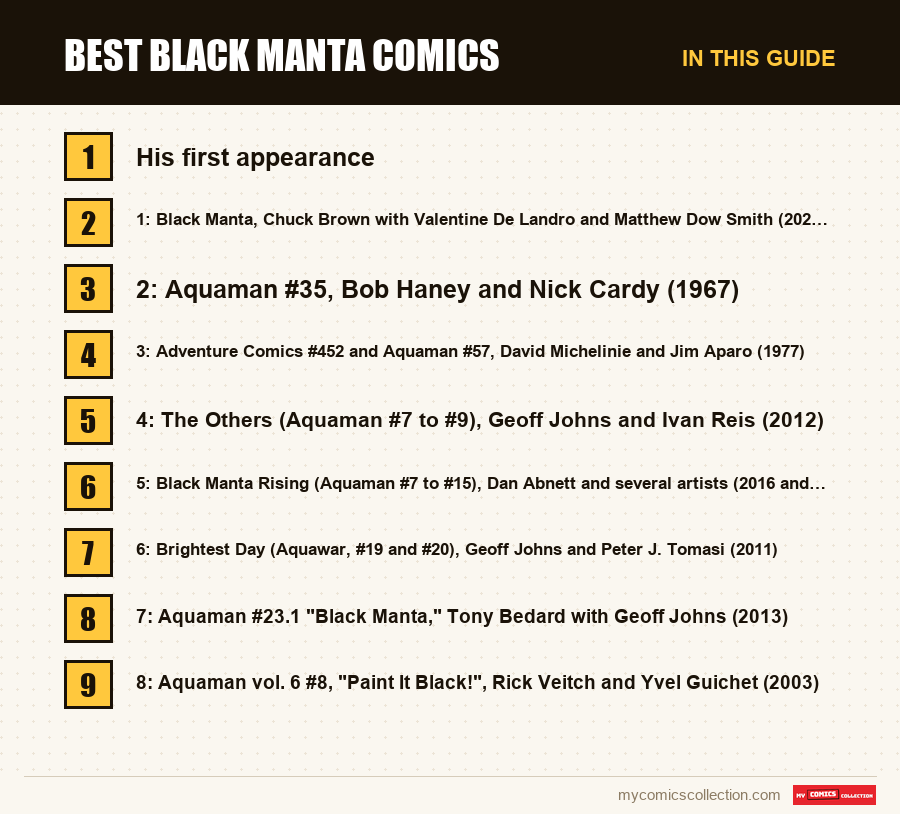
6: Brightest Day (Aquawar, #19 and #20), Geoff Johns and Peter J. Tomasi (2011)
In the Brightest Day series, written by Geoff Johns and Peter J. Tomasi with several artists, Manta finds a new angle: he is the father of Jackson Hyde, the new Aqualad, who first appeared in issue #4. Issues #19 and #20, which form the Aquawar two-parter, stage this family clash between Manta and the young hero, with Aquaman and Mera on the opposing side.
What this story brings is a Manta seen as a father. The grudge against Aquaman is joined by a relationship with a son who chose the other side, and that shift gives the character new depth. The whole series is an ensemble saga: Manta is not its subject, but these two issues belong to him.
This two-parter will speak mostly to readers who already follow Manta and want to know what becomes of his son Jackson. For the broader context, the guide to Aquaman crossovers recalls how the series interacts with DC's events.
7: Aquaman #23.1 "Black Manta," Tony Bedard with Geoff Johns (2013)
This one-shot belongs to the fall 2013 Villains Month initiative, tied to Forever Evil. Tony Bedard writes, from a plot by Bedard and Geoff Johns, and the interior art is by Jean-Claude St. Aubin. The story isolates Manta, fed by flashback memories, at the moment he learns that Aquaman may be dead and wonders how to carry on his revenge.
It is a small story, but it is interesting for asking a question rarely asked: what becomes of a man whose enemy disappears? It reads in a few minutes and suits those who want to round out the portrait after The Others. It is not a recommended place to start.
8: Aquaman vol. 6 #8, "Paint It Black!", Rick Veitch and Yvel Guichet (2003)
In the early 2000s, Rick Veitch writes an Aquaman series, and issue #8, "Paint It Black!", is drawn by Yvel Guichet and inked by Mark Propst. Manta arrives gravely wounded and Aquaman heals him, which reverses the usual relationship. The issue also revisits the character's childhood, with scenes that predate his 1967 appearance.
It offers a more inward view of the character. It is for readers who enjoy offbeat stories and already know Manta; it is not for a first encounter, because its effect depends on the contrast with the classic image of the villain.
Where to start based on your profile
To step into Manta's world in a single move, pick up Chuck Brown's Black Manta miniseries: six issues, nothing to know beforehand. If you prefer origins, read Aquaman #35, then the 1977 two-parter, Adventure Comics #452 and Aquaman #57.
If you follow Aquaman in order, go through The Others by Johns and Reis, then Black Manta Rising to see the character within the Rebirth era. The Aquaman reading guide puts these steps back in publication order.
If you collect, focus on the issues that are turning points: the 1967 first appearance, the 1977 story that fixes the grudge, and the 2010 to 2011 issues that tie Manta to Jackson Hyde. The rest of the stories are easy to find in collected editions.
The key issues to know
These ten markers chart Black Manta's career, from Bob Haney to Chuck Brown. No value is quoted: a copy is judged by comparing completed sales of single issues in the same grade.
- Aquaman #35 (1967): Black Manta's debut, written by Bob Haney and penciled by Nick Cardy.
- Adventure Comics #452 (1977): "Dark Destiny, Deadly Dreams," by David Michelinie and Jim Aparo, the death of Aquaman's son.
- Aquaman #57 (1977): "A Life for a Life," the sequel to the previous story.
- Aquaman vol. 6 #8 (2003): "Paint It Black!", by Rick Veitch and Yvel Guichet.
- Brightest Day #4 (2010): first appearance of Jackson Hyde, Manta's son turned Aqualad.
- Brightest Day #19 and #20 (2011): Aquawar.
- Aquaman #7 to #9 (2012): The Others, by Geoff Johns and Ivan Reis.
- Aquaman #23.1 (2013): the Villains Month issue devoted to Manta.
- Aquaman #7 to #15 (2016 and 2017): Black Manta Rising, by Dan Abnett.
- Black Manta #1 to #6 (2021 and 2022): Chuck Brown's miniseries.
For each single issue, check the sharpness of the corners, the condition of the spine, and the whiteness of the paper, because issues from the 1960s and 1970s age badly. Recent stories, by contrast, are plentiful and are judged mostly on grade. To put these issues in perspective, also browse the historical overview of Aquaman.
Frequently asked questions
Black Manta debuts in Aquaman #35, cover-dated 1967, in a story titled "Between Two Dooms!" It is written by Bob Haney and drawn by Nick Cardy. Everything in Manta's career flows from this issue, which reads in half an hour.
Chuck Brown's Black Manta miniseries (2021 and 2022) is the simplest choice: six issues, one complete story, no prerequisites. If you prefer origins, read Aquaman #35 (1967) first, then the Adventure Comics #452 and Aquaman #57 two-parter (1977).
The grudge is built in layers. The 1970s make it mutual with the death of Aquaman's son in Adventure Comics #452 (1977). The 2000s and 2010s enrich it through the character's childhood under Rick Veitch and his role as a father under Geoff Johns and Peter J. Tomasi in Brightest Day.
In Brightest Day, written by Geoff Johns and Peter J. Tomasi, Black Manta is the father of Jackson Hyde, the new Aqualad, who appears in issue #4 (2010). The Aquawar two-parter (#19 and #20, 2011) stages their clash, with Aquaman and Mera on the young hero's side.
The collected edition Aquaman Vol. 2: Black Manta Rising gathers issues #7 to #15 written by Dan Abnett, with Scot Eaton, Philippe Briones, and other artists. Read the series' first volume first to set the context, then this trade paperback, which makes Manta one of Atlantis's great threats.
Do you own a 1960s or 1970s Aquaman featuring Black Manta? A free estimate tells you where it stands.
Estimate my comic