
To find the best Bishop comics, start with his debut in The Uncanny X-Men #282 (November 1991) by John Byrne and Whilce Portacio, his first appearance, then issue 283 where he takes over the story. Follow with the Bishop miniseries (1994) by John Ostrander and Carlos Pacheco, then Messiah Complex (2007-2008), the story that makes him a child hunter. Recent readers can finish with Bishop: War College (2023).
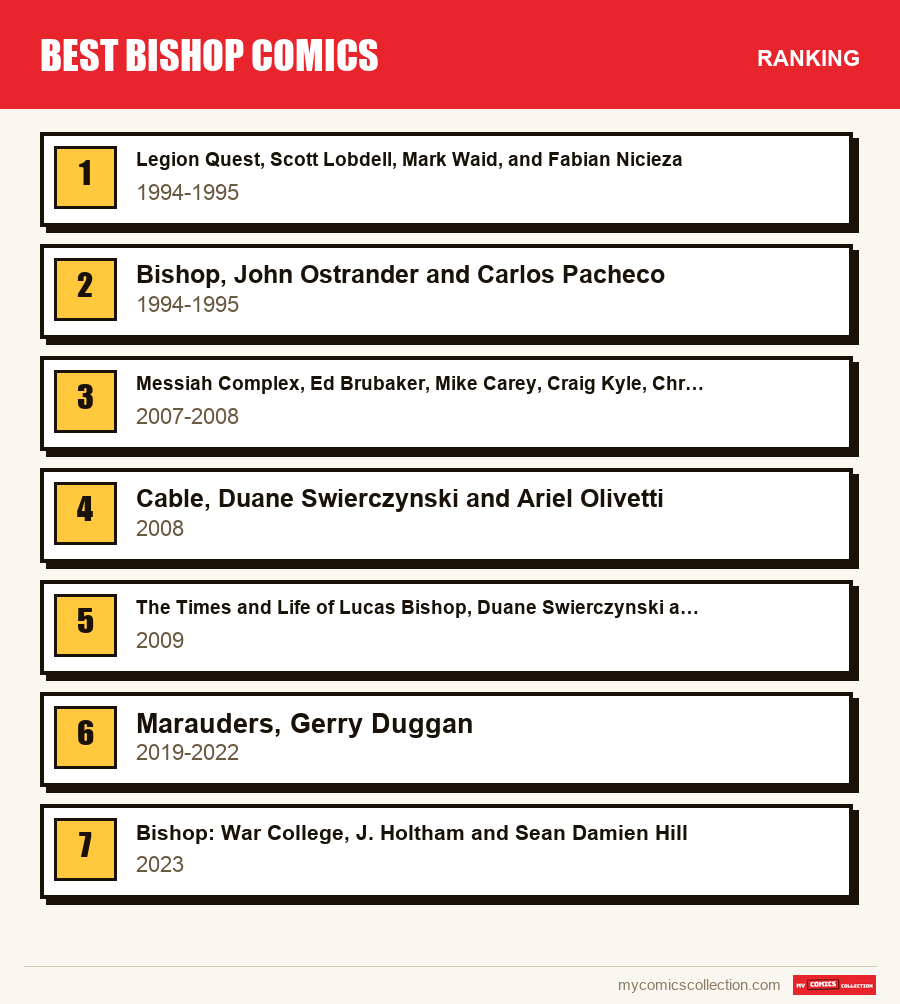
Lucas Bishop comes from a future where mutants are penned in, and that is where his hardness comes from: a time cop, he tracks fugitives all the way to the X-Men's present. His path alternates between ally, enemy, and guardian, often within the same series. This guide ranks seven reads to help you find your way, with what each adds to the character and how to read it.
As always in this guide, we only state verified information (creators, issue numbers, dates); the analysis is our own, with no reproduction of protected art or dialogue.
His first appearance
Byrne writes and Portacio draws the issue where Bishop debuts, The Uncanny X-Men #282, cover-dated November 1991. He only fills the last pages of this issue, which serves as a launch pad. His full entrance arrives in issue 283, dated December 1991, where he crosses paths with the X-Men and takes them for impostors.
The details of this issue, its printings, and the buying pitfalls are covered on a dedicated page: read the entry on Uncanny X-Men #282 before buying, rather than looking here for what is already explained there. Just remember the collecting principle: 282 carries the priority, 283 carries the reading.
The character, in this bibliography, is born in a distant future, raised in a mutant detention camp, then becomes commander of the Xavier's Security Enforcers, a security force. He travels through time in pursuit of fugitives. His sister Shard, raised with him by their grandmother, will also become an officer of that force, which gives his story a family dimension that readers of the 1990 period only discover later. The entries below follow the rest of this story.
A word on method before ranking: Bishop moves through series where he is not always the center. We therefore kept only stories where he plays a central role, as protagonist, as main adversary, or as a full teammate, so that each entry teaches you something about him and not only about the team around him.
1: Legion Quest, Scott Lobdell, Mark Waid, and Fabian Nicieza (1994-1995)
This crossover opens with The Uncanny X-Men #320, dated January 1995: Mark Waid writes the text on a plot by Scott Lobdell, Roger Cruz draws and Tim Townsend inks. Legion opens a portal in the Negev desert and drags Storm, Iceman, Bishop, and Psylocke through time. In the X-Men issues that complete the event, Fabian Nicieza takes over the script, with Andy Kubert and Ron Garney on art.
The stakes for Bishop are considerable: in this story, Legion accidentally kills Charles Xavier, history tips over, and Bishop becomes the time traveler left behind as the reality he knew disappears. It is the seed of Age of Apocalypse, whose issues we detail in our page on Apocalypse.
Who should you recommend it to? Whoever wants to understand where the reality of Age of Apocalypse comes from. How to read it? In a collected edition, because the issues are spread across several titles: the X-Men: Legion Quest volume gathers everything in order.
2: Bishop, John Ostrander and Carlos Pacheco (1994-1995)
The first series devoted to Bishop is a four-issue miniseries, written by John Ostrander and drawn by Carlos Pacheco. Bishop pursues and confronts Mountjoy, an adversary created for the occasion by the same creators. The story establishes Bishop's time cop role and gives him an investigation of his own, far from the X-Men's team life.
It suits the reader who wants a short story, wrapped up in four issues, with a strong visual identity. To read it, get the entire miniseries: the four issues form a whole. It comes shortly before Legion Quest and is open to a reader discovering the character.
3: Messiah Complex, Ed Brubaker, Mike Carey, Craig Kyle, Christopher Yost, and Peter David (2007-2008)
This event is a crossover between several X-Men series, written by Ed Brubaker, Mike Carey, Craig Kyle, Christopher Yost, and Peter David, with several artists. It follows the birth of the first mutant child since M-Day. Bishop appears in it as an antagonist: he tries to kill the infant, the child is kidnapped by the Marauders, and he then chases Cable and the child to Muir Island, where Predator X tears off his right arm.
This is the entry that changes the perception of the character the most. The hard ally becomes an obsessive hunter, to the point of losing a limb. It is for the reader who already knows Bishop and wants to see what he becomes under pressure. To read it, take the X-Men: Messiah Complex collection rather than the issues scattered across four series.
The writer Ed Brubaker, who wrote Uncanny X-Men during the event, has his own page: Ed Brubaker.
4: Cable, Duane Swierczynski and Ariel Olivetti (2008)
The 2008 Cable series directly extends Messiah Complex. Duane Swierczynski writes it, Ariel Olivetti draws issue 1, and the series runs twenty-five issues, until 2010. Cable flees through time with the child, and Bishop pursues them. Issue 2 pits them against each other in a direct clash, and over the course of the issues the hunt moves from the contemporary era to a distant future, where Bishop ends up stranded.
In this series, the little girl is named Hope Summers, in issue 10, which finally puts a name to the stakes of the whole hunt. The read is useful to anyone who wants to follow Bishop as an antagonist to the end, and to anyone interested in Cable: our Cable reading guide places the series in the general order. Read it in one go, in blocks of five or six issues.
5: The Times and Life of Lucas Bishop, Duane Swierczynski and Larry Stroman (2009)
This three-issue miniseries comes out starting in April 2009, written by Duane Swierczynski and drawn by Larry Stroman, with Mark Farmer on inks. It retells Bishop's story from his childhood in the camps of the future, as a recap of his path. The writer said he wrote it because he loved writing Bishop in Cable.
It is for the reader discovering the character who wants a summary of his origin without reading fifteen years of issues. How to read it? Before Messiah Complex if you want to understand what drives the hunter, or after if you would rather first see the antagonist in action. The three issues are easy to find together.
Do you collect this series?
Track what you own, what you are missing and what your collection is worth. 7-day trial.
Start my trial →
6: Marauders, Gerry Duggan (2019-2022)
Under the Krakoa status quo, Bishop joins the crew of Marauders, a series written by Gerry Duggan. Issue 1, dated 2019, is drawn by Matteo Lolli and brings together Kate Pryde, Storm, Pyro, Iceman, and Bishop, aboard a ship funded by Emma Frost and the Hellfire Trading Company.
The character is far from the hunter of 2008 here: he is part of a team that protects threatened mutants. This entry suits the reader of the Krakoa era, especially one who likes Kitty Pryde as a captain. Read the series in publication order, by arcs; Duggan writes it through its issue 27, in early 2022.
7: Bishop: War College, J. Holtham and Sean Damien Hill (2023)
This five-issue miniseries runs from February to June 2023. J. Holtham writes it, Sean Damien Hill draws most of it, with Alberto Foche Duarte on some issues. Bishop trains a new generation of war captains there, and the series makes him a teacher, a direct reversal of his hunter role.
It is for the reader who wants a recent, self-contained way in. The same year, Children of the Vault, four issues by Deniz Camp and Luca Maresca, brings Bishop and Cable together against the Children of the Vault in the Fall of X event. Read these two series after the previous entries to measure the distance traveled since 1991.
Where to start based on your profile
To get into Bishop without knowing his history, the simplest path is The Times and Life of Lucas Bishop, which sums up his past, followed by Bishop: War College. If you like the classics of the 1990s, start from issue 283 of Uncanny X-Men, then the Bishop miniseries and Legion Quest.
The reader drawn to time-travel plots will go straight to Messiah Complex and the 2008 Cable, keeping our selection of the best Cable runs close at hand. The one following current news will pick Marauders. The collector will choose one issue per period rather than aim for completeness.
The key issues to know
At the top of the list is The Uncanny X-Men #282 (November 1991), which shows Bishop for the first time. It is followed by issue 283 (December 1991), his first full appearance. Next come Bishop #1, from 1994, which opens his first series, and The Uncanny X-Men #320 (January 1995), the start of Legion Quest.
As for turning points, the 2008 Cable series extends his pursuit of Hope, and Marauders #1 (2019) turns him into a teammate. Bishop: War College #1 (2023) makes him an instructor. For each issue, ask the question of its status: first appearance, narrative turning point, or simple reading landmark. An early appearance is hunted for its rank in the bibliography, a recent turning point for the story it tells.
Before buying one of the 1990s issues, identify the edition of your copy: the same issue circulates in a newsstand version and a direct market version. Then compare copies of the same grade rather than similar titles.
How to read in collections or single issues
For the 1990s, collections are often the most readable solution: Legion Quest groups the issues scattered across several series. For Messiah Complex, the hardcover volume saves you from hunting for chapters in four collections. Single issues keep their appeal for the precise landmarks in the list above.
Short series, such as the 1994 miniseries, The Times and Life of Lucas Bishop, or Bishop: War College, are easy to complete in single issues. For a long series like Marauders, choose one arc and stop there: the character is not always its center.

Frequently asked questions
Bishop shows up in The Uncanny X-Men #282, from November 1991, conceived by John Byrne and Whilce Portacio. He only fills the last pages. His first full appearance is issue 283, from December 1991, where he takes over the story.
Start with The Uncanny X-Men #283 to see him in action, or with the miniseries The Times and Life of Lucas Bishop (2009), which sums up his origin. Then move on to Legion Quest and Messiah Complex. The two opening entries can be read without having read the rest.
Both, depending on the period. In Legion Quest, he is an X-Man caught in an event bigger than he is. In Messiah Complex and in Cable (2008), he becomes the antagonist chasing Hope. In Marauders and Bishop: War College, he is back on the mutants' side.
He is its indirect origin. In Legion Quest, which opens with Uncanny X-Men #320 from January 1995, Legion accidentally kills Charles Xavier, which upends history. Bishop becomes the time traveler left behind, and the reality that results is that of Age of Apocalypse.
Gerry Duggan's Marauders series, launched in 2019, puts him in Kate Pryde's crew. Bishop: War College (2023), by J. Holtham and Sean Damien Hill, is his own five-issue miniseries, and Children of the Vault (2023) pairs him with Cable.
A 1991 Uncanny X-Men or an issue from the Legion Quest era sleeping in your boxes? Get a first reference point before deciding what to keep.
Estimate my comic