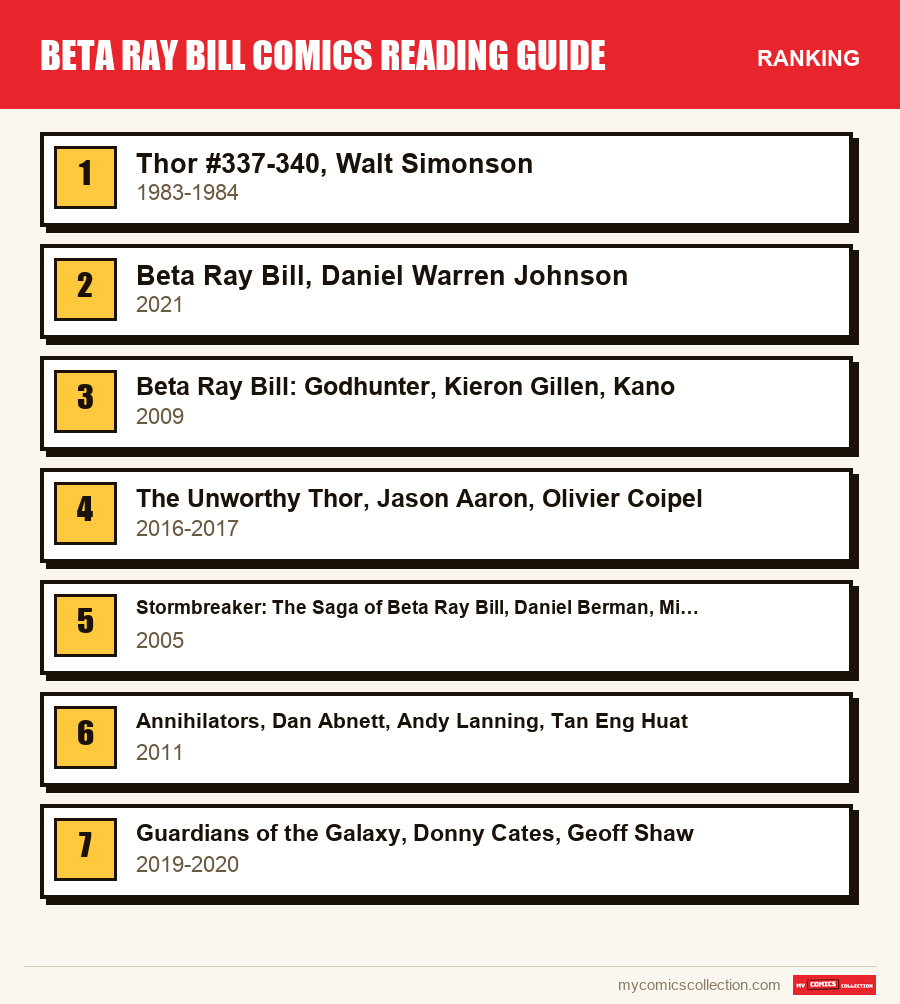
The best Beta Ray Bill comics start with his founding arc, Thor #337-340 (1983-1984), written and drawn by Walt Simonson, which remains the best place to start. Follow it with Daniel Warren Johnson's Beta Ray Bill miniseries (2021), then Godhunter (2009) and The Unworthy Thor (2016-2017). His first appearance is Thor #337, cover-dated November 1983, and it is the key issue of the lot.
Beta Ray Bill is an outsider who lifted Thor's hammer, and that is exactly what makes him interesting: he became the guardian of his own people without ever ceasing to be an ally of the Asgardians. That tension, between a defender of refugees and a hammer-bearer, has fed everything written about him for forty years. The character has no ongoing series that follows him from start to finish, so you need to know where to look. This list picks seven reads where he truly matters, names the ones where he shares the spotlight with a team, and suggests the order in which to approach them.
As always in this guide, only verified information (creators, issue numbers, dates) is stated as fact; the analysis is our own, with no reproduction of protected art or dialogue.
His first appearance
Beta Ray Bill is born in The Mighty Thor #337, cover-dated November 1983. Walt Simonson, who had just taken over the title, created him, wrote him and drew him. The issue sets up the image that will define the character: an elongated-skulled warrior from elsewhere who lifts the hammer of the god of thunder. We have already devoted a full page to this issue, with the details of its contents and its editions: the Thor #337 page. There is no point in copying it here.
What matters for your reading is that this debut is not a simple introductory issue followed by a return to the status quo. It opens a four-part arc, and that whole arc is what the list places first. A reader with only one evening to spare does not need to go back any further: everything needed to understand Bill is in those four issues of Thor.
1: Thor #337-340, Walt Simonson (1983-1984)
Simonson handles both the writing and the art on these four issues, which gives the whole run a unified tone. The arc tells of the meeting between the god of thunder and an alien defender who also has reasons to believe he has a claim to the weapon. The conflict is settled by a gesture from Odin, who has a hammer of his own forged for Bill, Stormbreaker. The rivalry between the two men turns into battlefield camaraderie, and a romantic triangle opens up with Sif.
Why read it first: because everything that follows rests on the rule laid down in 1983, that of a second hammer-bearer who owes nothing to Midgard. Who it is for: readers who want to understand why Bill is a major character and not a passing guest star. How to read it: in one go, in order, without skipping issue #338, which is his second appearance and where the duel really takes off. Issue #340 serves as a bridge, since it opens the Surtur saga, which runs through issue #353.
Modern editions collect these issues in reprinted volumes, which saves you from chasing the original single issues. To place these episodes within the larger era, our page on Walt Simonson lays out the map.
2: Beta Ray Bill, Daniel Warren Johnson (2021)
Daniel Warren Johnson writes and draws all five issues of 2021 on his own, with Mike Spicer on colors. It picks up the events of Donny Cates's Thor run and follows Bill on a quest for vengeance as he tries to bring Stormbreaker back to life. Odin and Surtur play central roles, and the final issue is a showdown with Surtur. The collected edition carries the subtitle Argent Star.
What this story brings: a Bill who holds the screen for five issues, with massive, highly readable art made for the page. Intended audience: today's reader, who wants a finished story without wading through the 1980s and 1990s. How to read it: after Simonson's arc if you can, but it stands on its own, which makes it a solid entry point for readers who prefer to start with the present. To follow the artist, see his creator page.
3: Beta Ray Bill: Godhunter, Kieron Gillen, Kano (2009)
The story unfolds on the cosmic side of the Marvel universe. Kieron Gillen writes it, Kano draws the three issues of the miniseries, and Patrick Zircher provides the covers. It is preceded by a one-shot, Secret Invasion Aftermath: Beta Ray Bill, The Green of Eden, written by Kieron Gillen and drawn by Dan Brereton. Both parts are collected in a single volume. The story pits Bill against Galactus: the protector of the Korbinites, who has lost his people, slides into vengeance and sets out to destroy the world-devourer.
What this story brings: the dark side of the character, that of a warrior who can fail to remain worthy of his weapon. Who it is for: readers who like short, tragic cosmic stories. How to read it: start with the one-shot, which sets up the situation, before the three issues. The Surfer, herald of Galactus, crosses paths with Bill there, which gives a hook to anyone who already knows Silver Surfer.
4: The Unworthy Thor, Jason Aaron, Olivier Coipel (2016-2017)
In these five issues, the hero is the Odinson, stripped of the right to wield the hammer. Beta Ray Bill is therefore not the subject, but he plays a leading part: from the first issue, he offers his own hammer to his old companion, and he later helps him get out of a cage. The miniseries is written by Jason Aaron and drawn by Olivier Coipel, with Matthew Wilson on colors.
What this story brings to Bill: loyalty. We see a hammer-bearer who has nothing to gain from helping a fallen man, and who does it anyway. Who it is for: those who have read Jason Aaron's run on Thor, whose plot it extends. How to read it: after Jason Aaron's Thor, not before, or the Odinson's stakes will stay abstract. Our pages on Jason Aaron and the Thor reading guide serve as signposts.
Do you collect this series?
Track what you own, what you are missing and what your collection is worth. 7-day trial.
Start my trial →
5: Stormbreaker: The Saga of Beta Ray Bill, Daniel Berman, Michael Avon Oeming, Andrea Di Vito (2005)
This six-issue miniseries is written by Daniel Berman and Michael Avon Oeming, with Andrea Di Vito on main art and Laura Villari on colors. It puts Bill on his home ground: the protector of the Korbinites faces Ashta, one of his people's lost deities, while priests prepare the release of a prototype named Alpha Ray Bill. The story then takes him to Asgard, after Ragnarök, and on to Earth, where he teams up with Spider-Man.
What this story brings: a portrait of a people's leader, charged with deciding what his role as hammer-bearer costs his own. Who it is for: collectors who want to see Bill treated as a monarch as much as a warrior. How to read it: as a second step, once you know the 1983 arc. The series is more uneven than the previous ones, but it supplies useful context on the Korbinites that later stories take for granted.
6: Annihilators, Dan Abnett, Andy Lanning, Tan Eng Huat (2011)
Here, Bill is no longer alone. Four issues signed by Dan Abnett and Andy Lanning on writing and Tan Eng Huat on art, for a five-member cosmic team: Beta Ray Bill, Silver Surfer, Quasar, Gladiator and Ronan the Accuser. The group was born from the aftermath of The Thanos Imperative. A sequel, Annihilators: Earthfall, takes the team to Earth to face the Universal Church of Truth, where it clashes with the Avengers.
What this story brings: Bill as a member of a cosmic collective, alongside four other characters. Who it is for: Marvel cosmic readers who want a team adventure. How to read it: without presenting it as a series devoted to him, since Bill shares the billing with four other characters. It comes as a complement, not an entry point.
7: Guardians of the Galaxy, Donny Cates, Geoff Shaw (2019-2020)
The 2019 series is written by Donny Cates. Geoff Shaw draws the first issues. Bill is among the members of the team, alongside Silver Surfer, Groot, Star-Lord and Cosmic Ghost Rider. His role there is collective, and the series ends after twelve issues.
What this story brings: the character within a contemporary team. Intended audience: those who already follow the Guardians. How to read it: for what it is, that is, an ensemble series. It takes the last spot in this selection for that reason, not because it would be weak. Cates's issues are best preceded by our Guardians of the Galaxy reading guide.
Where to start based on your profile
You like period stories and Simonson's art: open Thor #337, then read the arc through issue #340. You mostly read recent stories: pick up Daniel Warren Johnson's 2021 miniseries, which requires almost no prior reading. You already follow Thor through Jason Aaron's run: slot The Unworthy Thor in between two chapters of that series. You like cosmic Marvel: Godhunter, then Annihilators.
If you collect the original printings, the order is reversed: hunt for the 1983-1984 issues first, then the miniseries, whose more recent print runs are easier to find in good condition. If you prefer collected editions, everything above exists in volumes, which spares you from choosing between budget and completeness. In every case, our page on the Thor hub helps you place each title relative to the main series.
The key issues to know
The list below is a method for spotting what matters. It mentions no price. Before putting a number on a Bill, keep only completed transactions for the same issue, in comparable condition; a listing that says nothing about the edition proves nothing.
- Thor #337 (November 1983): Beta Ray Bill makes his entrance, from the pen and pencil of Walt Simonson. It is the benchmark issue, covered on its dedicated page.
- Thor #338: the character's second appearance, in direct continuity with the arc.
- Thor #340 (1984): opening of the Surtur saga, which runs through issue #353. Bill returns around issues #349 to #355. The issue serves as a hinge for anyone who wants to follow what comes next.
- Issue #1 of the Stormbreaker miniseries (2005): first of the six chapters in which Bill faces Ashta, by Berman and Oeming, with Di Vito on art.
- Beta Ray Bill: Godhunter #1 (2009): opening of the Kieron Gillen and Kano miniseries, useful for cosmic fans.
- The Unworthy Thor #1 (2016): the issue where Bill offers his hammer to the Odinson.
- Beta Ray Bill #1 (2021): start of Daniel Warren Johnson's miniseries, which exists in several variant covers.
For a broader overview around the god of thunder, see our page on Thor key issues. It places Bill within the full run of the series.
Frequently asked questions
Beta Ray Bill first appears in The Mighty Thor #337, cover-dated November 1983. Walt Simonson created him and wrote and drew the issue. It opens an arc that runs through issue #340, and it has its own page in this guide.
Two choices make sense. For the origin story, read Walt Simonson's Thor #337-340 (1983-1984). For a modern, self-contained tale, pick up Daniel Warren Johnson's Beta Ray Bill miniseries (2021), which requires very little background.
No, no ongoing series follows him from start to finish. He has miniseries: Stormbreaker: The Saga of Beta Ray Bill (2005), Godhunter (2009) and Beta Ray Bill (2021). Elsewhere, he shows up as an ally in Thor, or as a member of a cosmic team.
Stormbreaker is the hammer Beta Ray Bill receives at the end of the 1983-1984 arc. Odin has it forged for him so that this warrior from elsewhere has a weapon of his own rather than Thor's. It allows him to return to his original form.
Not for the 2021 miniseries, which was designed to be understood on its own. Simonson's arc, on the other hand, is the benchmark and reads without prerequisites, since it introduces the character. For The Unworthy Thor, it is better to know Jason Aaron's run.
Do you own a copy of Thor #337 or of a Beta Ray Bill miniseries? Get it appraised by comparing its condition to actual completed sales.
Appraise my comic