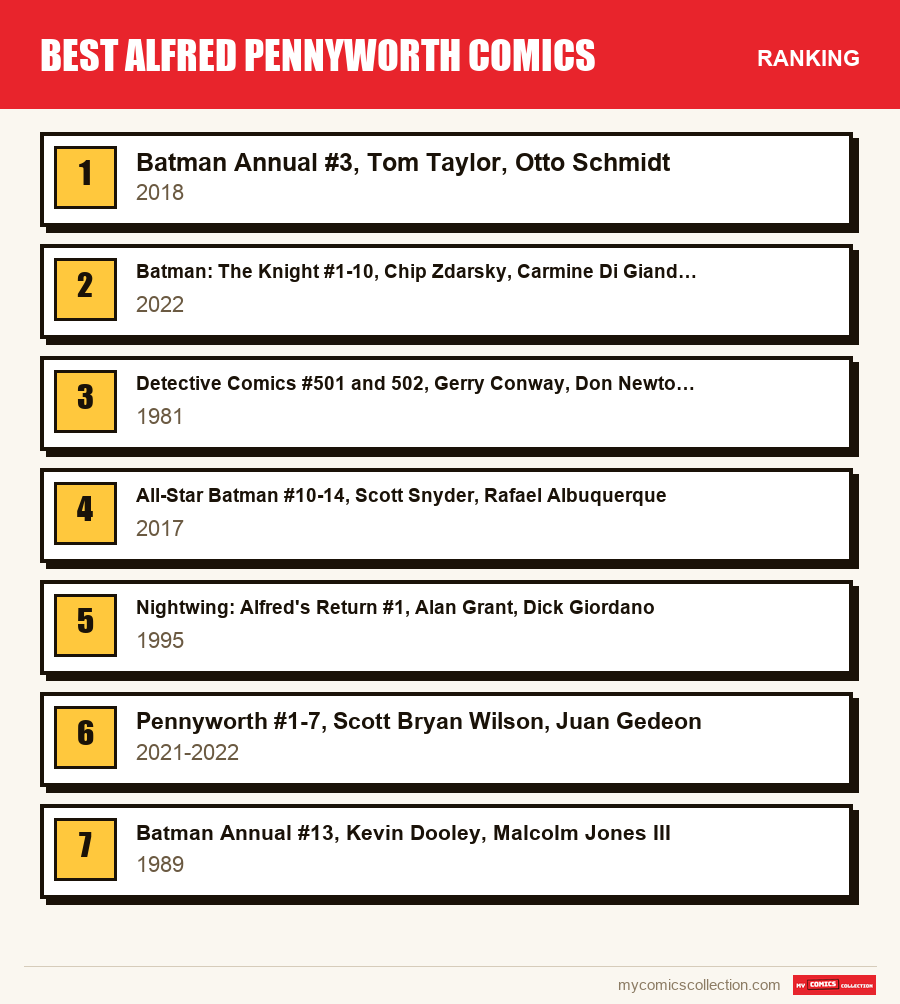
The best Alfred Pennyworth comics start with Batman Annual #3 (2018), the "Father's Day" story by Tom Taylor and Otto Schmidt, told from the butler's point of view. Next, read Batman: The Knight (2022) by Chip Zdarsky and Carmine Di Giandomenico, then Detective Comics #501 and 502 (1981) by Gerry Conway and Don Newton, where Julia Remarque appears. His first appearance is Batman #16 (April-May 1943).
Alfred is everywhere in Batman comics and almost never the headliner: he opens the door, patches up the wounds and vanishes by the next page. Ranking his best reads means hunting for the stories where his past, his voice or his bond with Bruce Wayne actually drives the plot. Seven stories stand out, from the most recent to the oldest, each with what it adds to the butler and how to read it.
As always in this guide, only verified facts (creators, issue numbers, dates) are stated; the analysis is our own, with no reproduction of protected art or dialogue.
His first appearance
Alfred makes his debut in Batman #16, dated April-May 1943, in the thirteen-page story "Here Comes Alfred!" Don Cameron writes, Bob Kane draws, and Jerry Robinson and George Roussos handle the inks. He appears there as Alfred Beagle: he comes to take over his father's post with the Wayne household, stumbles onto the identities of Batman and Robin, and offers to help them.
The look everyone knows comes later: in Detective Comics #83 (January 1944), Alfred returns from a health cure thinner and mustached. The following year, the series gives him a feature under his own name: "The Adventures of Alfred" starts in Batman #22 (April-May 1944) and runs for thirteen issues, skipping issue #35, through issue #36.
When Alfred truly carries the story
Alfred is a supporting character by design, and most stories that mention him keep him in service to others. We only kept stories where the plot rests on him: his narrative point of view, his personal past, his role as guardian, or an entire series under his name. In Batman #677 (July 2008), Black Glove agents beat him under Grant Morrison's pen, but he endures the scene without driving it: that issue is listed among the key issues, with his role spelled out.
The ranking runs from the read you can pick up cold to the most peripheral one.
1: Batman Annual #3, Tom Taylor, Otto Schmidt (2018)
The issue contains a thirty-eight-page story, "Father's Day," written by Tom Taylor and drawn and colored by Otto Schmidt, with a cover by Bryan Hitch. The story takes place on the eve of Father's Day and on the day itself, and it is told from Alfred's point of view: it starts with the phone call announcing the Waynes' deaths, then follows the present, where Batman fights the Drone, an adversary making his first appearance here under the name Peter Harris. Alfred is pushed to his limits during one of Gotham's worst nights.
What the read adds to Alfred is exactly what other series deny him: room. Otto Schmidt draws a calm, watchful butler who sees Bruce put himself in danger without being able to hold him back, and Tom Taylor makes that position the very subject of the story.
Who is it for? Any reader who wants to understand what Alfred means to Bruce in a single evening of reading. How should you read it? On its own, as a one-shot, preferably at the end of the day.
2: Batman: The Knight #1-10, Chip Zdarsky, Carmine Di Giandomenico (2022)
The ten-issue miniseries runs from January 18 to October 18, 2022, with Ivan Plascencia on colors and Pat Brosseau on letters. It tells the formative years of Bruce Wayne, from his teenage years to his return to Gotham. Alfred is the guardian who opposes the path of vengeance: he pushes Bruce to study so he can channel his anger, gets him out of jail, then parts ways with him on bad terms before hiring the detective Henri Ducard to track him down. When Bruce returns from his travels, the two reconcile and Bruce goes down into the Batcave.
Let's be clear about the role: Bruce is the engine of the series, and Alfred is not on every page. But the emotional stakes are his: Chip Zdarsky himself has stressed the ambiguity of a man who is both a surrogate father and an employee. It is the read that best shows what Bruce costs him.
Who is it for? Readers who enjoy origin stories and Bruce's successive mentors: the magician John Zatara teaches him escape artistry in New York, and our Zatanna guide helps place that family of magicians. How should you read it? All ten issues in one sitting, or in the trade paperback, with no prior reading required.
3: Detective Comics #501 and 502, Gerry Conway, Don Newton, Dan Adkins (1981)
Two issues, dated April and May 1981, carry the titles "The Man Who Killed Mlle. Marie" and "Who Shot Mlle. Marie?" Gerry Conway writes, Don Newton draws, Dan Adkins inks and Adrienne Roy colors. In the first, a man is murdered and the clues point to Alfred. In the second, Julia Remarque and her friends capture Batman and tie him up so he can witness Alfred's trial for the murder of Mlle. Marie. Julia wants him dead, but she plans a fair trial, and Lucius Fox is the one who defends him.
It is a turning point: the story gives a past and a moral debt to a man readers had only ever seen in the parlor. Julia Remarque, the future Julia Pennyworth, is born in issue #501, and later continuity presents her as the daughter of Alfred and Mlle. Marie.
Who is it for? Readers who like old-school mysteries and Batman detective stories. How should you read it? Both issues back to back: the first lays out the accusation and the second resolves it. The story also appears in the collection Batman Allies: Alfred Pennyworth, published in 2020.
4: All-Star Batman #10-14, Scott Snyder, Rafael Albuquerque (2017)
The "The First Ally" arc was published from July to December 2017. Scott Snyder writes, Rafael Albuquerque draws, Jordie Bellaire colors and Steve Wands letters. Batman is beaten there by an enemy whose attacks he cannot parry; he uncovers a conspiracy spanning generations, and the mastermind could be one of his closest allies. Old secrets cast doubt on that ally and push Batman toward dubious compromises. Flashbacks introduce Alfred and his father, Jarvis Pennyworth.
Alfred is the subject of the arc here more than its active protagonist: the adversary's identity points back to him, and the final issue pits Batman's future as a vigilante against the person he loves most. The backup stories in these single issues, "Killers-In-Law," are written by Rafael Albuquerque and Rafael Scavone and drawn by Sebastián Fiumara: they do not involve Alfred.
Who is it for? Readers who like Scott Snyder's Batman and stories where the family past catches up with the present. How should you read it? Straight through, from #10 to #14, with the trade paperback The First Ally.
Do you collect this series?
Track what you own, what you are missing and what your collection is worth. 7-day trial.
Start my trial →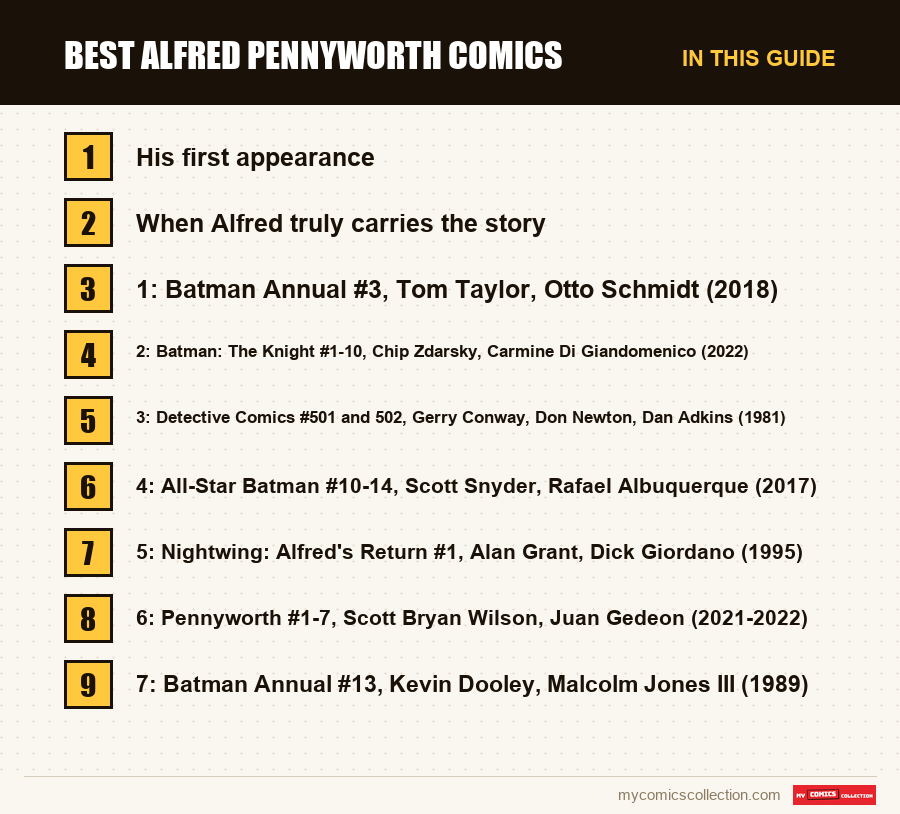
5: Nightwing: Alfred's Return #1, Alan Grant, Dick Giordano (1995)
This 54-page one-shot, titled "The Britannia Coup," came out in 1995 with a cover by Brian Stelfreeze. Alan Grant writes, Dick Giordano draws and inks, Adrienne Roy colors. Alfred has left Bruce Wayne's service and reunites in London with Joanna Clark, his old love. She asks him to help her son Derek, who is in gambling debt, and claims he is Alfred's son. Nightwing joins him, and the two uncover a plot to destroy the Channel Tunnel.
The ending is the most striking part: Derek dies saving Alfred's life, then Joanna admits she lied about his parentage, and Alfred decides to go back to his "family" in Gotham. The story shows Alfred as a man of action, far from the manor, with Nightwing arriving as backup. To place the former Robin in the larger picture, our Nightwing reading guide gives the order of the series.
Who is it for? Readers looking for an Alfred of espionage and travel, far from Gotham. How should you read it? On its own, or in the collection Nightwing: Ties That Bind (1997), which pairs it with the four issues of the Nightwing miniseries.
6: Pennyworth #1-7, Scott Bryan Wilson, Juan Gedeon (2021-2022)
This is the series that carries Alfred's name. Seven issues, written by Scott Bryan Wilson and drawn by Juan Gedeon, with John Rauch on colors and covers by Jorge Fornés. It accompanies the Pennyworth television series: DC presents it as the adventures of Alfred as an MI6 counterintelligence agent in Cold War Soviet Russia, and the series also covers his final years at Wayne Manor.
The read delivers an Alfred without Bruce, active, with enemies of his own. It is less essential than reads 1 to 3, since it speaks first to those who know the television series.
Who is it for? Readers of spy thrillers and viewers of the Pennyworth series. How should you read it? All seven issues in order, or the trade paperback that collects them.
7: Batman Annual #13, Kevin Dooley, Malcolm Jones III (1989)
In this 1989 annual, with a cover by George Pratt, an eight-page story, "Waiting in the Wings," is devoted to Alfred. Kevin Dooley writes it and Malcolm Jones III draws it, with Adrienne Roy on colors. The action is set in Bruce Wayne's early days as Batman: Alfred considers returning to the theater, then concludes that his role as Bruce's friend and confidant may be as demanding as a stage career. An acquaintance of Bruce's named Patti appears in the story.
The read adds one detail: Alfred's love of the stage, seen as a choice he could have made differently. It is a complement rather than an entry point. It appears in the collection Batman Allies: Alfred Pennyworth (2020).
Who is it for? Collectors completing a shelf of late-1980s annuals. How should you read it? After read 1, to see how two eras handle the same feeling. For the period of Batman's early days, turn to Batman #404 and Year One.
Where to start based on your profile
For a first encounter, pair Batman Annual #3, where Alfred narrates, with Batman: The Knight, where he raises Bruce: two evenings, two faces. If you prefer mysteries, move on to Detective Comics #501 and 502, which build the Julia Remarque mystery. If you follow Nightwing, read 5 is the most direct, and it shows Dick Grayson as backup.
If you collect the 1980s and 1990s, hunt down Batman Annual #13 and Nightwing: Alfred's Return #1. For Scott Snyder's Batman, finish with All-Star Batman #10-14.
The key issues to know
To place an Alfred single issue without quoting a price, compare copies in the same grade, from the same printing, sold recently.
- Batman #16 (April-May 1943): Alfred's first appearance, as Alfred Beagle, by Don Cameron and Bob Kane. This is the baseline reference.
- Detective Comics #83 (January 1944): Alfred takes on the slim, mustached look we know.
- Batman #22 (April-May 1944): start of the "The Adventures of Alfred" feature, which runs through issue #36.
- Detective Comics #328 (June 1964): Alfred disappears in the story "Gotham Gang Line-Up!"
- Detective Comics #356 (October 1966): Alfred's return, revealed as the character the Outsider, in "Inside Story of the Outsider!"
- Detective Comics #501 (April 1981): first appearance of Julia Remarque, by Gerry Conway and Don Newton.
- Batman #677 (July 2008): Alfred is beaten there by Black Glove agents. Grant Morrison writes, Tony Daniel draws, Sandu Florea inks; Alfred plays a secondary role, which is why it is absent from the ranking.
- Batman Annual #3 (2018): first appearance of the Drone, in Alfred's story by Tom Taylor and Otto Schmidt.
Check the indicia before any purchase. Batman #16 exists as a reprint: the year 1943 must appear inside, not only on the cover.
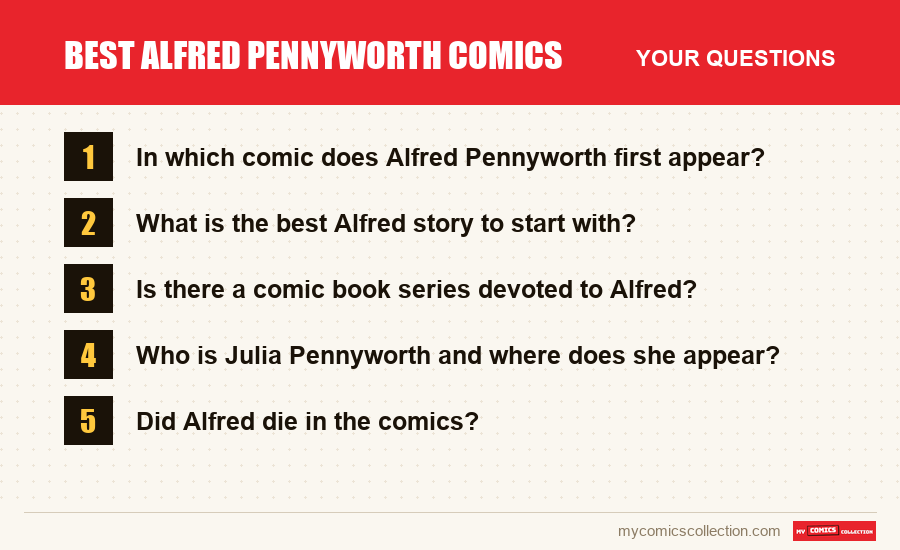
Frequently asked questions
Alfred appears in Batman #16, dated April-May 1943, in the story "Here Comes Alfred!" Don Cameron writes it, Bob Kane draws it, with Jerry Robinson and George Roussos on inks. He is called Alfred Beagle at the time and does not yet have his mustache, which arrives with Detective Comics #83 in January 1944.
The story "Father's Day," in Batman Annual #3 (2018), is the most accessible: Tom Taylor writes it, Otto Schmidt draws it, and it reads on its own, from Alfred's point of view. If you prefer a longer story, move on to Batman: The Knight, by Chip Zdarsky and Carmine Di Giandomenico.
Yes: Pennyworth, seven issues written by Scott Bryan Wilson and drawn by Juan Gedeon, published in 2021-2022. It follows Alfred as an MI6 agent in Cold War Russia and accompanies the television series of the same name. It is also collected in one trade paperback.
Julia Remarque, who becomes Julia Pennyworth, appears in Detective Comics #501 (April 1981), created by Gerry Conway and Don Newton. Issue #502 continues the story: she accuses Alfred of the murder of Mlle. Marie. Later stories make her the daughter of Alfred and Mlle. Marie.
In Detective Comics #328 (June 1964), he disappears while protecting Batman and Robin. Issue #356 (October 1966) explains his return: he had been turned into the Outsider before becoming himself again over the course of the story.
Do you own a copy of Batman #16 or another issue featuring Alfred? Get a free valuation.
Value my comic