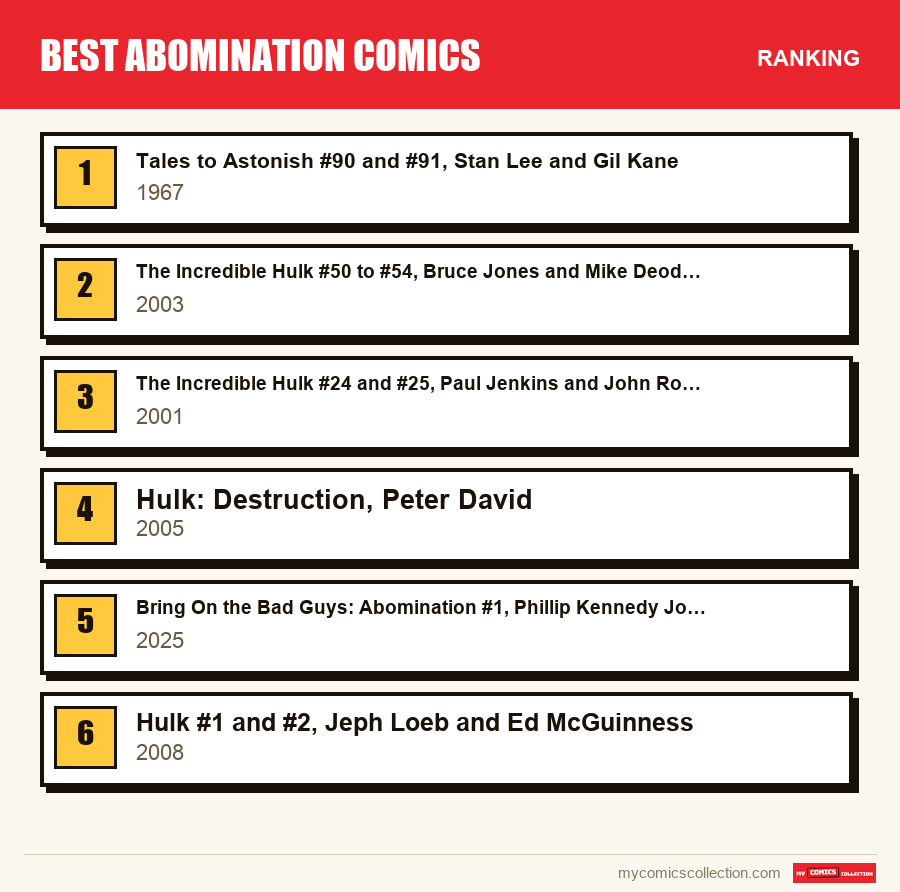
Emil Blonsky becomes the Abomination in Tales to Astonish #90, the April 1967 issue scripted by Stan Lee and drawn by Gil Kane. To find the best Abomination comics, start with that issue and the next, then move on to The Incredible Hulk #50 to #54 by Bruce Jones and Mike Deodato Jr. (2003), The Incredible Hulk #24 and #25 by Paul Jenkins and John Romita Jr. (2001) and Peter David's miniseries Hulk: Destruction (2005).
In the Hulk's rogues' gallery, Blonsky holds a place apart: neither a wordless monster nor a scientist gone astray, but an agent from the East who chose to become what he is, with his mind intact and the grudge that goes with it. That quirk makes him a more psychological adversary than he seems, and a more varied subject to read than his reputation as a scaly brute lets on. Here are six ranked reads, from 1967 to 2025.
As always in this guide, only verified facts (creators, issue numbers, dates) are stated as fact; the analysis is our own, with no reproduction of protected art or dialogue.
His first appearance
Emil Blonsky makes his entrance in Tales to Astonish #90, dated April 1967, in the series where the Hulk then shared top billing with Namor. Stan Lee and Gil Kane create the character, whose story continues in #91 of May 1967. Blonsky there is a Soviet spy who deliberately exposes himself to the radiation of Bruce Banner's gamma ray machine. He comes out of it stronger than the Hulk, and, a decisive detail, he keeps his intelligence.
That detail explains everything that follows. Where the Hulk is a colossus made primal by rage, the Abomination reasons, calculates and savors his victories. In these two issues, he beats the Hulk, kidnaps Betty Ross and forces Banner to devise a trap based on rays that drain his strength. For a collector, the appeal of these issues lies in this status as the birth of a lasting enemy of the series.
1: Tales to Astonish #90 and #91, Stan Lee and Gil Kane (1967)
This is the way in that lets you understand what Blonsky embodies at the start: a rival built to outdo the Hulk on his own turf. Stan Lee wanted an adversary stronger than the Hulk, and the story draws from that a tension later writers would struggle to renew: strength is no longer enough, cunning is needed. The second chapter, titled "Whosoever Harms the Hulk...!", sets up the principle that will keep coming back, that of a Banner who wins by wit rather than fists.
Who is it for? The patient reader, ready to accept the pace and tone of a 1967 story, and the collector who wants to own the source. How to read it? In order, the two chapters back to back, keeping in mind that issue #90 also contains a Namor story: the Abomination fills only half the book. If you're torn between reading and buying, the collected reprints bring these pages together without forcing you to hunt down the originals.
2: The Incredible Hulk #50 to #54, Bruce Jones and Mike Deodato Jr. (2003)
Later collected under the title Abominable, these five issues put the character at the center of a story of espionage and paranoia. The organization known as Home Base unleashes the Abomination against the Hulk in the city of Entropy, and Blonsky doesn't hold back from taunting his enemy about Betty Ross's death and about Nadia Dornova. Mike Deodato Jr.'s art, dark and nervous, gives the character a physical presence few series have offered him.
This read suits those who prefer a thriller mood to a clash of titans. It assumes you know the broad outlines of the period: the Hulk is tracked there by agencies that each play their own game, and Betty Ross is not what she seems. Read the five issues in one go; the third, in the middle, only makes sense with the two before it. In our view, it is the staging that best treats Blonsky as a living character and not as a mere obstacle.
3: The Incredible Hulk #24 and #25, Paul Jenkins and John Romita Jr. (2001)
This is the most intimate episode in the character's bibliography. General Ross there lets Banner know that the Abomination is responsible for Betty's death, and he pushes the Hulk to go after him. Blonsky, for his part, is shown in an unexpected register, a long way from the raging beast of popular imagery. The story ends without the Hulk finishing him off: Banner takes back control at the last moment, and Blonsky stays locked up, confronted with recordings that plunge him back into his life before the transformation.
This story suits anyone who wants a face-off rather than a battle. John Romita Jr.'s art makes the mass of the two colossi weigh on the panels, while Paul Jenkins focuses on what remains human in Blonsky. To follow it without losing the thread, it helps to bear in mind that Betty was given up for dead a few years earlier in the series of the day, which the story exploits without explaining it at length.
4: Hulk: Destruction, Peter David (2005)
Four issues devoted to Blonsky more than to the Hulk: it is the best chance to understand him from the inside. Peter David revisits his path in light of what the Defense Department might do with him, while Doc Samson and Thunderbolt Ross debate whether to use such an individual as a weapon on the riskiest missions. The story takes the adversary's point of view rather than the hero's, which changes the usual perspective.
This story suits those who already have the basics of the green universe down and want the adversary's angle. To place it in its writer's body of work, a marked-out path exists in our rundown on Peter David and the Hulk.
Do you collect this series?
Track what you own, what you are missing and what your collection is worth. 7-day trial.
Start my trial →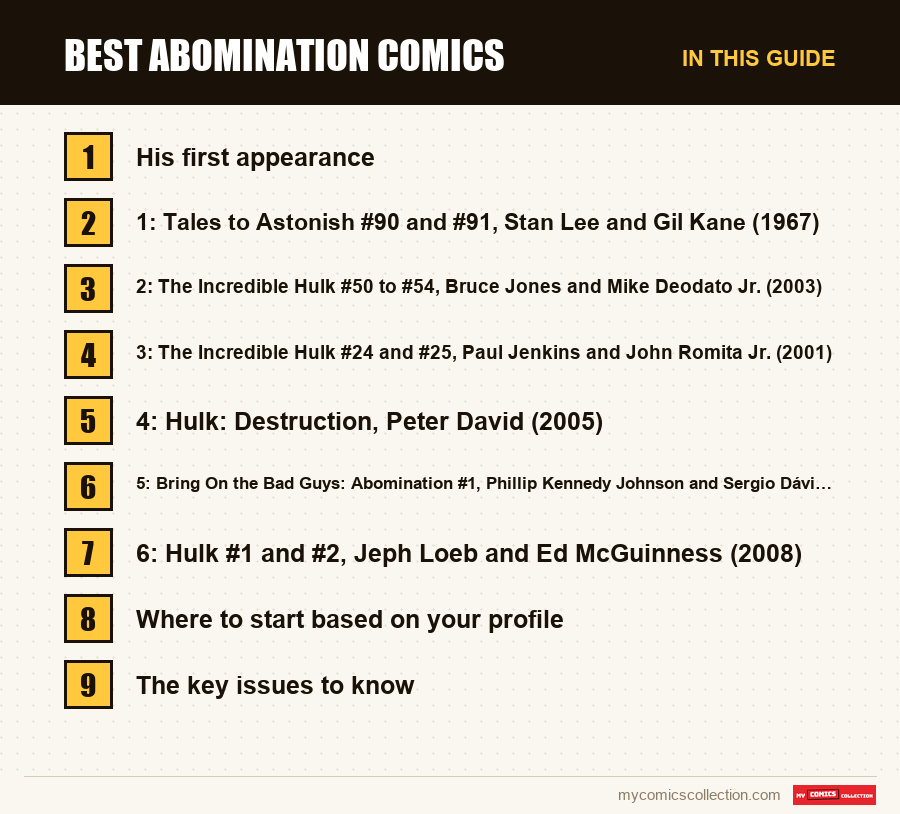
5: Bring On the Bad Guys: Abomination #1, Phillip Kennedy Johnson and Sergio Dávila (2025)
Published in July 2025, this one-shot is the third of the seven standalone stories in the Bring On the Bad Guys series, each devoted to a villain. Phillip Kennedy Johnson writes it and Sergio Dávila draws it, with a cover by Lee Bermejo. Blonsky is presented there as a hired gun: he took down a monster named Grootslang to win his freedom after a stay in a Wakandan prison, and he also delivered a soul to Mephisto. The tone is cynical and dry, far from the adventure of the 1960s.
It is the shortest and most accessible read in this ranking: one issue, no prerequisites, for a reader who wants to test the character without committing. Since it is recent, it says nothing about the character's future; read it as a snapshot of a mercenary Blonsky rather than as a founding chapter.
6: Hulk #1 and #2, Jeph Loeb and Ed McGuinness (2008)
Here, we have to be honest about the character's role: he is present only through his death. The 2008 Hulk series opens on the murder of the Abomination in Russia, and the central question becomes the identity of his killer: an unknown Red Hulk, whom Doc Samson and She-Hulk try to identify by reconstructing the scene. Jeph Loeb writes, Ed McGuinness draws, and the launch's coup rests on this mystery more than on Blonsky himself.
We put it last for that reason: it is a key issue, not an Abomination story. It will mostly interest the reader who wants to understand how the character left the stage before his later return. If you collect series debuts, the 2008 issue #1 is also tied to the arrival of Red Hulk, which makes it a read worth knowing regardless of Blonsky.
Where to start based on your profile
If you want to understand where the character comes from, read Tales to Astonish #90 and #91, then go straight to Peter David's miniseries: you'll get the birth and the most thorough point of view. For a reader who prefers thriller moods, the detour through The Incredible Hulk #50 to #54 pays off most, with Mike Deodato Jr. carrying every panel.
The reader in a hurry will begin with Bring On the Bad Guys: Abomination #1: a single issue, no prior knowledge. Anyone already following the Hulk in publication order will find their place in our Hulk reading guide, which situates the series as a whole. For the collector, it's better to read before buying: pick the collected edition first, then decide which original issues are worth the hunt.
Finally, for those discovering the Hulk himself, the wisest course is to read a few of the series' big arcs first before coming back to Blonsky; our selection of the best Hulk story arcs offers clear anchor points, after which the Abomination will make full sense as a counterpoint.
The key issues to know
The first appearance is Tales to Astonish #90 (April 1967); the immediate follow-up, #91 (May 1967), is part of the same package. Also remember The Incredible Hulk #136 and #137 (1971), which bring him back in a space story, and Silver Surfer #12 (January 1970), an early appearance outside the Hulk's series.
On the turning-point side, The Incredible Hulk #24 and #25 (2001) redefine his relationship with Banner; Hulk #1 (2008) marks his exit and the arrival of Red Hulk. The method for ranking these issues is simple: put the character's birth at the very top, the stories that change his relationship with Banner in the middle, and secondary appearances at the bottom. To place these publications within the series as a whole, our history of the Hulk in comics offers the chronological thread.
One reading tip to finish: the older an issue, the more the condition of the spine and corners weighs in the purchase. For a modern issue like those of 2003 or 2008, availability is wide and the question is no longer finding a copy, but deciding whether you want the trade paperback or the single issue. The trade paperback is enough to read; the single issue, to own.
Frequently asked questions
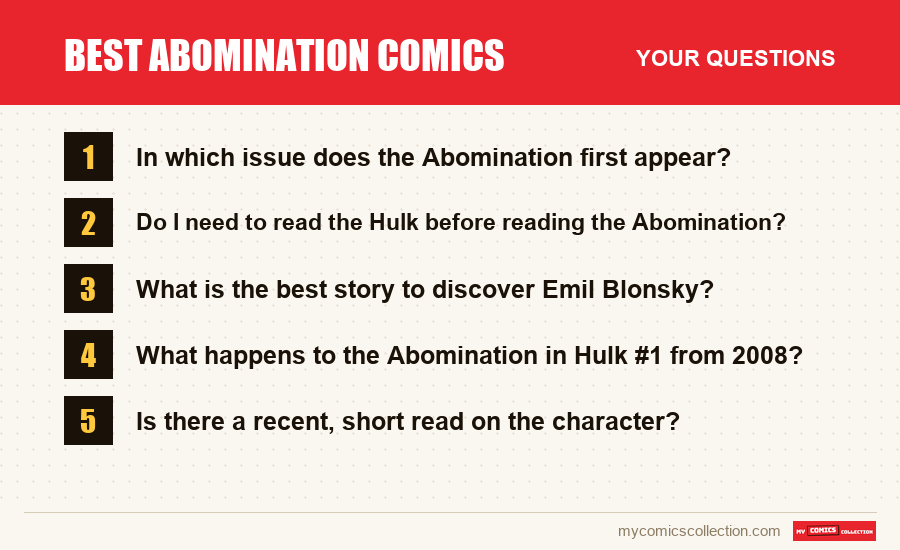
The Abomination appears in Tales to Astonish #90, dated April 1967, created by Stan Lee and Gil Kane. The story continues in issue #91, dated May 1967. Emil Blonsky there becomes stronger than the Hulk while keeping his intelligence, which sets him apart from most of the green hero's adversaries.
Not necessarily. The two 1967 issues and Peter David's miniseries Hulk: Destruction can be understood with little prior knowledge. On the other hand, the 2001 and 2003 episodes are better read after a few arcs of the series, because they rest on Betty Ross's story and on the agencies hunting Banner.
To understand the man behind the monster, Peter David's miniseries Hulk: Destruction (2005) is the richest, because it is devoted to Blonsky. For a more nervous, darker story, choose The Incredible Hulk #50 to #54 by Bruce Jones and Mike Deodato Jr. (2003). For the source, stick to 1967.
The 2008 Hulk series, written by Jeph Loeb and drawn by Ed McGuinness, opens on the murder of the Abomination in Russia. Doc Samson and She-Hulk investigate, and the identity of Red Hulk becomes the engine of the story. Blonsky is therefore only a starting element there, not the subject of the issues.
Yes, with Bring On the Bad Guys: Abomination #1, out in July 2025, with Phillip Kennedy Johnson on the script and Sergio Dávila on the art. It is a standalone one-shot, third in a series of seven, that presents Blonsky as a hired gun. It reads with no prior knowledge of the Hulk, in a single sitting.
Do you own an issue of Tales to Astonish or a Hulk series in which the Abomination appears? Request an appraisal of its condition and its place in the collection.
Appraise my comic