
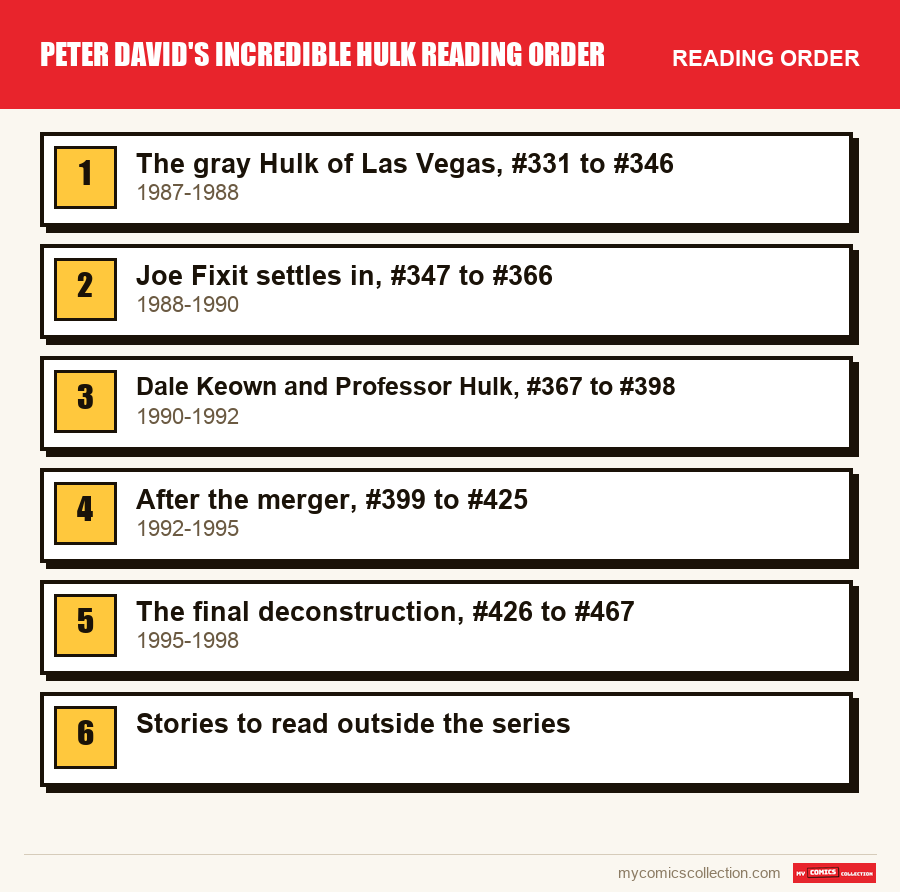
To read Peter David's Incredible Hulk in order, follow the regular series from #331 (1987) to #467 (1998), in five stages: the gray Hulk in Las Vegas with Todd McFarlane (#331 to #346), the consolidation of Joe Fixit (#347 to #366), the Dale Keown era and Professor Hulk (#367 to #398), the post-merger years (#399 to #425), then the final deconstruction (#426 to #467). Add the miniseries Future Imperfect after the third stage.
One hundred thirty-seven consecutive issues, a single writer, three major artists and a starting idea that changes nature twice: Peter David's run on The Incredible Hulk does not read as a string of arcs, but as a psychological serial in which each stage corrects the one before. Jumping in at random works poorly. This guide therefore fixes an order, stage by stage, with the issue numbers that serve as boundaries.
As always in this guide, we only state verified information (creators, issue numbers, dates); the analysis is our own, with no reproduction of panels or protected dialogue.
Before you start: what this run covers
Peter David takes over The Incredible Hulk at #331 in 1987 and signs #467 in 1998. In between, the series changes lead artist three times and Hulk twice: first the gray, cynical creature, then a merged version endowed with Banner's intelligence, then a return to the original fractures. The red thread is Bruce Banner's childhood and the way his anger split into distinct personalities. Anyone who has read the early work by Stan Lee and Jack Kirby knows that Hulk was then a monster with no inner life; David gives him one, and that is the stake of the whole read.
The entry point is not necessarily #331. A reader in a hurry can start with #340, whose Todd McFarlane cover pits the gray Hulk against Wolverine and is the subject of our entry on Incredible Hulk #340. But the complete order gives meaning to the shifts, and that is the one we follow.
Three faces of Hulk to spot before opening #331
The run rests on a distinction that the first readers in 1987 had to guess on their own. There is the savage Hulk, the one from Lee and Kirby, who hits and barely speaks. There is the gray Hulk, whom David exploits from the moment he arrives: a character, an irony, a head for business. And there is Professor Hulk, born at #377 from the merger of Banner and the beast. Keeping these three faces in mind transforms the reading: every scene becomes a question about which face is speaking and which one is hiding behind it.
This framework also explains why order matters. Reading #377 without having seen the gray Hulk means missing what the merger removes. Reading #426 and after without having lived through the Professor means not understanding what collapses. The stages below follow these slides from one face to another rather than the changes of artist, even if the two often coincide.
Stage 1: The gray Hulk of Las Vegas, #331 to #346 (1987-1988)
David settles in at #331 and takes the opposite tack from the green giant his predecessors left behind: the Hulk he writes is gray, cunning, sarcastic, and he operates in the casinos of Las Vegas, far from the military desert that served as the usual backdrop. The tone is closer to an ironic crime story than a monster movie, which is both disorienting and seductive.
Todd McFarlane draws this period, before leaving to illustrate Amazing Spider-Man (he draws #298 there). The visual peak of the stage is #340, where the gray Hulk meets Wolverine. It is an issue of image, not a first appearance: you read it for the confrontation and for the cover, which remains one of the most reproduced of the series. The stage reads as a block, over a weekend, because each issue directly continues the previous one.
What to take away on leaving #346: Banner does not control the beast, but the beast now has a voice, a job and a vocabulary. That voice will be the material for the rest of the run.
Stage 2: Joe Fixit settles in, #347 to #366 (1988-1990)
From #347 on, the gray Hulk takes on the identity of Joe Fixit, enforcer for a casino boss. The series gains a supporting cast that the early days never had: a setting, habits, a social life foreign to Banner's. David slips in nods to black comedy without ever leaving the register of violence.
The stage also serves as a laboratory. This is where the central idea of the run takes shape: the different incarnations of Hulk are not passing states but facets of one fractured psychology. The reader who finds stage 1 too brisk will find a steadier pace here, with episodes that mix investigation, humor and reflection on identity. No issue in this range is essential on its own, which makes it the easiest stretch to read in a collected edition.
If you read in single issues, do not try to acquire everything at once: this range is worth mostly for its continuity, and a lot of consecutive issues makes more sense than one isolated issue.
Stage 3: Dale Keown and Professor Hulk, #367 to #398 (1990-1992)
Dale Keown arrives at #367 and redraws the character: more massive, more expressive, with an exaggerated musculature that heralds the aesthetic of the early 1990s. It is the clearest visual change of the run, and it coincides with a change at the core. At #377, the personalities of Banner and Hulk merge: the result is Professor Hulk, a powerful creature who keeps Banner's intellect. The turning point is important enough that most rankings single out this issue as the second pivot of the run, after #340.
This stage also sees the arrival of the Pantheon, an organization of demigods that recruits the new Hulk and widens the series toward a mythological adventure register. #393, marked by an anniversary of the character and a special cover, closes the range: it is a landmark for collectors more than a narrative milestone.
Read this stage carefully, because everything the run will later destroy is built here. The effect of the ending only exists if you believed in the merger.
Do you collect this series?
Track what you own, what you are missing and what your collection is worth. 7-day trial.
Start my trial →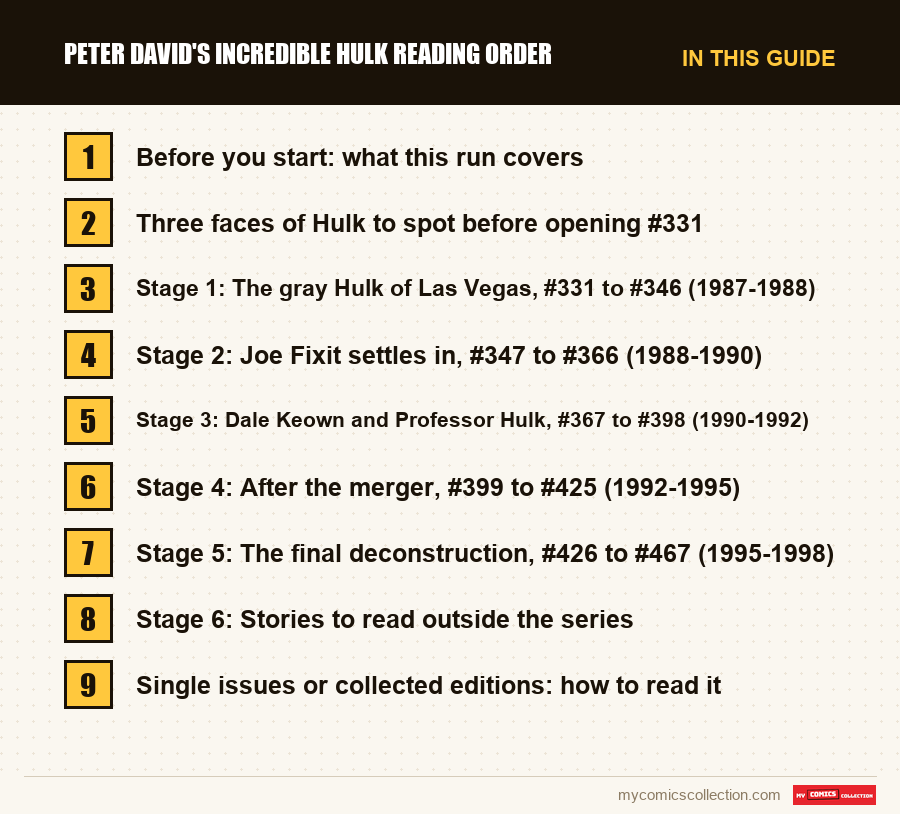
Stage 4: After the merger, #399 to #425 (1992-1995)
After Keown's departure, the series changes its graphic look: Gary Frank becomes the artist most associated with the period. His style, more realistic and more human, suits a story that refocuses on Banner's relationships: Betty, Rick Jones, and the friends the Professor fails to protect. The episodes concentrate more on emotional consequences than on fights.
This is also the stage where David starts to crack the merger, without announcing it. An attentive reader spots, from the start of the range, details that do not fit the image of an integrated Hulk. #425 closes the stage with a special-cover issue that suggests the character has died, an effect the series will quickly correct. For this range, we recommend reading straight through rather than dipping in: the writing plays on repetition and echoes.
Stage 5: The final deconstruction, #426 to #467 (1995-1998)
The last stage methodically undoes what the three before it had built. The Professor turns out not to be a real integration but one more personality, and the run closes on a dark, introspective note. The last years also see several artists pass through, which gives the range more narrative unity than graphic unity.
This stage is the most demanding of the five. It requires having read the previous ones, and it offers no victory. #467, in 1998, closes David's run without resolving the central question: that one will only find an answer twenty years later, in Al Ewing and Joe Bennett's Immortal Hulk (#1 to #50, 2018-2021), which reinterprets the incarnations of the period. If you want to see what the run becomes once reread by another writer, go to our entry on Immortal Hulk #1.
Stage 6: Stories to read outside the series
Two Peter David stories are read separately, with no issue of the regular series to slot in. The first is the miniseries Hulk: Future Imperfect (two issues, 1992-1993), drawn by George Pérez: Banner is thrown into a future where a tyrant Hulk, the Maestro, has taken power. Place it after stage 3, when the reader knows the merger and can gauge what the Maestro says about it. The second is Hulk: The End (2002), a one-shot written by David with Dale Keown on art, which imagines the end of the character: read it last, as an epilogue.
We do not list other tie-ins or annuals for this period: only these two stories are both certain and useful to the reading. To spot Hulk annuals and specials, see our entry on Hulk annuals and specials.
Single issues or collected editions: how to read it
Since the run is long, the question of format comes up from stage 1. Two approaches coexist. If you want to read, favor collected editions: they reprint the series in order, cut into coherent volumes, and can be read without hunting for issues. If you want to collect, start from single issues, beginning with the pivots: #340 for the image, #377 for the merger, then the issues that frame each stage.
In both cases, keep one rule: read stages 1 and 2 together, 3 and 4 together, and 5 alone. This segmentation follows the logic of the run, which changes tone at #367 and then at #426. To place this run in the character's history, see the best Hulk story arcs, and for an overview of his landmark issues, Hulk key issues.
One last tip for collectors: a run of one hundred thirty-seven issues is completed over time. Note your gaps as you go and prioritize the continuity of ranges over the single most famous issue; a complete range gets read, an isolated issue gets displayed.
Recap: the complete order
- The Incredible Hulk #331 to #346: the gray Hulk in Las Vegas, with #340 against Wolverine
- The Incredible Hulk #347 to #366: Joe Fixit settles in
- The Incredible Hulk #367 to #398: Dale Keown, merger at #377, Professor Hulk
- Hulk: Future Imperfect (1992-1993), two issues, George Pérez
- The Incredible Hulk #399 to #425: the post-merger years, Gary Frank
- The Incredible Hulk #426 to #467: the deconstruction, end of the run in 1998
- Hulk: The End (2002), epilogue with Dale Keown
Frequently asked questions
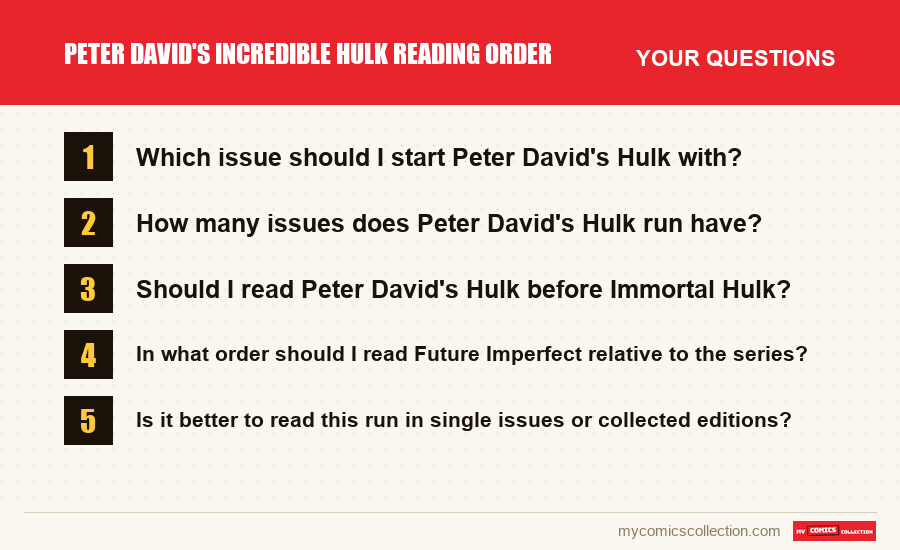
The run starts at #331 of The Incredible Hulk, in 1987. If you prefer a faster way in, Todd McFarlane's #340 sets the tone in a single issue. For a complete and logical path, start from #331 and move forward stage by stage up to #467.
From #331 to #467, it has one hundred thirty-seven consecutive issues, from 1987 to 1998. The math is simple: 467 minus 331, plus one. That excludes the miniseries Future Imperfect and the one-shot Hulk: The End, which are read separately.
It is not mandatory: Al Ewing's Immortal Hulk reads on its own. But David's run supplies the incarnations that Ewing picks up, such as the gray Hulk and the Professor. Knowing them enriches the read of #1 to #50 without conditioning it.
Place the two issues of Future Imperfect, drawn by George Pérez, after the Professor Hulk stage (#367 to #398). The Maestro, a Hulk turned tyrant, then makes full sense, since the reader already knows the merger the story puts in perspective.
For reading, collected editions are simpler: they respect the order and spare you the hunt for issues. For collecting, single issues offer the pivots, notably #340 and #377. Many readers combine both: collected editions for continuity, single issues for the ones they want to keep.
Do you own issues of The Incredible Hulk from the Peter David period, such as #340 or #377? Have them appraised.
Estimate my comic