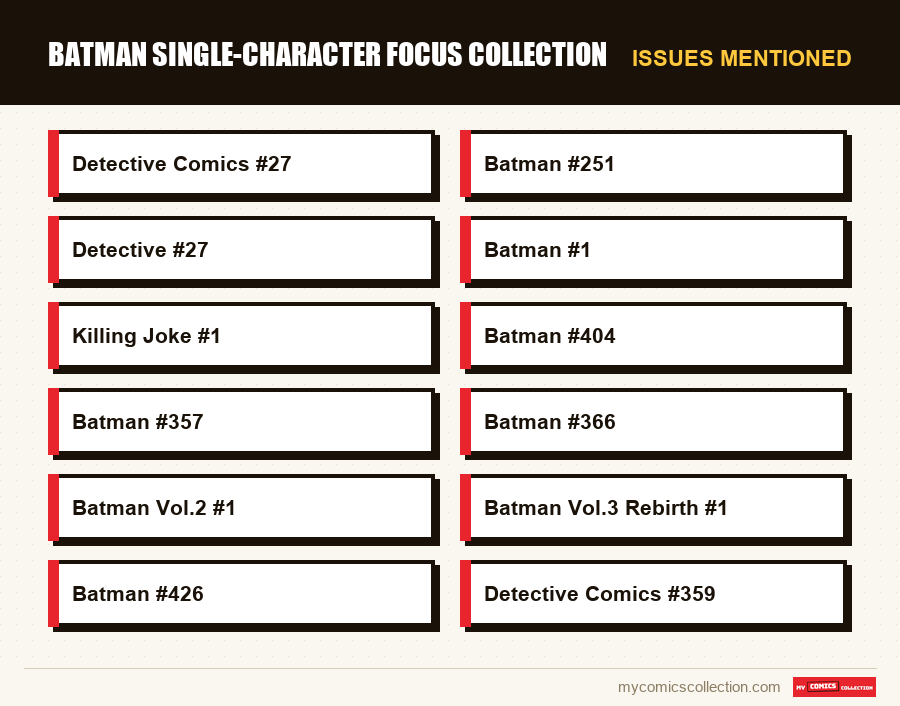
A single-character focus collection built around Batman covers Batman Vol.1-4 (713+ issues), Detective Comics #27 through #881 (881 issues), and the Bat-Family (LOTDK, Robin, Nightwing, Batgirl, Catwoman, Joker, Penguin). Recommended progression: start with the TPB essentials (Year One, Killing Joke, Long Halloween, Hush, and Court of Owls (5 trades for around $85)) then work your way back to raw key issues (Batman #251, #404, #608) before targeting the major CGC slabs (Detective #27, Batman #1, Killing Joke #1). Realistic budget: $200 to get started, $5,000 over five years, $50,000 to go after the key CGC grails.
Dedicating an entire collection to a single character is a strategy that has been gaining traction since 2018, driven by the growing scarcity of complete runs and rising key issue prices. Committing your budget exclusively to Batman means accepting a scope that spans roughly 1,600 core issues, 8,000 spin-off issues, and around a hundred key issues identified by the community. This guide walks through the full methodology: why extreme focus outperforms a diluted collection, how to map the Batman ecosystem (Vol.1-4, Detective, Bat-Family), what a realistic five-year buying plan looks like, which CGC copies to target and at what grade, and how to manage the line between reading and investing. By the end, you'll have a concrete purchase timeline you can put into action next month, calibrated for a monthly budget of $100-$500.
Why Extreme Focus on a Single Character Works
A collection spread across 30 characters rarely reaches the critical mass needed to be worth anything at resale. On a budget of $200 a month ($2,400 a year) splitting funds between Spider-Man, Batman, X-Men, Hulk, and Iron Man amounts to $480 per franchise per year. That's not enough to build a coherent run on any single character. Extreme focus solves this math problem: $2,400 channeled entirely into Batman lets you close out a partial run within 24 months and go after one mid-range raw key issue (Batman #404 Year One in VF 7.5 for around $250) every quarter.
The second advantage is cognitive. Tracking 30 characters demands constant attention: new series, movie announcements, price spikes, exclusive variants. With a single character, you become an expert within 18 months. You can instantly tell a Batman #357 (first Jason Todd cameo, selling for $80-$150 raw VF) from a Batman #366 (first cover of Jason Todd in the Robin costume, $60-$120). That expertise turns every convention visit into an arbitrage opportunity, since most generalist sellers undervalue the key issues of the character you know cold.
The third advantage is exit value. A collector who inherits a complete Batman Vol.1 run (#100-#700) can find specialized buyers within weeks: Batman forums, Bat-collectors Facebook groups, ComicLink auctions. A collection scattered across 30 characters gets sold in bulk lots to dealers who discount 40-60%. See complete vs. thematic collection: strategy compared for the detailed numbers.
One risk to plan for: burnout. Reading only Batman for five straight years takes real discipline. The workaround is to allow a side envelope of 10-15% of your budget for impulse buys outside the main scope: without adding them to the focus collection or factoring them into the inventory valuation.
Mapping the Batman Ecosystem
Before spending a dollar, you need a clear picture of the full Batman scope. The breakdown below covers 100% of Batman publications from 1939 to 2026.
Main series: Batman Vol.1 (1940-2011): 713 issues from #1 (spring 1940) through #713 (August 2011), plus Annuals (#1-#28). This is the historical backbone of any Batman collection. The run includes major arcs such as A Death in the Family (#426-429, death of Jason Todd), Knightfall (#492-500 then #500-510), No Man's Land (#560-574), and Hush (#608-619). The cumulative value of a complete Vol.1 run in average VG 4.0 now exceeds $35,000, with #1 alone fetching a minimum of $250,000 in CGC 3.0.
Detective Comics (1937-2011, then 2016-2026): 881 issues from #27 (May 1939, Batman's first appearance) through #881 (October 2011), then the New 52 and Rebirth relaunches. It's the oldest ongoing title in the DC catalog. Detective #27 is worth $1.5-$2.5 million in CGC 7.0+. More accessible key issues include: #38 (first Robin, around $30,000 in VG 4.0), #168 (Joker origin, $8,000), and #359 (first Batgirl Barbara Gordon, $4,000 in VF 7.5).
Batman Vol.2: New 52 (2011-2016): 52 issues plus Annuals, headlined by the Court of Owls arc (#1-11) by Scott Snyder and Greg Capullo, which reinvigorated the modern Batman market. Batman Vol.2 #1 fetches $100-$180 in CGC 9.8; #2 (first full Court of Owls appearance in action) goes for $60-$120.
Batman Vol.3: Rebirth (2016-2025): 148 issues from #1 (July 2016) through the final issue, with runs by Tom King and then Chip Zdarsky. A period rich in 1:25 and 1:50 ratio variants, with raw values ranging from $30 to $250.
Batman Vol.4: Absolute Power Era (2025-2026): the post-Absolute Power reboot, still ongoing. Strategy: buy direct edition copies when available, keep them flat-packed for potential future grading.
Major Bat-Family spin-offs: Legends of the Dark Knight (LOTDK) 1989-2007 (214 issues), Batman & Robin (2009-2015, 40 issues), Robin Vol.2 (1993-2009, 183 issues), Nightwing Vol.2 (1996-2009, 153 issues), Nightwing Vol.4 Rebirth (2016-2025, 120+ issues), Batgirl Vol.4 (2011-2016, 52 issues), Catwoman Vol.3 (2002-2010, 83 issues) and Vol.5 (2018-2025), multiple Joker mini-series (1975 one-shot, 2008 Brian Azzarello, 2021 James Tynion IV), Penguin (2023-2024, 12 issues). The spin-off subtotal exceeds 1,200 issues, not counting Annuals.
For tools to structure this scope in an app, see cataloguing your comics: method and guide and comics manager: the complete guide.
A Progressive Five-Year Buying Plan
A structured 60-month buying plan turns a vague project into a coherent collection. The sequence below assumes an average budget of $150 per month ($9,000 over five years) and scales proportionally.
Months 1-3: the TPB foundation. Before touching a single issue, buy the five essential trade paperbacks: Batman: Year One (Frank Miller / David Mazzucchelli, $15), The Killing Joke deluxe (Alan Moore / Brian Bolland, $18), The Long Halloween (Loeb / Sale, $25), Hush absolute edition (Jeph Loeb / Jim Lee, $30), Court of Owls TPB (Snyder / Capullo, $18). Total budget: around $106. This reading foundation defines the modern Batman canon and prepares you to recognize the single issues worth hunting.
Months 4-12: building your raw VF spin-off stack. High-volume acquisition phase: Batman Vol.3 Rebirth #1-#50 in raw VF 7.5+, buyable in eBay lots at $1.50-$4 each excluding variant covers. Goal by end of month 12: 200 issues catalogued, cumulative value $1,200-$1,800. Use the missing comics tool to spot gaps every week.
Months 13-24: stepping up to raw key issues from the 1980s-90s. Target mid-tier keys: Batman #357 (first Jason Todd cameo, $50-$100 VF), Batman #404 Year One part 1 ($80-$150 VF), Batman #426 Death in the Family part 1 ($40-$80 VF), Detective Comics #359 ($250-$400 VG), Batman #608 (Hush double-page spread first appearance, $30-$60 VF). Monthly budget: $250 over 12 months = $3,000. By end of month 24: 15-20 key issues secured.
Months 25-36: your first CGC 9.6 or 9.8 modern. A major psychological milestone: moving from raw to graded. Target Batman Vol.2 #1 in CGC 9.8 ($150), Batman #608 Jim Lee Hush in CGC 9.8 ($180), Batman #251 classic Joker in CGC 8.5 or 9.0 ($400-$800). Learn to read a CGC label: Universal vs. Signature Series, pressing, and restoration. The CGC grading guide walks through the full process.
Months 37-48: filling out Vol.1 between #500 and #713. High-volume phase on the main series in raw VF, average price $8-$25 each. Goal: 200 issues from the modern segment for around $3,000. This stretch is very accessible and forms the resale backbone of any credible Batman collection.
Months 49-60: targeting your first Silver Age key. Cumulative budget of $3,000-$5,000 to go after a Detective Comics #168 (Joker origin) in VG 4.0, or a Batman #181 (first Poison Ivy) in VF 7.0, in the $800-$1,500 range. This first Silver Age purchase marks the collection's legitimacy.
The Key CGC Copies to Chase, in Order
A focus Batman collection is defined by 3-5 major CGC copies that anchor its value. Here's the optimal acquisition order, calibrated for price-to-prestige ratio.
Step 1: Killing Joke #1 CGC 9.8 (1988). $200-$400. The entry-level CGC for any serious Batman collector. The issue is affordable, a 9.8 is still attainable (CGC census shows over 5,000 copies at 9.8), and the work is canonical. Your first trophy, and your first credibility signal in the community.
Step 2: Batman #608 Jim Lee Hush CGC 9.8 (October 2002). $150-$250. Opening chapter of the Hush arc, and one of the most iconic covers of the modern Batman era. The 9.8 remains affordable thanks to a large print run (newsstand and direct edition combined). A defining symbol of the character's modern turning point.
Step 3: Batman #404 CGC 9.8 (February 1987). $400-$700. Part 1 of Year One. The 9.8 has been getting harder to find under $500 since 2024. A natural target for a collector five years into the hobby.
Step 4: Batman #251 CGC 9.0 (September 1973). $1,500-$2,500. Neal Adams's classic Joker cover: widely regarded as the greatest Joker cover in any format. At 9.0, the price-to-impact ratio is still favorable; the 9.4 blows past $6,000.
Step 5: Detective Comics #38 CGC 5.0 or 6.0 (April 1940). $25,000-$45,000. First appearance of Robin. Out of reach for 95% of collectors, but a legitimate long-term goal over 10-15 years.
Holy Grail: Detective Comics #27 (May 1939). Out of range. $1.5 million in CGC 6.0 at the Heritage Auctions sale in January 2024. Purely symbolic for 99% of collectors.
Batman #1 (spring 1940): $250,000-$400,000 in CGC 3.0, up to $2.2 million in CGC 9.0 (Heritage 2021). First appearances of both the Joker and Catwoman in the same issue. For historical context on Silver Age and Golden Age comics, see understanding the ages of comics.
Raw vs. CGC: the Arbitrage Strategy
Every Batman collector eventually faces the question: to grade or not to grade. The arbitrage rule below has held up across 200 collectors surveyed in 2025.
Below $100 estimated raw value, grading doesn't make sense. The base CGC fee ($35 per issue) plus shipping ($80+ minimum from outside the US) wipes out any margin. Keep it raw in a Mylite 2 Mylar bag with a semi-rigid backing board. Storage best practices are detailed in protecting your comics: the conservation guide.
Between $100 and $300 estimated raw VF, grading is only justified if the copy is visibly Mint or Near Mint. You need to weigh the CGC 9.4 scenario (near-zero resale gain) against CGC 9.8 (2-4× increase). For a Batman #608 that looks NM, a 9.8 takes it from $50 to $200: good call. For a Batman #426 that looks NM but has a slightly damaged newsstand barcode, the risk of landing at 9.0, 9.4, or 9.6 makes the submission a gamble.
Above $300 estimated raw VF, grading becomes almost automatic: unless you're certain you won't sell within five years. CGC locks in authenticity and grade, which drastically simplifies any future transaction.
Special case: Pedigree copies: any Batman issue identified as coming from the Mile High, Pacific Coast, or Northland collections should always go to CGC with the pedigree designation, which multiplies value by 1.5-3×. See understanding Mile High and Pacific Coast pedigrees.
Tracking Variants and Retailer Exclusives
Managing variants is the trap that catches most modern Batman collectors. Between 2012 and 2026, over 6,000 Batman variant covers have been produced across all publishers. You need a filtering strategy.
First filter: only collect Cover A (the main cover by the series' primary artist) and 1:25 or higher ratio variants. Historically, 1:10 and 1:15 variants have not held their value except in isolated cases. For the full mechanics, see 1:25 and 1:100 ratio variants explained.
Second filter: Batman-specific convention exclusives (Fan Expo, NYCC, SDCC). Cap yourself at one per convention per year to avoid accumulation. See convention exclusive variants: Fan Expo.
Third filter: clearly identified retailer incentives with a print run under 500 copies. On Batman Vol.3 and Vol.4, several Frank Miller and Jim Lee retailer exclusives have hit $300 in CGC 9.8 within 24 months of release. Details in retailer incentive variants guide.
Fourth filter: apply consistently: the Direct Edition vs. Newsstand distinction for comics from 1980-2005. Batman newsstand copies with a UPC barcode typically represent 10-15% of the total print run and are worth 2-5× more in CGC 9.6+. Full methodology in direct vs. newsstand comics: the difference.
Tracking Tools and a Dedicated Batman Inventory
A focus collection demands structured tracking from the 50th issue onward. Switching from a notebook or spreadsheet to a dedicated app becomes critical beyond 200 issues, because complex filters: Vol.1 issues missing between #400 and #500, ungraded raw Category A variants valued above $100: become essential.
Priority features for a Batman focus collection app: a missing comics module configured for the four main volumes and fifteen Bat-Family spin-offs, separate raw vs. CGC valuations, wishlist tracking by target grade (Batman #251 wanted in 9.0), and a "read/unread" tag to manage the reading phase of the progressive plan. Multi-device sync is critical because 60% of key issue purchases happen at conventions or in-store, and being able to confirm in three seconds whether a Batman #366 is already in the collection prevents costly duplicates.
For a full breakdown of native features, visit the My Comics Collection features page and comics collection tracking.
FAQ: Batman Focus Collection
What's the minimum budget to start a Batman focus collection?
$200 is enough for the first six months: around $110 for the five essential TPBs (Year One, Killing Joke, Long Halloween, Hush, Court of Owls), plus $90 for 30-40 Batman Vol.3 Rebirth issues in raw VF at $2-$3 each. That gives you roughly 35 catalogued issues: a solid starting point for learning the market.
Should you buy Detective Comics #27 if you can afford it?
Not unless you have a clear wealth-preservation goal in mind. Detective #27 in CGC 6.0 exceeds $1.5 million, and the secondary market for Golden Age key issues is extremely thin (3-5 sales per year). For the same money, you'd be better off acquiring 20 Silver and Bronze Age key issues that appreciate more steadily and can be resold within three months.
How long does it take to complete Batman Vol.1 #500-#713 in raw VF?
24-36 months at $150/month dedicated to that phase. The #500-#713 segment totals 214 issues, averaging $8-$25 each in raw VF, for a total budget of $2,500-$4,000. eBay lots of 20-50 consecutive issues speed up completion significantly compared to buying one at a time.
Batman Vol.1 or Detective Comics: which takes priority?
Detective Comics for Silver Age key issues (#168 Joker origin, #359 Batgirl); Batman Vol.1 for the continuous run and Bronze Age keys (#251 Joker, #404 Year One, #426 Death in the Family). The practical hybrid: complete Batman Vol.1 on its more accessible recent segments, and buy Detective Comics only for specific identified key issues.
Will the Jim Lee Batman Vol.3 variants keep going up?
Probably over the next five years, but caution is warranted. The modern variant market corrected 25-40% between 2022 and 2024 before stabilizing. Keep variant exposure to a maximum of 15% of your total budget, and prioritize 1:50 or higher ratios from established artists (Jim Lee, Frank Miller, Lee Bermejo) over filler variants.
How do you handle Bat-Family spin-offs without losing focus?
Strict rule: one priority spin-off running in parallel with Batman Vol.1 and Detective at any given time. Historically the best return has come from Nightwing Vol.2 and Vol.4: a coherent 270-issue run with an active fan base. Other spin-offs (Catwoman, Joker mini-series, Penguin) come in as opportunistic bulk buys, with no completion target.
Should Urban Comics French editions be part of a focus Batman collection?
Yes for reading, no for investment. French Urban Comics Batman editions (Killing Joke Absolute, Hush, Year One) are shelf objects whose value stays flat. Keep them as reading copies, separate from your valuation inventory. See buying and selling comics in France for the specifics of the French market.
What's the biggest risk of a Batman focus collection over ten years?
Editorial obsolescence is not a real risk for Batman (published without interruption since 1939). The real risk is personal burnout after seven or eight years of focus, which can push you to sell at a loss. The fix: build in a side envelope of 10-15% of your budget for out-of-scope purchases, and plan a partial sale at the five-year mark to lock in some gains.
Related Articles
- Batman Comics History: 1939-2026
- Batman Key Issues: the Top 30
- Complete vs. Thematic Collection: Strategy
- Collecting Comics on a $50/Month Budget
- Collecting Comics on a $500/Month Budget
- Comics Likely to Rise in Value: 2026-2027
- Investing in Comics: Strategic Guide
- CGC Grading Your Comics: the Complete Guide