In short
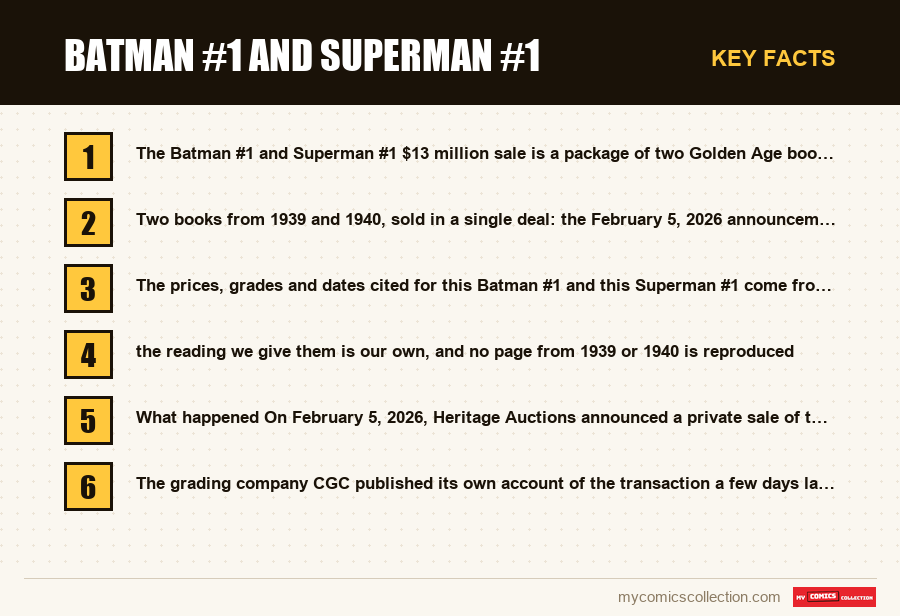
The Batman #1 and Superman #1 $13 million sale is a package of two Golden Age books announced by Heritage Auctions on February 5, 2026: a CGC 9.4 Batman #1, the highest-graded known copy, for $6 million, and a CGC 8.5 Mile High Superman #1 for $7 million. Both books belonged to the same Heritage client and were sold together to an anonymous buyer, who keeps them in a private collection.
Two books from 1939 and 1940, sold in a single deal: the February 5, 2026 announcement is unusual in linking the two most enduring heroes of publisher DC in one transaction. By its price, it is also one of the standout events of a start to the year that was already busy for the vintage comic market.
The prices, grades and dates cited for this Batman #1 and this Superman #1 come from Heritage's announcement, the CGC text and the market press; the reading we give them is our own, and no page from 1939 or 1940 is reproduced.
What happened
On February 5, 2026, Heritage Auctions announced a private sale of two books: a copy of Batman #1 graded CGC 9.4 and a copy of Superman #1 graded CGC 8.5, with Mile High pedigree. The total is $13 million. The Batman went for $6 million, the Superman for $7 million. The grading company CGC published its own account of the transaction a few days later, on February 10.
The sale grew out of a phone call. Heritage's consignment director, Nathan Howerton, reached out to a longtime client of the house who owned both books, and they agreed to sell them together in a private transaction. Jordan Seymour of SemperFi Comics put the books in touch with the buyer. The buyer remained anonymous and now keeps the books in a private collection.
The two credentials of the package are specific. The Batman #1 is described by the sources as the highest-graded known copy of that issue. The Superman #1 is described as the second highest-graded copy of its issue, and it carries the Mile High pedigree notation. The Batman issue is dated 1940, the Superman 1939, according to the specialist press.
CGC's release presents the sale as a new peak for a Batman comic: the result is nearly triple the previous benchmark for the character. The documents we read give neither the amount nor the grade nor the date of that earlier benchmark, so we do not invent them.
One last timeline marker: this announcement came after two other moments at the high end of the market. In November 2025, the Heritage auction of a Superman #1 CGC 9.0 stopped at $9.12 million. In January 2026, the transfer of an Action Comics #1 graded 9.0, priced at $15 million, was covered in another article on this guide.
Point 1: Batman #1, a copy that had already been through the auction room
With Batman #1, the hero gets a series of his own. The Joker and Catwoman make their first appearances in it, and it is this double legacy that places the book at the top of want lists. To compare 1940 copies with one another, see our page on the value of Batman #1.
The copy sold in February 2026 is not unknown to the market. In January 2021, this same copy, already alone at the top of the census at 9.4, was hammered at $2.22 million in a Heritage sale, as CGC reported at the time; a GoCollect analysis published in February 2026 draws the same link between the two transactions.
What to take from this, as a matter of method, is traceability. A copy that returns to the market can be followed from one sale to the next: same grade, same book, two dates. It is the cleanest comparison, because it removes the condition variable. Other comparisons, between different copies, must always state the grade and the channel.
The grade itself, 9.4 on the CGC scale, places the copy at the top of what the grader has recorded for this issue. To read what that means on the 10-point scale, our guide to the CGC census explains how to interpret a copy's place in the population registry.
Point 2: Superman #1 and the Mile High notation
Superman #1 is the first book to carry the character's name as its title. For a collector, it is the pivot that follows Action Comics #1: the character gets his own series.
The copy sold carries a CGC 8.5 grade and the Mile High pedigree notation. In CGC's vocabulary, a pedigree designates an original collection whose books are recognized as a set. In the case of Mile High, it is the Edgar Church collection, which CGC, on its page devoted to this provenance, and GoCollect both present as the first original-owner collection to be designated a pedigree. Note that some headlines speak of a "Church" pedigree: it is the same provenance, the collector's name on one side, the collection's name on the other.
This designation matters because it is printed on the label. Our guide to CGC labels explains how to read a label's color and what it says about restoration; the pedigree notation is added there as a piece of origin information, not as an extra grade.
One reading point is essential: a Superman #1 CGC 8.5 cannot be compared to a Superman #1 CGC 9.0 just by putting the prices side by side. The two grades are not equivalent, and neither are the two channels, a public auction in November 2025 and a private sale in February 2026. We stick to the facts: $9.12 million for a 9.0 at auction, $7 million for a Mile High pedigree 8.5 in a private sale.
Point 3: From the November 2025 result to the February 2026 package
The sequence of these three announcements deserves to be laid out flat, because it shows how the top of the market has moved in a few months even though the situations are not comparable. Here are the steps, with the grade, channel and date for each.
- November 2025: a Superman #1 graded 9.0 sells for $9.12 million in a Heritage Auctions sale open to the public.
- January 9, 2026: Nicolas Cage's Action Comics #1, graded 9.0, is transferred for $15 million without going through an auction room.
- February 5, 2026: two books from the same owner go in a single package, the Batman #1 graded 9.4 for $6 million and the Superman #1 graded 8.5, Mile High pedigree, for $7 million.
First observation: two of the three results are private sales. That means their known price is an announced price and that some information, such as the number of bidders or the fees, is not published. Second observation: the February package brings together two books sold as one block. The split of $6 million and $7 million between the two appears in the releases, but nothing indicates how the parties set that allocation.
Third observation, a matter of caution: a run of results is not a trend you can extend. It documents specific copies on specific dates. The vintage comic market has very few books at this grade level, and each transaction depends on a copy, a seller and a buyer being present at the same moment.
Do you collect this series?
Track what you own, what you are missing and what your collection is worth. 7-day trial.
Start my trial →
Point 4: How to read a private sale announced by an auction house
That Heritage Auctions, a house known for public auctions, announces a private sale may come as a surprise. The mechanism is simple, though: the house has a network of clients and consignors, and it can connect a seller and a buyer without going through a room. Here, it was the consignment director who contacted the owner, and a broker from SemperFi Comics who found the buyer.
For a collector, the distinction has three practical consequences. First, there is no public lot to consult: no catalog photograph and no bidding history, only the grades, any certification numbers and the press releases. Second, transaction fees are not published. Finally, the result is an isolated data point, which does not prove what a public listing would have brought.
If you ever consider bidding on a vintage book, the method remains that of an ordinary auction: read the lot description, check the certificate, factor in the fees before setting your ceiling. If you prefer to buy by private treaty, check that the grade and the certification match in the grading company's registry.
What this means for a collector
For most readers, this result changes nothing about their collection, and it would be misleading to suggest otherwise. A Batman #1 CGC 9.4 is not a benchmark for a Silver Age Batman, nor for a modern issue, nor for another, lower-grade copy of Batman #1. That said, the news does provide habits of method.
First habit: separate the grade, the channel and the date. Every result is read with these three pieces of information. The $6 million Batman #1 is a 9.4 sold privately in February 2026; the same copy, hammered in January 2021, went for a far lower sum, but in a different market context.
Second habit: read the label, not just the grade. For a pedigree book, the origin notation adds to the grade and is part of what you are buying. If you own a vintage book, check what its label says: color, certification number, any collection notation. For ungraded books, what counts is the state of the corners, spine, cover and paper.
Third habit: protect the condition. A book from 1939 or 1940 that reaches 8.5 or 9.4 has come through more than eight decades without major alteration. In your storage room, favor neutral bags and boards, rigid boxes, storage without pressure and dry air, away from windows. These precautions add no value; they delay the loss of points. To understand which era these two titles belong to, our article on the ages of comics sets out the landmarks.
If you are looking to complete a collection around these two characters, our Superman and Batman guides describe the accessible issues and the pitfalls of each edition. To estimate a book you already own, the free estimate tool starts from the page of your own issue.
What remains to be confirmed
Our sources are Heritage Auctions' announcement, the text published by CGC and the market press. Several points are not public:
- the identity of the buyer and of the seller, who remained anonymous;
- the amount, grade and date of the previous benchmark for a Batman comic, which the sources we read do not detail;
- the exact number of Batman #1 copies recorded by CGC, which is not given in the documents consulted;
- the fees and terms of the transaction, which are unpublished;
- the future of the two books, which remain in a private collection with no announced plan for display or resale.
The ranking of the best copies is not final: new submissions to CGC can shake it up, and our observations date from the time of writing.
Frequently asked questions
Together, $13 million, in a private sale announced on February 5, 2026 by Heritage Auctions. The CGC 9.4 Batman #1 was paid $6 million and the CGC 8.5 Mile High pedigree Superman #1 $7 million. The buyer is anonymous.
It is a CGC designation for books from the Edgar Church collection. Both CGC and GoCollect present it as the first original-owner collection to be designated a pedigree. It appears on the label, next to the grade, and documents the book's origin.
Yes. This 9.4, already at the top of the population registry, went under the hammer at Heritage on January 14, 2021 for $2.22 million, according to the news CGC published at the time. GoCollect recalls that sale in its February 2026 analysis, setting it beside the $6 million result.
It opens the series devoted to the hero and presents, in its pages, both the Joker and Catwoman for the first time. For a collector, a book that introduces two major figures is a benchmark, and its grade does the rest.
Not directly. A result concerns two specific copies, with their grade, their history and their sales channel. For your books, look at the issue number, the edition and the real condition, then look for equivalent sales by grade and by method of sale.
Do you own a Batman, a Superman or another Golden Age book? Start with your issue's page.
Estimate my comic