In short
The debut of Bane is Batman: Vengeance of Bane #1, a DC Comics one-shot dated January 1993. Chuck Dixon wrote it and Graham Nolan drew it, with Doug Moench credited as a co-creator and editor Dennis O'Neil supplying the starting idea. The issue sets up the Caribbean island of Santa Prisca, the Peña Duro prison and the drug Venom. It reached shelves a few months before Bane broke Batman's back in Batman #497, which made him famous.
Bane is a rare case of a villain whose debut and whose fame sit in two different comic books. The issue that introduces him is a single oversized special, and the issue that everyone remembers is a monthly Batman from July 1993. This guide stays on the debut: what the book is, who made it, what it sets in place, and what to look at before paying for a copy.
What was checked for this page: the title and cover date of the debut, the creator credits, the earlier source of Santa Prisca and Venom, and the dates and issue ranges of the Knightfall crossover. The reading of the issue's place in a collection is our own analysis. We do not reproduce pages or dialogue, and we state no inker, letterer or colorist for the issue because we did not confirm one.

The identity of the issue: title, date and credits
The book is titled Batman: Vengeance of Bane #1, with a cover date of January 1993. It was published by DC Comics as a one-shot, thicker than a regular monthly issue. Chuck Dixon is the writer and Graham Nolan the artist. Doug Moench completes the trio of credited creators, so a full credit line for Bane carries three names.
The character did not start from a blank page. Dennis O'Neil, then the editor in charge of the Batman line, proposed the initial idea: an opponent able to beat Batman through planning rather than muscle alone. Dixon and Nolan developed that idea into a person, a history and a look. Nolan has said that Dixon came up with an evil counterpart to Doc Savage, and that he himself designed the appearance with a Mexican luchador in mind. That detail explains the mask and the heavy, wrestler's frame better than any cover blurb does.
A practical point on naming: the same issue appears in listings as Vengeance of Bane #1, as a "Special", or as a "Special #1". They describe the same 1993 book. The same words also point to a different item, Batman: Vengeance of Bane II, a 1995 sequel. When you search, read the cover date before the title.
How Bane is introduced
The issue is an origin story. It presents Bane as a man born in captivity at the Peña Duro prison, on the Caribbean island of Santa Prisca, serving a life sentence that came from the revolutionary activities of his father, who is known as King Snake. The prison authorities made the boy a test subject for an experimental drug called Venom. He survived the experiment and came out of it dependent on the substance.
That package of facts is what every later writer reuses: a childhood inside a cell block, a body built by a chemical, and an intelligence trained by years of reading and planning. The issue does not show Bane facing Batman in the form the public remembers. It builds the man first. For a collector, that matters, because the story is quiet and psychological compared with the crossover that followed it.
The ingredients were not all new in 1993. Before Bane existed, O'Neil had already drawn up the island and the drug in a multi-part Legends of the Dark Knight story, issues #16 to #20. Bane therefore arrives in a setting that was already drawn and tested. The debut issue is where a villain was attached to that setting, not where the setting itself began, and that is worth knowing when you see sellers describe the first Venom appearance and the first Bane appearance as one and the same.
The editorial context behind the character
DC wanted an event for its Batman titles in the early 1990s. The publisher had recently run a very large storyline around Superman, and the Batman group wanted something on a comparable scale, without copying it. O'Neil's answer was a villain who would exhaust Batman and then defeat him with method. Dixon, Nolan and Moench turned that brief into a character who could carry a multi-title crossover.
The calendar shows how the pieces were arranged. Four issues of Batman: Sword of Azrael (O'Neil and Quesada, October 1992 to January 1993) brought in Jean-Paul Valley, the future wearer of the costume. Vengeance of Bane #1 carries the January 1993 date. The event that tied these threads together, Knightfall, spans nine Batman issues (#492 to #500) and eight Detective Comics issues (#659 to #666), and Batman #491 serves as its closing prelude. The debut was positioned to introduce Bane to readers just ahead of the story that would use him.
If you collect by creator, the debut also gives you a clean entry on each of three names. Dixon went on to write Bane repeatedly, Nolan drew him in the same period, and O'Neil's editorial role links the book to his own writing on the character's world. The O'Neil hub on this site lists his other issues.
Why the issue matters to collectors
A first appearance is valued because it is the earliest page on which a character exists, and Bane has become one of the best known Batman antagonists. His fame is wider than comics. The 2012 film The Dark Knight Rises put a version of him in front of a large audience, and the New 52 reintroduced him in Batman: The Dark Knight vol. 2 #6 in April 2012. Each of those moments brought readers back to the original book.
The debut also has a quality that the famous back-breaking issue lacks: it is the story of who he is. Readers who come to Bane through Knightfall often discover that the origin tells them why the plan in Knightfall looks the way it does. A collection that holds both issues tells the whole tale in two physical objects, one for the person and one for the event.
Keep the hierarchy straight when you plan a purchase. The debut is the first appearance. Batman #497, dated July 1993, is the better known key issue, with a cover by Kelley Jones and a break splash credited to Jim Aparo. Many people look for both, and a few buy the second one believing it to be the first appearance. It is not: the character was already in the world six months earlier.
Do you collect this series?
Track what you own, what you are missing and what your collection is worth. 7-day trial.
Start my trial →
Reprints and issues that get confused with it
Three different things are regularly mixed up with the debut, and they deserve to be separated.
The first is the 1995 sequel, Batman: Vengeance of Bane II, a different book with a different date. The second is Batman #497, the monthly issue with the famous cover. The third is the trade paperback that opens the event, Broken Bat, released in September 1993 and gathering Batman #491 to #497 plus Detective Comics #659 to #663. That volume does not contain the origin special, so it is not a way to read the debut story.
The crossover was reissued in several waves: a three-volume set in 2012, omnibus editions in 2017 and 2018, and anniversary editions in 2018 and 2019. Earlier trade printings carried Kelley Jones covers, while later printings used a different design. None of these is a copy of the original 1993 special. If your goal is the first printing of the first appearance, the item must be the January 1993 comic book itself, not a collection that references it.
Inspecting a copy of the January 1993 special
Because the issue is a thicker special, its spine and cover edges carry more stress than a thin monthly. Start with the spine: look for stress lines, color breaks and any splitting at the staples. The cover of a 1990s comic with a glossy finish shows handling more easily than older matte stock, so look at the corners and the edges under raking light.
Check the interior for tears at the staples and for any trimming. Confirm that the center pages are attached and that the book has its original cover. A comic with a restored or replaced cover should be sold as such, and a seller who is vague about restoration is a reason to ask more questions.
If the listing says a copy has been graded and encapsulated, read the label. A label should name the title, the issue number, the cover date and the publisher. Compare it with what you know: January 1993, Batman: Vengeance of Bane, DC Comics. A label that gives a different year or a different title is a sign to stop and verify. Photographs should show the actual front, back and spine of the copy, not a stock image.
Finally, set a method rather than a number. Compare several sold listings of the same grade and the same version of the book, discard outliers, and prefer the sales that include clear photographs. A free valuation tool can help you frame the question, but the physical condition of your copy decides which comparable applies.
The appearances that follow and are worth reading
Once you hold the debut, a short chain of later books explains what the character became. These are verified entries with dates and credits.
Batman #497 (July 1993). Part 11 of Knightfall, with a cover by Kelley Jones. Bane breaks Bruce Wayne's back in the issue, with the splash page credited to Jim Aparo. The saga then has Jean-Paul Valley take over the costume.
Batman #500 (1993). A triple-size issue in which Jean-Paul Valley, in a new mechanical suit, defeats Bane. It closes the Batman part of the crossover.
Batman: Vengeance of Bane II (1995). A sequel in which Bane swears off Venom, a vow that later writers do not always keep.
Secret Six (from 2008). The ongoing series, launched in September 2008, brings Bane in as a regular member of a team of morally gray characters and gives him a different role from the antagonist of 1993.
City of Bane (2019). Tom King's arc in the monthly Batman series shows Bane taking control of Gotham.
How the debut fits in a Bane shelf
A tidy Bane shelf can be organized in three layers. The first is the origin, which is the January 1993 special. The second is the event, the 1993 issues of Batman and Detective Comics inside the Knightfall range. The third is the later reinvention: the 1995 sequel, the Secret Six run and the 2019 arc.
The reason to separate them is practical. Each layer has a different cost of entry and a different level of scarcity. The event layer is spread across many issues, which means you can build it slowly. The origin is one book, which means you either have it or you do not. The later layer rewards readers who like long character arcs. The related guides on this site cover each layer with more detail, and you can follow them from the links above.
If you are new to the character, reading order matters. Read the event first for the shock, then the origin to understand the man, then the later material for the change. If you are already a collector, the sequence for purchase is usually the opposite: the origin first because it is the single hardest target, then the event issues.
Frequently asked questions
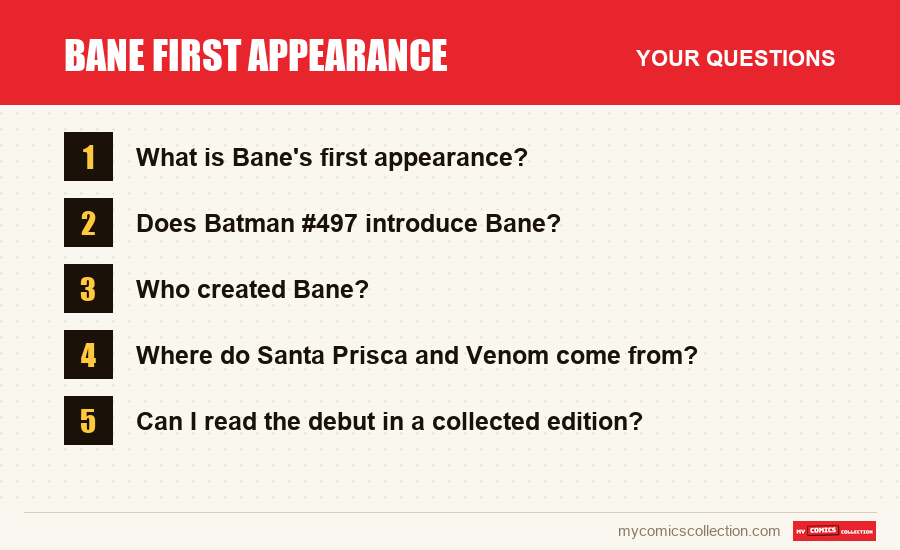
Look for Batman: Vengeance of Bane #1 with the January 1993 cover date. Chuck Dixon wrote it and Graham Nolan drew it, with Doug Moench credited as a co-creator. Some listings call it a "Special"; the item is the same one-shot, which is thicker than a standard monthly issue.
No. Batman #497, dated July 1993, is the issue in which Bane breaks Batman's back, with a Kelley Jones cover and a splash page credited to Jim Aparo. The character had already been introduced in the January 1993 special, several months before the monthly issue reached readers.
The credited creators are Chuck Dixon, Graham Nolan and Doug Moench. Dennis O'Neil, the Batman group editor, proposed the starting idea of an opponent who defeats Batman through method, and Dixon and Nolan developed it. Nolan has said that he designed the look with a Mexican luchador in mind.
The island and the drug were set up beforehand in the Legends of the Dark Knight serial that ran #16 to #20, written by O'Neil. The January 1993 special attached Bane to that setting. So the debut issue is the first Bane appearance, but it is not the first time Venom or Santa Prisca appear in print.
The Knightfall collections, such as Broken Bat from September 1993, the 2012 three-volume set and the 2017 and 2018 omnibuses, cover the crossover, not the origin special. For the debut story, look for a collection dedicated to Batman and Bane, and check its contents list before buying.
Holding a copy of Batman: Vengeance of Bane #1 or of Batman #497? Describe its condition and get a free estimate.
Estimate my comic