All of Rick Remender's personal series share three properties that his commissioned works do not: they have an ending, they have never been revived, and they have had only one artist. This is not an accident of production but the direct consequence of an editorial model where the author retains his rights. For a collector, this changes everything: no double numbering, no relaunch, no continuity to unravel: a number designates a single object, which is never guaranteed elsewhere.
So-called “creator-owned” publishing is often presented as a question of artistic freedom. This is true, but incomplete: it also produces objects that are materially different, and simpler to collect.
This article explains what this model actually changes, what it costs, and why its consequences are directly reflected in the price and availability of booklets.
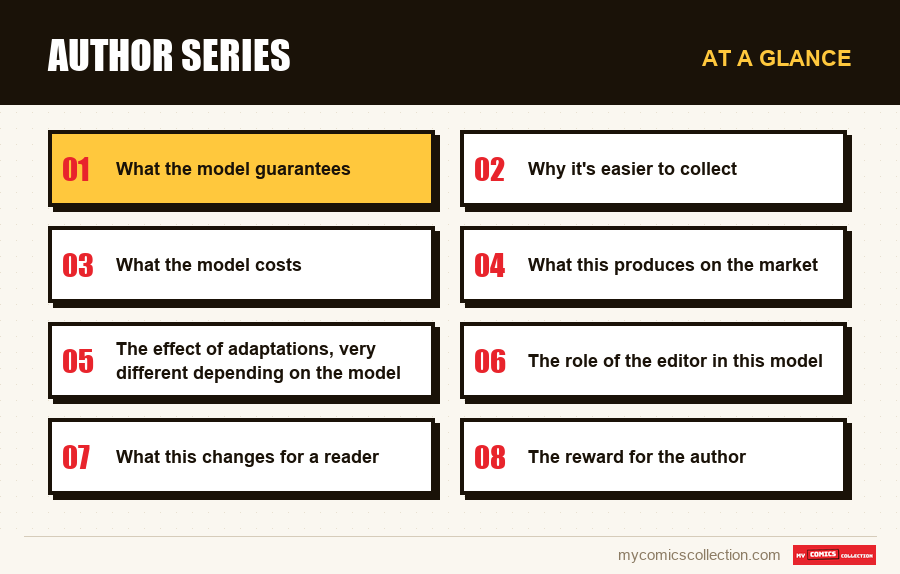
What the model guarantees
An ending, decided by the author
A series of publishers does not end: it changes hands. A title belonging to its author stops when the author has finished telling the story.
This is why each of his personal series is concluded, and none continues under another pen.
Une numérotation unique
No restart from zero, no double numbering, no change of title along the way. A number designates a single issue, definitively.
A designer from start to finish
The screenwriter chooses his artist and keeps him. None of his personal series has been replaced: which is structurally impossible to guarantee with a publisher.
Aucun croisement obligatoire
No editorial event that crosses the series and requires purchasing three other titles to understand a chapter.
Why it's easier to collect
The difference is not ideological: it is measured by the amount of information you need to know to identify a copy.
On a series from a major publisher, one issue alone is never enough. It takes the year, because the reminders multiply the issues bearing the same number. You need the screenwriter, because the series has had several authors. Sometimes you need the exact title, which changed during publication.
On a series belonging to its author, the title and number are enough. There is only one issue with this combination, and there will never be another. This is a considerable comfort, the value of which we only measure after having attempted to complete a series of the other type.
This also applies to the estimate. A reference on an author's title designates a unique object; the same information on a series relaunched three times does not designate anything precise without a year.
The only remaining trap. The bound volumes exist in several presentations with different layouts. This is true in this segment as elsewhere, and it is the main source of error: that of duplicates purchased without knowing it.
The numbering of the issues is reliable; that of the volumes is not. Recording the range of chapters that a volume contains remains essential.
What the model costs
Smaller print runs
A title launched without a known character is cautiously ordered by booksellers. The first issues are therefore rarer: good news for the value, bad news for those who want to complete.
Aucune avance de sécurité
The author and designer are paid from sales. A series that sells poorly ends, sometimes before the planned end: the risk is real and borne by them.
Des calendriers irréguliers
Without the industrial apparatus of a large publisher, delays and pauses between arcs are common. Several of his series have experienced them.
Less visibility
No character known to attract the eye on the shelves. These series are discovered by recommendation, which leaves excellent titles largely ignored.
What this produces on the market
The economic consequences of this model can be seen directly in the price structure, and they are consistent from one title to another.
The value focuses entirely on the first number. It was printed before the series had proven itself, so in conservative quantities. The following have benefited from increased orders and remain abundant indefinitely.
It's the exact opposite of a major publisher's series, where the value follows the event numbers-first appearance, death of a character, change of costume-distributed throughout the publication. On an author's title, there is no event of this type, since there is no collective continuity to punctuate.
The practical consequence is clear: in this segment, actively searching for anything other than the first number makes no sense. The others can be found effortlessly and at almost zero cost, regardless of their content.
The effect of adaptations, very different depending on the model
Here is a consequence of the property regime that we rarely suspect, and which is nevertheless visible in the prices.
When a series belonging to its creators is adapted for the screen, it is they who negotiate and perceive. The publisher reprints the volumes in quantity to accompany the release, making the story plus easy to find, no less.
But the original fascicles are not reprinted identically. The gap therefore widens between suddenly abundant volumes and a first issue whose stock remains what it was. An adaptation makes reading more accessible and the collectible more rare, simultaneously.
On a series from a major publisher, the effect is distributed quite differently: the demand is for the issues where the characters seen on the screen appear, scattered over decades of publication. There is not an object to search for but a list, and it is constituted by the continuity rather than the chronology of the series.
The role of the editor in this model
A clarification is necessary, because the expression “author-owner” is misleading: these series are not self-published.
A publisher intervenes well: it prints, distributes, manages relations with booksellers and advances part of the costs. What it doesn't do is acquire the rights to the story and characters, which remain with their creators.
This distribution explains the properties described above. The publisher has no interest in relaunching a series that does not belong to him, nor in entrusting the continuation to someone else: he simply does not have the right to do so. The stability of numbering arises from the legal regime, not from an editorial virtue.
She also explains what happens when a series ends due to lack of sales. It does not pass to another author: it ceases, and nothing replaces it. The absence of sequence is here a property of the model, not an accident.
Collecting this series?
Track what you own, what you are missing and what your collection is worth. 7 day trial.
Start my trial →What this changes for a reader
Three concrete advantages, which are not abstract.
You can read an entire series. Without external continuity, without obligatory crossover, without prequel to know. What the series contains is all there is to read.
Endings exist. A story designed to end is constructed differently from a series that must be able to continue indefinitely. The stakes can be final, the characters can die for good.
The graphics unit holds. A single designer from start to finish gives each series an identity that successive replacements prevent from obtaining elsewhere.
The reward for the author
This model is not an obvious choice, and it is worth saying what it requires, otherwise it would be described as a benefit without cost.
An author who writes a character belonging to a publisher receives a salary, without risk, and benefits from a pre-existing readership: the series sells because the character is known, independently of him. An author who launches a title in his own name has none of this: he is paid on sales, and he must build his audience himself.
This is why the usual trajectory goes in one direction and rarely the other. We go through a major publisher to gain notoriety which will then allow us to launch our own titles. The graphic address book created on this occasion also becomes the real asset of the personal series that follow.
For the reader, the conclusion to be drawn is nuanced: the two regimes are not opposed morally, they follow one another in a career. The second generally does not exist without the first.
What to record
The model simplifies inventory, but it doesn't eliminate it, and what's left to note isn't what you first think of.
For booklets: title, number, cover. The year and the screenwriter become superfluous, which is never the case on a publisher's series. Coverage remains essential: variants also exist in this segment.
For volumes: edition and chapter range. This is the only point where this model does not provide any simplification, and where errors cost the most.
The designer, once for the series. Sufficient here, since it does not change: with one exception in its bibliography, a series where the artist changes with each issue and where the field must be filled in copy by copy.
How to spot a title like this
The distinction is not always obvious on the shelves, and two clues are enough to quickly decide.
The first is the copyright notice, usually in small print on the credits page. A person's name appears on a title belonging to its creators; a company name over the others. This is the most reliable criterion, and it is never wrong.
The second is the numbering itself. A series whose number well exceeds a hundred without ever having started again at one, or on the contrary a short series which stops short at a round number, almost always falls under this model. Repeated reminders are the other's signature.
These two clues are worth well beyond this author, and they allow you to know, before purchasing, how much information you will need to remember to identify the copy later.
Frequently asked questions
No, a publisher prints and distributes. The difference lies in ownership: the rights to the story and the characters remain with the creators, whereas they belong to the publishing house in the classic model. It is this legal regime, and not an editorial policy, which guarantees the stability of the numbering.
Because a number designates a single issue, definitively. Without reminders or double numbering, the title and number are enough to identify a copy, whereas a series from a major publisher also requires the year and the name of the screenwriter to remove ambiguity.
She stops, and no one picks her up. Unlike a publisher's series which would pass to another author, a title belonging to its creators simply ceases to exist. The absence of a sequence is a property of the model, not an accident.
Rarely in this segment. The value there is concentrated on the first issue, printed before the series had proven itself; the following remain abundant and cheap indefinitely. It's the opposite of a major publisher's series, where event issues punctuate the entire publication.
It does not guarantee anything of the sort, and to pretend so would be dishonest: there are excellent series in both regimes. What it guarantees are material properties (an ending, stable numbering, a constant designer) which make the story more coherent and the object easier to identify.
The numbering is reliable, not the volumes
In this segment, a number designates a single issue, but a “volume 2” still designates several contents.