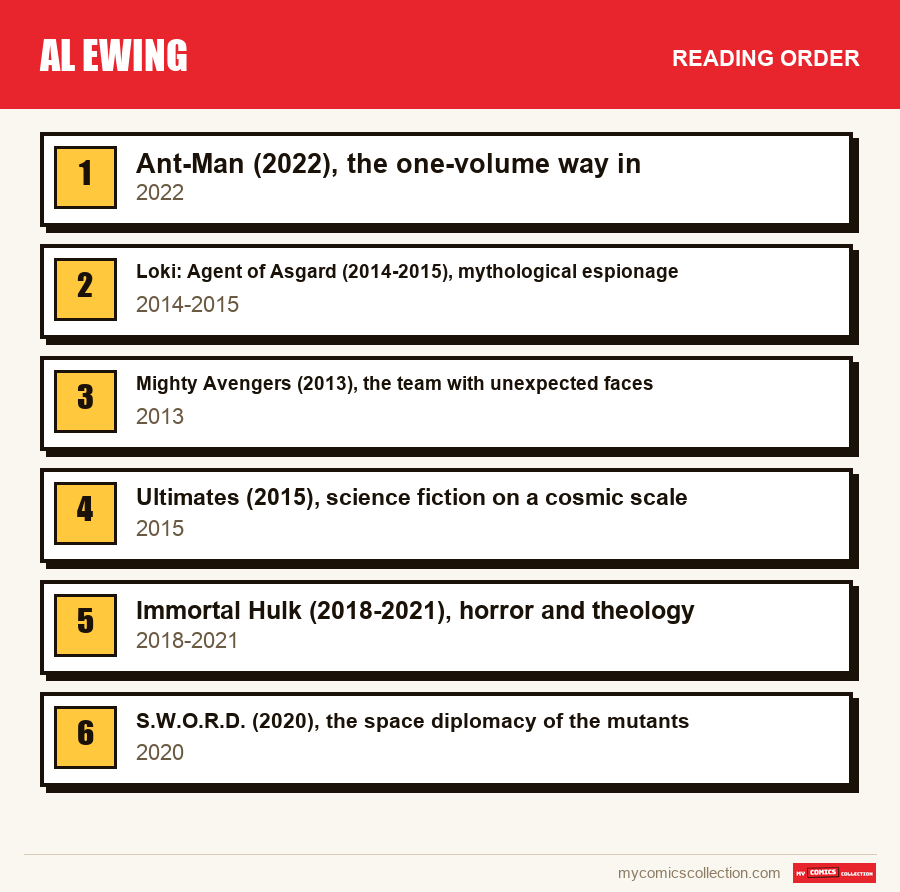
To approach Al Ewing, start with the 2022 Ant-Man miniseries (four chapters, art by Tom Reilly), then move on to Loki: Agent of Asgard (2014-2015, seventeen issues, with Lee Garbett). Next read Mighty Avengers (2013) and the Ultimates (2015), before the summit of the path: Immortal Hulk (2018-2021, fifty issues, with Joe Bennett). Save S.W.O.R.D. (2020) for last, since that series assumes you know the Krakoa mutant era. Each step reads on its own, but they shed light on one another.
Ewing has written for Marvel for more than ten years, and the bibliography throws off any reader who arrives without a guide: a mythological spy comedy, a body-horror book, a cosmic team, a tale of space diplomacy. What ties them together is neither genre nor character. It is a marked taste for continuity, which Ewing treats as material to work with rather than baggage to carry.
As always on this guide, only verified facts (creators, issues, dates) are stated as fact; the analysis is our own, with no reproduction of protected art or dialogue.
The principle behind this path
This guide does not tell Ewing's life story, and there is no biographical article here to point you to. The two most useful neighboring reads are our profile of the first issue of Immortal Hulk, which details the 2018 publishing context, and our ranking of the best Hulk runs. The rest of this page is only about reading.
The ordering criterion is the effort asked of the reader, not the publication date. Three things measure it: the number of issues to get through, the amount of continuity you need beforehand, and how strange the tone is. On those three axes, a four-chapter Ant-Man miniseries weighs little, while a fifty-issue horror series built on several years of Hulk weighs a lot. Between the two, the path places the team series, which multiply characters without requiring you to have read everything.
Before Marvel, Ewing wrote for the British weekly 2000 AD, notably Judge Dredd stories and the series Zombo, drawn by Henry Flint. Those works exist, but we leave them outside the path: their availability in French and in collected editions varies too much to build a reliable reading order on.
Step 1: Ant-Man (2022), the one-volume way in
This four-chapter miniseries, drawn by Tom Reilly, parades the wearers of the Ant-Man costume across the eras, from Hank Pym to more distant heirs. The thread is one of inheritance: each receives a name, a suit and a fault to make right. No prior reading is required, and the volume ends without leaving a loose thread.
Why start there: in twenty minutes you see Ewing's method, which is to link characters far apart in time through a simple idea, then put it to work. Our ranking of Ant-Man runs deliberately gives it a modest place, because the series counts as a synthesis more than a peak. That synthesis role is exactly what makes it the first read.
For collecting, the miniseries fits in four single issues or one collected edition. Both routes are equal: if you mainly want to read, take the collected edition; if you want a complete piece to shelve, four issues come together fast.
Step 2: Loki: Agent of Asgard (2014-2015), mythological espionage
Seventeen issues, drawn by Lee Garbett. Loki, a young adult, works as an agent of Asgard and carries out discreet missions in exchange for the erasure of past misdeeds. Meanwhile, a future version of himself, now a tyrant, hunts him down. The tone is that of a spy thriller: informants, contracts, bargaining, with constant irony.
The series builds on the child imagined by Kieron Gillen in Journey into Mystery, and reads better after it. It remains understandable without it, though, since Ewing recalls the essentials as the chapters go. Our guide to the best Loki runs explains this lineage in detail, and the Loki hub gathers the other reads on the god of mischief.
It is the first long series of the path: seventeen single issues, a clean beginning and end. For collectors, a run of this size is easy to complete from the boxes of recent issues. Just look out for issue 1, which buyers often ask for separately.
Step 3: Mighty Avengers (2013), the team with unexpected faces
Launched in 2013, this series entrusts an Avengers team to Luke Cage rather than the usual figures. It brings together heroes the general public follows less, including Blue Marvel and Spectrum. Greg Land draws the launch, and Valerio Schiti joins in later. The script advances through small neighborhood missions as much as cosmic threats, which gives the title a more down-to-earth tone than the other Avengers series of the period.
This step shows another side of Ewing: the conductor of an ensemble, who hands the floor to each character without sacrificing any. It sets up the next one, which takes several of these heroes into a much bigger frame.
As for reading, the series is easy to follow, but ties to the other Avengers titles of 2013 do exist. If a cross-reference slips past you, move on: the main story does not depend on the footnotes. The 2013 single issues are common; the collected editions gather the start of the series in one volume.
Step 4: Ultimates (2015), science fiction on a cosmic scale
With Kenneth Rocafort on art for the 2015 launch, Ewing brings together Captain Marvel, Black Panther, Blue Marvel, America Chavez and Spectrum in a team tasked with dealing with problems before they become catastrophes. Galactus plays a central role in the early chapters. The series then continues under the title Ultimates² in 2016. The Galactus hub helps place the devourer of worlds if you know him poorly.
Here the level goes up a notch: the Ultimates juggle large-scale ideas, one per chapter, leaning on decades of Marvel cosmic stories that the text does not always re-explain. It is for the reader who already enjoyed the team energy of Mighty Avengers and is willing to read slowly.
For collecting, you need to tell apart the two volumes of 2015 and 2016, each with its own numbering. Check the exact title before buying, since the cover does not always show the suffix. For simple reading, the collected editions cover each volume cleanly.
Do you collect this series?
Track what you own, what you're missing and what your collection is worth. 7-day trial.
Start my trial →
Step 5: Immortal Hulk (2018-2021), horror and theology
Fifty issues, drawn mainly by Joe Bennett, with covers by Alex Ross. Bruce Banner dies, then returns every night as a Hulk treated like a revenant. Ewing makes it a body-horror book, mixed with reflection on death and theology. It is the series that established the writer with a far wider audience than Marvel's usual readers, and the one most guides cite first.
Why place it fifth, and not first? Because it demands time, and because its strength rests on echoes with the whole history of Hulk. A reader who has already seen how Ewing handles continuity in Ant-Man or Loki will approach it with better keys. Our Hulk reading guide gives the landmarks on what to know beforehand, and the first issue profile details the June 2018 release.
For collecting, two logics coexist. Single issue 1 draws most of the interest, while the following issues are easy to complete. To read without clutter, the first collected edition, Or Is He Both?, covers issues 1 to 5 and lets you find out very quickly whether the series suits you.
Step 6: S.W.O.R.D. (2020), the space diplomacy of the mutants
With Valerio Schiti on art, Ewing writes a short series about the space agency charged with carrying mutant diplomacy beyond Earth. It belongs to the Krakoa era, launched by Jonathan Hickman in the X-Men line, and uses its rules: the mutant nation, its laws, its resources, its protocols. The story resembles a game of political chess where each character defends a specific interest.
It is the most demanding step of the path, not for its style but for its prerequisite: without a few collected editions of the 2019-2020 X-Men line, several stakes stay opaque. It suits the reader who already follows that period, or who wants to dive into it by way of Ewing.
For collecting, the series counts a small number of single issues, which makes it simple to complete. Collected editions suit it well, all the more because the story gains from being read in one block rather than at a monthly pace.
How to read: single issues or collected editions
For a writer who works in long stories, the rule is simple: read in collected editions, and collect single issues only for what draws you through its number 1s. Collected editions spare you the frustration of a monthly series where each episode ends on a pause. They also save you from hunting for the in-between issues, especially since Mighty Avengers, Ultimates and Immortal Hulk changed artists along the way.
If you prefer single issues, apply a rigorous checking method. First, verify the volume title (the Ultimates of 2015 and those of 2016 do not carry the same title). Next, spot the reprints of each series' number 1: a reprint is not worth the same as a first printing, and the indication appears in the legal box. Finally, variant covers are not all equally rare; when in doubt, compare them with the catalog before buying.
For recent copies, the market value of these 2013 to 2022 issues is not established, apart from the first issue of Immortal Hulk, which the reputation of the series has pushed forward. What will move the price elsewhere: the length of the series, the attention paid to the writer after a new project, and the availability of collected editions. A sold-out collected edition mechanically revives demand for single issues.
Recap: the recommended order
- Ant-Man (2022, four chapters): the short, complete way in.
- Loki: Agent of Asgard (2014-2015, seventeen issues): the mythological thriller.
- Mighty Avengers (2013): the team led by Luke Cage.
- Ultimates (2015, then Ultimates²): cosmic science fiction.
- Immortal Hulk (2018-2021, fifty issues): the summit, to tackle with time to spare.
- S.W.O.R.D. (2020): the series most dependent on its context.
If you only have time for one read, take Agent of Asgard; for two, add Immortal Hulk. The rest deepens the picture of the writer without changing the essentials.
Frequently asked questions
The 2022 Ant-Man miniseries, in four chapters drawn by Tom Reilly, is the shortest and needs no prior reading. For a longer story, Loki: Agent of Asgard (2014-2015, seventeen issues) is the other good way in. Immortal Hulk comes better after those two reads.
The basics are enough: Bruce Banner, gamma radiation, the character's double face. The first issue of June 2018 reads on its own. The more you know Hulk's history, the more of Ewing's echoes you will notice, but nothing obliges you to read fifty years of series beforehand.
Fifty issues, published between June 2018 and 2021, written by Al Ewing and drawn largely by Joe Bennett, with Alex Ross on most of the covers. The first collected edition, Or Is He Both?, gathers the first five issues, which is enough to test the series.
It is preferable, without being mandatory. Agent of Asgard extends the child Loki of Journey into Mystery and picks up its themes, but Ewing recalls the essentials along the way. A reader in a hurry can therefore start with Ewing, then go back to Gillen with a better-informed eye.
Collected editions for reading, since the stories stretch over long sequences and sometimes change artists. Single issues for collecting a specific title, especially the first numbers. The two can be combined: a collected edition for reading, the number 1s for the collection.
An issue of Immortal Hulk, Loki or Mighty Avengers sleeping in your boxes? Get it appraised before you decide.
Estimate my comic