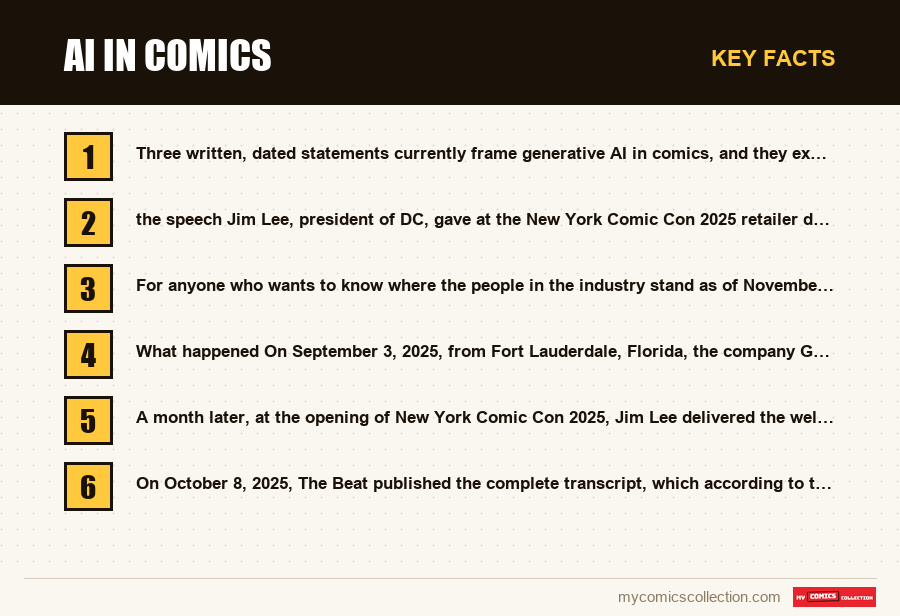
Three written, dated statements currently frame generative AI in comics, and they explain why readers and creators are pushing back: GalaxyCon's September 3, 2025 press release, which bans AI-generated art from its conventions; the speech Jim Lee, president of DC, gave at the New York Comic Con 2025 retailer day, with a transcript DC supplied and The Beat published on October 8, 2025; and the official Eisner Awards FAQ, which rules out any submission created in whole or in part by AI.
The debate over generative AI has reached the comics world through several doors at once: the artist alleys at conventions, publishers' speeches to specialty retailers, and the rules of professional awards. For anyone who wants to know where the people in the industry stand as of November 2026, the safest approach is to stick to the texts those people published or released themselves, and to read them to the letter.
For this article, we read three original documents: the GalaxyCon press release distributed through PR Newswire, the transcript of Jim Lee's speech that DC sent to The Beat, and the Eisner Awards frequently asked questions page on the Comic-Con International website. We do not repeat any accusation aimed at a specific work or person; the collecting method suggested below is our own reading.
What happened
On September 3, 2025, from Fort Lauderdale, Florida, the company GalaxyCon announced in a press release distributed on PR Newswire a ban on all AI-generated art at its shows, effective immediately. The measure applies to artists, vendors, and guests at four brands: GalaxyCon, Nightmare Weekend, Animate!, and Superstar Comic Con. The release specifies that the vendor terms and conditions were amended to write a zero-tolerance policy into them.
A month later, at the opening of New York Comic Con 2025, Jim Lee delivered the welcome speech for the day reserved for retailers. On October 8, 2025, The Beat published the complete transcript, which according to the editor's note was supplied by DC. In it you can read one unambiguous sentence: DC Comics will not support AI-generated storytelling or artwork, as long as Jim Lee and Anne DePies run the publisher.
The third text, and the most normative, is the Eisner Awards frequently asked questions page, hosted by Comic-Con International, which answers the question of whether material created by AI can be submitted. The answer is no, whether the AI is involved in part or in full. That page, which we consulted on November 21, 2026, does not say when the rule was added.
These three documents come from different kinds of players (a convention organizer, a publisher, and an organization that hands out awards) and are not part of a coordinated action. Each one governs a specific territory: what is sold at a booth, what a publisher agrees to publish, and what a jury agrees to consider.
Point 1: The GalaxyCon press release, a set of vendor rules
The September 3, 2025 text is short and reads like an organizer's decision. GalaxyCon says it is "proud" to announce the ban, effective immediately, and points to its vendor terms, where zero tolerance is now written down. The scope is broad: it covers not only the artists set up in the dedicated aisles, but also commercial vendors and guests.
Mike Broder, founder and president of GalaxyCon, justifies the measure by the way AI models are trained today, which in his words raises ethical and moral questions that the industry can no longer ignore. The release also recalls what the company presents as its long-standing support for artists, and announces that it will keep going in that direction.
For a visitor or a buyer, the practical reach of this text is contractual: it sets out what a vendor commits not to offer at a show under any of these four brands. It describes no enforcement procedure, does not specify how a violation would be established, and says nothing about works sold anywhere other than at a convention. It is a marketplace rule, in the physical sense of the word.
It is also worth noting what the release does not do: it names no vendor, mentions no incident, and takes no position on uses of AI beyond the creation of images that are sold or displayed. Reading it therefore has to stay within its subject.
Point 2: Jim Lee's statement to retailers
The welcome speech at the New York Comic Con 2025 retailer day was not devoted solely to AI. Jim Lee goes over the challenges the comics market has been through, and places AI in a list that, according to the transcript, runs through the turn of the year 2000 and then through NFTs. Among the challenges ahead, the text explicitly cites AI-generated writing and art.
The central line is quoted word for word by The Beat: DC Comics will not support AI-generated storytelling or artwork, not now and not later, as long as Anne DePies and Jim Lee are at the helm. Jim Lee adds that AI does not dream, does not feel, and that it does not make art but aggregates it. The Beat reports that the room, made up of comic shop owners, applauded.
That sentence should be read for what it is: a commitment from leadership, spoken aloud in front of business partners, then made public in written form by the publisher itself through the transcript sent to the press. It commits DC on its editorial policy; it is not presented as a published contractual clause, and it is explicitly tied to the leadership team in place in October 2025.
The statement was widely relayed in the following weeks, notably by Gizmodo and the Daily Dot. For the purposes of this article, we stick to the transcript published by The Beat, which is the text closest to the spoken words. The page devoted to Jim Lee also retraces the career as an artist that preceded his role as president.
Point 3: The Eisner Awards rules
The Eisner Awards are administered by Comic-Con International and presented every summer during San Diego Comic-Con. Their frequently asked questions page contains an entry devoted to AI, worded as a question: can material created by artificial intelligence be submitted? The site's answer is that material created by AI, in part or in full, does not meet the submission requirements.
The same entry adds that if there is any question, the awards administrator and the judges are the sole judges of eligibility. In other words, the rule does not come with a list of technical criteria: it entrusts the assessment of borderline cases to the people in charge of selection.
Two points of interpretation deserve emphasis. First, the rule concerns works submitted to the jury, not a publisher's entire output: a publisher may have its own policy, stricter or looser, and may or may not submit its titles. Second, the phrase "in part or in full" is broader than a ban on works that are entirely generated: it also covers a partial contribution to a collaborative book.
The page does not date the introduction of this rule, and in the pages we read, Comic-Con International has not published a more detailed document on how to declare or verify the absence of AI in a submission.
Do you collect this series?
Track what you own, what you are missing and what your collection is worth. 7-day trial.
Start my trial →
Point 4: Three texts, three scopes
Placed side by side, the September 2025 press release, the October 2025 transcript, and the Eisner FAQ do not say the same thing, and that is what makes them useful to read separately. GalaxyCon governs sales and display at its shows. DC states an editorial commitment from its leadership. The Eisners set an eligibility condition for an award.
None of these texts precisely defines what counts as "generative AI" as opposed to the everyday digital tools used for drawing and coloring. The GalaxyCon release speaks of AI-generated art, the DC transcript of AI-generated storytelling and artwork, and the Eisner FAQ of material created by AI. These similar wordings leave it to each organization to settle concrete cases, as the Eisner FAQ in fact says expressly.
For a reader trying to understand the opposition visible among some readers and creators, these texts give the arguments as the players themselves put them: the training of the models for GalaxyCon, the nature of creation for Jim Lee, and the protection of competition conditions for the Eisners. We do not comment on them beyond their letter.
What this changes for a collector
These decisions do not change the usual criteria for judging a copy. They do, however, underline the value of documenting precisely what you own: which edition, which printing, which cover, and who signed it according to the printed credits. Here is a neutral method, valid for any issue, that assumes nothing about where an image came from.
Identify the edition. On a recent American single issue, it is the indicia that tells you: that short block of legal notices, placed depending on the publisher at the foot of an interior page or at the end of the issue, gives the publishing company, the exact title of the series, the numbering, and the month shown on the cover. It is the starting point for telling apart two series with the same name relaunched a few years apart, or a regular issue from a special. For older issues, the barcode and the cover price let you separate direct market copies from those meant for newsstands, as our guide on the difference between direct and newsstand explains.
Identify the printing. A reprint is flagged in several ways depending on the publisher and the era: a "second printing" notice or equivalent on the cover, a modified cover, a line of descending numbers in the indicia of a collected edition, or a printing note at the end of the volume. Note these clues one by one, rather than relying on the general look of the book. Our article on first printing versus reprint details the signs to check.
Identify the cover credits. Variants are often credited in the indicia or on the credits page, with the name of the artist for each cover. The solicitations the publisher releases several months before the on-sale date also list the planned covers, but a solicitation is an announcement: it can be revised before printing. The credit that counts for your copy is the one printed in the issue you are holding. For the different types of alternate covers, see our guide to cover variants.
Document. For each piece, note the purchase date, the source, the edition, the printing, and the exact cover, and keep a dated screenshot of the solicitation if a variant interests you before it comes out. If you resell, describe the copy with these verifiable details rather than with adjectives. These habits apply to a recent variant just as they do to an issue from the 1980s; they simply stand out more when convention and award rules insist on the human origin of the work on display.
Finally, if you buy originals or prints at a convention, the GalaxyCon text shows that a show's rules are binding on its vendors: you can ask a vendor which terms apply at the show where you are. Signatures obtained on site follow their own procedures, described in our article on convention signatures.
What remains to be confirmed
Several points appear in none of the documents we read, and we do not fill them in with guesses:
- The date the AI rule was introduced in the Eisner Awards FAQ: the page does not say.
- The declaration or verification procedure expected of Eisner entrants: no detailed document was published in the pages we consulted.
- How GalaxyCon's ban is enforced at its shows: the September 3, 2025 release describes none.
- How Jim Lee's commitment translates into written rules for DC's creator contracts: the transcript says nothing about it.
- The written positions of other publishers and other conventions: we cite none, having not read the original text.
This article describes the state of the published documents as of November 21, 2026.
Frequently asked questions
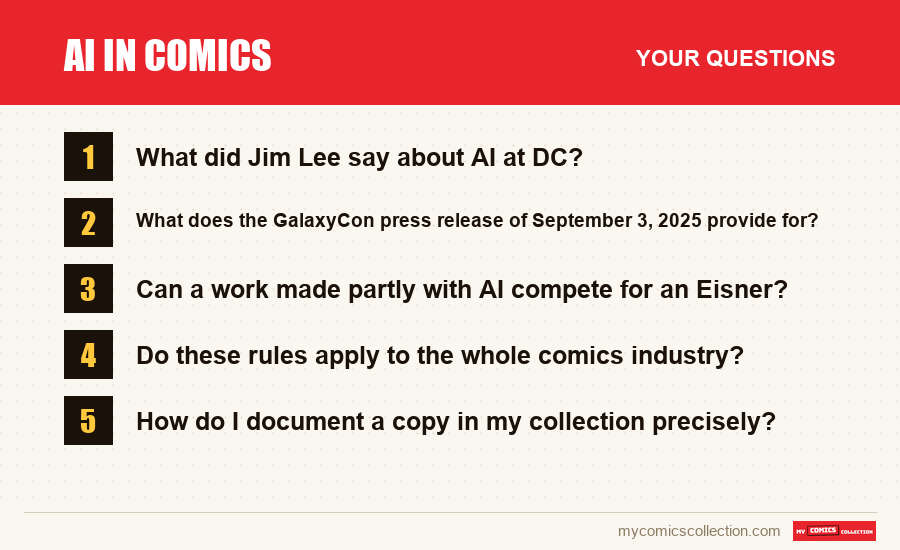
In the welcome speech at the New York Comic Con 2025 retailer day, Jim Lee said that DC will not support AI-generated storytelling or artwork, as long as Anne DePies and Jim Lee run the publisher. The Beat published the transcript supplied by DC on October 8, 2025.
An immediate ban on AI-generated art at the GalaxyCon, Nightmare Weekend, Animate!, and Superstar Comic Con shows, covering artists, vendors, and guests. The vendor terms were amended to write in zero tolerance. Mike Broder cites the ethical questions raised by the training of the models.
No, according to the official Eisner Awards FAQ: material created by AI, in part or in full, does not meet the submission requirements. In case of doubt, the awards administrator and the judges alone decide on eligibility. The page does not say since when the rule has applied.
No. Each text has its own scope: the GalaxyCon release concerns its four convention brands, Jim Lee's statement commits DC's editorial policy, and the Eisner FAQ sets the conditions of an award. Other publishers and conventions have their own rules, which are found in their own documents.
Start with the indicia (publishing company, series title, numbering, cover month), then look for reprint marks and the name of the artist credited for the cover in the issue itself. Keep the dated solicitation for a variant and the source of the purchase, and describe these details if you resell.
Have you noted the edition, the printing, and the cover credit of an issue in your collection? Get it appraised based on those details and its condition.
Appraise my comic