30 Days of Night (2007) David Slade , with Josh Hartnett, adapts the comic book of Steve Niles and Ben Templesmith (IDW, 2002). The film stays true to the horrific concept of vampires attacking an Alaskan town during the month-long polar night. Here is the detailed comparison, film versus comics.
Adaptation of a horror comic with a fearsomely effective concept, 30 Days of Night brings to the screen an invasion of vampires in polar darkness. Source-by-source decryption.
As in each article in this series, only verified information (creators, distribution, dates, publishers) is stated; the comparative analysis is ours, without reproducing dialogue or protected images.
Title : 30 Days of Night (2007)
Director: David Slade
Actors: Josh Hartnett (Eben), Melissa George (Stella), Danny Huston (Marlow)
Exit : October 2007
Studio: Columbia Pictures
30 Days of Night (2002): Steve Niles & Ben Templesmith
IDW Publishing: the independent publisher
Barrow, Alaska: diving into the polar night
Vampires: merciless predators
- Le concept: an Alaskan town without sun for a month.
- The attack of vampires taking advantage of the darkness.
- The sheriff Eben and the besieged survivors.
- The vampires fierce and unromantic.
- The atmosphere cold and desperate.
- Le visual style Templesmith's abstract is adapted.
- Some characters and scenes are developed.
- The comic strip, brief, is fleshed out for the feature film.
- The progress of the seat is reorganized.
- Overall loyalty to the concept and tone.
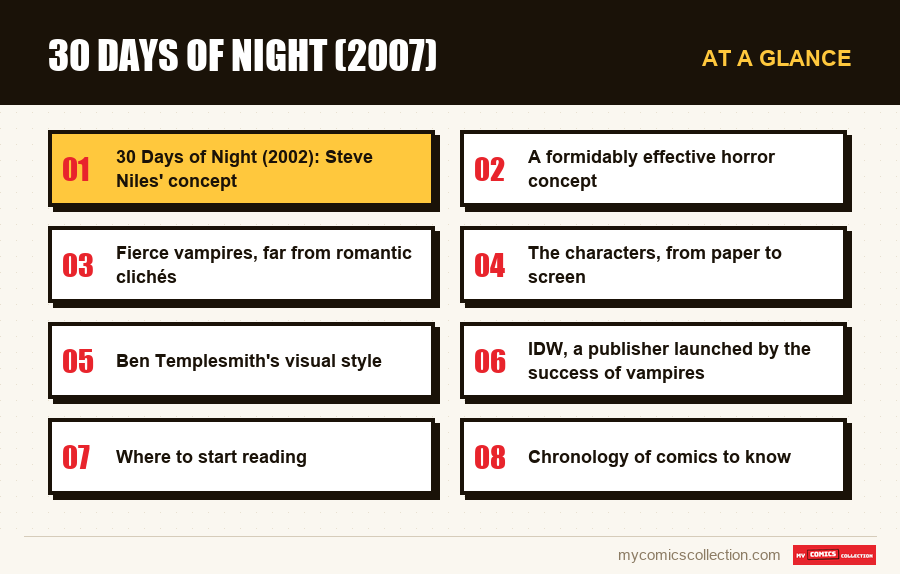
30 Days of Night (2002): Steve Niles' concept
30 Days of Night adapts the miniseries created by Steve Niles and drawn by Ben Templesmith, published in 2002 by IDW Publishing, an independent publisher. The comic is based on a fearsomely effective horror concept: in Barrow, the northernmost town of Alaska, the sun does not rise for an entire month during the winter. This prolonged polar night offers a unique opportunity to a band of vampires, who decide to attack the isolated town to feast on its inhabitants during thirty days of total darkness, without fearing the light of day which would destroy them. The story follows Sheriff Eben and the survivors as they attempt to resist these ruthless predators. This simple but brilliant concept made the comic a success, reigniting interest in a horrifying, non-romantic treatment of vampires.
David Slade's film faithfully takes up this concept and its atmosphere. Josh Hartnett plays Sheriff Eben, confronted with the invasion of vampires during the polar night of Barrow. The film preserves the premise: the prolonged darkness offering a feast to the vampires -, the siege of the city, the survivors holed up and above all the ferocious and bestial nature of the vampires, far from any romanticization. The icy, desperate and bloody atmosphere of the comics is recreated on screen. This fidelity to the concept and tone makes the film a respectful adaptation. The film, however, expands on the brief story of the comic, developing certain characters and rearranging the sequence of the siege for the needs of the feature film.
A formidably effective horror concept
The great strength of 30 Days of Night, both a comic book and a film, lies in its concept. The idea of a city plunged into night for a month, offering vampires an ideal hunting ground without fear of the sun, is remarkably effective in horror. This premise eliminates the vampires' primary weakness-daylight-for an extended period of time, creating a desperate siege situation where the inhabitants have no respite. The isolation of Barrow, cut off from the rest of the world by the cold and the distance, reinforces the feeling of trap and helplessness. This concept, both simple and brilliant, anchors the horror in a realistic situation, the polar night does exist, which makes it all the more chilling and credible.
The film fully exploits this concept, making darkness and isolation the drivers of anxiety. The long night, the cold, the snow and the lack of help create an oppressive and desperate atmosphere, faithful to the comics. The prolonged siege, where survivors must hold out day after day against super-powerful predators, generates constant tension. This effectiveness of the concept made the success of both the film and the comic strip. For the reader, it illustrates the power of a simple and strong idea, capable of renewing a genre as codified as that of vampires. 30 Days of Night invites you to discover the comic book by Steve Niles, whose formidable concept and horrific execution have marked the genre, proving that an original premise can be enough to create a memorable and chilling work of horror.
Fierce vampires, far from romantic clichés
An essential aspect of 30 Days of Night, faithfully reproduced by the film, is the treatment of vampires. At a time when the vampire was often romanticized, presented as a seductive and tormented being, Steve Niles's comics return to the sources of horror: his vampires are bestial predators, ferocious and merciless, devoid of any humanity or romanticism. They hunt, kill and feed mercilessly, like pure monsters. Their appearance, their language and their behavior radically distance them from the seductive vampire, making them nightmarish creatures. This bias has renewed the genre, reminding us that the vampire is above all a figure of terror.
The film faithfully maintains this approach. The vampires of 30 Days of Night are terrifying predators, with bestial movements and relentless cruelty, led by the chilling Marlow. Far from any seduction, they embody death and savagery. This treatment, faithful to the comics, anchors the film in pure horror and distinguishes it from romantic vampire stories. This ferocity contributes greatly to the film's atmosphere of terror and despair. For the reader, it illustrates the vision of Steve Niles, who wanted to restore the vampire to its monstrous and frightening dimension. 30 Days of Night invites you to discover comics, whose merciless vampires, enhanced by the unique visual style of Ben Templesmith, have left their mark on the horror genre and remind us that, behind the romantic myth, the vampire remains a bloodthirsty nightmare creature.
The characters, from paper to screen
- Eben Oleson: The Sheriff of Barrow, faithful to the comics.
- Stella: His companion, developed for the film.
- Marlow: The leader of the vampires, chilling and merciless.
- The people of Barrow: Survivors under siege.
- The vampires: Bestial predators, faithful to the comics.
Collecting this series?
Track what you own, what you are missing and what your collection is worth. 7 day trial.
Start my trial →Ben Templesmith's visual style
A distinctive element of the 30 Days of Night comic is Ben Templesmith's graphic style. His art, dark, abstract and expressionist, mixes digital painting, blurred textures and cold colors to create a nightmare atmosphere. Far from realism, Templesmith's line favors atmosphere, anguish and suggestion, making each plate an evocative and disturbing composition. This unique style, perfectly suited to the horror and darkness of the story, has greatly contributed to the identity and success of the comic strip. It illustrates the importance of graphic style in horror comics, where the visual atmosphere is as crucial as the storyline in instilling fear.
The film cannot exactly reproduce Templesmith's painterly style, but it captures its spirit through its artistic direction: darkness, cold, icy hues and a careful visual aesthetic creating an oppressive atmosphere. David Slade transposes the anguish and darkness of the comic strip to the screen, faithful to its visual tone. This adaptation of the atmosphere, in the absence of the exact line, honors the original work. For the reader, Templesmith's style is inseparable from the 30 Days of Night experience, an essential component of its horrific power. He reminds us that horror comics rely as much on visual art as on storytelling. Discovering comics means immersing yourself in the unique graphic universe of Templesmith, whose nightmarish aesthetic makes 30 Days of Night a visually striking work of horror with an inimitable atmosphere.
IDW, a publisher launched by the success of vampires
The success of 30 Days of Night was instrumental in the rise of IDW Publishing, the publisher that published it. Founded in the early 2000s, IDW was a young independent publisher seeking to find a place in a market dominated by big names. The triumph of 30 Days of Night, both in comics and through its film adaptation, has considerably strengthened the notoriety and credibility of the publisher, helping to make it one of the important players in American independent comics. This success illustrates how a work with a strong concept can propel a small publisher and open up new perspectives, particularly in the field of adaptations.
This trajectory testifies to the vitality of the independent scene and the role of original concepts in the success of publishers. IDW was able to capitalize on the success of 30 Days of Night to develop its catalog and acquire the licenses for many popular franchises, becoming a major publisher. For the reader and the collector, this story underlines the importance of founding works in the construction of a publishing house. She reminds us that independent comics, far from the big superhero publishers, are fertile ground where daring concepts can transform the destiny of a publisher. 30 Days of Night is not only a landmark work of horror: it is also the success that launched IDW, illustrating the link between creativity, commercial success and the development of a publishing player, in a sector where originality makes the difference.
Where to start reading
To discover the source, the comic strip 30 Days of Night by Steve Niles and Ben Templesmith (2002) is available as a collection. A short and chilling story, with a unique visual style, it offers the original experience of the concept. Sequels, like “Dark Days,” extend the universe. This cult horror comic is best enjoyed for its formidable concept and nightmarish atmosphere.
Chronology of comics to know
- 2002: 30 Days of Night: the mini-series from Steve Niles and Ben Templesmith at IDW.
- 2004: “Dark Days” and other sequels extend the universe.
- 2007: The film faithfully adapts the original concept.
Collection side: what numbers to aim for after the film
30 Days of Night points to the keys to independent comics. 30 Days of Night #1 (2002, first issue of the mini-series at IDW) is the key sought after by collectors, marking the success that launched the publisher IDW and revived interest in the horror vampire. Issues illustrated by Ben Templesmith are popular. The collections are accessible targets. These numbers cover generally affordable budgets. As always, condition and gradation determine value; relying on real recent sales is strongly recommended.
Its place in the saga and for the collector
30 Days of Night will remain as a faithful adaptation of a horror comic with a formidable concept, bringing to the screen an invasion of vampires in the polar night. For the collector, it highlighted 30 Days of Night #1, the key to the work of Steve Niles at IDW. It illustrates the power of a simple and strong concept. Beyond the film, the original comic book remains a reference in modern horror, to be discovered for its concept and the style of Ben Templesmith. 30 Days of Night reminds us that independent comics contain significant works of horror, and that an original idea can renew a genre as codified as that of vampires.
The verdict: a faithful and chilling adaptation
- Loyalty: the concept of the polar night, the attack of the vampires, Sheriff Eben, the siege of the survivors, the fierce vampires and the icy atmosphere come from the comics.
- Freedoms: the visual style of Templesmith adapted, certain characters and scenes developed, the brief comic expanded, the sequence of the siege rearranged.
- Collectible numbers: 30 Days of Night #1 (2002, IDW).
30 Days of Night faithfully adapts the horror comic by Steve Niles and Ben Templesmith, bringing to the screen its fearsome concept: ferocious vampires attacking an Alaskan town during the month-long polar night. Faithful to the concept, the chilling tone and the bestial vampires while fleshing out the story, the film is a horrifying success. For both the reader and the collector, it is an invitation to discover 30 Days of Night.
Frequently asked questions
From 30 Days of Night (2002), created by Steve Niles and drawn by Ben Templesmith, published by IDW Publishing. The comic is based on a horror concept: vampires attack Barrow, Alaska, during the month-long polar night. The film adapts it faithfully.
The concept is based on a real phenomenon: in Barrow, the northernmost town in Alaska, the sun does not rise for a month during the winter. This polar night offers vampires an ideal hunting ground without fear of the sun, which makes the horror all the more believable and chilling.
No, on the contrary. Both the comics and the film bring about a return to pure horror: vampires are bestial predators, ferocious and merciless, far from the romanticized seductive vampire. They embody death and savagery, renewing the genre by giving the vampire back its monstrous dimension.
Yes, largely. David Slade retains the concept of the polar night, the siege, Sheriff Eben, the ferocity of the vampires and the icy and desperate atmosphere. However, it expands the brief story of the comic, developing certain characters and rearranging the course of the siege for the feature film.
30 Days of Night #1 (2002, first issue from IDW) is the key sought after, marking the success that launched publisher IDW. The issues illustrated by Ben Templesmith are popular, and the collections are accessible to readers.
Does the film make you want to collect? Estimate the value for free of your numbers (30 Days of Night #1…) with our tool based on current eBay listings.