A publisher who relaunches a title starts from number 1: twenty years later, the same series name therefore carries each issue a second time. For Zatanna's appearances in Hawkman No. 4, this produces a spectacular mix: as of August 30, 2026, a generic search on a general American auction site returns 20 unverified advertisements, the lowest claimed amount of which is $3.20 and the highest $825.00, with a median of $329.98 which strictly describes neither of the two objects brought together by the query. The five cheapest listings all belong to a second series of the same name, and two of them don't say so anywhere. The pair “title + number” is therefore no longer sufficient to identify a booklet: the volume or year of launch must be added.
The confusion in question here is not a specialist subtlety. It is neither based on a variant cover that is difficult to spot, nor on a difference in printing invisible to the naked eye, nor on a printing defect that only careful examination would reveal. It is based on a banal editorial fact: a series was stopped, then resumed years later under exactly the same name, with a numbering that starts again at 1. From that moment on, two completely distinct issues, separated by more than two decades, published in unrelated industrial and commercial conditions, bear the same designation. Nothing in the way we usually talk about a comic (“such title, such issue”) allows them to be separated.
The survey carried out on August 30, 2026 on the current announcements of a general auction site on the American market gives this abstraction a very concrete form, and above all very quantified. It is necessary to clarify from the outset what these amounts are and what they are not: they are sums claimed by sellers at a given time, not completed transactions. No one paid these prices; they describe stated expectations, not an observed market. And as the reading only exists for a single date, it does not show any evolution: to speak of an increase or decrease based on this material would be a pure invention. The copies passed by a verification body were also counted separately, because they do not describe the same population of objects.
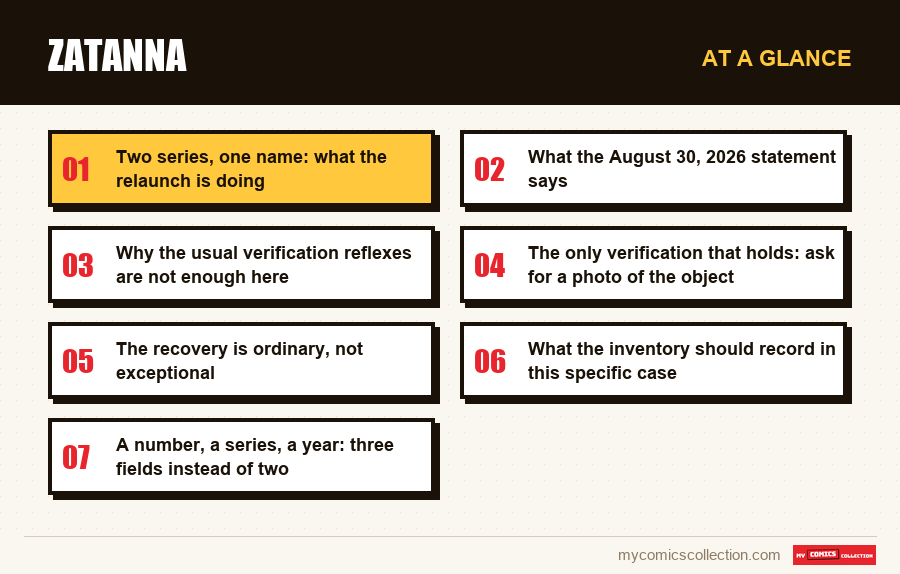
Two series, one name: what the relaunch is doing
When a publisher relaunches a title, they are obviously not trying to trap collectors. It uses a name that has recognition value, it starts with a number 1 because a first issue sells better than an issue 137, and it offers the reader a clean entry point. The decision is commercial and perfectly rational from a publishing point of view. Its consequences for the inventory, on the other hand, are lasting: from the relaunch, each issue of the new series has a perfect homonym in the old one, and this homonym can be worth a hundred times more or a hundred times less.
The case that concerns us is particularly clear because the resemblance is total on the two dimensions that the collector uses spontaneously. The title is strictly identical: not a spelling variation, not an added subtitle, not a mention of a mini-series. The number is the same: 4. And to top it off, Zatanna appears in both, which means that the search by character, which often serves as a safety net when we doubt a reference, also brings the two together in the same bag. All three usual angles of attack fail simultaneously.
What really separates the two objects is only visible in one place: the year of publication, and the volume mention that some sellers take the trouble to add. Of the five least expensive listings in the survey, two are explicitly labeled “2nd Series,” one is 1986, and two are neither. In other words: in two out of five cases, the seller's description, taken as is, contains no information allowing us to know which booklet we are talking about. The price displayed: $3.20 for the lowest: is the only clue, and a price is not proof of identity.
What the August 30, 2026 statement says
20 annonces non vérifiées, deux populations mélangées
The generic query returns 20 unverified listings, with a minimum of $3.20, a median of $329.98, and a maximum of $825.00. Twenty is a small number in itself; mixed, it becomes unusable. No price level can be deduced from such a set.
37 exemplaires vérifiés, comptés à part
The copies passed by a verification organization form a distinct group of 37 advertisements: minimum $395.54, median $825.00, maximum $7,500.00. These are again amounts claimed, not sales. The isolated maximum reflects the hope of a seller and nothing else.
The five cheapest ads are all from the second series
$3.20, $4.00, $4.99, $6.98 and $7.98: these five announcements all relate to the relaunched title, and indicate it by a mention of volume, by the year 1986, or by nothing at all. They have no connection with the 1964 issue.
Direct Edition and Newsstand on the same relaunched issue
Two ads in the second series explicitly distinguish between a « Direct Edition » edition and a « Newsstand » edition, at $4.99 and $7.98. The subdivision therefore exists within the recent series itself, which adds a level of granularity beneath the main confusion.
The most important point of this entire article is contained in a single sentence: the $329.98 median does not describe any real item. It is the arithmetic result of a stack of issues worth a few dollars and issues worth several hundred dollars, placed in the same table because they share a name and a number. A median only makes sense if we are certain that it concerns a homogeneous population. Here, the homogeneity is contradicted by reading the first five lines. To take this number as an estimate is to produce a value which belongs neither to the old issue nor to the recent issue.
The difference between $3.20 and $825.00 is not a value range for the same item. It should not be read as market amplitude, state premium or volatility. This is the distance between two different issues that the query accidentally brought together, and this distance has no economic significance.
The same goes for the difference between the unverified lower limit and the median of verified copies at $825.00: we compare a population of recent uncertified issues to a population of old copies passed by a verification body. Two criteria change at the same time, which prohibits attributing the difference to one or the other.
Why the usual verification reflexes are not enough here
Search by title does not discriminate against anything
The series name is identical character for character in both cases. No textual query on the title alone can therefore separate the two sets, whatever the care taken in the wording.
The year is not always indicated
Of the five low advertisements in the survey, only one carries a year. Filter by date assumes the seller has entered it; when the field is empty, the filter silently discards ads instead of deciding.
The volume statement depends on the seller
Two ads say "2nd Series", the other three do not. This mention is a courtesy from the seller, not a standard imposed by the platform: its absence never means that we are dealing with the first series.
The price displayed is not proof
A very low amount strongly suggests the recent series, but an uninformed seller can offer an old issue at a ridiculous price, or vice versa. Inferring the identity of the object from the price reverses the logical order of the verification.
The number alone is ambiguous by construction
After a restart, any number lower than the last of the original series exists in duplicate. The ambiguity is not accidental: it is mechanical, and it affects the entire numbered range common to the two series.
The presence of the character does not decide either
Zatanna appears in both booklets concerned. The filter by character, which often serves as a cross-reference, brings together the two populations here and reinforces the illusion of a coherent whole.
Collecting this series?
Track what you own, what you are missing and what your collection is worth. 7 day trial.
Start my trial →The only verification that holds: ask for a photo of the object
Since neither the title, nor the number, nor the character, nor the price allow any conclusion, and since the year and the mention of volume are missing in two out of five advertisements, only one thing remains: what is printed on the booklet itself. The cover bears a date indication, the inside bear bears another, the barcode or its absence also provides information on the period and the distribution circuit. These elements are on the object, they do not depend on the rigor of the seller, and they cannot be omitted by negligence of seizure.
Concretely, this means that an advertisement without a year or volume mention requires a question before any purchase: a legible photograph of the entire cover, and if possible of the interior page bearing the legal notices. This request is not aggressive; it is the natural counterpart of a market where the title and number are ambiguous. A serious seller understands it immediately. A seller who refuses or responds evasively has just given useful information about the seriousness of the ad.
We must also accept an unpleasant consequence of this reasoning: as long as the photo is not obtained, the identity of the booklet remains undetermined, and there is nothing to say about it. Neither “it’s probably the old one”, nor “given the price, it’s the recent one”. The reflex of filling uncertainty with a plausible deduction is exactly what produces the most stubborn inventory errors, because an assumption recorded in a database very quickly becomes fact for the person who rereads it six months later. On this point, the discipline of collection outfit applied to Zatanna is better than any quick estimate.
This caution has a positive corollary: once the photo is obtained, the ambiguity disappears completely. This is not a case where expertise remains questionable, where two specialists could diverge, where the state introduces a gray zone. The printed date decides, definitively. This is good news: the problem is painful but entirely soluble, provided you take action at the right time, that is to say before the purchase and before the seizure.
The recovery is ordinary, not exceptional
It would be tempting to treat this case as a curiosity, a local accident that it would be enough to be wary of once. This would be an error of analysis. Relaunching a title from a new number 1 is a common, old editorial practice that is perfectly accepted by the industry. It responds to the logic of commercial relaunch, change of creative team, repositioning of a character, or simply renewal of the readership. Nothing indicates that it must cease, and everything indicates on the contrary that it will continue.
The consequence is structural. It's not "certain series are tricky": it's "the title + number pair is an insufficient identifier, by nature". The difference between these two formulations is considerable. In the first case, we manage exceptions piecemeal, by mentally keeping a list of series to watch, a list which will always be incomplete. In the second, we change the way we record information, once and for all, and the problem ceases to arise individually.
This shift is worth making early. A collection of thirty misidentified fascicles can be corrected in one evening; a collection of several hundred, of which we no longer know which ones were seized from an ambiguous announcement, can only be corrected by taking each physical copy one by one. The cost of rigor is low at the beginning and increases very quickly thereafter. This is as true for a beginning collector as it is for a reader tracing a character's scattered appearances across several decades of publication, as shown Zatanna's editorial history.
Finally, this question goes far beyond the case of the character mentioned here. It is also not limited to old titles. A recent relaunch produces exactly the same effect as soon as a catalog accumulates enough years: it is the temporal gap which creates the ambiguity, and this gap grows on its own. Any collection intended to last will therefore one day have to face the problem, and it is better to face it cold.
What the inventory should record in this specific case
The volume or year the series was launched, next to the issue. It's the missing field that produces all the confusion described here. Without it, two lines "Hawkman No. 4" are indistinguishable in a database, while they separate a booklet for a few dollars demanded from a booklet whose verified copies are displayed at several hundred. With it, the distinction is made once upon entry and never needs to be made again.
The exact mention appearing in the original announcement, copied as is. When an ad says "2nd Series" or has the year 1986, this string of characters is the record of what was purchased. Copying it into a note avoids having to later reconstruct reasoning that you did only once, at a time when you had the announcement in front of you and when you no longer have it.
The absence of information, when it is the case, noted as such. Two of the five lower advertisements in the survey bear neither year nor mention of volume. If a copy was acquired under these conditions and the identification is based on a photo received by message, it must be recorded: “identified by photo, silent announcement”. An empty box says nothing; a box that says "nothing was specified" says something useful.
The distribution circuit when it is mentioned, Direct Edition or Newsstand. The statement shows that two advertisements from the second series distinguish these two forms for the same number, at $4.99 and $7.98. It is an additional subdivision within a series already homonymous with another: to ignore it amounts to reintroducing an ambiguity just below the one that has just been resolved.
The date and nature of the price statement associated with the line. The amounts cited here were observed on August 30, 2026 and are sums requested, not sales concluded, with verified copies being counted separately. Recording this precision with the figure prevents an amount claimed on a given date from transforming, six months later, into a supposedly solid inventory value. The same principle applies to any monitoring of the value of Zatanna comics.
First look for a year or volume mention in the ad title. If neither is there (which is the case for two of the five low advertisements noted on August 30, 2026) ask for a legible photograph of the cover and the notices printed inside. This is the only source that does not depend on the care taken by the seller in its description.
Because it is calculated on 20 ads which belong to two different series. A median assumes a homogeneous population; here, it falls between a group worth a few dollars and a group worth several hundred, without corresponding to either. It therefore describes neither the 1964 issue nor that of the relaunched series.
No. In the statement, the five least expensive advertisements actually belong to the second series, but a price remains an intention of the seller, not a characteristic of the object. Deducing the identity of a booklet from its displayed price amounts to reasoning in reverse: it is the identification which must precede the assessment of the price.
They form a distinct set of 37 listings, with a minimum of $395.54, a median of $825.00 and a maximum of $7,500.00, again as of August 30, 2026 and still in requested amounts. They should not be merged with the 20 unverified advertisements: two criteria differ at the same time, the series and the passage by a verification body.
Not at all. It was taken on a single date, on current announcements. A single measurement does not by construction contain any information on a price movement: it would take at least two comparable readings, spaced over time and covering separate populations series by series, to begin to speak of a trend.
A number, a series, a year: three fields instead of two
My Comics Collection records the series and its launch year next to the issue, making the confusion described in this article impossible. Your estimates then relate to truly comparable objects, and an ambiguous line is identified before it contaminates the total.