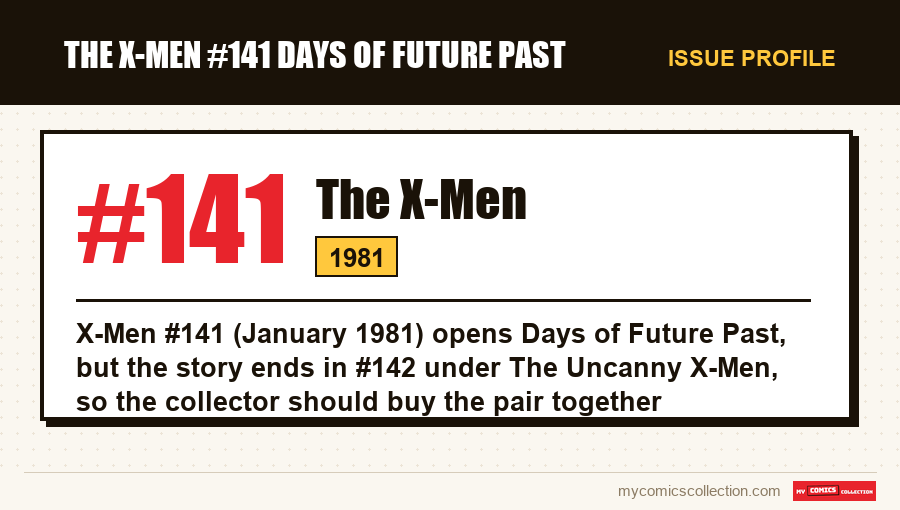
The X-Men #141, cover-dated January 1981, opens “Days of Future Past”: Chris Claremont on writing, John Byrne on pencils and co-plotting, Terry Austin on inks. A Kate Pryde from a future ravaged by the Sentinels projects her mind into the 1980 Kitty Pryde to prevent a political assassination. The story wraps up in the next issue, published under the title The Uncanny X-Men, and the issue is worth buying for both the plot and the new faces it introduces.
A buyer after this issue has to accept a constraint that few key issues impose: you are not buying one issue, you are buying a pair. The story runs across two comics, no more, and the second one carries a different series name. A collector who orders only the 141 ends up with half a story, and often discovers this after paying postage. That is also what makes listings so tricky: a seller who writes “Uncanny X-Men 141” is not necessarily lying, since they are copying the cover logo, but they blur a distinction that the catalogue respects to the letter.
As always on this guide, only verified information (creators, issue numbers, dates) is stated as fact; the analysis is our own, with no reproduction of panels or protected dialogue.
What issue 141 actually contains
The comic cover-dated January 1981 runs on two intertwined threads. The first takes place in a future where North America is run by the Sentinels, where surviving mutants wear camp uniforms and where ruined neighborhoods serve as the setting rather than as background. The second takes place in 1980, in the near-ordinary daily life of a team, until an adult consciousness takes the place of a teenager's.
The device is simple to state and hard to sustain in such a short page count: Kate Pryde, the mature version of the school's youngest recruit, sees her mind sent back into her 1980 body to stop the political murder from which the repression grew. In a single installment the issue establishes an entire future, a countdown and a heroine who has to convince her teammates.
On the creative side, the Claremont, Byrne, Austin trio is working here at its point of balance, with Byrne credited for layouts as much as for pencils. The cover, by the same team, has become the signature image of the arc: a wanted poster announcing a death or a capture, set behind two characters, sums up the story without opening the comic. It is recognizable as a thumbnail, which matters on marketplaces.
Two issues, two series titles: how the trap works
The bibliographic detail to keep in mind is this. In the catalogue, the series launched in 1963 is called The X-Men, and keeps that name up to and including 141. From 142 onward, it is registered under the title The Uncanny X-Men, dated 1981. The cover, however, has shown the word “Uncanny” since the late 1970s, long before the indicia inside adopted it. The catalogue follows the indicia, not the logo.
The practical consequence: the conclusion of the story is not found under the same series entry as its beginning. A collector who scans a want list under The X-Men sees the 141 and stops there, since the series ends on it; the 142 waits in another entry. The reverse happens too, and more often: a search for “Uncanny X-Men 141” returns correct listings, because sellers index by logo, but applying the same reflex to a want list creates an invisible gap.
The rule for an inventory is to leave both issues in their respective series and link them with a shared tag. You find the pair in a single search, without forcing the catalogue to say anything other than what the comic itself prints.
What the series was publishing in January 1981
The issue arrives at a time when the series is no longer a catch-up title but a flagship. The team lines up characters established since the mid-1970s relaunch, along with a very recent recruit, the teenager the whole arc depends on, who had appeared about a dozen issues earlier. The story plays on an immediate contrast: the newcomer, the least experienced, becomes the vehicle for the narrative.
Another piece of context: the series has just wrapped up a large cosmic storyline, and “Days of Future Past” acts as a retreat toward the political and the intimate. No galaxies, no empires, but a public hearing, an attack and a room. This change of scale is part of what gave the arc its reputation as a peak of the Claremont-Byrne cycle, which ends two issues later.
Finally, the alternate-future mechanism was not yet an automatic feature of the genre. It would become one, and it is that legacy that keeps demand alive for the original comic.
Why this issue became a key
Three reasons combine, and they do not appeal to the same buyer. The first is narrative: the 141 is the entry point to a story whose formula has been reused, parodied and adapted for four decades, in film as in animation. A buyer who owns only a handful of 1980s comics often goes for this one first.
The second is the concentration of debuts. The issue introduces the villain team version led by Mystique, and with it several members appearing for the first time, along with a young woman from the future whose importance would keep growing in the mutant series of the following years. An issue that combines several useful first appearances does not depend on a single segment of demand, which cushions market slumps.
The third is iconographic. The wanted poster on the cover has been quoted, reworked and paid tribute to by other publishers and other series. A cover that has become a model sustains its own fame, independently of the content, and this is a variable people underestimate when they reason only in terms of first appearances.
What moves the price
On a January 1981 comic, the dominant variable is not rarity, it is condition. Print runs for the series at that date were comfortable, and copies are findable, but a clean copy becomes scarce for a material reason: the cover is dark with large flat areas, and anything that marks the paper shows. A reading crease on the spine, a rubbed corner, a light wear along the spine all become visible to the naked eye, whereas a light-colored cover forgives them.
Next comes the edition received by the market, which is checked with a magnifying glass and whose clues are detailed in the next section. Then grading, which on this issue works in steps: the gaps widen at the top of the scale, where the flatness of the cover and the freshness of the blacks separate copies that look alike in photos.
A last factor is seasonal: news around the arc's screen adaptations has produced clear spikes of interest, followed by declines. Buying during a spike means paying a visibility premium that fades. Tracking the history of completed sales, not asking prices, remains the only honest way to place an offer. Our free estimate page is designed for exactly this.
Recognizing one edition from another
Start with the price block on the cover. The comics of this early-1980s period circulated with price blocks intended for markets other than the US, including Canadian-priced copies, which are period printings and not counterfeits. Their relative value is debated among buyers, and sources disagree: some treat them the same as standard copies, others apply a discount or a premium. In every case, the information must appear in the listing.
Then look at the barcode box. For this period, copies destined for newsstand distribution and those destined for the specialty channel do not always show the same box, and sources disagree on the exact date when the distinction became standard at the publisher. The practical conclusion does not change: photograph that box, compare it with a reference copy of the same month, and do not pay a premium for a marking you cannot verify.
A third family is reprints. The arc has been reissued several times, in a series of reprints launched in the mid-1980s that added pages to some issues, then in collected editions, then in reprints with an identical cover. The last are the most deceptive in a thumbnail. The markers are always the same: the indicia carry a reprint notice and a recent date, the barcode is a modern code, and the paper is white and heavy where the original has yellowed. A copy presented as an original whose edges are perfectly white in 2026 deserves a question before any offer.
Do you collect this series?
Track what you own, what you are missing and what your collection is worth. 7-day trial.
Start my trial →
Traps when buying
The first trap is the title: a lot sold as “the complete Days of Future Past arc” must contain two issues, and the photo must show both covers. One that shows only one should be discussed before payment.
The second is confusion with tributes: later covers reuse the wanted poster, sometimes with other characters, sometimes in other series, and pass for the original in a thumbnail. Ask for a photo of the logo block and the price block, not just the center of the image.
The third concerns defects that do not show from the front. On this issue, two points deserve a dedicated photo: the staples, whose rust migrates onto the center fold, and the lower right corner of the cover, which suffers on copies handled in stacks. Also ask for a view of the edges, flat and under raking light.
The fourth is the blind lot: the series' comics from 1980 and 1981 are sold in bundles of ten or twenty, and a 141 regularly hides in them. Require a photo of the contents spread out, not the stack seen from above.
Neighboring issues that matter too
The first neighbor is obviously the 142, and it is not optional. It is the second half of the story, and the market treats it as such: its price follows that of the 141 with a lag, generally at a more accessible level, which makes it the right first purchase when you want to test a seller before entrusting them with a more expensive piece.
Next come the issues that establish the teenage recruit, about a dozen installments earlier, then those that precede the arc, where political hostility toward mutants is rising. Finally, the issue that closes Byrne's run, two issues after the 141, is sought after for its place in the cycle more than for its content. The X-Men hub gives the chronology of the titles and their renamings.
What grading changes
Having a 1981 comic graded only makes sense in two situations. The first: the copy is clearly very nice, flat cover, sharp blacks, crisp corners, and you are aiming for the top of the scale, where the value gap between two neighboring grades can represent several times the cost of the operation. The second: you are buying a graded and sealed piece at a distance, and you are paying for the absence of surprise rather than for the number.
Outside these cases, grading costs more than it returns on this issue, because the supply of average copies is abundant. One detail specific to the 141 deserves attention: on a cover with large dark flat areas, a period printing defect, such as misregistration or a light ink smudge, can be mistaken for damage by an untrained eye. A description that distinguishes a printing defect from later damage is the sign of a serious seller.
How to track this pair in a collection
Good practice comes down to three steps. Record the 141 under the series The X-Men and the 142 under The Uncanny X-Men, without trying to merge them artificially: your inventory should reflect what is printed. Then apply a shared tag to both lines, for example the arc's name, so you can pull them up together when you prepare a sale or an insurance valuation. Finally, in the condition field, note not a letter grade but the two or three real defects you observed, for example a spine crease and a blunted corner.
That last point serves you the day you resell: a description that names its defects draws fewer disputes than an optimistic grade. Also note somewhere that the series changes its name between these two issues, because that is the mistake people make twice otherwise.
What to keep in mind before making an offer
The X-Men #141 is a solid key for an unusual reason: its interest rests neither on a single character nor on a single appearance, but on a narrative device that has become common heritage of the genre. It is bought together with the 142, it is verified at the price block and the indicia, it is photographed at the edges, and it is graded only if the copy truly deserves it. Do those four things, and you will avoid three quarters of the disappointments on this issue.
Torn between two copies of the 141, or want to know what yours is worth before hunting for the 142? Have the pair appraised rather than the single issue.
Estimate my comic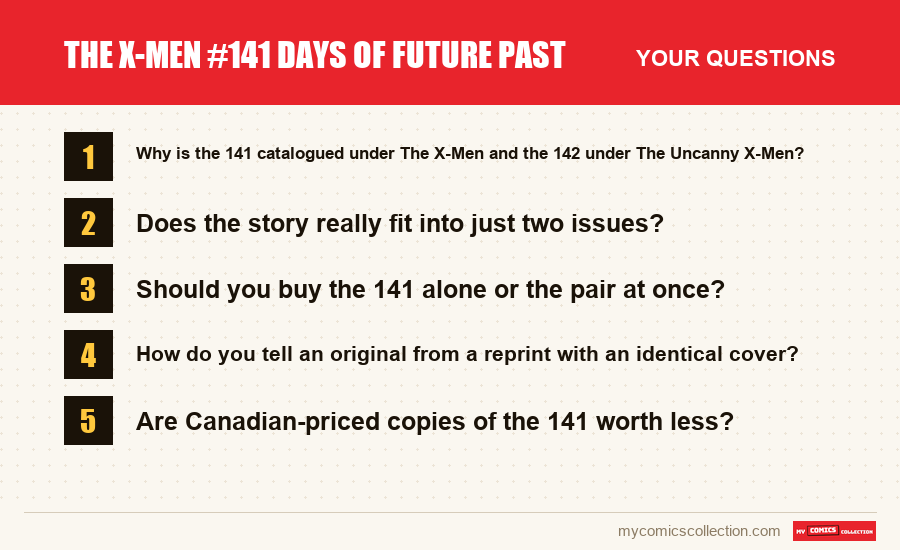
Frequently asked questions
Because the catalogue follows the legal indicia printed inside, not the cover logo. The 1963 series is registered as The X-Men through issue 141, then as The Uncanny X-Men from 142, dated 1981. The word “Uncanny” had nonetheless appeared on the cover since the late 1970s.
Yes. “Days of Future Past” begins in the issue cover-dated January 1981 and concludes in the next one. The many follow-ups, echoes and variations published later are separate stories, sometimes in other series. To own the original arc, two comics are enough, but both are essential.
The pair, and if possible from the same seller to share postage and get two copies in comparable condition. Buying the 142 first is a defensible strategy: it generally costs less, which lets you judge the packing and the honesty of the description before committing to the main piece.
Open the indicia: a reprint carries a reprint notice and a recent date. Check the barcode, which is modern on reprints. Check the paper, white and stiff on a recent printing, yellowed and soft on a 1981 copy. Finally, be wary of edges that are perfectly pristine.
Opinions differ, and market practices have not settled. They are period printings, not copies, and some buyers look for them precisely for that reason. The only safe rule is transparency: the price block must be visible in the photo, and the listing must mention it before the sale.