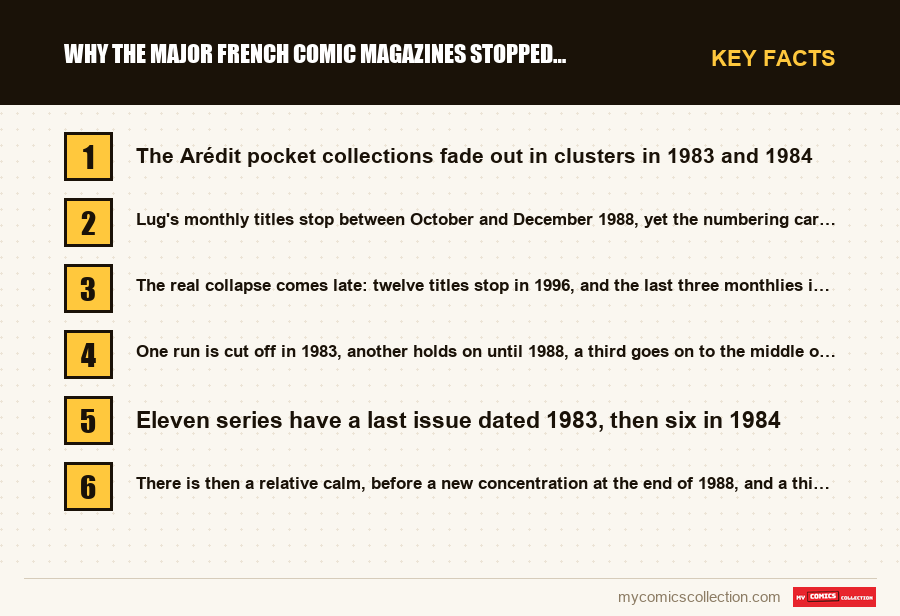
The catalog does not show one disappearance but three, separated by years. The Arédit pocket collections fade out in clusters in 1983 and 1984. Lug's monthly titles stop between October and December 1988, yet the numbering carries on without a break at Semic in January 1989. The real collapse comes late: twelve titles stop in 1996, and the last three monthlies in 1998, after changing the material they published.
When you open a stack of magazines inherited from an attic, the question that comes first is not "how much is this worth" but "why does it stop there". One run is cut off in 1983, another holds on until 1988, a third goes on to the middle of the 1990s and then becomes unrecognizable. These breaks are not of the same kind, and the catalog lets you tell them apart: cover dates, issue numbers, credits and recorded titles trace a sequence, not a single collapse.
As always in this guide, only verified information (creators, issue numbers, dates) is stated as fact. The analysis is ours, with no reproduction of panels or protected dialogue.
Three waves of stoppages, not a single end
The first thing the data contradicts is the idea of a single break. If you sort the French series by the cover date of their last issue, the stoppages do not spread out evenly: they bunch together. Eleven series have a last issue dated 1983, then six in 1984. There is then a relative calm, before a new concentration at the end of 1988, and a third, the most abrupt, in 1996.
Between these clusters, whole years count only one or two stoppages. This alternation of troughs and peaks is what you would expect when a decision affects an entire line rather than an isolated title. It does not say why: the catalog records neither circulation figures nor publisher accounts. It does show that the titles of one publisher stop together, which moves the question from the title to the collection.
1983 and 1984: the pocket collections fade out in clusters
The first drop affects the small formats of Arédit-Artima, and it is tightly grouped in time. Démon ends with issue 20, dated January 1983; Thor closes with issue 27, dated September of the same year. Between those two limits, nine other series from the same house post their last issue.
The age of the series concerned makes the cluster even more telling. Eclipso, launched in 1968, stops at issue 84 in February 1983; Etranges Aventures, begun two years earlier still, breaks off at issue 78 in March. These are not failed launches that were closed after a few issues, but lines fifteen years old or more that stop a few weeks apart. The following year continues the movement: Spectral ends in January 1984, Thor le fils d'Odin in September, and very little of this pocket collection remains afterward.
Relaunches announced in the issues, two years before the end
The catalog records only one heading per issue, and this indexing choice becomes revealing in the last years of these collections. For some issues, the recorded heading is not that of an episode but that of an editorial page. Eclipso 75 and Choc 25, both dated the first quarter of 1981, carry the same recorded heading, which announces a fresh start for the pocket collection. Two different titles, the same page, the same quarter.
The signal repeats in June 1982 with Etranges Aventures 75, whose recorded heading announces a redesigned presentation for the books in the collection. And in February 1984, issue 25 of Captain America carries a heading that evokes the end of several years of black-and-white publication: two issues later, with issue 27 of June 1984, the series ends. In other words, the changes of presentation came one to three years before the stoppages, not after them.
These headings must be read for what they are. They do not mean that the issue contained only in-house advertising, but that the page retained for that issue is an editorial page. The real contents can only be checked on the copy itself.
1986 and 1987: the satellites leave before the monthlies
At Lug, the order of the stoppages is instructive. The peripheral titles, the ones that came out a few times a year around the monthlies, fade first. Ombrax publishes its last issue, number 242, dated March 10, 1986. Une Aventure des Fantastiques ends with its issue 43 in 1987, as does L'Araignée with its issue 29 and Une Aventure de l'Araignée with its issue 31.
The last two issues of Une Aventure des Fantastiques are the most telling: issue 41, dated December 1986, and issue 42, dated April 1987, carry recorded headings that explicitly mention a second edition, first for La Panthère noire and then for Docteur Fatalis. A line that ends its run by reprinting material already published is a measurable fact, recorded in the heading itself, and it comes eighteen months before the monthlies of the same house stop.
Sagédition follows a similar but offset calendar. Batman Poche closes with its issue 52 in October 1984, Superman Poche in March 1987. In that last line, the final issues are double numbers, such as 106-107 from September 1986 and 108-109 from November: putting two numbers under one cover is, again, a dated clue that can be read without assuming anything.
December 1988: a stoppage that does not interrupt the numbering
Next comes the break that collective memory remembers, and it is the one the catalog most invites us to qualify. Strange Spécial Origines stops at 226 on October 5, 1988, Spécial Strange at 59 in November, then Strange at 228 on December 5, Spidey at 107 and Titans at 119 on December 10, Nova at 131 the same month. Six monthly or bimonthly titles from one house close their numbering within three months.
But the sequel exists. In January 1989, the catalog records Strange 229, Nova 132, Titans 120 and Spécial Strange 60, under another publisher, Semic. The numbering does not restart at 1: it continues. This is therefore not the disappearance of a magazine but a takeover, and it is directly practical information for anyone completing a run. The issue that follows your Strange 228 is number 229, dated January 5, 1989; nothing is missing between the two.
One detail from 1988 deserves attention. Spidey 106 and Titans 118, both dated November 10, carry the same recorded heading, which also appears on Strange Spécial Origines 226. The same material runs through several titles within a few weeks. Drawing a conclusion from that about the state of the available stock would go beyond the data, and sources disagree about how rights circulated between the lines.
Do you collect this series?
Track what you own, what you are missing and what your collection is worth. 7-day trial.
Start my trial →
1996: twelve titles stop in the same year
The densest cluster in the catalog is not that of 1988: it is that of 1996, when twelve series post their last issue. Spécial Strange ends with 115 in December, X-Men with 25 and Hulk with 29 the same month. Serval-Wolverine and Facteur X, which had come out six times a year since the start of the decade, also stop.
The rhythm of these titles just before they stopped runs counter to intuition. Spécial Strange appeared six times a year from 1989 to 1993, eight times in 1995, then twelve times in 1996, the very year it ceased. A series that doubles its frequency in its final year does not look like a title being allowed to die out, and this rules out reading the cluster as simple gradual exhaustion.
One isolated heading sums up the ambiguity of that year. The last issue of 2099, number 36 dated November 1996, carries as its recorded heading an announcement of a fresh start. A fresh start on a final issue signals at the very least a gap between what was announced and what was published. The causes usually given for 1996, market saturation or the reversal of the American comics market, are debated, and nothing in the catalog allows us to choose between them.
1997: a gap in publication, then a different body of material
Three monthlies survive 1996, and what happens to them is the most measurable part of the whole file. Strange, Nova and Titans came out twelve times a year up to December 1996 without exception. Then publication stops. Strange resumes with issue 325 in May 1997, five months later; Nova does not return until issue 228 in December 1997, twelve months after its 227, and Titans follows the same calendar with its 216.
When these titles reappear, the recorded credits are no longer the same. Before the gap, Nova was credited to Tom DeFalco, Paul Ryan and Sal Buscema; afterward, the credits read Brett Booth, Jim Lee and Travis Charest. Strange, which carried the names of J. M. DeMatteis, Mark Bagley and Len Kaminski in 1996, is credited from issue 325 onward to Doug Moench, Grant Morrison, John Byrne, Howard Porter and Kelley Jones. This is not a change of style: it is a different body of material, and the headings confirm it, such as this Flash of the Two Cities published in Strange in August 1997.
Titans takes the logic to its end. Its last six issues carry, as recorded headings, titles that designate the first issues of other series, from Weapon Zero in December 1997 to JLA in May 1998, with credits that include Marc Silvestri, Michael Turner, Brandon Peterson and David Finch. And Nova ends with two issues from April and May 1998 whose headings announce, in two parts, a fresh start. The catalog therefore shows a magazine that, in its final months, serves as a showcase for upcoming series rather than for the material that had sustained it.
One detail in the credits completes the picture: in these 1998 issues, the fields mix American and French names, which is rare elsewhere in the catalog. These numbers were thus put together differently, with an identified local contribution. Who decided what, however, the data does not say.
What remains in the catalog after 1998
After May 1998, only one line remains, and its form says better than any commentary what changed. Spécial DC starts in July 1997 and ends with issue 24 in April 2005: twenty-four issues over nearly eight years, where a monthly would have produced twelve a year.
The rhythm is also very irregular. One issue appears in 1998, two in 1999, four in 2000, and the last arrives in 2005 after a long absence. That profile is no longer that of a magazine you could count on, but that of an occasional publication. Over this period, a missing issue in your run proves nothing, since the gap between two issues can reach several quarters.
What this chronology lets us say, and what it does not
What can be asserted fits in a few words. The stoppages are grouped by publisher and by collection. They unfold in three phases separated by roughly five and eight years. The peripheral lines leave before the central lines. Announcements of a new format come before the stoppages rather than after them. And in 1997, the material published by the last three monthlies changes radically, which the credits and the headings establish without ambiguity.
What cannot be asserted is just as clear. Nothing here demonstrates an economic cause: we do not know what a page cost or how contracts were negotiated. The most common explanations, changing reading habits, concentration among publishers, the shift toward albums, are plausible and debated, and the catalog settles none of them.
Not every series waited for the large clusters, moreover. Thor, at Semic, ends with issue 31 in 1993, three years before the wave of 1996. An isolated stoppage remains an isolated stoppage, and that is one more reason to date your run before concluding anything about why it was interrupted.
How to use this sequence on your own stacks
The method requires no tools. Note the cover date of the most recent issue in each run, then place it against the boundaries identified above: the pockets, the end of 1988, the great wave, the last three monthlies. You will know at once whether your run is complete by nature or whether a continuation exists under another publisher.
Then check the number, not only the year. A gap in dates does not measure a gap in numbers: two issues separated by a full year can be consecutive if you are in the 1997 window. And remember that the catalog keeps only one heading per issue, whereas a French magazine often published three or four. For heroes who crossed several lines, from the Wolverine of the 1990s to the Thor of the small formats, by way of the Silver Surfer and the Arédit Flash, the full contents can only be checked on the copy itself.
Frequently asked questions
No. The catalog shows three distinct concentrations: eleven Arédit pocket series in 1983, six Lug titles between October and December 1988, then twelve series in 1996. Between these clusters, whole years count only one or two stoppages. Speaking of a single end would flatten a sequence spread over fifteen years.
No, nothing is missing. Issue 228 is dated December 5, 1988, and it is the last issue published by Lug. The next, issue 229, is dated January 5, 1989 and carries the name of another publisher, Semic. The numbering continues without resetting: your run simply carries on under another brand.
Because publication was interrupted. Nova came out twelve times a year up to its 227th issue, and then issue 228 arrived only a year later. Strange had a five-month gap over the same period. These two issues are indeed consecutive despite the year between them: always check the number before concluding there is a gap.
Not from this data. The catalog records dates, numbers, headings and credits, never circulation figures or publisher accounts. The causes put forward, changing readership or the reorganization of publishers, remain debated and the sources disagree. The chronology can be described with precision without claiming to explain it.
The credits say otherwise. From December 1997, the recorded headings point to the first issues of other series, and the credits cite Marc Silvestri, Michael Turner or Brandon Peterson, where the 1996 issues carried other names. The complete contents, however, still need to be checked issue by issue on the copy.