Brainiac is one of the rare characters whose reference version is not the first, but a redesign that arrived half a century after his creation. This late version stood out because it retained the core of the concept-the collector of worlds-rather than replacing it, because it retrospectively explained earlier incarnations rather than erasing them, and because it gave the character a recognizable silhouette without a line of dialogue. The price of this success is heavy: once a version becomes authoritative, it closes the character to subsequent reinventions and demotes fifty years of stories to the rank of drafts. On the market side, the effect is zero: as of August 29, 2026, the issues which carry this period of recasting were asking for a median of less than eight dollars.
In the overwhelming majority of cases, the canonical version of a comic book character is the founding version, or the one that closely followed it. The reader learns the character through his point of origin, subsequent authors inherit this point of origin, and adaptations take it up because it is the most stable. Brainiac is an exception. The version that we consider today to be the good one: the one which serves as an implicit reference as soon as the character is written, the one which the adaptations recover, the one which makes the previous ones difficult to reread without embarrassment: was published decades after the creation of the name. This is not an accident of timing. It is an identifiable editorial mechanism, and it is only triggered when several conditions are met at the same time.
This article covers these conditions one by one and then invoices them. Because late canonization is not only a creative success: it is an operation which locks a character. Once a version is recognized as the version, the authors who come after no longer write the character, they write within that version. And everything before it starts to seem like preparatory essays, which is a fancy way of saying that these stories become unreadable.
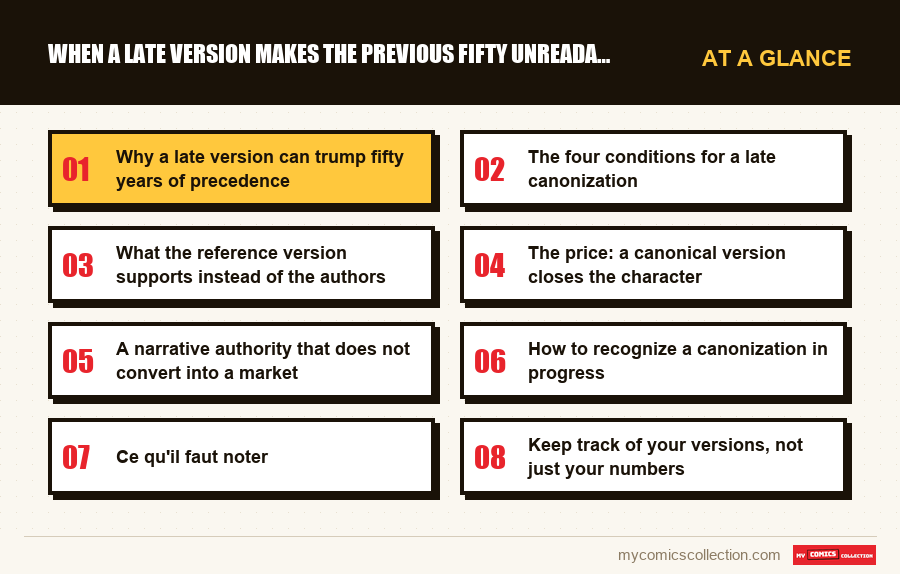
Why a late version can trump fifty years of precedence
Priority is a powerful but not decisive advantage. What decides is the capacity of a version to serve as a common base. A character written over decades by dozens of authors accumulates contradictory layers: an origin, then a second origin which contradicts the first, changes in appearance, changes in motivation, parallel versions which coexist without speaking to each other. There comes a time when accumulation becomes a cost. The author who takes up the character must choose which layer he honors, and this choice involves everything he writes. The canonical version is the one that removes this cost: after it, there is no more choice to make, there is a character.
Brainiac is a textbook case because its initial concept is extraordinarily solid and its historical execution extraordinarily unstable. The core (an intelligence that collects civilizations, reduces them, preserves them, and destroys what it has copied) is immediately readable and does not age. The incarnations have moved a lot: the nature of the thing has changed several times, its appearance too, its reason for acting as well. The concept survived each change, but no incarnation succeeded in becoming the incarnation. A character in this state is an available character: he is waiting for a version that fixes him.
The four conditions for a late canonization
Keep the core, recast the envelope
A redesign that replaces the concept produces another character with the same name, and the reader senses it immediately. A redesign that keeps the core (here, the collection of worlds as a central gesture) and only redoes the envelope around it is accepted without negotiation. The reader recognizes what he already knew, in a form that finally works. This is the most restrictive condition: it prohibits the author from being inventive where he would most like to be.
Explain the past instead of denying it
A recast that declares previous versions void creates a debt: the reader who read these versions finds themselves with invalidated memories. A recasting that explains them (which offers a retrospective reading making each previous incarnation a manifestation, a fragment, an intermediary) transforms a contradiction in depth. The old stories are no longer errors, they become clues. It is the movement that buys the support of old readers.
A visual definition that does without text
A version only becomes canonical if it is transmitted without being read. This requires an immediately identifiable silhouette, a visual device that we understand in an image and which alone says what the character is doing. A remarkable but visually neutral redesign remains a respected redesign; a visually decisive redesign becomes the default reference, even for those who have never read it.
An editorial moment seeking a stable version
The best redesign in the world doesn't canonize anything if the catalog doesn't need a stable release. It is essential when the publisher consolidates, when several teams must write the same character without contradicting each other, when adaptations in preparation require a single base. Canonization is as much an organizational decision as it is a writing success.
These four conditions are not substitutes for each other. A revision that fills three of them produces a version admired, cited, claimed by its defenders, and competed with. It takes all four together to achieve this particular result: that the question “which version of this character?” » ceases to be asked. This silence is the true signature of the canon.
The canon is not an official statement. No publisher publishes a press release saying that one version replaces the others. The canon notices a negative signal: the moment when the following authors cease to justify their choice of version.
As long as a screenwriter must explain, even implicitly, which incarnation he is taking on, the character is not fixed. When he can write without explaining anything because the version is self-evident, the canonization has taken place: often several years before anyone notices.
What the reference version supports instead of the authors
The question of nature
Machine, living being, intelligence without body, or combination of the three: this question has long changed in response from one incarnation to another. The canonical version cuts it, and above all it makes it retroactively coherent. An author who takes up the character no longer starts from scratch on this point.
The question of seniority
An antagonist whose past is not defined is reduced to his recent appearances. A canonical version which establishes temporal depth, the idea that what we see is the last state of a very ancient process, gives the character a weight that his successive appearances did not give him.
The question of motivation
Collecting is not conquering. An antagonist who wants to rule enters an already saturated category; an antagonist who wants to own, classify and maintain occupies a place that no one else holds. The reference version locks this motivation and prohibits drifts towards the generic tyrant.
The question of scale
An adversary who threatens a city and an adversary who threatens entire civilizations are not written the same way. Setting the scale means setting the type of story that can be told with the character, and suddenly eliminating the stories where he appears underused.
The question of multiplicity
Divergent versions having coexisted, the rework must decide whether they are errors or exemplars. Treating multiplicity as a property of character rather than an archival flaw is the move that absorbs the greatest number of previous narratives without throwing any away.
The entry point question
A late canonical version moves the character's entrance. The new reader no longer starts with the first appearances, he starts with the recast, and then goes back if he wants to. This is a complete reversal of the usual reading order, detailed in our reading guide.
The price: a canonical version closes the character
Canonization is generally presented as a gain without compensation. This is false. To fix a character is to remove it from creative circulation. Before the reference version, Brainiac was a concept that each author could use in their own way: this instability produced failed versions, but it also produced the possibility of producing a successful one. Afterwards, the margin disappears. The author who would like to propose a radically different reading encounters an immediate objection: it is not the character. And this objection doesn't come from the publisher, it comes from the readership, which makes it much harder to get around.
The second cost relates to the past. A redesign that explains the earlier versions gives them a place, but this place is subordinate. These stories are no longer read for themselves; they read like steps towards the final version. It’s a form of conservation that looks a lot like elegant discarding. A reader who discovers ancient incarnations today no longer judges them on their own intentions: he compares them to what they have become, and they lose each time. Fifty years of stories turn into drafts of a text they didn't know they were writing.
The third cost is the most insidious: the canonical version becomes a ceiling. As long as a character does not have a reference version, each new attempt can become the right one, and this hope attracts ambitious authors. Once the reference is established, the best possible outcome for an author is to write well within what exists. It's less attractive. The canonized characters often receive, in the years that follow, technically correct and unchallenging treatments: not because of a decline in the quality of the teams, but because the room left for invention has been reduced.
Finally, a canon creates its own reading orthodoxy. It becomes difficult to discuss the choices of the reference version, because to discuss it is to discuss the character himself. What the overhaul excluded (possible directions, tones, minority interpretations) disappears without debate. Canon doesn't win an argument, it makes it pointless.
Collecting this series?
Track what you own, what you are missing and what your collection is worth. 7 day trial.
Start my trial →A narrative authority that does not convert into a market
One might assume that such a status is seen in the announcements. This is not the case, and this is the clearest point of this file. A survey of online advertisements carried out on August 29, 2026 over the overhaul period which sets this version gives the following image, keeping in mind that these are amounts requested by sellers and not recorded transactions.
For raw copies, without certification: 182 listings identified, with requests ranging from $1.50 to $299.21 and a median value of $7.19. In other words, half of the sellers were asking less than seven dollars and twenty cents. The maximum of $299.21 does not describe a price level: it is the hope of an isolated seller, displayed in an environment where nothing forces him to be realistic. A single tall ad doesn't say anything about what anyone paid for.
As for the copies verified by certification, the statement of the same day included only 3 advertisements, between 239.95 and 1,000.00 dollars, with an intermediate value of 250.00 dollars. It must be said unequivocally: three announcements do not support any conclusion on a price level. This is not a sample, it is a numerical anecdote. It can be cited as a census fact, never as a valuation reference, and it would be just as imprudent to deduce from it any direction in time: a single statement does not describe a movement.
The exploitable fact is elsewhere, and it is solid: becoming the reference version of a major character has not produced any market on the booklets which carry this version. A median under eight dollars, three verified copies for one hundred and eighty-two gross announcements: the picture is one of abundant and available material. The prudent formula is also the most accurate: narrative authority and market value are two independent quantities. One version can govern the way a character is written and adapted for years without it translating into any strain on the copies. The mechanisms that cause ads to appear are covered separately in our analysis of value of Brainiac comics.
This dissociation is not paradoxical once we state it. What creates scarcity is a combination of material conditions (quantity produced, conservation rate, age of the medium) over which editorial quality has no control. A modern redesign is released in an industrial context that produces a lot and preserves well. It may be the version that counts and remain, for a collector, the easiest booklet to find in the entire bibliography of the character. This is not a contradiction, it is the rule.
How to recognize a canonization in progress
The signal is never critical reception. A redesign welcomed upon its publication may not fix anything at all, and a redesign received lukewarmly may become the benchmark five years later. What matters are the subsequent uses: what the following authors take up without discussing it.
Observe what later accounts take for granted. If several independent authors use the same features without ever justifying or recalling them, the version is installed. The canon is recognized by what the texts cease to explain, not by what they affirm.
Yes, but afterwards. Reading them first makes for a frustrating experience, because they seem hesitant until you know the reading that will unify them. Reading them afterwards makes them fascinating: we observe a concept seeking its form. L'ordre recommandé est détaillé dans le guide de lecture.
C'est rare et coûteux. It would take a recast meeting the same four conditions for a readership which, this time, already has a satisfactory answer. More often than not, subsequent attempts become recognized variants rather than replacements.
The August 29, 2026 statement does not show this. Of the 182 gross announcements recorded that day for the period concerned, the median requested was $7.19. These are amounts claimed by sellers, not completed sales, and they do not suggest any particular tension.
As for price information, nothing. Three listings, ranging between $239.95 and $1,000.00, do not constitute a usable sample. We can only note that certification remained marginal on this equipment at the time of the survey.
Ce qu'il faut noter
The retained core is what distinguishes a redesign from a replacement. Brainiac has survived profound changes in nature and appearance because the central act-collecting worlds-has never been touched. When evaluating a late version of any character, first ask yourself what she refused to change: that's where her authority comes into play, not in her additions.
Retrospective explanation is better than erasure, but it subordinates. Giving meaning to previous incarnations preserves them from discard and simultaneously deprives them of their autonomy. An ancient story reinterpreted as a fragment of a later whole is no longer read for what it intended to be. It’s a rescue that takes the form of relegation.
Visual transmission decides more than text. A version whose silhouette can be read in an image circulates without being read, including among people who will never read the booklets concerned. It is this channel, and not the quality of writing, which explains why a redesign becomes the default reference where others remain proposals.
Canonization costs the character's availability. After it, creative ambition no longer has a target: we can no longer make the version, only write well in the existing one. The correct, no-issue treatments that often follow a major overhaul are not a recruiting accident, they are the mechanical effect of a closed space.
The reference status is not readable in the announcements. The August 29, 2026 statement gives a median requested of $7.19 on 182 gross listings and only 3 verified copies: amounts claimed, never sales. Narrative authority and marketability evolve independently, and confusing the two is the most common way to get a character wrong. The material benchmarks are listed in our survey of numéros clés.
Keep track of your versions, not just your numbers
A character going through several incarnations requires more detailed monitoring than a simple list of booklets: what version, what period, what state. My Comics Collection allows you to organize your collection by series and arc, track what you're missing, and instantly find what you already own.