
Polling the market for vintage Black Canary booklets produces a polluted list: on August 29, 2026, the uncertified segment had 108 bids asking between $1.59 and $787.50, median $17.45, while the 14 verified copies were priced at $40.00 to $14,900.00, median $1,947.50. A ratio greater than one hundred between two medians does not describe a prime: it indicates that the two lists do not contain the same objects. The checked segment then serves as a sorting tool: look at it first to identify what you're looking for, then return to the other knowing what to discard.
Type the name of the heroine accompanied by a mention of an old era into a classified ads engine and you get a hundred results. The first impression is that of an abundant, accessible market, where issues from the 1940s circulate at ridiculous prices. This impression is false, and its falsehood is not due to manipulation: it is due to the way in which the ad titles are written. The expression “golden age” is not reserved for publications from this period. Over the decades, it has become a selling point that publishers and sellers attach to reissues, tribute series and modern rereadings. The engine doesn't make a difference. He gives you back everything that carries words.
The August 29, 2026 reading makes this contamination measurable. Among the cheapest proposals in the uncertified segment are publications dated 1993, 2000, 2001 and 2011, asking between $1.59 and $3.38. None is a period fascicle; all use the expression in their title. They pull the median downward, inflate the number, and give the busy researcher the illusion of a floor that does not exist. The following is not a price guide (a count taken on a single day cannot describe any movement, neither rise nor fall) but a reading method applicable to any research relating to an ancient period.
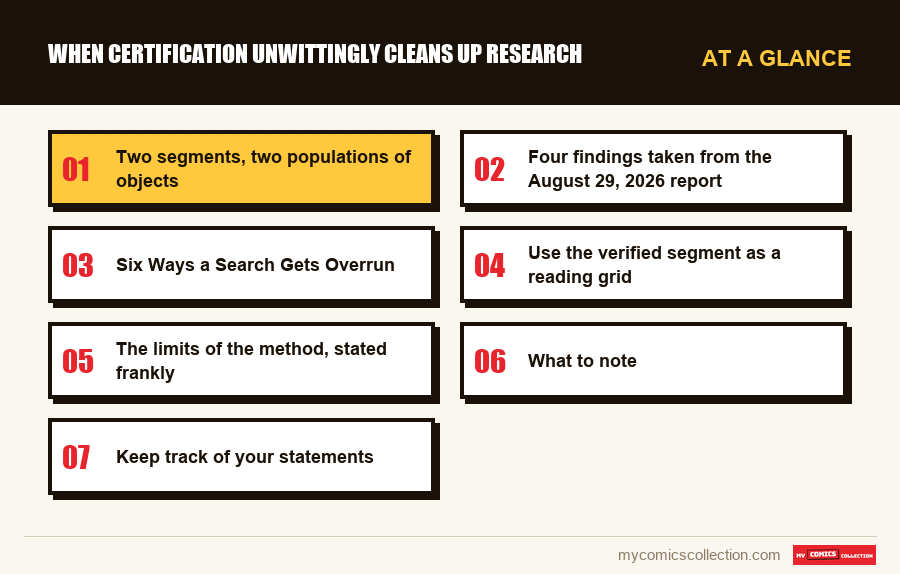
Two segments, two populations of objects
A commercial search engine does not know the publication date of a booklet. He knows the character string that the seller entered. When this string contains a period formula, the ad enters your results whether the item is seventy-five years old or fifteen. This is a structural defect, not an accident: no one can prevent a seller from calling a story set in this era, a reissue of old stories, or a series from the 1990s dedicated to the heroes of the first generation, a “golden age”.
The result, on the August 29, 2026 statement, is an uncertified list of 108 proposals with asking price ranges from $1.59 to $787.50. This amplitude is the first clue. A homogenous set of comparable objects does not scale by a factor of nearly five hundred. Such dispersion means that we have mixed things that have nothing in common except a word in their title. The median of $17.45 then does not describe any real object: it describes the center of a heterogeneous pile, which has no informative value.
The verified segment does not undergo this contamination. Fourteen listings only, with amounts claimed ranging from $40.00 to $14,900.00 and a median of $1,947.50. The reason for its cleanliness is not mysterious and nothing virtuous: having a booklet certified costs money and takes time. No one incurs this expense for a recent publication whose market value is measured in coins. The certification therefore did not sort the objects because it knows how to date them: it sorted them because its cost dissuades anyone who owns a worthless object from submitting it.
This mechanism is what I call an involuntary filter. The procedure was never designed to clean up a query, and yet it does. In ancient periods, where lexical contamination is maximum, this secondary effect becomes the most reliable tool available to a researcher to know what the object he is tracking really looks like.
Four findings taken from the August 29, 2026 report
A report of more than a hundred
The requested median of the verified segment exceeds that of the raw segment by a factor of more than one hundred. No conservation premium, no buyer preference produces such a gap. When you encounter this kind of relationship, stop seeing a difference in quality: it is the symptom of a mixture of objects foreign to each other.
The bottom of the list betrays the odd one out
The cheapest proposals in the uncertified segment, between $1.59 and $3.38, correspond to publications dated 1993, 2000, 2001 and 2011. They all use the period formula in their title without belonging to the period. The floor of a contaminated list is almost always occupied by intruders.
Fourteen announcements is not a measure
The verified segment takes fourteen lines. On such a thin squad, a median is an indication of position, not a statistic. Two ads added or removed would move it strongly in one direction or the other. Use it to guide you, never to argue a price.
The summit is only one person's opinion
The highest amount in the verified segment, $14,900.00, is isolated. A solitary maximum expresses a seller's hope, not an observed transaction. It does not prove that a buyer exists at this level, and it should never be used as an anchor for evaluating an item.
These four observations can be read together. Taken in isolation, the ratio of one hundred could be seen as a spectacular premium granted to examples in impeccable condition; crossed with the composition at the bottom of the list, it reveals its true nature. Taken in isolation, the maximum of the verified segment would seem to set an order of magnitude; compared to a staff of fourteen, it becomes what it is again, an individual opinion posted on a given day. All these figures are claimed amounts recorded on August 29, 2026, and nothing else. None correspond to an amount actually paid.
A precision which conditions everything that follows: this count was carried out on a single date. It cannot therefore describe any evolution, no trend, no market movement. To write that a price “rises” or “falls” from a single reading would be pure invention: it would take at least two photographs separated in time to sketch a direction.
Another clarification: ads measure what sellers ask for, not what buyers accept. An ad can remain posted for months without takers and continue to weigh on the statistics. The distance between the asking price and the agreed price is not visible anywhere in these figures.
Six Ways a Search Gets Overrun
The engine reads words, not dates
No classified ads filter knows the actual year of publication of a booklet. It matches your query to a title freely written by a seller. Any formula evoking an era therefore becomes a magnet for false positives, all the more effective if the formula is rewarding.
Tribute series claim the era
Publications appearing well after the period explicitly deal with heroes of the first generation. Their title legitimately contains the period formula. The seller is not lying; the engine cannot distinguish a story that speaks of the time from an object from the time.
The period label is a commercial argument
Adding a mention of seniority to a title increases the visibility of the ad without costing a cent. The practice is becoming widespread mechanically. The more a formula evokes rarity, the more it is taken up by objects which do not have the right to it, and the more the raw segment deteriorates.
Lots drown out unity
A set sold as a unit carries a price which does not relate to any particular issue. Slipped into a list of isolated objects, it distorts any reading of the center as well as the extremes, by pulling the distribution in a direction that nothing justifies.
The numbering overlaps
The same position in a numbering can designate unrelated objects depending on the series and period considered. A search based on a number rather than a complete identity therefore brings back elements from several different collections, without indicating it.
Reissues carry content, not age
A reprint faithfully reproduces an ancient story while being, physically, a recent object. Its title will mention the time of the story. Nothing in the search results distinguishes the reproduced content from the original media, and this is precisely where the confusion sets in.
Collecting this series?
Track what you own, what you are missing and what your collection is worth. 7 day trial.
Start my trial →Use the verified segment as a reading grid
The practical conclusion reverses the usual order of gestures. The common reflex consists of going through the entire list and then discarding along the way what seems suspicious: a method that is exhausting, subjective, and which fails as soon as the intruder is well presented. The reverse method is to first open the restricted list of verified items. It is short, here fourteen lines, so readable in its entirety in a few minutes.
This reading teaches you what a truly old object looks like: which series come back, what mentions appear on the covers, what formats and what presentations are typical, what attributes serious sellers take the trouble to detail. You come out with a sketch. This portrait is not a prize, the numbers are too small for that, it is a description of the target object.
You then return to the raw segment with this portrait in mind. The 108 propositions cease to be an indistinct magma: they are divided into two piles, those which resemble the portrait and those which do not. The second pile is quickly emptied, because the intruders are similar to each other and are indicated by converging clues: a modern layout, a recent date readable in the legal notices, a condition too perfect for the claimed age, an asking price of a few dollars.
What you get at the end of this double pass is the only set on which a price comparison makes sense. It will be significantly smaller than 108. Nor will it contain only the fourteen verified copies: authentically old fascicles circulate without certification, and it is even these which constitute the majority of accessible occasions. The verified segment is not the target, it is the instrument that allows it to be recognized.
The method is transposed as is to any character whose editorial history begins early and is still continuing. The more the decades accumulate, the more recent publications have had opportunities to claim the founding era, and the more the raw segment deteriorates. Consult our statement of Black Canary key numbers to have a stable list of benchmarks before facing a page of results.
The limits of the method, stated frankly
An involuntary filter remains involuntary, and this requires reservations. The first is the size of the sample checked. Fourteen ads are enough to draw up a composite portrait; they are not enough to establish a price level. Moving the median of $1,947.50 to the status of “reference value” would be a fault in reasoning, because it would only take one or two announcements to change for this number to move by several hundred dollars.
The second reservation concerns the selection itself. Certification favors examples in good condition, those for which the owner considered the expense profitable. The portrait she paints is therefore that of a high-end, not that of the entire population of surviving old fascicles. A genuinely old but badly damaged example will never appear in this segment, and yet it is a perfectly legitimate item for a collection.
The third reservation is temporal. A count taken on August 29, 2026 describes that day. Ads appear and disappear continuously; a reading done again a week later would give other numbers. This does not invalidate the method (the relationship between the two segments is a structural phenomenon, not a coincidence of date) but it prohibits any assertion about a market direction.
The fourth reservation concerns the intruders themselves. There is no guarantee that a researcher will identify them all. Some reissues deliberately imitate the original presentation, and poor ad photography doesn't always make a difference. When in doubt, good practice consists of considering the object as unidentified rather than automatically placing it in the flattering category.
What to note
A ratio of more than one hundred between two medians is not a bonus, it is an alert. On August 29, 2026, the requested median of verified copies exceeded that of the raw segment by a factor of more than one hundred. No difference in condition, no buyer preference creates such a gap between comparable objects. When you see this kind of discrepancy, stop: your query has mixed up categories. Look for the odd one out before looking for a market explanation.
The floor of a list is where intruders congregate. The proposals at 1.59, 2, 3 dollars in the raw segment corresponded to publications from 1993, 2000, 2001 and 2011 which carried the period formula in their title. Systematically inspecting the five or ten cheapest lines in a search is the quickest diagnostic gesture possible: if they don't look like what you're looking for, the median of the list is worthless.
Read the verified segment before the raw segment, never the other way around. The short list can be read in full, the long list cannot. Starting with the fourteen verified copies gives you a portrait of the target object in a few minutes, a portrait which then makes sorting the 108 proposals quick and reliable. The reverse order, going through the long list and then trying to cross-check, costs hours and misses the best-presented intruders.
Fourteen ads give direction, not a price. The median of $1,947.50 found in the verified segment is based on such a thin population that the removal or addition of two lines would move it significantly. Use it to establish an order of magnitude before a negotiation, not to justify an amount. And remember that the $14,900.00 maximum is isolated: it reflects a seller's hope, not an observed price.
A single statement says nothing about the passage of time. All the numbers cited here were counted on August 29, 2026 and correspond to amounts claimed, never to sales concluded. They show no rise, no fall, no trend: a single point does not trace a curve. If you want to follow a movement, you must repeat the same count at regular intervals and keep each reading, otherwise you will only ever have a succession of impressions.
Because the list does not contain what it claims to contain. Of the 108 proposals noted on August 29, 2026, some correspond to recent publications - 1993, 2000, 2001, 2011 appear among the least expensive, between $1.59 and $3.38 - which use the expression "golden age" in their title without belonging to this period. These elements pull the median of $17.45 down and make it unexploitable as is.
It does not prove it directly, and that is not its purpose. Its sorting effect is indirect: the process costs money, so no one hires it for a recent publication of low value. The verified segment thus finds itself purged of intruders, not because it detects them, but because their owners have no reason to pay for them. It's an involuntary filter, and it should be treated as such.
No. The verified segment is a reading instrument, not a recommended sales department. Authentically old booklets circulate without certification and constitute the majority of affordable opportunities. The method consists of first reading the short list to find out what the object looks like, then returning to the long list with this portrait in mind to locate the real pieces.
They indicate no such thing. The count was carried out on a single date, August 29, 2026. A single observation cannot describe any evolution: at least two readings spaced over time would be necessary to speak of a direction. Furthermore, these are amounts claimed by sellers, not completed transactions, which further removes them from a market indicator.
By convergence of indices rather than by a single criterion: an asking price of a few dollars, a recent publication date readable in the mentions of the object, a modern graphic presentation, a state of conservation incompatible with the claimed age. The catalog then makes it possible to verify the exact identity of the publication. If in doubt, classify the ad as unidentified rather than giving it the benefit of the doubt.
Keep track of your statements
A sorting method is only good if you keep what it produces. Save your booklets, note the date and amount of each advertisement observed, and find at a glance what you had already discarded the previous time: instead of starting the same sorting again with each search.