On the French market, the two letters “VF” sometimes designate a language, French version, sometimes a state of conservation, Very Fine. The two usages circulate side by side, and nothing in the letters themselves says which one applies. Out of 550 distinct announcements observed on August 30, 2026, “VF” appears in 202 and “VO” in 181. The same line can use the two acronyms in their two opposite meanings: “Comics VO” for the language, “(VF)” for the state, in the same title. Three clues allow us to decide for sure, and they are visible to the eye.
The French collector lives with a couple of acronyms installed for a long time: VO for the original version, VF for the French version. It's a shared reading reflex, outside the world of comics in fact. The booklet market has superimposed an Anglo-Saxon state scale where the same two letters designate a level of conservation. The collision is not theoretical: it happens in ad headlines, every day, and it happens in both directions.
The example that served as a starting point for this article is a line raised to €5.01: “Avengers#217 Kiosque VF- 1reThe Wasp Iron Man Thor Marvel Print. The acronym is followed by a minus sign. A language has no degrees: there is no French version at least. This little feature is enough to decide, and it is precisely the kind of clue that this article aims to make systematic.
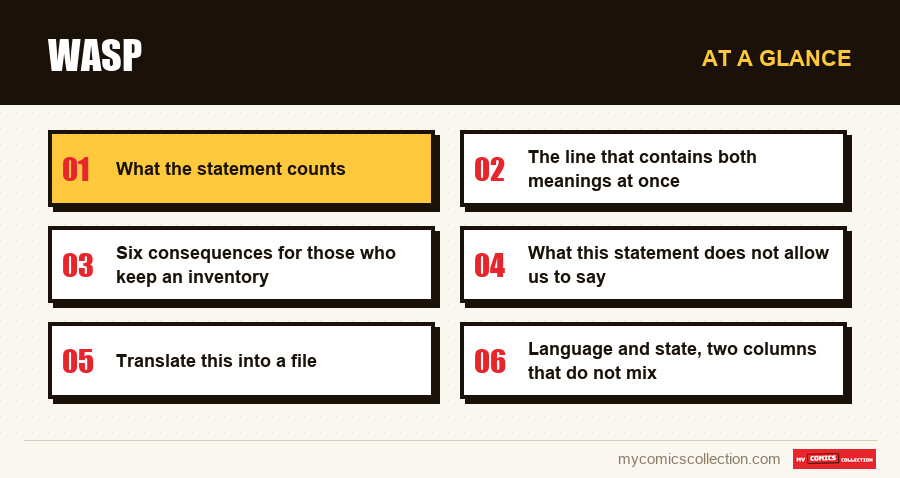
What the statement counts
I surveyed the French market on August 30, 2026 on several queries around the character and his French name, then duplicated the results: 550 distinct ads. The amounts quoted are only used to identify specific lines; these are sommes réclamées On that day, sales were never concluded, and a single day's observation does not describe any trend.
The acronym “VF” appears in 202 of these advertisements, the acronym “VO” in 181. Among the occurrences of VF, 52 take the form “VF/NM” and 19 the form “VF+” or “VF-”. The Anglo-Saxon state vocabulary is also present in 83 advertisements in the form “NM”, while the French state abbreviation (TBE, BE) only appears in 15. Finally, 197 advertisements use the word “kiosk”.
This last figure deserves a word, because it shows that the market easily mixes two vocabularies. “Kiosk” is a French word which designates a sales channel; it coexists in the same titles with English state abbreviations. No one finds this contradictory, and that is the problem: coexistence is so banal that it does not trigger any distrust.
The line that contains both meanings at once
The most demonstrative case of the survey is a family of advertisements built on this model: “Thor #430* 8.0 (VF) Comics VO* 1991”. Read it slowly. «Comics VO» announcement language: original version. “8.0 (VF)” announces the state: the numerical note is followed by its equivalent in letters. In the same title, a few characters apart, the two acronyms are used in two registers which have nothing to do with each other.
At the other end of the statement, two advertisements use “VF” in the linguistic sense without the slightest ambiguity. The first is entitled “Diverse Comics VF and VO (Marvel and Indies)”: the opposition between the two acronyms leaves no doubt, it is about languages. The second, “VF @ marvel France COMICS @: Astonishing
Un signe tranche
« VF- » to €5.01, « VF+ » elsewhere. Nineteen advertisements in the survey bear a sign. A language has no nuances: the sign always designates a state.
Un chiffre tranche
“8.0 (VF)”, “9.0 (VF/NM)”. When a numerical note precedes the acronym in parentheses, this is the translation into letters, never a language.
Une barre tranche
“VF/NM” out of 52 ads, “F/VF” on many others. An interval between two neighboring levels only makes sense on a state scale.
L'opposition à VO tranche
«VF and VO» in the same title, without note or sign: the two acronyms respond to each other like two languages. This is the only case where VF definitely designates French.
There remains the case which cannot be resolved: a “VF” alone, without sign, without number, without bar, without VO opposite. The statement contains some. Nothing in the title allows you to decide, and no reading rule will change anything: the only solution is to look at the object or ask the seller the question.
It should be noted that frequency does not help choose a default direction. Two hundred and two occurrences of VF against one hundred and eighty-one of VO: the two vocabulary universes are massively present in the same set of results. Betting systematically on one means being wrong almost every other time.
And the error is not symmetrical. Taking a state for a language makes you buy a booklet in English when you thought you were taking it in French. Taking a language as a state registers a conservation note that has never been given.
Six consequences for those who keep an inventory
An invented language
A “VF” status copied into a language field transforms an English booklet into a French edition. The error is undetectable once the box is closed.
Un état inventé
A “VF” of language copied into a status field gives the copy a rating that no one has given. However, it will weigh on any subsequent estimate.
Des recherches polluées
Filter on “VF” to find French editions brings back English issues rated Very Fine. The filter appears to work: this is what makes it misleading.
Deux échelles mélangées
The report mixes TBE and BE on 15 advertisements with an Anglo-Saxon vocabulary on 83. Putting the two in the same column amounts to adding measures which do not convert.
The circuit is not the language
« Kiosque », present in 197 advertisements, describes a distribution method. It says nothing about the language of the booklet and should not be used to infer it.
A doubt that must be assumed
When no clue decides, the correct entry is the empty field accompanied by a note, not a guess which will then take on the value of fact.
A clarification is required on the meaning of these three tests. They are not probabilities: they are impossibilities. A sign supposes a graduation, a numerical note supposes a scale, a bar supposes two neighboring levels. None of these three forms makes sense when applied to a language, and it is for this reason that a single clue is enough to make a definitive decision. Where many reading rules are based on frequency: “in most cases this means…”:, these are based on the very nature of what is written.
This difference has a practical consequence: you can apply these tests without knowing anything about the series, the publisher or the seller. A collector who discovers a title for the first time reads “VF/NM” and immediately knows that it is a state, without needing context. This is exactly what we expect from an input rule: that it works when we have the least information.
Collecting this series?
Track what you own, what you are missing and what your collection is worth. 7 day trial.
Start my trial →What this statement does not allow us to say
This count describes a writing usage among sellers, on a date, on a set of requests. It does not measure the actual distribution of French and English editions in circulation: many announcements specify neither, and those that do are not a representative sample of what exists.
It also does not say which of the two uses would be the oldest, nor if one is gaining ground over the other. A single observation shows no movement, and I have no way of knowing how these conventions took hold. What the survey establishes is narrower: the two uses coexist today, in comparable volume, in the same search results.
Finally, I am careful not to interpret ambiguous cases. An ad with a “VF” alone is not a faulty ad: it is simply written for a reader who shares the seller's context. The problem is not in the announcement, it arises at the moment when information is copied into a database whose meaning depended on a context that we did not keep.
Translate this into a file
The instructions are simple to formulate: language and state are two fields, and neither accepts the raw acronym. The language field receives “French” or “English”, written in full. The state field receives a value from the scale you use. The acronym “VF”, as it is, has no place in either, because it only becomes interpretable with the rest of the title.
Apply the three tests in order before entering. A sign next to it, a number in front, a bar towards a neighboring level: each of these indices designates a state, and only one is enough. An explicit opposition to “VO” in the same title designates a language. In the absence of any clue, don't decide: leave the field empty and note the seller's exact wording elsewhere.
This last point is the one that we neglect the most, and it is the most useful. A sheet with an empty field tells the truth: we don't know. A form filled out randomly says something false with the appearance of verified data, and nothing will later distinguish it from the information actually verified. The vacuum is reversible, the invention is not.
Finally, a word about the lists of characters that often accompany these announcements: “The Wasp Iron Man Thor” on the line at €5.01, “Jocaste Wasp Wonder Man” on another. These lists are useful for finding a booklet when searching by character, and they are worth keeping in the notes. However, they do not constitute a description of the content: a name cited in a sales title certifies that the seller wrote it, not that he verified the presence of the character in the episode.
Both, according to the announcements, and there is no sense by default. Of the 550 announcements observed on August 30, 2026, the acronym appears 202 times, sometimes for the language, sometimes for the state. The same line can even contain both uses: “Comics VO” for the language and “8.0 (VF)” for the state, in the same title.
Three indices designate a state, and only one is enough: a sign next to the acronym (“VF+”, “VF-”), a numerical note just before (“8.0 (VF)”), or a bar towards a neighboring level (“VF/NM”, “F/VF”). Conversely, a “VF” opposed to a “VO” in the same title designates a language. Without any of these clues, we cannot decide.
Because a language has no degrees. There is no French “less” version nor a French “plus” version. A sign supposes a graduation, therefore a scale: we are necessarily in the vocabulary of conservation. Nineteen advertisements in the statement bear such a sign, and the reasoning applies to each one without exception.
No. It describes a distribution circuit, present in 197 of the advertisements noted, and it is also found on leaflets in English. This is useful information in itself, worth noting in a dedicated field, but it does not allow one to deduce the language of the copy.
Leave the field empty and copy the exact wording from the seller in the notes. An empty field states a truth: the information is not established. A field filled out haphazardly produces seemingly verified data that, in six months, nothing will distinguish it from that which you had actually checked.
Language and state, two columns that do not mix
My Comics Collection separates what the seller wrote from what you checked, and leaves a blank field saying it's empty.