Usagi Yojimbo is based on a series of autonomous stories, and yet a stable cast has been built up over forty years. These characters do not form a team: they appear, sometimes disappear for years, and come back changed. It’s this device:continuity through people rather than plot: which allows the series to be both readable out of order and cumulative for those who follow it.
Understanding how this distribution works sheds light on a practical question: what do we lose by reading this series out of order?
This article describes the roles the cast occupies, what their spaced return produces, why none of them are essential, and what this means for a reader who buys as they find.
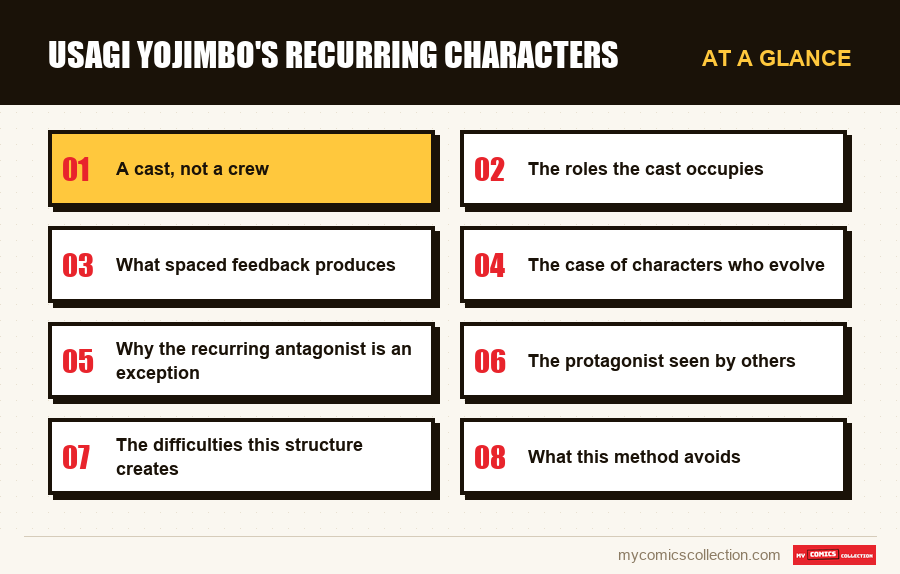
A cast, not a crew
The distinction is decisive and it separates this series from almost all of what is published around it.
A team supposes characters brought together for a long time, acting together, whose absence is noticed and justified. A cast only supposes a set of people who exist in the same world and whom the story summons when it needs them.
Here the protagonist travels alone most of the time. The other figures live in places, do jobs, lead their lives, and come across him when his travels take them there.
This configuration has a structural consequence: no one needs to be explained when they return. A character absent for thirty issues reappears without the story having to justify where he was, since he was not supposed to be anywhere in particular.
The roles the cast occupies
The interested traveling companion
A bounty hunter who accompanies the protagonist without sharing his scruples. He works for money, says so, and this frankness serves as a permanent counterpoint to the main character's code of honor.
This is the most frequently invoked role, because it produces disagreement without producing conflict.
An equal in the service of a lord
A warrior in the service of a clan, whose competence is never questioned and whose official position contrasts with the wandering of the protagonist.
She embodies what he could have been if he had kept a master.
The threat that returns
An antagonist convinced to act in the name of a higher justice, which makes him impossible to reason with and impossible to consider as a simple bandit.
His periodic reappearance is the only element of the series that produces apprehension from one story to the next.
The figures of a profession
Investigators, artisans, merchants, religious figures: characters defined by their work, who return because the protagonist passes through their town again.
They anchor the series in a world that continues to spin in his absence.
What spaced feedback produces
The interval between two appearances is not a management fault: it produces an effect that continued presence would not produce.
Time is obviously passing. A character seen again after a long absence has aged, changed circumstances, sometimes lost someone. The reader notices the gap instead of accompanying it, which makes the duration sensitive.
Attachment is built without familiarity. We don't know these people well, we find them with pleasure, and this rarity prevents the wear and tear that threatens the omnipresent characters.
Each return is an event. In a series where nothing is announced, the reappearance of a known figure on the front page is enough to give the episode a particular weight.
This last point is worth emphasizing, as it is the main suspense mechanism of the series. There is no long-term plot, but there is a reunion, and they fulfill the function that the plot would occupy elsewhere.
None of these characters are essential. A reader who discovers the series through a story where none of them appears is not missing anything: the whole story works.
This is precisely what makes the series buyable out of order. The distribution adds depth to those who know it, without ever becoming a prerequisite for those who do not know it.
The case of characters who evolve
One exception to this autonomy is worth noting, because it is the only thing that really rewards orderly reading.
Certain figures do not just return: they transform from one appearance to another. A child grows up, an adversary becomes an ally, a relationship changes in nature without anything announcing it.
These developments take place over dozens of issues and are never summarized. A reader who picks up the series along the way will not perceive them, and nothing will warn him that he is missing something.
This is the only real cost of messy reading, and it must be said honestly: it is on a layer of emotion, not on comprehension. We understand everything; we feel less.
For a reader who enjoys the series and plans to stay with it, this is a good reason to start from the beginning at one point or another: not out of obligation but to find what was not visible the first time.
Why the recurring antagonist is an exception
One figure works differently than the others, and the discrepancy deserves to be explained.
The companions and professional figures return by chance: the protagonist passes by there again. The antagonist returns because he is looking. Her presence is never accidental, and that's what makes her disturbing in a series where everything else is an encounter.
This imbalance is deliberate. In a world where people cross paths, an intention that persists over years seems like an anomaly, and that's exactly the desired effect.
This antagonist brings to the series the only thing that its structure denied it: a threat that cannot be resolved in one issue. Each confrontation ends, and yet nothing is over. It is the only thread that the reader carries from one story to the next.
A less confident author would have made it the driving force of the series. Here, the figure remains rare: enough for its return to count, spaced out enough to never become the reason to read.
The protagonist seen by others
A more discreet use of the cast is worth noting, because it solves a problem that single-character series deal poorly with.
A character who travels alone is difficult to characterize other than by his actions. Without someone to judge him, the reader only has the story to tell him what this man is worth, and the story cannot decide without heaviness.
Recurring figures fulfill this function. The interested companion mocks his scruples; the warrior serving a clan reminds him of what he left behind; professional people treat him sometimes as a protector, sometimes as a troublemaker depending on what his passage has cost their city.
None of these looks are presented as the right one. They contradict each other, and the reader comes to terms with the whole rather than with an author's judgment.
This is where the cast fully justifies its existence. She is not there to populate the setting nor to provide allies in the fights: she is the device by which the story says what it thinks of its own protagonist without ever having to formulate it.
Collecting this series?
Track what you own, what you are missing and what your collection is worth. 7 day trial.
Start my trial →The difficulties this structure creates
Untraceable apparitions
There is no indication in which issues a given figure appears. Following a character requires keeping the list yourself.
A poorly identified foreground
The first appearances are not indicated anywhere on the object, contrary to custom in character series.
Invisible developments out of order
A transformation spread over years goes unnoticed if one reads out of order, without any warning signal.
Collections that cut poorly
The volumes are grouped by chronology of publication, which sometimes separates two related appearances of the same character.
A practical consequence arises from this for the reader who composes his collection in leaps and bounds. The stories where the protagonist travels alone are the easiest to approach in isolation, but they are also the ones that say the least about him. Those where he meets people require a little context and give a lot more. With equal findings, it is better to favor the latter to get a fair idea of the series.
What this method avoids
It is worth naming what this structure preserves, because it is the most common fault of long series.
A series that installs a permanent team ends up having to keep everyone busy. Each episode must give each member something to do, otherwise there will be characters present unnecessarily.
This obligation produces filler: subplots intended to justify a presence, dialogues which exist to remind us that a character is there. The cost in pages is considerable and it gets worse over time, as the distribution widens.
Here, this cost is zero. A story that needs no one calls for no one, and a cast of twenty figures weighs no more than a cast of three.
This explains why after forty years, the series shows no sign of congestion: a problem from which almost all series of this length suffer.
What to record
The useful field here has nothing to do with value or condition: it concerns narrative content, which is unusual in an inventory.
The figures present in each issue. Since no source indexes them and the covers do not announce them, the list only exists if you put it together. This is what allows you to reread the appearances of a character in succession: a frequent use in this series and impossible without a note.
A reader who becomes attached to a secondary figure will sooner or later want to find his passages. Without this field, it will have to go through hundreds of numbers again.
The mention of a first appearance, when you identify it. It does not appear on anything and is lost as soon as it is forgotten.
These two fields transform a collection into a searchable object. On a series without a continuous plot, this is the only way to piece together threads that the author has deliberately left scattered.
Frequently asked questions
No, none are essential. A story where none of them appear works whole, and a reader who ignores them misses nothing in understanding. The distribution adds depth to those who know it without ever becoming a prerequisite.
A layer of emotion, no understanding. Certain figures transform over dozens of issues (a child grows up, an adversary becomes an ally) without these developments ever being summarized. We understand everything; we feel less. This is a good reason to start from the beginning again someday.
There is no source indicating this, and the covers do not announce it. The list only exists if you build it up as you read: it's the most useful field to note in this series, and the most expensive to piece together after the fact.
Because they don't form a team: they live in places, do jobs, and the protagonist comes across them when his travels take him there. The interval makes time sensitive (we find them aged, changed situations) and transforms each return into an event.
No, and it's directly related to this structure. A series with a permanent team must keep everyone busy each episode, which produces increasing filler. Here a story that needs no one calls for no one: a cast of twenty figures weighs no more than one of three.
In which issues does he appear?
No source indexes it. The list only exists if you keep it as you read.