Most stories of Usagi Yojimbo take one to three chapters, conclude, and require no further action. This choice goes against the grain of everything the medium has done for forty years, where the long arc has become the norm and the full story an exception. He explains why you can enter this series anywhere, why it does not cope well with the sequence, and why it has survived four changes of publisher without ever losing its readers along the way.
It is an almost extinct form, and examining it teaches as much about what it allows as about what the longbow cost the medium.
This article describes this format, shows what it requires of the author, what it gives to the reader, its real limitations, and why it has allowed this series to last where others have stopped.
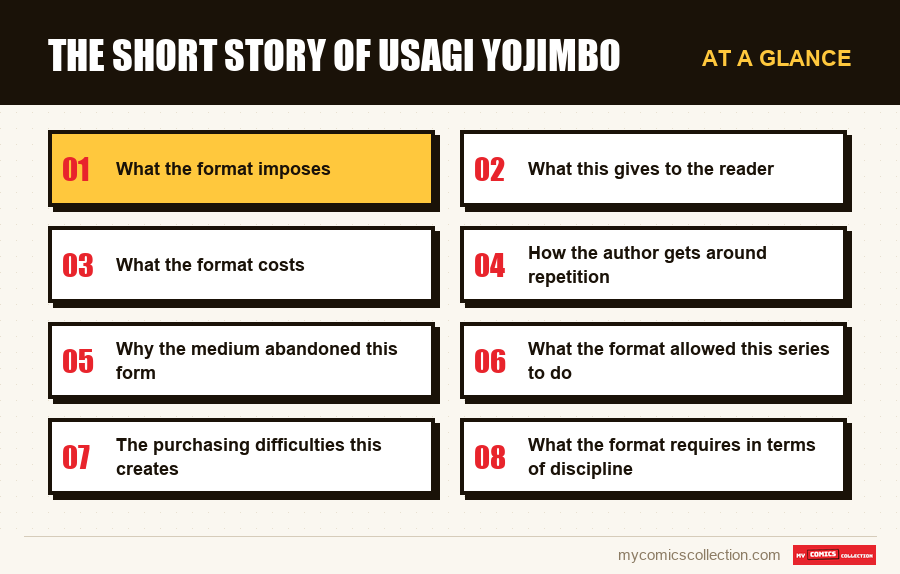
What the format imposes
A story that must begin and end in twenty-four pages obeys precise constraints, and it is worth listing them because they are seen in each story.
Context must be provided immediately. No reminders of previous episodes, no guesses about what the reader knows. The character arrives somewhere, and the location can be explained in a few boxes.
The distribution must be tiny. Three or four secondary characters maximum, presented in one page, characterized by their profession rather than their psychology.
The problem should appear quickly. Usually in the first third, often on the first page. There is no room to build in a threat incrementally.
The resolution must be complete. No thread dangles, no promise is made to the reader for the rest. This is what most distinguishes this format from the episode of a continuous series.
What this gives to the reader
No entry cost
Opening a volume randomly works. There is no prior investment, no catching up to do, no feeling of arriving after everyone else.
This is what makes this series recommendable to someone who doesn't read comics.
No exit costs
We stop after any story without leaving any story behind. A property that almost no long series offers.
Effortless recovery
After years of interruption, we reopen a volume and we are at home. Nothing to reread, nothing to remember.
A density per story
Each story must justify its existence in a few pages. This produces a focus that longbows often lose along the way.
What the format costs
It would be dishonest to only present the advantages, because the limits are real and they explain why the medium has massively abandoned this form.
The formula is visible. A character arrives, a local problem reveals itself, he intervenes, he leaves. Read in a row, the stories resemble each other: this is the most frequent criticism and it is well-founded.
The stakes are leveling off. Twenty-four pages do not allow us to construct a considerable threat. The stories therefore concern local affairs: a village, a family, a road. A reader looking for magnitude will not find it.
The secondary characters evaporate. An endearing figure introduced into a story usually disappears at its end. It's frustrating, and it's structural.
The protagonist's development is slow. It can only evolve between stories, in small steps, which requires dozens of volumes to produce what a long arc does in ten chapters.
The reading rule that follows from all this. Space. One volume every few months rather than five in a row.
This is exactly the opposite of the advice given for a series with long arcs, where the sequence is necessary to hold the thread. Here, the sequence reveals the formula; the spacing makes it invisible.
How the author gets around repetition
An author who practices this form for forty years must resolve the problem of the formula, otherwise he will tire. Three processes come back.
Change of subject, not structure. The form remains the same, but what is shown varies: a different profession, a different region, a different custom. The documented world provides a reservoir of renewal that plot alone would not have.
The movement of the protagonist towards the margins. Some stories make him secondary, almost a spectator of a matter that is resolved without him. This is a powerful variation, and it costs nothing.
Insertion of long arches. Periodically, the series allows itself a story of six or ten chapters. These breaths break the rhythm and make the short stories effective.
These three processes do not eliminate the formula: they make it bearable over time. It is a management of repetition rather than an escape from it, and this is probably the only solution available for this form.
Why the medium abandoned this form
The one-episode full story dominated comics until the 1970s, then almost disappeared. The reasons are economic before being artistic.
The long arc produces an object that can be sold in bookstores: a coherent bound volume, with a beginning and an end, which can be placed on the shelves like a novel. A collection of short stories sells poorly in this form.
It also builds loyalty. A reader caught in the middle of an arc returns the following month; a reader who has just finished a complete story has no obligation to return.
The short format is therefore structurally disadvantaged by the current commercial model, regardless of its qualities. That a series has maintained it for forty years is an anomaly, and it deserves to be noted as such.
What the format allowed this series to do
A direct link exists between this form and the longevity of the work, and it is rarely established.
Four publisher changes in forty years should have been fatal to a series with tight continuity. Each transition imposes an interruption, a change of audience, sometimes a renumbering which loses readers.
A series of self-contained narratives navigate these transitions unharmed. A new reader who arrives after a change of publisher hasn't missed anything, since there was nothing to miss. The old reader finds exactly what he knew.
The format therefore functioned as an insurance against editorial instability, something its author was probably not looking for when choosing it. It was an unexpected benefit that may have saved the series.
The purchasing difficulties this creates
No progress markers
Without an identifiable arc, it is impossible to say “I am in the volume where such and such a thing happens”. The volumes look similar from the outside.
Des résumés inutiles
A back cover describing three independent stories reveals nothing. You have to leaf through.
Un suivi difficile
Knowing what you have read requires keeping a list of stories, not volumes. No standard classification provides for this.
No “can’t miss” volume
The consistency of quality makes any specific recommendation arbitrary, confusing buyers accustomed to lists of essential titles.
Collecting this series?
Track what you own, what you are missing and what your collection is worth. 7 day trial.
Start my trial →What the format requires in terms of discipline
Writing a complete story in twenty-four pages, month after month for forty years, requires a discipline whose demands are difficult to appreciate when we read the result.
A longbow writer has a valuable resource: he can differ. A scene that doesn't work is made up for in the next chapter, an approximate characterization becomes clearer later, a poorly exploited idea returns in a better form. Time repairs.
The short format removes this resource. Each story is judged alone, on its own, with no possibility of making up for it. A failed story remains a failure, and the reader who opened it at random will only have known that one.
This requirement explains a characteristic that one notices when reading several volumes: homogeneity of level. There are few peaks and almost no troughs, which is not the sign of a modest ambition but of an assumed constraint: each story must reach a threshold, none can afford to be a transitional chapter.
This is also what makes the series difficult to recommend by a specific title. On a work with arches, we cite the best; here, we cite the whole, for lack of significant difference between the pieces.
What the reader must accept in return
This form also asks something of the reader, and this explains why it is not suitable for everyone.
It requires giving up waiting. There is nothing to anticipate, no questions left open at the end of a volume, no planned return of a character seen twenty pages earlier. The pleasure of speculation, considerable in series with continuity, is entirely absent here.
It also requires accepting loss. A successful secondary figure disappears on the last page and will not return. A reader accustomed to stories that capitalize on their good ideas experiences this as a waste.
What the form offers in exchange is of another order: each reading is complete in itself, and leaves no debt. It's a different contract, neither superior nor inferior, and it's best to know which one you're signing before opening the first volume.
A form that returns elsewhere
It is worth noting that this form has not disappeared everywhere, and where it remains says a lot about its conditions of survival.
It persists in periodical publications which do not depend on volume sales, in certain national traditions where the short format remains the norm, and among authors who publish directly to their audience.
The common point is significant: it survives where the story doesn't need to be put together to sell. As soon as the bound volume becomes the main product, the long arc imposes itself mechanically.
This suggests that the disappearance of the short format is not an aesthetic judgment of the medium on itself but a consequence of the way in which it sells: which is a more useful and less flattering explanation.
Ce qu'il faut enregistrer
An unusual field imposes itself on a series of autonomous stories, and it has no equivalent elsewhere.
The list of stories read, not volumes. Since the publishers' collections partially overlap, and since the unit of reading is the story and not the volume, this is the only way to know what we have really covered.
It's tedious, and it's the only method that works over forty years of publication at four houses.
The date of reading, too. On a series that we read at intervals spaced several months apart, knowing when we have read what allows us to measure the resumption, and to avoid reopening the series three weeks later, when the formula would still be fresh.
These two fields answer a question that this form poses more than any other: have I already read this story, and is it long enough for the next one?
Frequently asked questions
For commercial reasons above all. The long arc produces a coherent bound volume, salable in bookstores like a novel, and it builds loyalty: a reader caught in the middle of an arc comes back. A collection of short stories sells poorly in this form, and doesn't keep anyone coming back.
It is read in sequence, and the criticism is well-founded: the structure of the stories is similar from one episode to the next. The author manages it by changing the subject, occasionally moving the protagonist to the margins, and periodically inserting long arcs, but he does not eliminate it.
To a large extent, yes, and by a mechanism rarely noted. Four publisher changes would have been fatal to a series with tight continuity; autonomous stories pass through these transitions without harm, since a reader who arrives later has not missed anything. It was an unexpected benefit that perhaps saved the work.
By leafing through, because the summaries don't tell you anything: describing three independent stories says nothing about the quality of the whole. The homogeneity of level also makes any precise recommendation arbitrary: there is no volume that cannot be missed.
This is the only method that works, listing stories rather than volumes. The publishers' collections partially overlap and the unit of reading being history, no classification by volume allows us to know what we have really covered over forty years.
List stories, not volumes
Out of a series of stand-alone stories published by four houses, the volume says nothing of what we have read.