The most common misunderstanding about Usagi Yojimbo is to take it for a children's series because of its animal design. The violence is real, rapid, and above all it has lasting consequences: characters die, wounds remain, and the protagonist bears what he did. The gap between appearance and content is not an accident: it is a device that allows us to deal head-on with subjects that a realistic drawing would make unbearable.
This question determines who can recommend the series to, and it is almost always poorly answered.
This article describes how violence is treated, what animal drawing allows, what you need to know before offering this series, and why this device works where it could have failed.
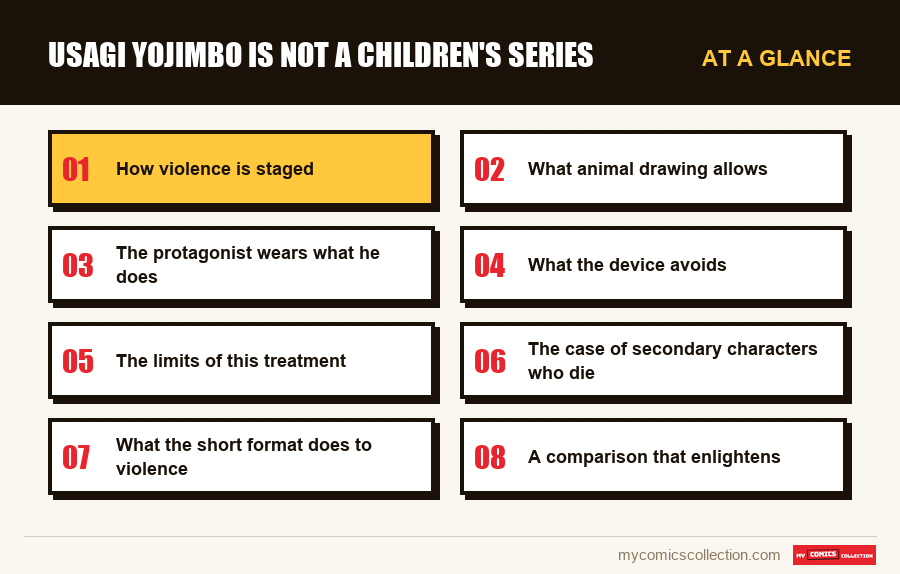
How violence is staged
It obeys constant rules over forty years, and identifying them allows you to know exactly what you are going to read.
It is brief. A confrontation is resolved in a few squares, sometimes in just one. There are no fights spread out over pages, no prolonged exchanges, no twists and turns during the duel.
It is decisive. When a blade hits, someone dies or is left scarred. No one gets up from a serious blow to resume the fight.
It is not very graphic. The blood exists but remains sober, often suggested. It is not a series of hemoglobin: the effect comes from the purpose of the gesture, not from its detail.
It is followed by consequences. This is the decisive point: a death produces mourning, an injury convalescence, a confrontation of reprisals. Nothing closes between two stories.
What animal drawing allows
A distance that allows frontality
A realistic character killed with a saber produces an unbearable image. A stylized character allows you to show the same scene and let the reader appreciate its scope without being overwhelmed.
The graphic distance does not attenuate the point: it makes it possible to hold it.
Immediate readability
Simple, distinct silhouettes make each encounter understandable at a glance, which is essential when the fight lasts three squares.
A designation without caricature
The species distinguish the characters without locking them into ethnic or social types, which a realistic drawing in a historical setting would have made difficult.
A contrast that highlights
The softness of the line makes the brutality more striking by contrast. A hard-drawn series would need to do more to produce the same effect.
The protagonist wears what he does
This is what most distinguishes this series from action stories with invincible heroes, and it has been developed consistently over forty years.
The character kills. Often, and sometimes people who didn't entirely deserve it. The story doesn't excuse it, doesn't praise it, or pretend it doesn't carry weight.
We see him return to places where he intervened, come across families that he deprived of someone, refuse fights that he would have accepted when he was younger. His journey is a long learning of what his skill costs, and this learning never fully succeeds.
This produces a character who is neither a self-assured vigilante nor a conventionally tormented warrior. He does what he knows how to do, he measures the cost, and he moves on: which is closer to the way people live with their actions.
Who can we give it to. To a teenager, without hesitation. To a younger child, it's entirely up to them: there's nothing gratuitous or self-indulgent, but characters die and the story doesn't disguise it.
What would be a mistake is to offer the series thinking that it is youthful because of the cover. The drawing does not warn of anything, and the disappointment would be for the adult who chose the gift.
What the device avoids
Three pitfalls that most action stories do not overcome, and that the stylization-consequences combination allows us to avoid here.
Decorative violence. When a fight costs nothing, it becomes a number. Here each confrontation involves something, which prevents it from being there to furnish.
Graphic complacency. A drawing that details the injuries invites the reader to contemplate. The sobriety of the line shifts the attention to what comes next rather than to the moment itself.
The priceless hero. A protagonist who kills without ever doing anything about it is the genre's most common fault. This accumulates, and this accumulation is visible from one volume to another.
These three avoidances are not independent: they all arise from the same decision to give consequences. It is consequence, not sobriety, that keeps violence from becoming a spectacle.
The limits of this treatment
A misleading cover
Nothing on the object warns of what it contains. This is the main practical criticism that can be made of this series.
A recurrence of clashes
Many stories end in a fight. The short format formula encourages this, and the variety of treatment does not always compensate.
A morality sometimes supported
Some stories state their lesson rather than letting it be inferred. It's rare and it's surprising.
Few nuanced adversaries
The antagonists are often bandits or fairly crude corrupt officials. The complexity is on the side of the victims.
The case of secondary characters who die
One effect deserves to be isolated, because it constitutes the main source of discomfort in this series for a reader accustomed to adventure stories.
Not all secondary figures introduced into a story survive. A sympathetic craftsman presented in three pages, whose profession and family we have seen, can die before the end of the story: without anything having announced it and without his death serving as a lesson.
This practice is rare, and it is deliberate. A story that systematically protects its endearing secondary characters establishes a convention that the reader quickly perceives: If I get attached to someone, it’s because they will survive. This comfort removes any real tension.
By breaking this convention at irregular intervals, the series maintains an uncertainty that brief confrontations would not be enough to produce. You never know, when you open a story, if the people you are going to meet will still be there on the last page.
The price of this choice is real: certain endings leave a bitterness disproportionate to the length of the story. This is also what distinguishes these short stories from simple formal exercises: they engage something.
Collecting this series?
Track what you own, what you are missing and what your collection is worth. 7 day trial.
Start my trial →What the short format does to violence
Form and content respond to each other here in a precise manner, and this articulation explains part of the effect produced.
A story that must last twenty-four pages cannot devote ten pages to a fight. The brevity of the clashes is therefore not only an aesthetic bias: it is imposed by the format, which has no room for anything else.
This constraint produces an unexpected benefit. A three-square fight requires us to show the essentials, the decisive move and its result, rather than the choreography that leads to it. The reader therefore remembers the outcome, not the performance.
Conversely, consequences have all the remaining space. Out of twenty-four pages including three of combat, there remain twenty-one pages to show what this combat produced. The relationship between the act and its consequences is structurally inverted compared to the ordinary action story.
A comparison that enlightens
It is worth situating this treatment in relation to the two options that the medium usually practices.
Violence without consequences dominates the mainstream action story: we fight, we win, the next episode starts again from scratch. It's effective and doesn't involve anything.
Violence as a subject characterizes a part of adult production: the story lingers on the brutality, details it, makes it its subject. It’s sometimes powerful and often self-indulgent.
This series occupies a third, rarer position: violence as a given of a world. It's neither gratuitous nor central: it's part of a time when people carried guns, and the story treats it with the same seriousness as the rest of what it documents.
This is consistent with the entire project. An author who shows at length how a blade is forged cannot then claim that it does not cut.
What this changes for an adult reader
The misunderstanding works both ways, and the latter is less often reported.
An adult reader may dismiss this series precisely because it seems youthful, and miss a work that treats its subjects more seriously than many more serious-looking stories.
This is a real cost for the work. The device that allows it to be frontal is also the one that prevents it from being taken seriously by a part of the public that it would naturally target.
The only answer is to say it clearly, which few recommendations do. A cover showing a rabbit with a saber requires an accompanying sentence, and this sentence is rarely provided.
What you need to know before buying
Two practical clarifications, which arise from the above.
The volumes do not carry a consistent age indication. Depending on the publishers and the periods, certain collections are presented as general public and others not, for comparable content. These mentions therefore do not constitute a reliable guide.
Shelf classification varies. Depending on the bookstores, the series can be found in youth, general comics, or independent. This doesn't provide any information and complicates the search as much as the choice.
The only reliable method is to flip through a few pages. Three plates are enough to know if the tone suits who you intend the book for: this is also the advice that applies to choosing a volume, the series being homogeneous in level.
What to record
An unusual field is justified here, and it concerns less the collection than the use.
To whom you can lend this volume. On a series that is given away and lent a lot, this is one of its main uses, noting your appreciation of the content avoids entrusting it to the wrong reader based on the cover.
This seems trivial. On a work whose appearance contradicts the content, this is the most useful information that an inventory can provide.
L'éditeur et l'année remain essential, for reasons of identification specific to this series published by four successive houses without the number making it possible to decide.
These fields answer what this series asks more than others: who can I give this book to, and what period is it from?
Questions fréquentes
To a teenager without hesitation; for a younger child, it's entirely up to them. There is nothing gratuitous or indulgent, but characters die and the story does not disguise it. What would be a mistake is to offer it believing that it is youth because of the cover.
It doesn't alleviate it, it makes it tenable. A realistic character killed with a saber produces an unbearable image; a stylized character makes it possible to show the same scene and allow its scope to be measured. Graphic distance authorizes frontality instead of softening it.
No, and above all he wears what he does. He kills often, sometimes people who didn't entirely deserve it, and the story doesn't excuse him. We see him encounter families that he has deprived of someone and refuse fights that he would have accepted when he was younger: his journey is a learning of the price of his competence.
It contains violence without making it its subject. The clashes are brief, not very graphic, and above all followed by lasting consequences: it is the consequence, and not the sobriety of the line, which prevents the violence from becoming a spectacle. It occupies a rare position: violence as a given of a world.
No way. Depending on the publishers and the periods, certain collections are presented as general public and others not, for comparable content. The shelf classification varies just as much from one bookstore to another. Flipping through three boards remains the only reliable method.
Who can I lend this volume to?
On a work whose appearance contradicts the content, this is the most useful information in an inventory.