Usagi Yojimbo's anime adaptation had a perfectly measurable effect on the market, but in the ad titles, not in the prices. As of August 29, 2026, 29 gross ads mention the distribution platform in their title, applied indifferently to issues from all eras, from $2.35 requested. The name of the television series has become a selling point attached to what the seller has in stock, unrelated to the content of the copy.
It's a textbook case for understanding what an adaptation actually does to a series' market, and what it doesn't do.
This article explains what the reading shows, explains why the available data does not demonstrate a price effect, describes what adaptation changes for a buyer, and specifies what to check before purchasing in this context.
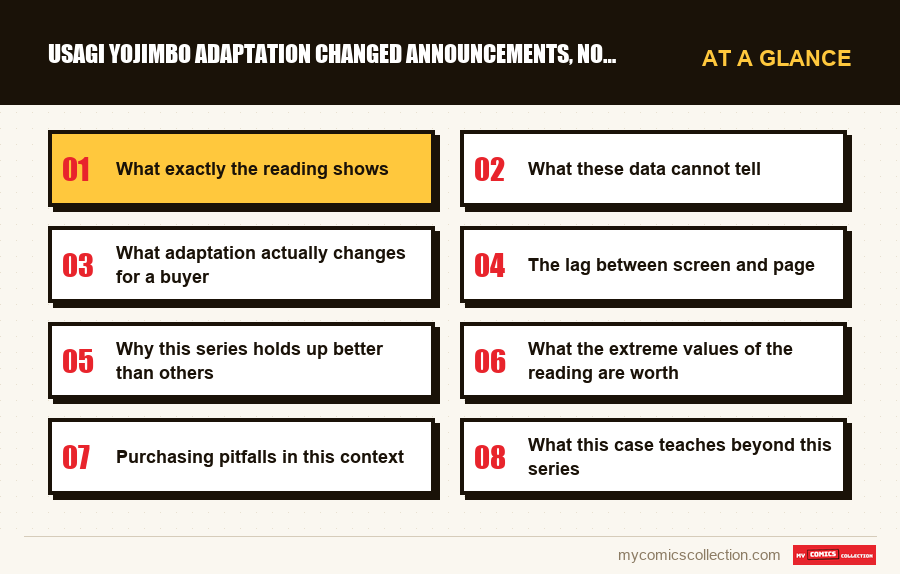
What exactly the reading shows
The following figures are asking prices observed on August 29, 2026, recorded separately in gross and graded. They describe the intentions of sellers, never transactions.
Ads that invoke adaptation
29 gross ads, of $2.35 to $159.00 requested, median $30.48. The name of the platform appears in the title of the ad.
The copies concerned belong to all periods, without apparent logic.
The actual content of these ads
A current issue from the 2010s to $2.35, one issue of a mini-series to $4.24, a 1990s derivative of $9.99. None have anything to do with adaptation.
The keyword is attached to ordinary copies.
The graded slope
22 ads, of $38.00 to $5,692.50 requested, median $99.00. The maximum is an isolated request, to be treated as such.
These certified examples come from the early periods and would have this price level without any adaptation.
Search by program title
A search for the exact title of the animated series does not return no announcement comic strip, neither raw nor graded.
The program did not generate its own publications that would circulate in this market.
What these data cannot tell
You have to be explicit about a limit, because that's where most market commentary goes wrong.
A statement of current announcements does not measure progress. He photographs what sellers are asking for today. It says nothing about what they were asking for before the adaptation was announced, nor what buyers actually paid.
To assert that the adaptation caused prices to rise would require comparing two separate statements over time, on the same references, and having concluded sales rather than requests. These elements are not in the data used here.
What is observable, on the other hand, is solid: the mention of adaptation in the titles is massive and undifferentiated. Twenty-nine ads invoke it for copies that have no connection with the program, including one for $2.35.
This observation does not depend on any temporal comparison. It describes an SEO practice, not a pricing trend.
The median of $30.48 on these listings is worth reading with caution. It is more than double the medians recorded per editorial period, which are around fourteen dollars.
This does not prove that the adaptation enhances these exemplars. A seller who takes the trouble to add a keyword to his title is also, in general, a seller who takes care of his SEO and aims for a higher price. The gap describes a seller type, not an item type.
What adaptation actually changes for a buyer
Three concrete effects, none of which concern price.
Noise in searches. A buyer looking for a specific reference sees ads selected on a promotional keyword rather than on content. Sorting becomes longer.
The arrival of new, poorly informed buyers. Viewers of the program look for “the comic strip of the series” and buy at random, sometimes a derivative or an anthology unrelated to what they saw.
The confusion between the versions of the character. The program presents a version which is not that of the historical numbers. A reader who discovers through the screen and then buys old issues will not find what he was looking for.
This last point is the most damaging, and it is entirely avoidable: you just need to know, before buying, that the program and the published series do not tell the same thing.
The lag between screen and page
It's worth clarifying how the two differ, as this is the source of most disappointment.
The published series is a black and white historical story, with significant violence, in which the protagonist wears what he does. The pace is measured, the stories closed in one issue, the documentation abundant.
An animated adaptation intended for a wide audience proceeds differently, by necessity: accelerated pace, lighter register, narrative arc spread over a season, characters added to broaden the cast.
None of these choices are illegitimate: they are the constraints of the format and the target audience. But they produce an object that does not prepare you for reading numbers, and which even prepares you to be disappointed.
The reverse route works better. A reader of the issues looks at the program as a variation and expects nothing else.
Why this series holds up better than others
One observation is worth making, as it sets this title apart from most that make it to the screen.
On many series, an adaptation causes an outbreak on a handful of identified references: the first appearance of a character shown on screen, the number from which an episode is taken. These references are known, listed, sought after, and their price takes off independently of the rest.
Here, this mechanism finds no support. There is no “number from which the episode is taken”, the adaptation does not take up identifiable stories one by one. And the character's first appearance is in a collective anthology that is already expensive for reasons prior to any adaptation.
The result is that media attention has no target to focus on. It is distributed across the entire catalog, where it becomes diluted: which is precisely reflected in the lack of differentiation observed in the ad titles.
It is a structural property of the series, linked to its form in closed and autonomous stories. The same form that makes it readable out of order also makes it difficult to speculate through isolated references.
Collecting this series?
Track what you own, what you are missing and what your collection is worth. 7 day trial.
Start my trial →What the extreme values of the reading are worth
A word on the demand at $5,692.50 that appeared on the graded side, because this kind of figure circulates quickly and poorly.
It is isolated among twenty-two certified advertisements whose median is $99.00. Nothing in the statement corroborates it, and an unparalleled request does not constitute a price: it constitutes a proposal that no element requires us to consider as serious.
However, these extreme values have a real effect. Taken out of context, they create expectations among occasional sellers, who align their own requests with the highest figure they have seen.
This is how an isolated request ends up spreading in a market without any transaction having validated it. The mechanism is visible in this statement as in that of the first appearances, where a demand of five figures coexists with a median of three.
The protection is always the same: read the median, count the announcements, and be wary of any number that has no neighbor.
Purchasing pitfalls in this context
The decorative keyword
The mention of a platform in a title says nothing about the content of the copy, and it is applied to all periods indifferently.
The news bonus
A seller who references adaptation generally aims for a price higher than the median observed per period.
The wrong version expected
Buying old issues hoping to recapture the tone of the program leads to predictable disappointment.
Reading a median out of context
Comparing the $30.48 in this subset to the fourteen dollars in the statements per period is like comparing two different populations.
What this case teaches beyond this series
The mechanism observed here is reproduced with each adaptation, and knowing how to recognize it is useful well beyond this title.
An adaptation announcement first produces an effect on the titled, almost immediate and at no cost to the seller. It then sometimes produces an effect on the requests, slower. Finally, it rarely produces an effect on the transactions, which alone would constitute a market development.
The three are systematically confused in the comments we read. Finding that “the ads mention the series” is presented as proof that “prices are going up”, even though the first fact in no way implies the second.
The method to guard against this is simple and applicable everywhere: look to see if the examples cited in these announcements have any connection with the adaptation. Here, a running number at $2.35 answers the question.
When the keyword is attached to anything, it describes a sales practice. When he designates precise references (a first appearance, a number adapted to the screen) he can describe a real movement.
What to record
The relevant field here is temporal, which is unusual in a collection inventory.
The price paid and its date. On a series affected by audiovisual news, this is the only data which will allow, in two years, to know if the event had a lasting effect or if you bought at the height of a temporary agitation.
No public statement will provide this answer retrospectively, since the announcements disappear and the requests are not archived. Your own history is the only time series you will have.
The origin of the purchase deserves to be noted in this precise context: a copy acquired during a period of media exposure was not purchased under the same conditions as another, and remembering this avoids drawing false conclusions when comparing your own acquisitions.
These two fields are of no use in identifying an item. They are used to evaluate your own decisions, which is a rare and valuable use of an inventory.
Frequently asked questions
The data used here does not allow us to say this. A current listing survey photographs what sellers are asking for today; it says nothing about what they asked before, nor what the buyers paid. Demonstrating this would require two statements separated in time and sales concluded.
Because it is a free and immediate SEO argument. The 29 advertisements noted apply it to copies from all periods unrelated to the program: including a current issue at $2.35. The keyword describes a seller practice, not a property of the object.
Know before buying that the two do not say the same thing. The published series is a black and white historical narrative with significant violence; an animated adaptation for the general public proceeds with an accelerated pace and light register. The reverse route-read first, watch later-works much better.
No. It is certainly double the medians recorded per editorial period, but a seller who adds a promotional keyword is also a seller who takes care of his SEO and aims higher. The gap describes a seller type, not an item type.
A search for the exact title of the animated series does not turn up any comic book announcements, either raw or graded. The program has not generated any publications of its own circulating in this market: what you will find under this keyword is the original series.
At what price, and on what date?
On a series affected by news, your history is the only time series you will have.