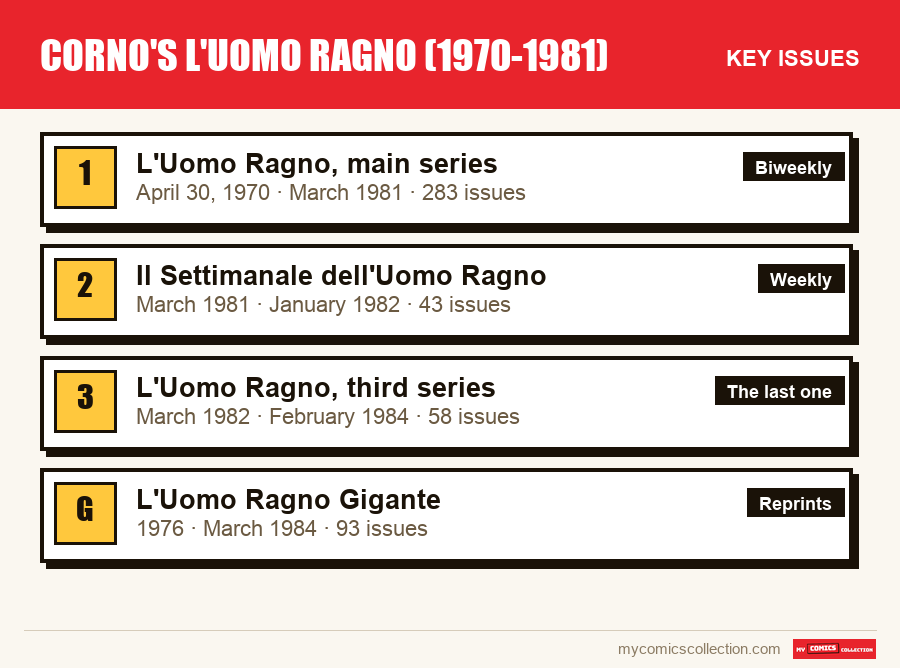
L'Uomo Ragno is the first Italian edition of Spider-Man, published in Milan by Editoriale Corno starting on April 30, 1970. The series runs 283 issues until March 1981, at the pace of one issue every two weeks, in stapled comics of 48 pages in a 17 x 26 cm format. The first issues alternate color and black-and-white pages; full color arrives at no. 50. Corno then publishes a weekly (43 issues, 1981 to 1982), then a third series (58 issues, 1982 to 1984), cut short by the publisher's bankruptcy. What makes a copy valuable: its rank in the series (the first issues first), its condition, and the fact that it is truly an original and not a Gigante reprint or a fake no. 59.
French collectors know the Lug editions and their Strange well. Mexican collectors have their own editions. In Italy, the name that opens every conversation is Corno, the Milan publisher that introduced Marvel superheroes to an entire generation starting in 1970. Its comics, long considered unimportant childhood reading, are now sought after, cataloged, protected.
This article is for those who found a pile of L'Uomo Ragno in an attic, for those who buy them, and more broadly for everyone interested in foreign editions of Spider-Man, a subject we also cover regarding foreign editions of Madame Web. It gives no price guide: no verifiable source publishes a recent one. It does, however, give the reference points that let you identify a copy and understand what makes it more or less desirable.
Corno, the publisher that imported Marvel into Italy
Editoriale Corno was born in Milan in 1960, under another name, on the initiative of Andrea Corno and his brother-in-law Luciano Secchi, who would write under the pseudonym Max Bunker. The house began with anthologies of American newspaper comic strips, then found success in the mid-1960s with its own series, notably Kriminal and Satanik, drawn by Magnus, then Alan Ford from 1969.
The year 1970 marked a turning point: Corno acquired the publication rights to the Marvel superheroes. According to the publisher's own account, these series were offered to it by an agency from which it was already buying other American titles. It started cautiously with only two series: L'Uomo Ragno, devoted to Spider-Man, and Devil, the Italian name of Daredevil. Success was immediate, with print runs reaching one hundred thousand copies according to the publisher's history. The Fantastici Quattro and Thor followed in 1971, Capitan America and an anthology devoted to supporting characters in 1973.
Corno was not quite the first to publish Marvel in Italy. Fantastic Four stories had appeared a few years earlier in two supplements of a creator-driven comics magazine, and another publisher had launched in 1966 a series devoted to Sergeant Fury. But it is Corno that durably established these characters on Italian newsstands.
L'Uomo Ragno, first series: identification markers
L'Uomo Ragno, main series
Comics of 48 pages, in a 17 x 26 cm format, bound by staples. Each issue contains two to four translated Marvel stories, including at least one Spider-Man, the others devoted to Doctor Strange, Ant-Man and his successive avatars, Iron Man, Devil or Hulk. Nearly all of these stories were new in Italian at the time of their publication.
A printing detail serves as an immediate marker. In the first issues, pages alternate in pairs: two color pages, two black-and-white pages. From no. 50 on, all pages are in color. A comic numbered after 50 that contained black-and-white pages should therefore raise suspicion.
Covers are the other point of attention. The graphic identity of Corno's publications owes much to illustrator Luigi Corteggi, who drew many logos and hundreds of covers for the house. Before concluding there is an anomaly because an Italian cover differs from the American original, you should therefore compare it with a reference Italian copy, not with the original comic.
The following series, and what not to confuse
The end of the first series does not mean the end of Spider-Man at Corno. The publisher chains several publications, which a collector must know how to separate in their list.
Il Settimanale dell'Uomo Ragno
It replaces the main series with comparable content, this time every week. Its short duration makes it a series easier to complete than the first.
L'Uomo Ragno, third series
The publisher's last Spider-Man series. No. 59 was announced in no. 58, but it never came out: Corno's bankruptcy interrupted publication.
L'Uomo Ragno Gigante
A reprint collection that reprints the stories already published in the main series, in a larger format, 21 x 28 cm.
Corno also published, in parallel, Il Giornalino de l'Uomo Ragno, aimed at younger readers and inspired by the animated version of the character, unrelated to comics continuity. It is not an edition of the Marvel stories in the strict sense, and it is filed apart in a collection.
After Corno's disappearance, Spider-Man's adventures returned to Italy in May 1987 at a new publisher, Star Comics, which picked up publication of the stories where it had stopped, under the same title. These late-1980s comics form yet another series, not to be confused with those of Corno.
What makes a Corno Uomo Ragno valuable
Without giving figures, we can describe the hierarchy that structures this market. It resembles what is observed on the Lug editions in France, with a few Italian particularities.
The rank in the series
No. 1 of April 30, 1970 is the symbolic piece of all of Corno's Marvel output. The first issues, and more broadly those of the two-tone period before no. 50, are the most sought after, because they were bought by children who read them, traded them and threw them away.
The condition
Modest paper, staples that rust, covers that come off, children's names written in pen: the average condition of surviving copies is low. A clean copy, with bright colors and an intact spine, stands out clearly from the lot.
The content
Issues that translate into Italian for the first time an important American story, such as a first appearance of a major adversary, interest fans of the character more than transitional issues.
The authenticity
Check that it is an original and not a Gigante, a later edition or a fake. The format, the collection notation and the presence or absence of black-and-white pages are the first three checks.
The continuity of the collection
A complete series, or a long run with no gaps, is worth more than the sum of its issues taken one by one, because it spares the buyer years of searching.
An important note for foreign collectors: an Italian edition does not replace the American original, and its market is first of all Italian. Its demand depends on the nostalgia of a generation of readers who discovered Marvel in these comics. It is a real market, but narrower and more local than that of American comics of the same period.
Why Corno collapsed
From 1975, some of Corno's Marvel series stop, offset by new short-lived titles. From 1979, the drop in sales becomes general. The publisher tries to react by multiplying reprints, special issues and sticker albums tied to the cartoons broadcast on television. In vain: the house closes in 1984.
Italian historians put forward several explanations. The first readers grew up and drifted away, disappointed by late-1970s American stories judged more repetitive. Unfaithful translations, a lack of editorial care and an approximate respect for the order of stories wore out an audience that had become more demanding. The youngest, finally, watched television more than they read comics. This fall probably explains part of the scarcity of late issues in good condition, aimed at a shrinking audience.
Sorting an Italian collection step by step
For anyone inheriting a box of comics, the first step is to sort them by series: main, weekly, third series, Gigante, other Corno titles like Devil or the Fantastici Quattro. The second is to note, for each copy, the number, the collection notation, the presence of black-and-white pages and the general condition. The third is to match each Italian story to its original American issue, which lets you quickly spot translations of key issues.
This work takes time, but it changes everything when it comes to estimating, insuring or selling. A precise list, with the series and condition of each copy, is the only document that lets a serious buyer make a serious offer. For the estimation method itself, see our guide to estimating the value of a specific comic, or ask for a free estimate.