The Herald of Galactus had a series in his name launched in 1968, then a second series relaunched under the même titre in 1987. The two numberings start from 1 and overlap: a number 9 exists in each. As neither the cover nor most of the announcements bear the year of launch, a search by title returns the two series mixed together, and overwhelmingly the recent one. Taken on August 29, 2026, the unverified market shows 54 listings asking for $2.99 to $2,999.99, median $44.75: a figure that describes neither series, since it adds them together. Only the year of publication properly separates the two homonymous titles.
There is a category of collection errors that does not come from counterfeiting, overvalued condition, or misreading a defect. It comes from the very identity of the booklet: two different objects carry, on the cover, exactly the same sequence of words. The title devoted to the herald of Galactus is a textbook case. A series was launched in 1968. It stopped. Twenty years later, in 1987, the publisher relaunched an identical title, with its own numbering which restarted at 1. From then on, saying “number 9” no longer designated anything specific. Two fascicles meet this description, separated by two decades, and nothing in the wording allows us to decide.
This is not a scholarly curiosity. This is an inventory problem that becomes apparent as soon as you type the title into a commercial search engine. The statement from August 29, 2026 is clear: out of 54 unverified advertisements, the amounts claimed range from $2.99 to $2,999.99. The bottom of the range is occupied by booklets dated 1987: three of them between $2.99 and $4.95, including one in an edition intended for specialized stores. The top of the range is a completely different commodity. These amounts are prices asked by sellers on a given date, not completed transactions, and a single statement says absolutely nothing about a trend: it photographs a stall, it does not film a market.
Why does a publisher relaunch a title instead of creating one?
The reuse of a title is not an administrative accident, it is a calculation. A title that has already been sold is an asset: it has been printed on covers, cited in letters to readers, listed in mail order catalogs, spoken in stores. The name is already installed in the heads of part of the readership, and this installation was expensive the first time. Relaunching it costs much less than imposing a new name, which would have to start from scratch on all channels at once. The publisher not only has the right to use his own title; he has a direct economic interest in doing so.
Added to this is signal logic. Using the exact title, rather than attaching a subtitle or a reminder, tells the old reader that it is indeed the same thing that is coming back. The continuity displayed is a selling point. The distinctive subtitle weakens precisely what we were trying to reactivate: it announces a derivative product rather than a return. Between bibliographic clarity and commercial efficiency, periodical publishing has long ago decided, and it has decided in the direction that complicates the life of collectors.
Finally, nothing in the production of the booklet requires displaying the year the series was launched. The cover bears a number, often a month, a face price, a logo. It does not bear any mention of the type "series started in 1987", because this information is of no use to the buyer of the newsstand, who buys the issue of the month. The information only had value thirty years later, on a second-hand market where two homonymous series coexisted, and at that time, it had never been printed.
The result is a lasting asymmetry: the publisher produces two series perfectly distinguishable in its own registers, and two objects physically indistinguishable at first glance for those who encounter them separately. The distinction exists, it is even documented in the catalog; it simply does not travel with the object.
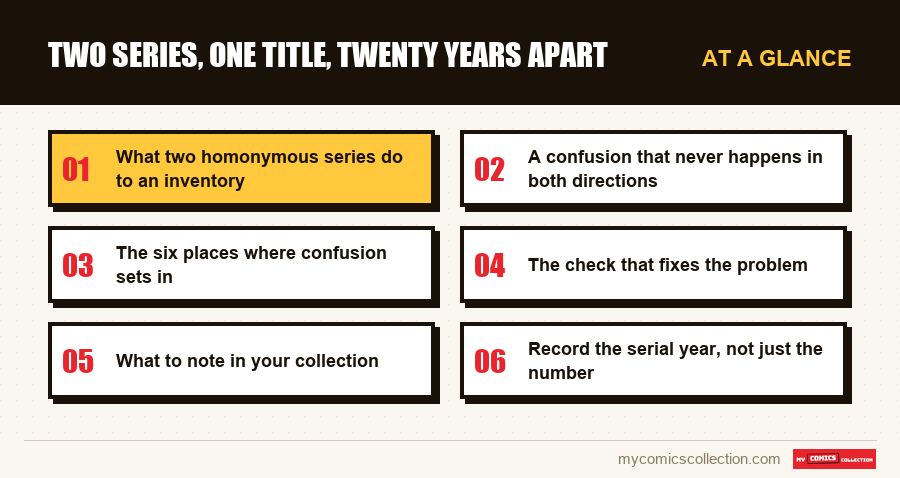
What two homonymous series do to an inventory
The “title + number” key ceases to be unique
Most inventories, shortage lists and announcements identify an issue by its title and number. With two homonymous series whose numbering overlaps, this key designates two objects. A number 9 refers to an issue from the 1968 series and to an issue from the 1987 series, without any element of the key allowing a choice.
Sorting by number mixes two eras
Arranging the series in ascending order produces a list that silently alternates between two decades. Nothing signals the break: the issues follow each other neatly, and a reader in a hurry sees a continuous collection where there are two superimposed sets.
The missing list is filled next
A collector who notes "I'm missing numbers 4, 7 and 9" without specifying the year writes a list that only he can interpret, and again, as long as he remembers it. Transmitted to a seller, this list will be honored with the most available issues, that is to say those from the recent series.
Any aggregated statistic becomes unreadable
The 54 unverified advertisements noted on August 29, 2026 form a single set in which two very different goods coexist. Their median of $44.75 is the price of nothing: neither that of a 1968 issue, nor that of a 1987 issue. It is the arithmetic midpoint of a mixture.
This last consequence deserves to be asked frankly, because it traps even attentive buyers. A median is reassuring: it is reputed to resist extremes, it gives the impression of a “normal” level. But it cannot resist the fact that we have stacked two distinct populations. When a portion of the listings are asking for less than five dollars and another portion is asking for several hundred or thousands, the median lands somewhere in the middle, in an area where there may be no representative bids. The figure is correct in the arithmetic sense and false in the descriptive sense.
Two reservations to keep in mind regarding the data from August 29, 2026. On the verified side, there are only four ads, asking for $699.99 to $8,599.99, with a median posted at $3,949.99. Four offers do not allow any price level to be established: the workforce is too low for a median to have any meaning, and the only honest thing to say about it is precisely that it is too low. This figure is used to measure the scarcity of the certified supply, not to set a value.
On the unverified side, the median of $44.75 suffers from a different but equally disqualifying defect: it aggregates two homonymous series. It does not describe either the 1968 series or the 1987 series. As long as the statement is not separated by year of launch, no price conclusion can be drawn for one or the other. And in both cases, these are amounts claimed on a single date, never sales concluded: a single statement shows no movement.
A confusion that never happens in both directions
The most important point of this file is perhaps this: the error is not symmetrical. One might believe that confusion between two homonymous series is equally distributed, with one in two buyers making the mistake in each direction. This is not what the market produces, and the reason is the structure of the supply.
The 1968 series is old, its print run has been absorbed by time, and what remains of it in good condition is rare and expensive. The 1987 series belongs to a period of massive printing: it is abundant, and the survey shows it since the bottom of the range is occupied by issues dated 1987, between $2.99 and $4.95. When a search by title returns 54 ads, the overwhelming majority of what comes up therefore falls into the second set. It's mechanical: the engine displays what's on sale, and what's on sale is what's in abundance.
From this asymmetry arises the unique direction of the error. No one looks for a three-dollar booklet and is offered, out of confusion, a copy worth several thousand: the seller of a rare object describes it precisely, because his margin depends on it. The opposite happens constantly. Someone looks for the old series, types in the title, sees a mass of cheap ads, concludes that the title is common, and buys a 1987 issue believing it completes a 1968 series. The confusion always occurs from the expensive to the cheap, never the other way around.
The same mechanism distorts the perception of value even before the purchase. A collector who discovers the title through a quick search gets the impression that these issues are worth almost nothing. This impression is correct for the series that he mostly saw, and false for the one he was looking for. He can then give up on an old, correctly priced example, judging it to be overpriced compared to a reference level that he built on the wrong series.
A mention like “edition intended for specialized stores”, observed at the bottom of the range, adds a layer: it is a variant of the distribution channel, which only exists for the recent period. Its mere presence in an advertisement implicitly dates the booklet, but you still have to know how to read it, and it does not appear in all the advertisements.
Collecting this series?
Track what you own, what you are missing and what your collection is worth. 7 day trial.
Start my trial →The six places where confusion sets in
Search by title alone
Typing the name of the series into a merchant engine does not filter anything: both series respond to the same keyword. The result is sorted by textual relevance or by price, never by year of launch, so that the abundant series occupies the screen.
The year missing from the announcement
There is no obligation for a seller to indicate the year the series was launched. Many mention at most the date on the cover, when they mention it. The information which separates the two titles is therefore optional where it would be decisive.
The cover that does not date
The logo, number and face price appear on the object; the year the series started, no. In a cropped ad photo, two homonymous booklets bearing the same number may look enough alike for a buyer in a hurry to look no further.
Lots and group sales
A lot announced as “the series” can bring together booklets from both sets. The buyer receives a continuity of numbers which is not one, and the defect is only revealed when storing or reselling piece by piece.
Overlapping numbers
The overlap zone is the most dangerous: as long as the two numberings overlap, each number concerned designates two objects. A number 9 exists in both series, and it is exactly the type of rank that a missing list cites without precision.
Playlists reproduced as is
A reading recommendation that cites an issue without its year carries ambiguity wherever it is copied. The reader who follows it buys the booklet that is easiest to find, that is to say, once again, that of the recent series.
The check that fixes the problem
The solution consists of a simple rule, but it must be applied before the purchase and not after: never consider that a title and a number identify a booklet. There needs to be a third element, and that element is the year the series launched. Two homonymous series are only distinguished by this; any other method (the logo, the model, the printing of the cover) requires expertise that most buyers do not have and that an ad photo does not always allow them to exercise.
Concretely, this means having the seller specify the year covered by the booklet and, if possible, the opening date of the series. This also means asking for a legible photo of the entire cover rather than just a detail, and of the indicia, that block of legal notices printed inside, which carries the publishing information. An ad that refuses these elements on a title known to exist in two versions is not necessarily dishonest; it is simply unusable for this type of verification, which is enough to deviate from it when the difference in price level between the two series is that which is observed.
As for his own collection, the rule is the same mirrored. An inventory that only records the title and number reproduces the ambiguity of the market at home. Adding the year to the file costs a few seconds at the time of entry and avoids having to reopen the boxes years later to make a decision. This is also what makes a shortage list transferable: a seller or another collector can honor it without interpretation.
Finally, when it comes to assessing a price level, the rule is to refuse any statistics that have not been separated by series. A median calculated on a homonymous title is an artifact. Reconstructing two separate statements takes longer, results in smaller numbers, and often leads to the observation that there are not enough advertisements to conclude: as is the case here on the verified side, with only four offers. This observation of insufficiency is a useful result; the mixed median is not one.
What to note in your collection
The year the series was launched, systematically. It is the only field that separates two titles of the same name. Without it, a “title + number 9” card designates two different issues, and the doubt is irrecoverable once the object is put away. Noting 1968 or 1987 next to the number transforms an ambiguous file into a usable file, even by someone other than yourself.
The date shown on the booklet itself. It is distinct from the opening year of the series and can be read directly on the object or in the index. It serves as a cross-check: a booklet whose cover date contradicts the serial year assigned to it indicates an entry error or a poorly described announcement. This is the least expensive check of all.
The distribution circuit, when it is mentioned. An edition intended for specialized shops, like the one observed at the bottom of the range of the survey, is not a decorative variant: it places the booklet in a period and in a mode of sale. Recording this note avoids later comparing two copies which do not belong to the same circuit.
The origin and date of each amount recorded. A price noted without its date loses all value in a few months, and a price noted without its source no longer allows us to know whether it was a seller's request or a transaction. The figures for August 29, 2026 cited here are amounts claimed on this specific date; recorded without this mention, they would become false reference values.
The verified or unverified status of the item, in a separate field. The four advertisements for verified copies noted on August 29, 2026 and the 54 unverified advertisements do not describe the same merchandise and should never be added together in the same calculation. Separating the two in your own file is what allows you, later, to compare what is comparable, and to note, where applicable, that a number is too low to conclude.
The title and number are not enough, since both series share them. You need the date on the booklet, readable on the cover or in the legal notice block printed inside. Ask the seller for a clear photo of one or the other. If no date can be obtained, the identification remains incomplete, and it is better to abstain than to guess.
Because it is calculated on 54 advertisements which mix the two homonymous series. It sits between a set of recent issues asking for a few dollars and much higher offers, in an area that does not correspond to the usual level of either series. It is arithmetically exact and descriptively misleading. It would take two separate surveys per year to obtain a usable benchmark.
They show that the certified supply is very limited, and nothing else. Four ads, asking for $699.99 to $8,599.99, make up too small a number to establish a price level: the resulting median of $3,949.99 has no statistical significance. The only solid lesson is the scarcity of verified supply, not its valuation.
Yes, and it's common. The title is an asset already established among the readership, and relaunching it costs less than imposing a new name. There is also no requirement to add a distinctive mention on the cover: such a mention would weaken precisely the effect of continuity sought. The distinction exists in the edition registers and in the catalog, but it does not travel with the object.
No, no development can be deduced from this. This is a statement made on a single date, August 29, 2026, and relates to amounts requested by sellers, not to sales concluded. A single measurement shows no movement, and an isolated maximum reflects a seller's hope rather than an observed price. It would take several readings spaced over time, and separated by series, to speak of a trend.
Record the serial year, not just the number
My Comics Collection lets you record for each issue its title, its number, its year and its verification status, then instantly find out whether the number 9 you own belongs to the old series or its relaunch. Your shortage lists become transferable, and your price comparisons stop mixing two different goods.