On this identity, the name carries no market. Two successive carriers, the one that has existed since the 1960s and its successor from the 2000s, give, on the same day, almost superimposable raw medians: $5.89 asked on 178 listings pour la première, $5.45 asked on 180 listings for the second. Four decades of seniority gap, incommensurable notoriety, a clear order of succession: none of this can be read in the figures. The certified segment is almost non-existent on both sides, seven announcements pour l'une, huit for the other. All these values are asking prices observed on August 29, 2026, never closed sales, and they describe the offer of only one day.
An old figure is expected to cost more than a recent one, and a famous figure is expected to be different from a lesser known figure. On this transmitted identity, the reading of August 29, 2026 shows neither: the two distributions are held in the same place, in the same low band.
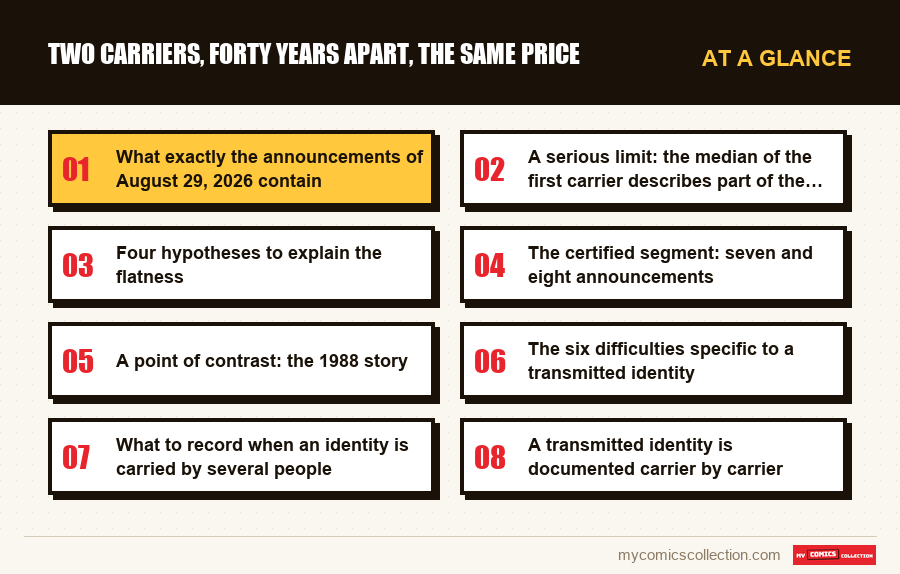
The following describes precisely what the statement contains, poses a heavy methodological limit which reduces its scope, proposes four hypotheses to explain this platitude, shows a point of contrast on the same character, and details what must be recorded when documenting an identity carried by several people.
What exactly the announcements of August 29, 2026 contain
Two questions were carried out on the same day, one on the first carrier, the other on the one which took over the identity in the 2000s. Raw and certified are counted separately, because they are two markets which do not behave in the same way and mixing them creates an average which describes nothing.
The first carrier, raw
178 ads, of $2.49 to $544.00 requested, median $5.89. Half of the offer is under six dollars, despite a amplitude that goes very high.
The first carrier, certified
7 ads only, of $73.99 to $850.00, median $99.00. Seven verified objects compared to one hundred and seventy-eight raw ads.
The successor of the 2000s, in raw form
180 ads, of $0.99 to $85.00 requested, median $5.45. A population almost identical in size, centered in almost the same place.
The successor, certified
8 ads, of $15.00 to $124.99, median $100.00. The segment checked is as narrow as in the first, and its median is of the same order.
The striking fact is not the level of the medians, it is their proximity. Forty-four cents separates $5.89 from $5.45, out of two almost equal ad populations, one hundred and seventy-eight versus one hundred and eighty. If seniority or notoriety translated mechanically into asking prices, the gap should be visible; he is not.
The real difference between the two sets is not read in the center, it is read at the extremes. The top of the gross amplitude reaches $544.00 for the first carrier and stops at $85.00 for the successor. In other words, the oldest identity includes a few isolated objects that rise high, but these objects do not move the median: they are too few in number to weigh on the center of a distribution of one hundred and seventy-eight lines.
The bottom of the amplitude tells the other half. The first carrier starts at $2.49, the successor at $0.99. In both cases, there is a supply at less than three dollars, and it is sufficiently extensive that half of each population is below six dollars.
We must immediately raise the reservation which governs the entire article. A count carried out on a single date provides information on what was offered that day, and not beyond. Nothing here supports the assertion that a price is rising, falling or remaining stable. These numbers capture what sellers were asking for on August 29, 2026, and that's exactly what they're saying.
A serious limit: the median of the first carrier describes part of the new
This limit must be set before any interpretation, because it weakens the most spectacular conclusion of the article.
The question relating to the first carrier is largely occupied by recent releases, from 2026, displayed between $2.49 and $3.16 requested. These announcements do not concern old issues: they are publications of the year, sold at a novelty price. They weigh all the more on the result as they are located at the very bottom of the amplitude and as they are numerous.
The consequence is direct. The median of $5.89 does not describe the market for old issues bearing this character. It describes a mix, in which the new home market occupies a significant part. Presenting this figure as the price of a figure from the 1960s would be a misreading, and it would be dishonest to downplay it on the grounds that it weakens the thesis.
What the limit does not destroy, however, is the initial observation. The point of the article is not that this market is low in absolute terms: it is that it is flat between the two carriers. And this flatness is partly produced by the very presence of this abundant new, which constitutes an explanation rather than an objection.
Finally, a query by name brings back what the name brings back. It does not isolate its own perimeter: it collects everything that sellers have chosen to label in this way, from the old issue to the publication of the month. This bias is structural and applies to both carriers; it does not cancel the comparison, it fixes its scope.
Two surveys carried out on the same day on the same keyword do not delimit watertight groups. They are porous: an ad can answer both questions, and some probably concern neither carrier in the strict sense. What we are comparing are two collections, not two bibliographies.
This is precisely why comparing medians is better than comparing extremes. A median resists the few aberrant lines that an imprecise collection always brings back; a maximum, no. The $544.00 at the top of the range can be for a single item, the $5.89 in the middle can be for eighty-nine ads on either side.
Four hypotheses to explain the flatness
The explanations that follow are hypotheses. The statement makes them plausible, it does not demonstrate them: a state of supply never proves the cause of its own form.
First hypothesis: the appearances are distributed massively in series which do not bear this name. A figure of this type intervenes a lot in other characters, in series in which she is not the star. These booklets are valued first and foremost as ordinary issues of their respective series, not as character objects. The mechanism is general and it always produces the same effect: an abundant supply, but from which each unit draws its price from elsewhere.
Second hypothesis: numerous but short solo series. An identity that gets multiple titles to its name, each stopping after a limited time, doesn't build the same thing as a long, ongoing series. It produces several first issues, several relaunches, several endings, and therefore a fragmented offering, in which no set is long enough to become the obvious reference. Demand is spread across competing blocks instead of concentrated.
Third hypothesis: an identity transmitted several times divides attention instead of accumulating it. This is the most counterintuitive mechanism. We readily imagine that a succession adds up the audiences; it is at least as likely that it separates them. A reader attached to one carrier does not look for the booklets of another, and the buyer who questions the name alone finds himself faced with a heterogeneous whole where he does not know what he is looking at. The name then ceases to be a signal of value and becomes a simple shelf label.
Fourth hypothesis: abundant recent production permanently fuels supply. The 2026 releases recorded between $2.49 and $3.16 are a direct illustration of this. As long as new equipment continually enters the market at a novelty price, the bottom of the distribution is continually replenished, and the median remains pulled toward that bottom regardless of the character's seniority.
These four mechanisms are not mutually exclusive. They can act together, and this is probably the case here: dispersion of apparitions, fragmentation of solo series, division of attention between carriers, continuous replenishment by the new. None needs the others to function, but their addition is enough to explain that an old and known figure displays the same median as a much more recent figure.
The certified segment: seven and eight announcements
The most telling figure in the statement is perhaps this one. Seven certified announcements for the first carrier, eight for the successor, compared to one hundred and seventy-eight and one hundred and eighty raw announcements.
Certification has a cost, and this cost is only justified if the object is identified as important. No one incurs the expense on a booklet that sells for a few dollars: the gesture would not be profitable, and it would not make the object more readable for a buyer. Such a narrow verified segment therefore signals the absence of sufficiently designated objects to merit the procedure, not a general lack of interest.
The certified medians, $99.00 on one side and $100.00 on the other, should be handled with extreme caution. Out of seven or eight listings, a median is not a market measure: it is the value of the middle of a very small pile. Two or three ads removed or added would move it significantly. It deserves to be cited for what it is, an order of magnitude observed on a given day, and no more.
The certified amplitude says more than its median. For the first carrier, it ranges from $73.99 to $850.00; at the successor, from $15.00 to $124.99. Here again, the oldest identity has a top of the range that the most recent does not have, without this moving the center.
Bringing the two segments together gives the clearest picture of the situation: two abundant raw markets, two almost empty certified markets, and a difference in level between raw and certified which is counted dozens of times. This gap is not an anomaly, it is the normal consequence of the fact that only already distinguished objects cross the certification threshold.
Collecting this series?
Track what you own, what you are missing and what your collection is worth. 7 day trial.
Start my trial →A point of contrast: the 1988 story
The same day, a question about a 1988 story involving this character gives a radically different image: 49 certified listings and a verified median of $199.00.
Forty-nine copies checked against seven and eight. The ratio is of the order of six to seven times, on collections carried out on the same day, around the same figure. This is not a difference of degree, it is a change in the nature of the observed market.
The careful reading of this contrast is that it is not about the character but the object. An identified story is a nameable object, which sellers and buyers designate in the same way; an identity carried by several people over decades is not. The first lends itself to certification because everyone knows what is certified; the second does not lend itself to it, because the name alone does not say what object we are talking about.
This point of contrast therefore does not relativize the thesis, it specifies it. The flatness noted on the two carriers is not a property of the character taken as a whole: it is a property of the interrogations by identity name, which bring back heterogeneous masses. As soon as a question targets a specific story, the population changes and so does the market.
The same caveat applies in full to these numbers: forty-nine listings and $199.00 describe the August 29, 2026 certified offer, not a trend, and these are asking prices.
The six difficulties specific to a transmitted identity
They appear when we search, when we tidy up or when we buy, and they compound each other.
One name for many people
The same label designates different characters. An ad that displays the name alone does not say who it is talking about.
Short and multiple solo series
Several titles, several restarts, several endings: no set establishes itself as the reference course.
Appearances outside of his titles
An important part of the presence is played out in series which do not bear this name, and which are valued as such.
New mixed with old
The year's publications coexist with old issues in the same list of results, using the same keyword.
A certificate too rare to serve as a benchmark
Seven and eight verified ads do not constitute a sample. Nothing stable can be deduced from this.
A photograph of a single day
A single statement describes the offer on a date. Any reading in terms of increase or decrease is illegitimate.
These six difficulties explain why two collectors who declare themselves to follow the same identity almost never own the same set, and why the figures they cite are not comparable without caution.
What to record when an identity is carried by several people
The useful record here is not that of a serial number. It must bear what the common name erases.
The carrier concerned by the fascicle, line by line. This is the most important and most often missing data. Without it, an inventory mixes different characters under the same label, and it becomes impossible to know if you have one course or a sample of several courses. The catalog allows titles and numbers to be identified; he does not fill in the column that says who it is for you.
The host title and the nature of the presence. Many of the issues concerned initially belong to a series which does not bear this name. Noting the title, and specifying whether the bearer has the plot, a supporting role or a brief appearance, allows us to find later the limits we had set without having to reopen the copies, and to explain why a particular issue is negotiated like an ordinary issue of its series.
The distinction between recent publication and old booklet. The August 29, 2026 reading shows exactly why: 2026 publications posted between $2.49 and $3.16 took up a significant portion of the question. An inventory that does not separate new from old reproduces this bias in your home, and any resulting estimate will be an average of two different markets.
The declared state and, where applicable, the existence of certification. With seven and eight announcements verified on one side and forty-nine on the other on the same day, the presence or absence of certification is not a detail: it is what explains most of the difference between two amounts. Recording separates two populations that should never be added together.
The asking price, with its date and quality. An amount without a date means nothing on a flat and abundantly replenished market. Saving "asking price, August 29, 2026," like all values in this article, preserves the only lastingly usable information: what was being offered at the time you looked, and the fact that it was a seller's inquiry, not a completed sale.
On August 29, 2026, the first carrier gave a gross median of $5.89 requested on 178 advertisements, and its successor from the 2000s a median of $5.45 on 180 advertisements. Several mechanisms can explain this, without any being demonstrated by these figures: scattered appearances in series which do not bear this name, numerous but short solo series, a transmitted identity which divides attention, and recent production which replenishes the bottom of the market.
The statement doesn't show it. The difference between the two sets can be seen at the extremes: the gross amplitude rises to $544.00 for the first carrier compared to $85.00 for the successor, but not in the center, where only forty-four centimes separate the two medians. A few isolated objects rising high do not move the median of a population of nearly one hundred and eighty listings.
No, and this is the main limitation of this survey. The question about the first carrier is largely occupied by recent releases, from 2026, displayed between $2.49 and $3.16 requested. The median obtained therefore largely describes the new market, not that of old booklets. It should be read as the center of a medley, not as the prize of a 1960s figure.
Seven certified announcements for the first carrier, eight for the successor, on August 29, 2026. Having a copy verified represents an expense which only makes sense if the object is identifiable as important; on a mass of booklets that sell for a few dollars, no one hires him. On such low numbers, the verified medians: $99.00 and $100.00: are orders of magnitude, not market measurements.
On the same day, this story showed 49 verified listings and a verified median of $199.00, or six to seven times more verified copies than the two identity name queries. The careful reading is that the contrast concerns the object, not the character: an identified story can be named in the same way by everyone, an identity carried successively by several people is not. Like the rest, these values are asking prices observed on August 29, 2026 and say nothing about an evolution.
A transmitted identity is documented carrier by carrier
Who bears the identity on this issue, host title, new or old, certified or raw, asking price and its date: the five columns without which an inventory mixes several markets.