The disappearance of Supergirl, which occurred in 1985 during a major collective event, was respected for around twenty years, which is exceptional in a medium where disappearances are usually resolved within a few seasons. The reason is not dramatic but structural: this disappearance served as a tool for an operation to simplify the catalog, and undoing it would have reopened the problem it resolved. On the market side, the August 29, 2026 statement has 154 unverified listings, claimed between $8.73 and $29,600.00, with a median of $27.30, and 37 listings of verified copies, claimed between $49.99 and $589.00, median $165.00.
In serial superhero fiction, the disappearance of a character is a figure of speech about as banal as the cliffhanger. It is announced, it is commented on, it is sold, and it is almost always undone. The regular reader has integrated this convention to the point that it no longer produces much effect: when a publisher removes a character from its catalog, the question is not whether he will return, but when, and by what narrative process. This is what makes the case of Supergirl instructive. Its disappearance in 1985 did not last a few seasons: it lasted about twenty years. Such a duration cannot be explained by the quality of the scene, nor by the respect that an editor would want for the character. It can be explained by the role that this disappearance played in the very organization of the catalog.
The thesis of this article is contained in one sentence: a disappearance holds when it has a structural function, not just a dramatic function. A dramatic disappearance is an effect: it produces shock, sadness, conversation, and an effect can be replayed as many times as you want, which makes it precisely reversible. A structural disappearance is an instrument: it serves to hold something else together, and it cannot be removed without this other thing collapsing. This is the case here, and it is this difference, rather than the content of the scene, that we will examine. We will end with what twenty years does to the public and what the cost, editorially, is of the return of a character whose absence was a principle of order.
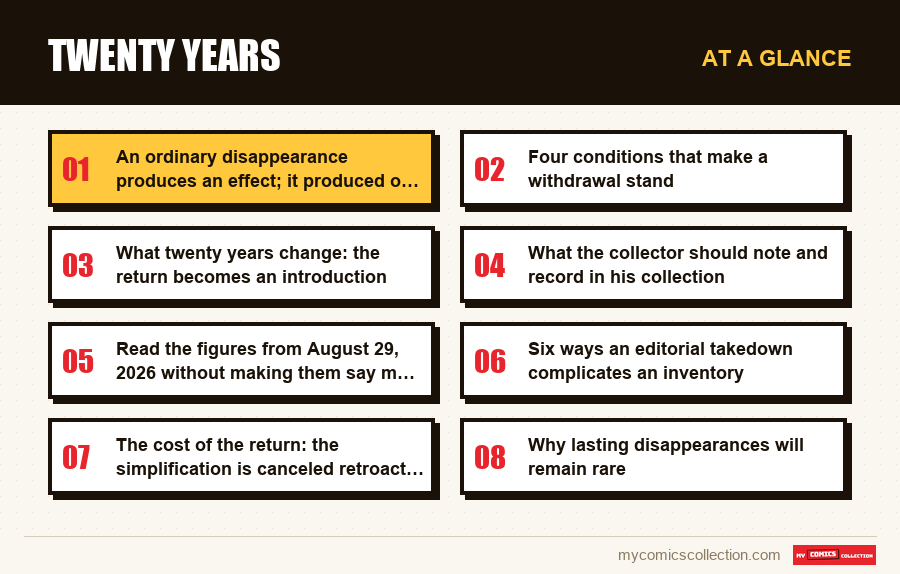
An ordinary disappearance produces an effect; it produced order
We must distinguish two uses of the same gesture. In the first, an editor removes a character to create a shock: the story gains an issue, the surviving characters gain a mourning to bear, the series gains a moment that will be talked about. This is an expressive use. Nothing in the mechanics of the catalog depends on the character remaining absent; the only cost of return is a cost of credibility, and this cost is low because the public is used to it. In the second use, the withdrawal is used to solve an architectural problem. The character is not removed because his absence is moving, but because his presence complicates something. There, the return is no longer a question of credibility: it reopens a technical file.
The 1985 event clearly falls into the second case. His stated argument was the simplification of a body that had become difficult to read, accumulated over decades of successive additions, parallel versions, duplicates and competing continuities. A catalog that grows for a long time ends up producing situations that no new reader can reconstruct without instructions. The editorial operation aimed to reduce this whole to something unified, and this reduction meant eliminating not plots but positions: characters whose very existence duplicated or contradicted another existence. The disappearance of Supergirl is of this order. It was not the consequence of the operation, it was one of its instruments, and as such it demonstrated it.
The logical consequence is immediate. When a withdrawal is the argument of an operation, undoing it amounts to disavowing the operation. It is no longer just one narrative reversal among others, it is a declaration according to which the simplification project did not take place, or did not produce what it announced. No publisher takes this kind of decision lightly, and especially not in the years immediately following, as long as the operation still serves as a common reference for current series. This is why the first decade of absence is not enigmatic: the disappearance was protected by the function it fulfilled.
Four conditions that make a withdrawal stand
Removal Solves a Real Problem
The catalog suffered from degraded readability due to accumulation. The withdrawal did not serve to move people: it served to eliminate a redundancy of position. An action that resolves a problem is protected by the problem itself, as long as it has not been resolved otherwise.
The withdrawal is public and claimed
Simplification was the stated argument of the 1985 operation, not a side effect discovered after the fact. A claimed gesture commits the publisher to his public; undoing it costs more than canceling a decision that remained discreet within a single series.
The following series build on it
Once the simplification has taken place, the stories subsequently published take for granted the state of the catalog it produced. Each new series adds a layer that builds on this foundation. The thicker the layer becomes, the more going back involves taking back what was built on it.
The return reopens exactly what had been closed
Bringing back the character means reintroducing the position that the operation had deleted, therefore restoring the redundancy that it aimed for. The question is no longer “how to bring him back?” » but “what becomes of the reason for simplification? ". This question has no convenient answer.
These four conditions are rarely met together. Most disappearances do not fulfill any of them: they do not resolve any organizational problem, they remain internal to a series, the following stories do not depend on them, and their cancellation does not reopen anything at all. It is for this reason that the convention of return was established. It is not a lack of rigor on the part of the authors; it is the mechanical consequence of the fact that most withdrawals are effects. An effect, by definition, is replayed.
The right question to ask when faced with an announced disappearance is therefore not “is it well written?” » but “what purpose does it serve apart from the stage where it occurs? ". If the answer is “nothing other than this scene”, the return is almost guaranteed, regardless of the seriousness of the treatment.
If the response involves the organization of the catalog (a simplification, a fusion of continuities, a reduction in the number of titles) then the withdrawal has a protection which does not depend on the taste of the following authors. It is this protection, and not an intention of loyalty, which explains the long durations.
What twenty years change: the return becomes an introduction
An absence of two or three years has no demographic effect. The readership who read the disappearance is still there when the character returns; the return speaks directly to him, it completes an experience he had. Twenty years is something else. Over such a period, the readership is largely renewed: an entire generation of readers enters the catalog, settles there, becomes attached to it, and does so in a state of the catalog where the character does not exist. For these readers, absence is not absence: it is the normal state of things. We don't notice the void left by someone of whom we have never read a page.
This completely changes the nature of the return transaction. What the editor thinks he's doing, restoring a character to those who lost him, is actually only a small part of what he's doing. For the majority of his active readership, he does not restore anything: he presents. He must explain who this character is, where he comes from, what he does in the landscape, why he occupies this place rather than another. In other words, he must produce an introduction, with everything an introduction requires: a hook, a clear definition, a reason to exist alongside the characters already established. A return simply recalls; an introduction must convince. It's not the same writing work, and it's not the same commercial promise.
The problem is that the publisher must do both at the same time, for two audiences whose expectations contradict each other. The old reader expects continuity: that the returning character is recognizable, that his absence has weight, that the return means something in relation to what took place. The recent reader expects the opposite: not to be asked to review twenty years of editorial history to understand a current series. Too much continuity and the door closes to newcomers; not enough and the elders do not recognize anything that they had followed. Most long returns are played out in this arbitrage, and many are damaged there.
There is a third audience, more discreet and yet decisive: the one who took the disappearance for granted and attached a value to it. For these readers, the absence was not a deprivation but a principle: the sign that the editor knew how to make a decision, that what he published committed something. The return removes this sign from them. We cannot respond to them with a narrative argument, because their objection is not one: it concerns the credibility of the whole. It is a real cost, difficult to measure, and rarely anticipated in decisions of this type.
What the collector should note and record in his collection
Distinguish the dramatic fascicle from the structural fascicle. Many collections confuse two categories: issues where something strong happens and those which modify the organization of the catalog. They are not the same objects, and they do not behave in the same way over time. When you record a number linked to a simplification operation, note the function, not just the scene: it is this function which explains why the number remains cited twenty years later, and why it continues to appear in reference lists.
Record collective event membership, not just series title. A disappearance that occurred during an event in 1985 is not inventoried like an ordinary episode of a monthly series. The same arc can cross several titles, and an isolated issue may only be understandable within a larger whole. Write in your card the name of the event, the position of the number in the sequence, and what is required to read the passage. Without this field, your inventory will say what you own but not what you can read.
Note the period of absence as collection data. Twenty years without publication means twenty years of issues in which the character does not appear: therefore a clear border in your follow-up. If you collect around a character rather than around a title, this boundary determines where to look and where not to look. Recording it avoids unnecessary research and attribution errors, especially for periods when other characters occupy a neighboring position.
Systematically separate the checked copies from the others in your notes. The August 29, 2026 statement shows this clearly: 154 unverified listings carry a claimed median of $27.30, while 37 verified copy listings carry a claimed median of $165.00. These two sets do not describe the same object and should never be mixed in the same average. If your tool does not distinguish between the two states, you will get a number that does not correspond to anything real.
Date each amount you enter. A price without a date is dead information: we do not know to which market it relates, nor if it is still current, nor what we can do with it the following year. Enter the amount, its source, its status, verified or not, and the day of the statement. This is the only way to later constitute a comparable series; without it, you accumulate isolated figures that do not speak to each other.
Collecting this series?
Track what you own, what you are missing and what your collection is worth. 7 day trial.
Start my trial →Read the figures from August 29, 2026 without making them say more
The amounts recorded on August 29, 2026 are sums claimed by sellers that day, displayed on online advertisements. These are not completed transactions: no one guarantees that a buyer has agreed to one of these amounts. An ad is a request, and a request can go unanswered for as long as it is online. This distinction is not a detail of method; it changes what we have the right to conclude.
On the unverified side, 154 listings range from $8.73 to $29,600.00, for a median of $27.30. The gap between the highest amount and the median is such that it cannot describe the same market: an amount more than a thousand times higher than the central value reflects the expectation of an isolated seller, not an observed level. We therefore dismiss it, and we do not make it a subject. What remains is instructive: with a median of $27.30, the unverified side is located in an area where current copies are found, which is consistent with a booklet widely distributed at the time.
On the verified side, 37 listings range from $49.99 to $589.00, median $165.00. The number is small, but it is not insignificant; it allows for cautious reading without authorizing a firm conclusion. The relationship between the two medians is clear, and it corresponds to what we generally observe when an item goes through a verification procedure: the state becomes an established datum, the uncertainty decreases, and the demand range narrows from below. A range that starts around fifty dollars indicates that there are virtually no verified copies offered at token amounts.
Finally, and this is the most important limitation: these figures come from a single reading, carried out on a single day. A single measurement shows no trajectory. It does not say whether the amounts claimed are rising, falling or stagnating, because there is no point of comparison to which to relate it. Any phrase like “the market is progressing” would here be a pure invention. What this statement provides is a snapshot: the disposition of requests on a date, nothing more, and it is already useful provided you do not ask it for anything else. THE guide de lecture Supergirl will help you locate the booklets that interest you before looking for prices.
Six ways an editorial takedown complicates an inventory
The position survives the character
When a narrative space is vacated, it is often reoccupied by another figure bearing a similar name. An inventory that indexes by name then mixes different characters. Must index by complete identity, otherwise two distinct entries silently merge.
Twenty years of emptiness to document
A long absence creates a range without appearances. If your tracking does not materialize it, you will search for years for numbers that do not exist and you will believe your collection to be incomplete without it being so.
Two pricing regimes, one field
Verified and unverified do not belong to the same market. An inventory with a single value field produces an average that does not correspond to any real situation. Two separate fields are the minimum.
The isolated number cannot be read alone
A booklet belonging to a collective event only has meaning when accompanied. Possessing it without knowing what surrounds it results in a mute object. Note the adjacent numbers needed for reading.
The numbering overlaps
After a simplification, the series often start from a new starting point in numbering. The same number can then designate several issues separated by several decades. Without mention of the period, apparent duplicates abound.
Reissues blur the trace
A significant passage is reprinted in many forms over time. Distinguishing the original edition from later editions is essential, otherwise your inventory gives a rarity status to an object that does not have one.
The cost of the return: the simplification is canceled retroactively
The most concrete question remains: what happens when the editor finally brings the character back? The answer does not lie in the story of the return, however careful it may be, but in a mechanical effect. The 1985 simplification derived its legitimacy from what it had removed. By restoring one of the removed elements, the editor is not only making an addition: he is removing part of the retroactive scope of the operation. The gesture was not definitive, so it was not what it claimed to be, so the other retrenchments also become negotiable. The demonstration is unraveled by the end by which it was held.
Then comes the accumulation. A catalog that is simplified does not remain simple: it immediately begins to grow again, because that is the nature of an ongoing publication. Twenty years later, he has again produced layers, variants, parallel versions, competing continuities. Bringing a removed character back to this already re-encumbered set does not add a space to an empty board; this adds a position in a table which increasingly resembles the one we wanted to reduce. At the end of the cycle, the catalog becomes what it was before the operation, with the addition of the history of the operation itself to be documented.
This does not mean that the return is a mistake. A publisher has good reasons to want to have an identifiable character, whose name circulates beyond the comic book readership, rather than permanently banning a resource. This means that the cost exists and that it is of a particular nature: it is not a one-off credibility cost, it is a loss of value relating to a past decision, and therefore to all decisions of the same type. This is why, after such feedback, subsequent withdrawal announcements are received with less confidence: not because readers have become cynical, but because they have observed a precedent and drawn the reasonable conclusion from it.
For the collector, there is a practical lesson here. The lasting value of a number linked to a withdrawal does not come from the emotion of the scene, which fades, nor from the supposed rarity, which is rarely demonstrated. It comes from the fact that the issue documents a moment when the organization of the catalog changed. This moment remains, even if the character returns: it does not cease to have taken place. This is probably why these fascicles remain cited long after the disappearance they recount has been undone, and why they continue to appear in the lists of issues that collectors seek first. On the character's first appearance and ancient milestones, the page dedicated to the first appearance provides useful detail.
Why lasting disappearances will remain rare
Because the structural function is rare, and it is not decided in a series. Removing a character to simplify a catalog requires an operation on the scale of the entire publisher, with a mandate, a timetable and consequences on all titles. This type of project only takes place exceptionally, because it is expensive and disrupts the series in progress. Most screenwriters have neither the mandate nor the means to make a takedown anything other than a strong moment, and a strong moment has no protection against its own erasure.
Because it wasn't just about moving people. It was one of the instruments of an operation to simplify the catalog in 1985, and undoing an instrument amounts to undoing the operation. A purely dramatic disappearance does not support anything: it can be canceled without anything else changing, which explains the usual brevity.
Look at what she's used for off stage. If it is the stated argument of an editorial project, if the series subsequently published are based on the state of the catalog it produces, and if its cancellation would reopen an organizational problem, it has protection. If none of this is true, she will likely be defeated.
The readership is no longer the same. After twenty years, the majority of active readers have never known the character in publication: the return gives them nothing, it presents them with a new figure. The editor must therefore write an introduction and a review simultaneously, for two audiences whose expectations conflict.
They describe amounts claimed by sellers that day, not completed sales: 154 unverified listings from $8.73 to $29,600.00, median $27.30; 37 verified listings from $49.99 to $589.00, median $165.00. The highest amount on the unverified side is clearly out of the norm compared to a median of $27.30 and must be discarded. A single reading does not show any evolution.
Yes. Thirty-seven announcements are enough to observe a range, but not to establish a stable price level: a few announcements removed or added would significantly move the median. Treat this figure as an order of magnitude for August 29, 2026, to be rechecked, and not as a reference value.
Track what you have, not just what you're looking for
A character absent for twenty years, two distinct price regimes, numberings which overlap after simplification: these are exactly the cases that a hand-held inventory loses sight of. My Comics Collection records the status, period, ownership event and date of each amount recorded, so that your figures remain comparable with each other.