In 2011, the publisher erased a change that had been in place for twenty-three years and restored Barbara Gordon's physical ability to wear the costume. Twenty-three years earlier, a serious assault had deprived her of the use of her legs, and she had become the computer scientist who coordinated others from a screen. The return to costume buys legibility (a name, a silhouette, a function that coincides) and costs a role that nothing else occupied in the catalog. On the market, the difference is not seen: on August 29, 2026, uncertified ads for the series launched in 2011 asked for a median of $10.55, those for the team series from the previous period $9.32.
There are two ways to permanently modify a comic book character. The first is additive: we add a costume, an ally, a city, a temporary death, and the reader integrates the novelty without anything from the past becoming false. The second is subtractive: we remove something which has served as a basis for hundreds of fascicles, and we must then decide what becomes of these fascicles. The 2011 cancellation frankly belongs to the second category. For twenty-three years, a physical characteristic had not only been a biographical detail of the character: it had dictated his narrative function, his place in teams, his way of appearing in a scene, and even the reason why other characters came to talk to him.
Going back on such structuring data is never a correction of detail. It’s an arbitrage, and one that has identifiable winners and losers. This article looks at the two columns of the balance sheet without assuming that one must trump the other, and then wonders why this kind of decision always comes at the same time, that of a general reset, and never in a regular issue. He ends with the only possible numerical verification: what the sellers asked for on August 29, 2026, on both sides of the hinge.
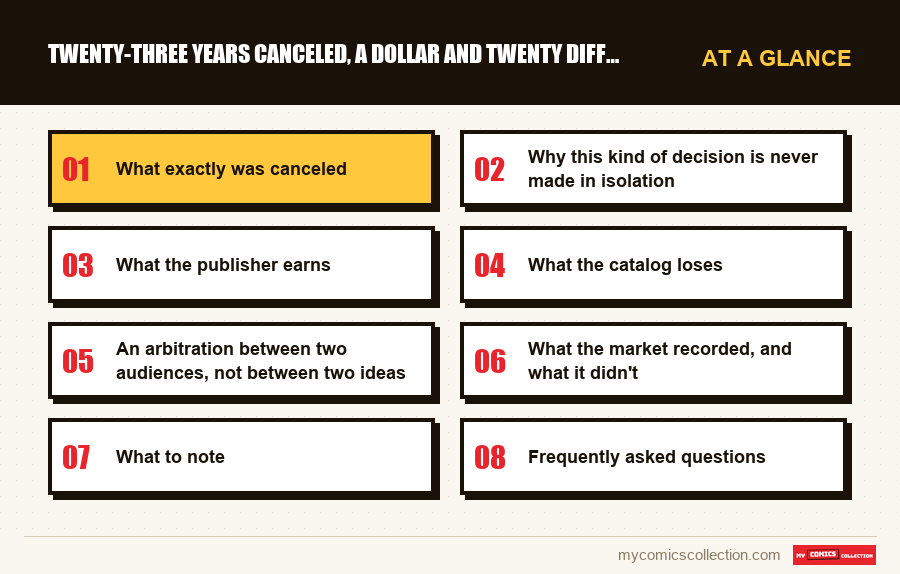
What exactly was canceled
We have to be precise about the nature of the decision, because the usual shorthand: “she became Batgirl again”: covers three different operations. The first is physical: the consequence of the 1988 aggression is lifted, the character walks again. The second is functional: the position of technical coordinator, occupied without interruption for more than two decades, ceases to be hers. The third is narrative: the corpus built around this position: the investigations carried out remotely, the teams set up from an armchair, the professional relationships established with characters who had no reason to encounter a vigilante in the field: loses its anchor point in the present of the series.
These three operations are often confused, even though they have neither the same cost nor the same reversibility. We can imagine a character who puts the costume back on while retaining its coordination function, or who abandons this function without the physical data changing. The editor chose to move everything at once, which is consistent with the context, we'll come back to that, but which also makes the assessment more difficult to establish. Each commenter can legitimately point to a different column and be right.
A fourth consequence, less commented on, is purely documentary. A reader who discovers the character after 2011 has no signal warning him that the previous corpus does not tell the same thing. The name is identical, the cover sometimes shows the same silhouette, the credits overlap. Nothing says that between two issues separated by a year of publication there passes a border that the fiction itself does not indicate. This is exactly the kind of discontinuity that the guide de lecture needs to explain, because the series doesn't.
Why this kind of decision is never made in isolation
An editor who wanted to reverse a change of this magnitude in a regular issue would immediately run into an internal credibility problem. A diegetic explanation would be required-a treatment, an intervention, a manipulation-and this explanation would in turn become an element of continuity that subsequent authors would have to carry around. Worse: it would give the editorial gesture the appearance of an individual whim, attributable to an author, questionable issue by issue.
The master reset solves this problem with a single movement. When an entire catalog restarts at the same time, the cancellation no longer needs to be justified in fiction: it is absorbed by a global justification which applies to dozens of titles at once. No one asks why a certain character has become younger, why a particular marriage never took place, why a certain death no longer counts. The argumentative cost is shared.
This pooling explains a phenomenon that we observe with every large-scale relaunch: the most contested changes arrive in groups, and never alone. This is not a coincidence of timing, it is a property of the device. A reset is a window during which the political cost of an unpopular decision is divided by the number of simultaneous decisions. An editor who has a difficult modification in reserve waits for this window, because outside of it the same modification would cost him much more in public discussion.
The counterpart is that the window does not discriminate. It allows useful corrections and questionable corrections, technical adjustments and major reversals to pass at the same time, without visible hierarchy. A reader who discovers the catalog after the fact cannot know, by looking at the relaunch, which decisions were the subject of a real internal debate and which were taken by simple alignment. Everything happens on the same plane, on the same date, with the same apparent authority.
It should be added that the reset also serves as a commercial alibi. It mechanically produces a wave of first issues, therefore an entry point for new readers and a reason for promotion. The cancellation of a twenty-three year old change, in this context, is not only a creative decision: it is an element of communication, which guarantees that we will talk about the relaunch elsewhere than in the specialized pages.
What the publisher earns
A character describable in one sentence
A masked vigilante who patrols in costume tells a new reader without preamble. A technical coordinator who leads a team from a computer station asks to first explain why she does not go into the field, which requires recounting the attack, therefore starting with a dark episode several decades old. Immediate readability has real editorial value.
An alignment between name and function
For twenty-three years, the character's most recognizable name designated an activity that she no longer carried out. This discrepancy is acceptable for an established readership, costly for everything else: each appearance outside of continuity required a decision between the name that the public knows and the role that the series gives it.
Convergence with adaptations
Outside of the booklets, the character has mostly been shown in costume. A publisher who supplies derivative products, animation and licenses has an obvious interest in ensuring that the reference version of comics resembles the one that the general public already has in mind, rather than maintaining two parallel figures.
Reusability without constraints
A terrain character can be placed in any action scene, any crossover, any team-up, without the authors having to rethink the accessibility of the setting or justify its presence. This casting flexibility is invisible to the reader and decisive for those planning a publication schedule.
None of these four gains are illusory, and it would be dishonest to present the decision as purely destructive. A publisher who is relaunching an entire catalog is looking for characters that can be presented to a new reader without instructions. By this precise measure, the return to costume is a success: it transforms a figure that required a paragraph of explanation into a figure that requires none. The debate is not about the existence of the gain, but about its price.
A gain in readability is measured on readers who have not yet read. A loss of specificity is measured by those who have already read. The two populations do not overlap, and the editor does not have the same means of consulting them: the first is estimated through projections, the second is expressed immediately and loudly.
This is a structural asymmetry, not an accident. She explains why decisions of this type almost always seem brutal at the moment they are made, and why the public discussion that follows says nothing about their success or failure at three years.
What the catalog loses
An unparalleled role
Remote coordination was a narrative function, not a prop. It allowed for investigative, intelligence and logistical intrigues that street fighting does not produce. By returning the character to the field, the editor left this position vacant, and nothing in the catalog occupied it with the same authority.
Twenty-three years difficult to place
Two decades of stories don't disappear from the shelves, but they stop leading somewhere. A reader who discovers them today reads stories whose logical conclusion has been removed from the present of the series, without the page warning them of this.
A rare representation
A major armchair character, active, competent and central to his team, existed almost nowhere else in the major catalogs. The rarity of a representation changes the scope of its withdrawal: it is not one role among others that changes, it is the only one in its category.
An impossible range of stories
Certain plots were only relatable with this configuration: the scene where help arrives too late, the one where the coordinator sees everything and cannot intervene, the one where expertise replaces force. These situations are outside the repertoire available at the same time as the chair.
A continuity mark erased
This characteristic served as a dating marker: its presence placed a story after 1988, its absence before. By canceling it, we deprive readers of a simple marker and we make it necessary to know the editorial calendar to order the issues.
An attachment transformed into litigation
A readership had built up around this precise version, for reasons that cannot be reduced to taste. Withdrawal does not convert this attachment into disinterest: it converts it into protest, which is a lasting image cost and impossible to provision for.
Collecting this series?
Track what you own, what you are missing and what your collection is worth. 7 day trial.
Start my trial →An arbitration between two audiences, not between two ideas
Presented as an aesthetic debate, the subject becomes insoluble: everyone can defend a preference. Presented as an arbitration between two audiences, it becomes analyzable again. On the one hand, an established readership who followed twenty-three years of development and for whom the removed characteristic had become part of the character's identity. On the other, an audience that the publisher hopes to reach and who, by definition, have nothing to lose since they have read nothing.
The difficulty is that these two audiences do not have the same weight depending on the horizon chosen. At one year, the installed readership is the only one that really exists: it buys, it comments, it relays. In five years, the population targeted by the recovery may have become the majority, and no one will remember the debate. A publisher who decides in favor of the long term therefore systematically makes a decision which appears indefensible at the time it is announced.
This does not imply that the decision is good. A long-term bet can fail, and failure is never visible for several years. What this implies is that the vehemence of immediate reactions is not a measure of the quality of the choice, one way or the other. It measures the size and mobilization of the group that loses something, which is another question.
It is also worth noting what the arbitration does not say. He's not saying that the earlier version was poorly written, or that it didn't sell. A reboot decision isn't just based on the results of a title: it's based on the place the character should occupy in a rebooting set. A character can be perfectly well served in his series and still be displaced, because the function we want to give him elsewhere does not correspond to the one he occupied.
It is this overall logic that makes individual explanations unsatisfactory. Looking for a person responsible, an author, an isolated intention, amounts to looking at the wrong level. The decision is made where we look at the entire catalog, and this is also why it is almost always contemporary with a reset: this is the only moment when this level of decision is activated.
What the market recorded, and what it didn't
All that remains is the verification. Does a change that is so discussed, so structuring, so commented on, leave a trace in what sellers ask for? A list of announcements published on August 29, 2026 allows us to ask the question for both periods at the same time.
For the series launched in 2011, 132 listings without certification were online that day, with prices listed ranging from $1.99 to $200.00 and a median value of $10.55. Seven listings were for verified copies, between $41.99 and $149.99, median $75.00. For the team series that carried the character during the previous period, noted on the same day, 152 listings without certification ranged from $1.00 to $40.00, median at $9.32; only two announcements concerned verified copies.
The central fact lies in the comparison of the two medians: $10.55 versus $9.32. Twenty-three years of role undone, a character returned to its original function, a relaunch widely commented on, and a gap of around a dollar and twenty between before and after. Worded carefully: nothing in these figures distinguishes the two periods. The gap exists, it is not zero, but it is too small to support any conclusion on the relative value of the two versions of the character.
Three precautions are necessary before doing anything with it. First, the two populations are not strictly comparable: they relate to different periods of publication, on different formats, and on series whose print runs and distribution circuits were not the same. Then, these are amounts requested by sellers, not concluded transactions: a $200.00 ad proves that a seller wrote it, nothing more. Finally, a reading carried out on a single date shows no evolution. It does not indicate an increase, a decrease, or an effect of the 2011 decision on prices: a trajectory would require at least two separate readings over time, and that is not what we have here.
The certification part is even less usable. Seven ads on one side, two on the other: these numbers are too small for a median to mean anything, and the apparent gap between $75.00 and the rest is explained firstly by the fact that we only submit for certification the copies that we consider already valuable. It is a selected population, not a sample. Reading it as a measure of value amounts to confusing the result with the selection criterion.
What we can say, on the other hand, can be summed up in one sentence: the most discussed editorial turning point in the character's recent history cannot be seen in the prices asked that day. Critical debate and the market for current booklets simply do not measure the same thing. THE key numbers behave according to other logics, and nothing in this statement allows them to be extrapolated.
What to note
The 2011 date is a reading boundary, not a value boundary. It separates two incompatible narrative configurations and should appear in any collection organization relating to this character, not because it changes prices (the August 29, 2026 statement shows no such thing) but because it determines whether or not the issues you put side by side tell the same thing.
The name alone is not enough to identify a period. A booklet with this name can be from before 1988, from the twenty-three year interval, or from after 2011, and the covers do not always announce this. The only reliable identification is through the series and year of publication; relying on the character represented leads to mixing together groups that have no continuity between them.
The intermediate period is sought under a title other than that of the character. Most of his activity during these twenty-three years took place in a team series, which means that research carried out solely on the name misses the main corpus. This is a common cataloging pitfall: the central character of a period is not always the one who gives the series its title.
The amounts recorded are requests, not sales. The 132 and 152 ads counted on August 29, 2026 say what sellers were hoping to get that day. A range from $1.00 to $200.00 measures the gap between sellers' ambitions, not the magnitude of a market. Treating an ad as a rating is the most common and costly mistake.
A single measurement says nothing about a trend. This reading was taken on one date, over two series. It does not allow us to assert that something went up, or that something went down, or that the editorial decision had any effect. Any sentence attributing a price movement to the 2011 cancellation is beyond what the data allows, and it's better said than implied.
Frequently asked questions
The physical consequence of an attack that occurred in the stories in 1988, which deprived Barbara Gordon of the use of her legs and led her, for twenty-three years, to act as a technical coordinator rather than in the field. The revival restores her ability to wear the costume and, with it, her original function as a field vigilante.
Because an overall relaunch provides a global justification which eliminates the need to explain each change in the fiction, and because it divides the cost of the dispute between dozens of simultaneous decisions. Taken in isolation, the same cancellation would require an internal explanation that subsequent authors would have to assume, and would concentrate the entire public debate on it alone.
They remain readable and available, but they cease to feed into the present of the series: their logical outcome has been removed. Concretely, a reader can discover them without difficulty, provided they know that they form a closed whole and not an introduction to what is published next.
The August 29, 2026 statement does not show this. Uncertified ads for the team series showed a median of $9.32 compared to $10.55 for the series launched in 2011: a difference of about a dollar and twenty, between two sets of different eras and formats, therefore too weak and too poorly matched to support a conclusion.
Seven on one side, two on the other: numbers too small to produce statistics. The median of $75.00 observed on the seven announcements of the 2011 series mainly reflects the fact that we only certify copies already deemed valuable, which makes it a chosen population rather than a measure of the market.
Two periods, one name: keep the distinction in your collection
A library that arranges these booklets by character name mixes together sets that fiction separates. My Comics Collection allows you to follow each series on its own, to precisely date your copies and to instantly find what you own on either side of the 2011 hinge.