The Kingpin was born in 1967 as the adversary of a bright hero, and he ended up becoming the definitive antagonist of another hero, much darker, to the point that the majority of readers spontaneously placed his origin in the wrong series. This transfer is neither an accident nor an editor's shortcut: a displaced figure arrives with a past already written, a reputation already built and an appearance counter already filled, a depth that no custom-created antagonist can produce in one episode. For the collector, the consequence is documentary before being financial: the first appearance is in a series which is no longer his, therefore in the place where no one goes to look for it. As of August 29, 2026, a statement of amounts claimed gives 49 uncertified listings between $4.99 and $400,000.00 for a median of $189.99, and 43 verified listings between $200.00 and $15,500.00 for a median of $1,200.00. These are seller requests frozen on a single date, not closed deals.
There are two ways to make a great antagonist. The first consists of drawing him as a negative of the hero: we take his values, we reverse them, we add a symmetrical motivation, and we obtain a perfectly adjusted opponent, whose only fault is having arrived the day before. The second consists of taking a figure already in service elsewhere and placing it opposite a hero who was not expecting it. The first method produces consistent villains. The second produces credible villains. The Kingpin belongs to the second category, and it probably constitutes the clearest demonstration of this in all of superhero publishing: designed in 1967 for one title, it became the structural obstacle of another title, without it having to be rewritten.
This story interests the collector for a very concrete reason. The classification of a character in a collection almost always follows their mental association, not their actual journey. We place the Kingpin on the side of the dark hero because that's where we met him, and we look for his key numbers in this series. However, the documentary starting points have not changed: they remained in the original title, under covers which do not highlight the character, in a decade that no one associates with him. A transferred antagonist therefore systematically creates a cataloging blind spot, and this blind spot survives all reissues.
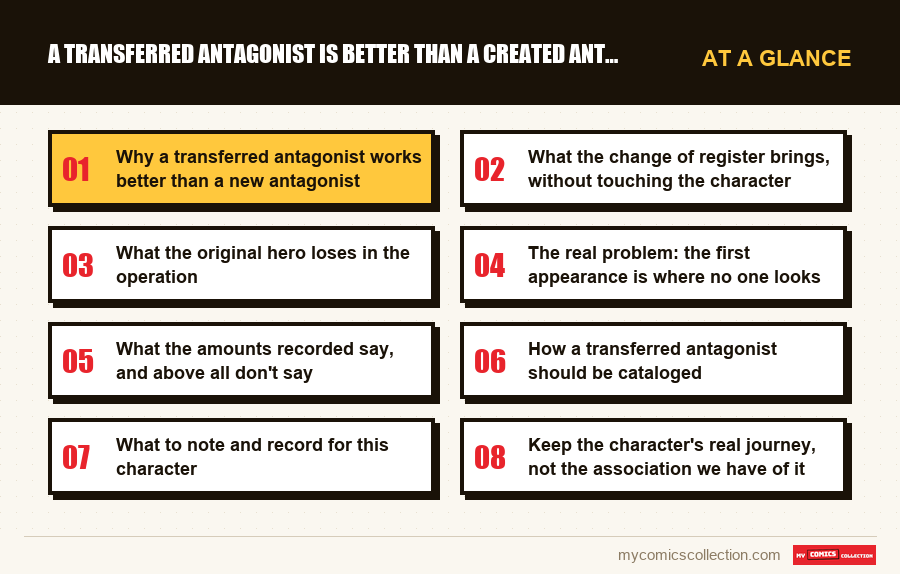
Why a transferred antagonist works better than a new antagonist
A villain created for a hero must justify everything in the same episode: his existence, his method, his ability to represent a credible threat, and the reason why no one had heard of him until then. It's a huge narrative burden, and it almost always produces the same flaw: the reader understands that the threat is calibrated. A transferred antagonist has nothing to justify. He arrives with a file. Readers who have encountered him elsewhere already know what he is capable of, and those who have never seen him perceive despite everything, from the way the other characters treat him, that he precedes the current story. This anteriority is impossible to simulate: we can write “he has been feared for twenty years”, but we cannot fabricate the twenty years of publications which prove it.
The second advantage is economic in the narrative sense of the term. A displaced figure doesn't need an origin: it already has one, and the screenwriter can devote his pages to conflict rather than presentation. Where a new antagonist consumes an entire arc to become interesting, the transferred antagonist is operational from its first square. Publishers know this perfectly, and that is why the maneuver is repeated: it transforms already accumulated capital into an immediately available threat.
The third advantage is the most subtle. A figure designed elsewhere has not been cut to the measure of the hero she now faces. There remains therefore some play between the two, angles which do not overlap, methods which do not exactly respond to the hero's abilities. This gap is precisely what makes the confrontation unpredictable. A tailor-made antagonist is a problem whose solution exists by construction; an imported antagonist is a problem that was not designed to be solved by that hero.
Finally, the transfer protects against wear. A villain created for a title wears out with that title: if the series changes tone, he becomes unsuitable and disappears. A figure who has already changed context once has demonstrated that she can do it again. Its editorial value is no longer linked to a setting, it is linked to itself, and this explains the longevity of displaced antagonists compared to the massive mortality of antagonists created to order.
What the change of register brings, without touching the character
The same method changes direction
A figure who operates through economic power, intimidation and patience seems almost decorative in the face of a luminous hero whose stories are resolved in spectacular battles. Place her face to face with a hero anchored in a neighborhood, whose issues are judicial and territorial, and the same methods become the central threat. Nothing was changed in the character: it was the context that revealed what he was already wearing.
Lack of power becomes an asset
In a register where the adversaries have superhuman abilities, a figure without power appears as a second-rate antagonist. In an urban and realistic register, this same absence of power makes it undisplaceable: we cannot neutralize it with a punch, because its force is not physical but structural. The move transforms an apparent weakness into a narrative lock.
La disproportion d'échelle
An antagonist designed to threaten an entire city finds himself, in a tighter title, weighing down a few streets. This disproportion, far from weakening the figure, crushes it on the hero: the threat is no longer distant and abstract, it occupies the same space as him. The transfer thus produces an intensity that neither the original series nor a new creation would have obtained.
The past becomes a resource
All appearances accumulated in the original series remain available. A screenwriter can draw from it episodes, alliances, failures, without inventing anything. The transferred antagonist therefore arrives with a usable library of continuity, when a new antagonist only has a blank page behind him.
We must emphasize one point, because it is counterintuitive: in the case of the Caïd, the transfer did not require any overhaul. The character has not been redesigned, his motivations have not been reversed, his method has not changed. It's the contrast with the new hero who did all the work. A figure cut against a sunny protagonist becomes formidable opposite a dark protagonist, because the second does not have the narrative means that the first employed to get rid of it. The transfer adds nothing to the character; it takes away from the hero his escape routes.
The practical consequence, for those who constitute a collection, can be summed up in one sentence: mental association and documentary location are two different things, and they do not coincide here. Looking for the beginnings of the character in the series with which he is associated leads to a dead end, regardless of the care taken in the research.
Another, less obvious consequence: reissues and thematic collections aggravate the phenomenon rather than correct it. A collection dedicated to the antagonist brings together his significant confrontations, therefore mainly those of the second hero, and relegates his original publications to a summary mention. The reader who discovers the character through a collection comes away with a reversed chronology.
What the original hero loses in the operation
There's a lot of talk about what the finishing hero wins. We rarely talk about the cost. The original hero finds himself deprived of an established opponent, and he receives nothing in exchange: no publisher compensates a transfer with a replacement creation of equivalent value. His gallery of antagonists widens a notch, and this hollow is not filled, because filling a hollow requires precisely the installation time that the transferred character had taken years to accumulate.
The lack first manifests itself in variety of register. A good gallery of adversaries covers several types of threat: brute force, cunning, personal obsession, and organized power. The removal of a figure embodying organized power leaves an entire register vacant, and the stories of the original hero mechanically reorient themselves towards the remaining registers. The readership perceives this narrowing without always identifying it: they simply find that the stories are more similar.
The lack then manifests itself in continuity. Past apparitions do not disappear, but they cease to be powered. An opponent who is never seen again becomes a memory, and a memory does not create a stake. The following writers therefore inherit a series where part of the story is closed without conclusion: they can neither use the figure, nor remove it properly, nor replace it.
Finally, the lack manifests itself in the perception of the title itself. A series is largely defined by its recurring adversaries. When one of them becomes the emblem of another title, the original series loses a piece of its public identity, and the collective memory reattributes the character without hesitation. This is what makes the transfer irreversible: even if a screenwriter brought the figure back into its original title, the public would read it as a borrowing.
Collecting this series?
Track what you own, what you are missing and what your collection is worth. 7 day trial.
Start my trial →The real problem: the first appearance is where no one looks
Search starts from wrong title
The collector types in the name of the hero with whom he associates the antagonist, and he scans an entire series without ever reaching the starting point. The error is not in the method but in the premise, which makes it particularly difficult to detect: the research appears rigorous until the end.
The decade does not match
A creation from 1967 is located in a window that the modern reader does not associate with the character, because he discovered him in a much later editorial context. Filtering on the wrong period eliminates the correct number before you even see it.
The cover doesn't announce it
A first appearance in a series that is not one's own is rarely noticed on the cover. The issue presents itself as a regular episode of the host title, and nothing in its visuals alerts the buyer that it holds a starting point.
The lots hide it
Sold in a lot made up by title, the issue is described by the host series and by its general condition, never by the character who debuts in it. It thus passes through several hands without ever being identified for what it is.
Numbering doesn't help
A number only belongs to its own series. Retaining a figure without retaining the exact title that bears it leads to confusing issues that are completely foreign to each other, and this confusion is the primary cause of unnecessary purchases on transferred characters.
Reissues blur the line
Collections, reissues and subsequent versions reproduce the same content under another reference. Without a file that explicitly distinguishes the original publication from its repeats, a collection accumulates copies of the same episode in the belief that it is progressing.
What the amounts recorded say, and above all don't say
The survey carried out on August 29, 2026 brings together what sellers asked for that day, and nothing else. None of the sums cited correspond to a concluded transaction: they are published proposals, of which we do not know whether they found a buyer. The distinction is not rhetorical, because the displayed price incorporates the seller's optimism, while a concluded price incorporates a buyer's agreement.
On the uncertified side, 49 listings range from $4.99 to $400,000.00, for a median of $189.99. This maximum of $400,000.00 is clearly out of proportion with the rest of the distribution: it must be discarded, it says nothing about what all sellers are asking for and it does not deserve further attention. The median of $189.99 correctly describes the middle of the pack, and it is the only usable benchmark on this side.
On the verified side, 43 listings range from $200.00 to $15,500.00, with a median of $1,200.00. These two sets must be read separately and never against each other: a copy passed by a verification body is a different object, with a certified condition and sealed packaging, and the difference between the two medians reflects this difference in nature as much as the quality of the copies concerned.
Finally, an observation taken on a single date does not describe any trajectory. It does not allow us to say that demands are increasing, nor to say that they are decreasing, nor to project anything for the following months. To speak of movement, we would need at least two comparable measurements spaced over time, which this report does not have. Any dynamic reading of these figures would be an invention.
How a transferred antagonist should be cataloged
The basic rule is simple: a collection sheet must record the real journey of the character, not the reader's association with them. This means that the “first appearance” line points to the original series, with its exact title and date, regardless of the hero to which the figure is spontaneously attached. Everything else (the major clashes, the defining arcs, the iconic covers) then falls into place, in chronological order, regardless of the series that carries them.
This discipline has an immediate effect on research. A collection which indexes the character rather than the title makes it possible to find all its publications at once, including those which lie dormant in series which one would not have thought of consulting. This is exactly what human memory fails to do, because it ranks by hero and not by antagonist.
It also has an effect on purchases. A collector who knows, card in hand, that the original publication belongs to another title stops buying issues of the original title in the hope of coming across it. The search list becomes short and precise, instead of long and vague. To prioritize what really matters in the character's journey, the census of key numbers et selection of major arcs are two complementary entries: the first sorts by tipping point, the second by narrative unit.
What to note and record for this character
The host title of the first appearance, written in full. Never write down a number alone. A figure without the exact name of the series that bears it is unusable, and on a transferred character it is even dangerous, since the same figure exists in the series with which we usually associate the figure. The form must make it impossible to confuse the two titles.
The distinction between the original hero and the arrival hero, on two separate fields. A collection that only has an “associated with” field ends up overwriting real history in favor of popular association. Two distinct fields preserve the editorial information and make it possible to find, years later, why the publications are spread over two apparently unrelated series.
The status of each copy: raw or verified, without ever mixing the two in the same total. The statement of August 29, 2026 shows this clearly, with 49 announcements on one side and 43 on the other: these are two distinct markets, and adding their amounts would produce a figure that describes nothing. Note the status at the item level, not at the record level.
The date of the statement next to each amount recorded. A price noted without its date loses all usefulness after a few months, because it can no longer be compared to anything. A dated price, on the other hand, becomes the first point in a series which will allow, later and only later, to note a possible evolution.
The aberrant nature of an isolated request, reported in a note. When an announcement is several orders of magnitude different from the rest, such as the maximum of $400,000.00 observed on the non-certified side, the sheet must say so so that the value is not used later as a reference. A one-line note is enough to prevent a discarded number from coming back through the back door.
Because the movement immediately delivers what a creation takes years to obtain: a past, a reputation and previous appearances. A new antagonist must consume several episodes to become credible, when an imported figure is from his first panel. It is a transfer of already constituted narrative capital.
No, and that is precisely the point of the case. Its method and mode of action have remained the same; it is the change of register which has modified their scope. An almost decorative figure facing a solar hero becomes a central obstacle facing a hero anchored in an urban and judicial environment.
In the original series, that of 1967, not in the one with which we associate the character today. This is the main difficulty of the subject: the starting point is exactly where intuition says not to look. Detailed identification of the original number avoid skimming the bad series for months.
Not at all. The statement of August 29, 2026 is a photograph taken at a single moment: it describes what sellers asked for that day, without saying whether these requests were successful, and without allowing the slightest comparison with a previous date. Noticing movement would require at least two spaced readings.
It is better to read them separately. A copy passed by a verification body is a different object, with a certified condition and clean packaging; comparing it directly to a raw copy mixes two things. The respective medians of $189.99 and $1,200.00 describe two distinct sets, not two steps of the same scale.
Keep the character's real journey, not the association we have of it
A sheet which distinguishes the original series from the arrival series, records the status of each copy and dates each recorded amount resolves at once the three traps of the transferred antagonist. My Comics Collection holds this file for you and makes your publications searchable by character, not just by title.