Tokyo Ghost takes about ten issues and can be read in one go. An anticipation where the population of a megalopolis lives on a constant drip of entertainment, and where two agents responsible for maintaining order find themselves thrown into the last place in the world that has disconnected. Drawing by Sean Murphy, saturated and furious. The story is complete, short and concluded: this is probably the best entry point into Rick Remender's work for those who want to judge quickly.
Published in 2015, the series was received as a satirical exaggeration. It is much less so today, which gives it a second life that few anticipatory stories obtain.
This article explains what it says, why its design makes it a special object, and what you need to know before buying it: all without detracting from anything that matters.
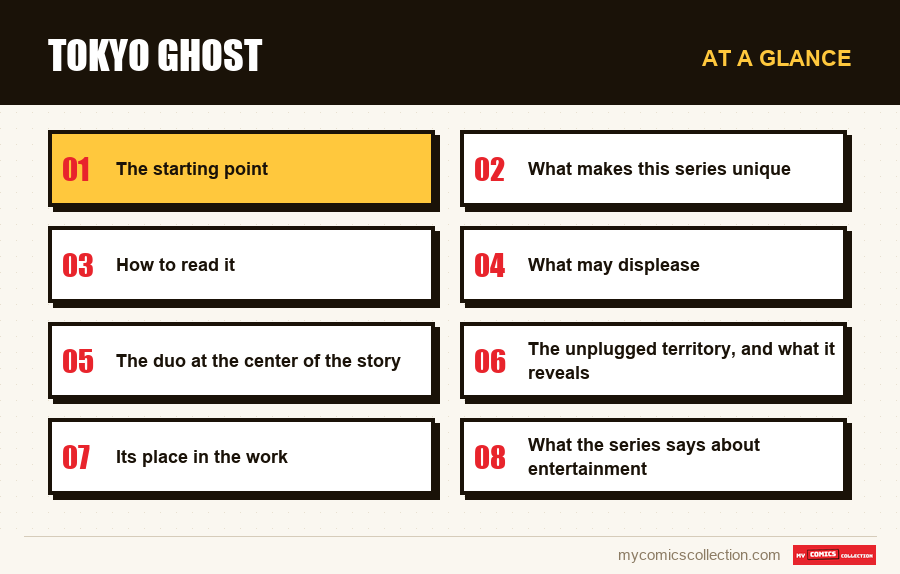
The starting point
In a future megalopolis, the population is maintained in a state of continuous consumption: flow of images, permanent stimulation, no interruption ever granted or even desired. No one is forced to do so: the inhabitants are simply supplied, without interruption, and that is more than enough.
Two agents maintain order on behalf of a media mogul. One is a colossus entirely dependent on these flows, the other is the only person in the story to have kept her head free, and she wants to leave.
A mission sends them to a territory that has made the opposite choice: to unplug entirely, and live with the consequences of this renunciation. This is where the story shifts, and urban satire gradually gives way to something much more intimate, of which the city was basically just the setting.
What makes this series unique
A drawing that contributes to the subject
Sean Murphy saturates his pages: details everywhere, excessive architecture, no resting place for the eye. The reader is himself subjected to the overload that the story describes.
This is not gratuitous virtuosity. The contrast with the sequences of the unplugged territory, much more airy and silent, produces an almost physical relief in the reader.
An addiction treated like a bond
The colossus is not dependent out of weakness: its consumption keeps it in a state where it does not have to face what it is. This is the author's usual motif: comfort that enslaves.
A short format, a real ending
About ten issues, two bound volumes, and a conclusion fully written as such. No risk of interruption along the way, or commitment spread over several years.
An anticipation that has aged backwards
What passed for a caricature in 2015 today reads like a barely forced description. The series is more relevant now than when it came out.
How to read it
Three reading tips, and the first is more important than it seems.
In one go, or almost. The story is short and its pace is based on continuous acceleration. Spread over months, it loses most of its effect: the feeling of excitement is part of the point.
In bound volumes. Two volumes are enough for the entirety, making it one of its author's easiest series to put together. The issues are only of interest for the first issue.
Without looking for connection. The series is completely autonomous: no prequel, no derivative, no link with its other titles. You can read it without knowing anything about the author.
What may displease
The graphic density is tiring
The pages are so busy that some readers find them unreadable. This is a bias consistent with the subject, but it is not suitable for everyone.
An unsubtle satire
The statement on the consumption of images is explicit and repeated. A reader who prefers allusive stories will find the demonstration supported.
Extreme violence
The clashes are graphic and frequent, including in the first chapters. It is probably the most violent of his titles.
A rhythm that never goes down
There is little down time. Readers who like the story to breathe between two sequences will find almost none here.
Why it’s a good entry point. Around ten issues, two volumes, a written ending, no prerequisites: it is the title of this author which requires the least commitment to know if his style suits you.
If you hang, the whole rest of his bibliography opens. If you don't stick with it, you will have invested two volumes rather than a series of forty issues, and you will know that the complaint concerns the substance rather than the format.
The duo at the center of the story
Many science fiction stories treat their characters as megaphones. This one does the opposite, and this is what prevents it from being reduced to its satire.
The two agents do not form a convenient pair of opposites: one lucid, the other blind. She has kept her head free, but she remains; he is completely dependent, but he never lied about what he was. Their bond is not a matter of rescue: it is a long habit, and the story takes seriously what is solid about this habit.
The question that runs through the series is therefore not “will she save him?” » but “what remains of an attachment when the other has ceased to be there? ". This is a more difficult question, and it doesn't have a comfortable answer.
A reader who approaches the series for its futuristic setting may miss this axis. However, it is what gives the conclusion its weight, and what distinguishes the title from the dystopias of its generation, generally more interested in their system than in their inhabitants.
The unplugged territory, and what it reveals
The second part of the story takes place in a place that has given up on flows. This is where the series goes beyond satire, and it's worth understanding how.
An ordinary story would make this refuge a utopia, and its abandonment a tragedy. This one can't be resolved. The place is calming but closed, and the question he asks the character is not “do you want to stay?” » but “at what price?” ".
This is exactly the mechanism that the author uses elsewhere in other genres: you get what you wanted, and the payment begins at that moment. The regained calm is a gift, and like any gift with him, it creates a debt.
This construction explains why the series resists rereading. The first reading is carried away by the rhythm; the second shows that every relief of the story is the beginning of a trap.
Collecting this series?
Track what you own, what you are missing and what your collection is worth. 7 day trial.
Start my trial →Its place in the work
It is his most immediately spectacular title, and paradoxically one of the most faithful to his obsessions.
There we find intact the protagonist who destroys himself by what relieves him, the damaged emotional bond, and the violence which leaves its marks. What changes is the sound volume: where his fantasy whispers and his underwater story murmurs, this one screams.
It is also the only one of his titles where the designer is better known to the general public than him. This has a direct consequence for a second-hand buyer: a significant proportion of the advertisements mention the designer without mentioning the screenwriter, and a search by the name of the author of the text alone misses the point.
Finally, it is the one who has gained the most over time. Most of the anticipations from this period today appear dated in their predictions; this one got closer to its subject.
This is probably because she did not predict anything technical. It describes no specific device, no identifiable network, no innovation to date: only a state of mind and an economy of attention. The stories of anticipation that age poorly are those that bet on objects; this one bet on a behavior, which goes out of fashion much less quickly.
What the series says about entertainment
A clarification is necessary, because the subject lends itself to misunderstandings: it is not a story which condemns entertainment.
What he describes is not pleasure but no interruption. The characters are not stunned by what they are watching; they are so by never having to stop. The difference is essential, and the story is there: the unplugged territory is not presented as morally superior, only as a place where silence becomes possible again.
This is what prevents the series from turning into a sermon. She doesn't say that we should give up, she shows what happens to someone who has never been given the choice of being bored.
This refusal to conclude is consistent with the rest of the author's work, where we never find a position to adopt: only characters who pay what they have accepted.
What to record
In a short series, two catalog confusions recur regularly.
The format. Fascicle, bound volume, or edition bringing together the entirety: all three exist and bear the same title. A line that does not specify which one no longer allows us to know what we really own.
The cover, on the booklets. The first issue exists in several versions, the asking prices of which vary from single to tenfold. The word “variant” alone is not enough: it is necessary to note which one.
Let's add the condition, raw or certified, which weighs more here than on any other title by the same author. This is the series of its production where the gap between the two markets is the greatest.
The question that an inventory must resolve is simple: is what I own the current copy or the object sought? Three fields respond to it; the title alone, never.
Frequently asked questions
Two bound volumes cover the entire story, making it one of its author's shortest and easiest-to-assemble series. There is also an edition bringing everything together in a single object, not to be confused with the separate volumes at the time of purchase.
Absolutely not. The story is entirely self-contained, with no prequels or spin-offs, and makes no reference to any of its other titles. This is even one of the reasons why it constitutes a good first read by this author.
It requires effort, and it is deliberate: the visual saturation reproduces in the reader what the characters undergo, who also have no respite. The sequences located outside the city are much more airy, and this contrast is part of the construction: the relief felt when turning these pages is a desired effect. If the first scenes exhaust you, know that the story then takes real breaths, and that they arrive quite early.
Better than when it was published, which is rare for an anticipation. What was received as a satirical caricature in 2015 today reads like a barely forced description, and the story has gained rather than lost.
Because here he is better known to the general public than the screenwriter, which is unique in this bibliography. Many sellers therefore put their name forward in their advertisements without citing the author of the text: a search carried out solely in the name of the screenwriter misses a real part of the available offer.
Three formats, one title
Issue, volume or integral: without this precision, a catalog line no longer says what it describes.