The Time Runs Out reading order covers the last movement of Jonathan Hickman's Avengers cycle: Avengers vol. 5 #35 to 44 and New Avengers vol. 3 #24 to 33, twenty single issues published from 2014 to 2015. Read Infinity and the issues that follow it first, then alternate the two series by cover date. The story closes on Secret Wars (2015), the series by Hickman and Esad Ribić.
Some events you read for the action, and others you read for the deadline. Time Runs Out belongs to the second family: Jonathan Hickman brings to a close a story begun years earlier, and the twenty issues that make it up are spread across two series that have to be read together. This guide gives you the order, the exact boundaries and the useful extras.
As always on this guide, we only state verified information (creators, issue numbers, dates). The analysis is our own, with no reproduction of protected art or dialogue.
What to read before the event
Time Runs Out is not an entry point: it is a conclusion. Jonathan Hickman wrote Avengers vol. 5 from #1 to #44, from February 2013 to June 2015, and New Avengers vol. 3 from #1 to #33, from 2013 to 2015. The event's twenty issues are therefore the last stretch of two entire series. Ideally you come to them after reading at least the beginning of each.
The minimum prelude comes down to three landmarks. In New Avengers, the team is the Illuminati: Black Panther, Black Bolt, Captain America, Doctor Strange, Iron Man, Mister Fantastic and Namor, joined by Beast in #3 after the death of Professor X, while Captain America leaves the group in the same issue. This small group discovers that the universe is deteriorating and that whole universes are colliding: this is the phenomenon of "incursions." In Avengers, the Infinity event is the big milestone.
If you only remember one thing, make it this: read Infinity first, because Hickman's two series converge there before each heads off toward the final countdown. The Infinity guide gives you the exact issue numbers, so there is no need to repeat them here.
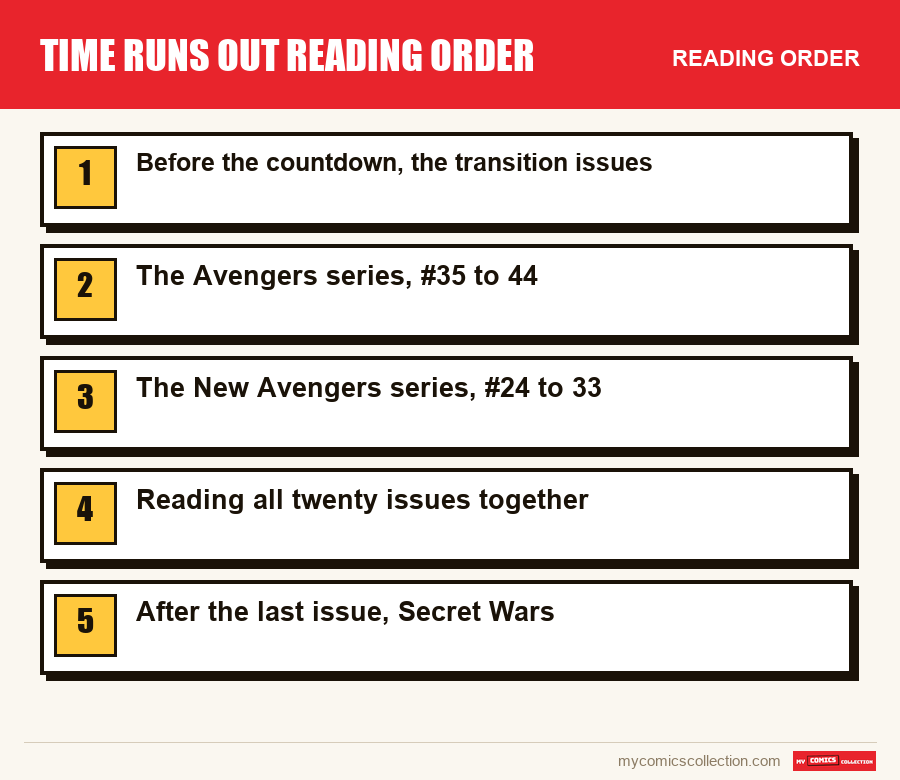
Phase 1: Before the countdown, the transition issues
Before #35, the Avengers series has two issues with decimal numbers: #34.1 has Al Ewing on script and Dale Keown on art, while #34.2 brings together Sam Humphries and Bengal. Hickman signs neither.
#34.2 was collected with Avengers World #17 to 21 under the title Before Time Runs Out, a prelude volume that carries the event's name. This step is therefore optional for understanding the event, but it is useful if you want to read the full chronology: it slips in between the end of the Infinity cycle and the event's first issue.
The method is simple: if you read single issues, slot these in after Avengers #34 and before #35. If you go through the trade paperback, open it before the first volume of Time Runs Out. In both cases they act as an airlock between the sweep of Infinity and the tighter tension of the ending.
Phase 2: The Avengers series, #35 to 44
The event's first thread is Avengers vol. 5 #35 to 44, written by Jonathan Hickman from start to finish. The art changes often, which is a hallmark of this run: Mike Deodato draws several issues, Stefano Caselli does others, and Kev Walker appears on #44. #35 is shared among several artists, including Dustin Weaver. This rotation gives the whole an uneven rhythm, but the voice remains Hickman's.
A practical tip: note the artist of each issue as you build your collection. This criterion helps you tell two similar single issues apart in a list of listings, and it explains why some issues are more sought after than others. It says nothing about their narrative quality, which depends entirely on the script.
Spoiler warning: the series' last issue, #44, wraps up the story just before Secret Wars. If you would rather discover it knowing nothing, simply read the ten issues in order without looking at the covers of the ones that follow.
Phase 3: The New Avengers series, #24 to 33
The second thread is New Avengers vol. 3 #24 to 33, also written by Jonathan Hickman. It is the Illuminati's series, the one that shows from the inside the group's decisions in the face of the incursions: the heroes build extreme weapons there and confront the question of what it is permissible to sacrifice to save a reality. Issue #33 is the last of the series, and you will find it in the event's collected editions.
Why read them in parallel rather than one after the other? Because the two series answer each other: a decision made in one finds its consequences in the other. Reading ten issues of Avengers and then ten of New Avengers would mean knowing the ending before the beginning. The recommended method is therefore to alternate by cover date, and failing that, to move in blocks of two or three issues from one series and then the other, keeping the lowest numbers in mind.
For a reader short on time, New Avengers is the most coherent series to read on its own: it follows a small group and a continuous narrative thread. But it loses meaning without the counterpoint of Avengers, which is broader and more collective. The ideal is still to read both.
Phase 4: Reading all twenty issues together
The twenty issues, Avengers #35 to 44 and New Avengers #24 to 33, were collected in four volumes under the title Time Runs Out. That gives you a valuable clue: the publisher itself conceived these issues as a single story spread across two series, to be read continuously and not title by title. If you read in trade paperback, just follow the four volumes in order; they are already interleaved.
If you read single issues, get both series for the same period and shelve them side by side. To find the right order, the cover date printed at the top of the issue is your guide. Keep in mind that this date does not always match the actual on-sale date, but it is more than enough to alternate correctly.
One last point of method: reread an issue if you lose the thread. The event is dense, the characters are numerous, and Hickman trusts the reader's attention rather than recaps. This is not a flaw; it is how this writer builds his long stories, and it is also what makes rereading pay off.
Do you collect this series?
Track what you own, what you are missing and what your collection is worth. 7-day trial.
Start my trial →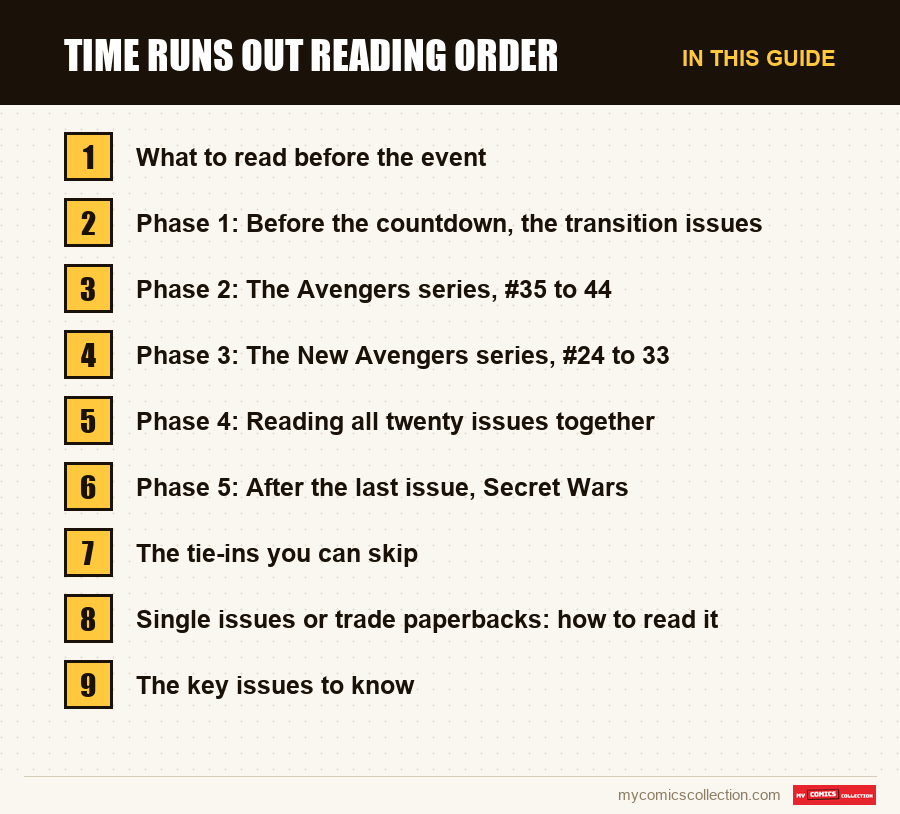
Phase 5: After the last issue, Secret Wars
After Avengers #44 and New Avengers #33, the reading continues in Secret Wars, the 2015 version. Esad Ribić draws Jonathan Hickman's scripts; the first issue came out on May 6, 2015, and a #0 distributed for Free Comic Book Day is added to it. In this story, the incursions end up destroying the Marvel 616 and Ultimate 1610 universes, whose fragments are brought together in Battleworld, a planet divided into domains.
The series also concludes Hickman's writing on Fantastic Four, which he wrote from 2009 to 2012; that is one more reason to read his whole Marvel run before opening this final volume. Our article on Battleworld and Secret Wars details the world this series sets up, without repeating here what you will find there.
Two groups of books orbit this sequel: Miles Morales: Ultimate Spider-Man #6 to 12, by Brian Michael Bendis and David Marquez, shelved with Time Runs Out and collected under the title Revelations, and the "Last Days" tie-ins of Secret Wars, which show the last adventures of several characters before the end of the Marvel universe (Magneto #18 to 21, Ms. Marvel #16 to 19, Loki: Agent of Asgard #14 to 17, among others). These are extras by theme rather than mandatory steps.
The tie-ins you can skip
For Time Runs Out, the notion of a tie-in is misleading, because the event has almost no satellites: it is itself made up of two series. What you can skip without losing anything are the transition issues #34.1 and #34.2, the Avengers World issues and the "Last Days" sets of Secret Wars. They enrich the universe without conditioning your understanding of the twenty issues.
The Miles Morales: Ultimate Spider-Man series, #6 to 12, falls into the same category: it is aimed at readers who follow the Ultimate universe, and you can understand Time Runs Out without having read it. Skipping them is nothing to be ashamed of: these titles exist for those who want a complete panorama, not for those looking for the main line.
The general rule for a demanding reader is this: if an issue is not written by Hickman and does not carry the numbers #35 to 44 of Avengers or #24 to 33 of New Avengers, it is optional.
Single issues or trade paperbacks: how to read it
The publication was collected in four Time Runs Out volumes, which together contain Avengers #35 to 44 and New Avengers #24 to 33. A prelude, Before Time Runs Out, groups Avengers #34.2 and Avengers World #17 to 21; #34.1 is not in it. The sequel, Secret Wars (2015) #0 to 9, also exists as a collected edition, as do its tie-ins, subset by subset.
In trade paperback, reading is simplest: the publisher has already done the interleaving. In single issues, it is up to you to organize it, but the task stays reasonable: twenty issues, two series, an alternation by cover date. If you plan to build a collection of single issues, start by locating the final issue of each series, #44 and #33, which bound the event.
Before buying a collected edition, check its table of contents issue by issue. The volumes carry similar titles, and it is easy to confuse the prelude, the event's four volumes and the tie-in collections. The table of contents remains the only reliable guarantee of scope.
The key issues to know
In a concluding event, the key issues are boundary issues. For Avengers, they are #35, which opens the event, and #44, which closes it. For New Avengers, they are #24 and #33, the latter being the last issue of the series. These four single issues are the ones you hunt for first when you want to document the event.
To assess a copy, the method stays constant: identify the standard cover, spot any variants by their markings, then compare current listings with sales that actually closed. Never settle on an isolated value. For an expert's view on these issues, our article on Hickman's key issues on Avengers sets the frame.
Finally, Secret Wars #0, tied to Free Comic Book Day, is a landmark of its own: it sits outside the main numbering and deserves a careful check of the cover, since editions of this kind are often confused with regular issues.
Summary: the complete order
- Infinity (2013) and the issues of Avengers and New Avengers around it: see our dedicated guide.
- Avengers #34.1 and #34.2, with Avengers World #17 to 21: the optional prelude (#34.2 and Avengers World are collected under the title Before Time Runs Out).
- Avengers #35 to 44 and New Avengers #24 to 33, alternating by cover date: Time Runs Out.
- Secret Wars #0 to 9 (2015), Jonathan Hickman and Esad Ribić.
- Extras of your choice: the "Last Days" tie-ins and Miles Morales: Ultimate Spider-Man #6 to 12.
Frequently asked questions
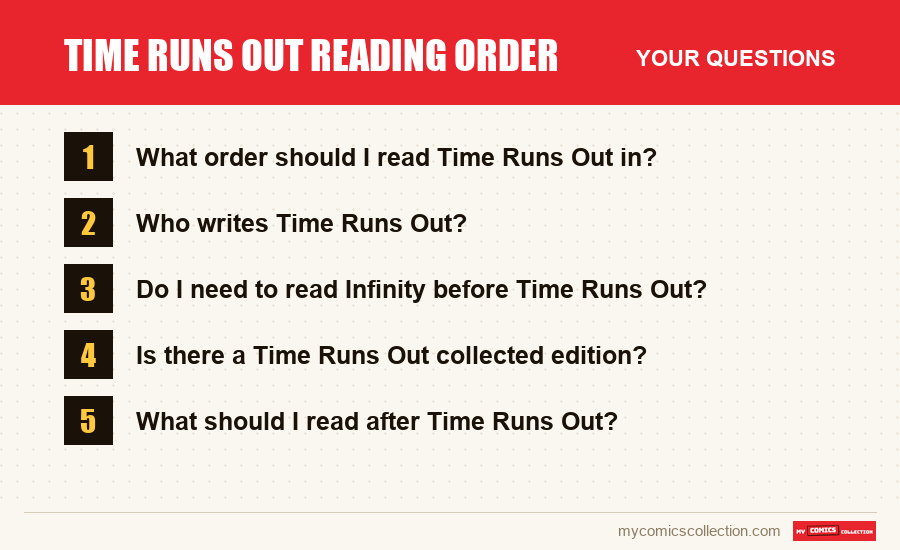
Read Infinity first, then the transition issues if you want the full chronology. Next alternate Avengers #35 to 44 and New Avengers #24 to 33 by cover date. Finish with Secret Wars #0 to 9, which concludes the whole thing.
Jonathan Hickman writes all twenty issues: Avengers #35 to 44 and New Avengers #24 to 33. The art changes: Mike Deodato and Stefano Caselli share several issues of Avengers, and Kev Walker appears on #44. The whole leads directly into Secret Wars.
It is strongly recommended. Time Runs Out directly continues Hickman's cycle, of which Infinity is a major milestone. Without it, you will miss the context of the Illuminati and the incursions. Our Infinity guide gives the exact issues to read before starting the twenty issues.
Yes: four volumes titled Time Runs Out collect Avengers #35 to 44 and New Avengers #24 to 33. A Before Time Runs Out volume gathers the prelude. Reread each volume's table of contents before paying, because the titles look alike.
Move on to Secret Wars (2015) #0 to 9, by Jonathan Hickman and Esad Ribić. It concludes the cycle and opens Battleworld. As extras, the "Last Days" tie-ins and Miles Morales: Ultimate Spider-Man #6 to 12 widen the picture.
Do you own issues of Avengers or New Avengers from the Hickman era? Get them appraised before you put them away.
Estimate my comic