In short
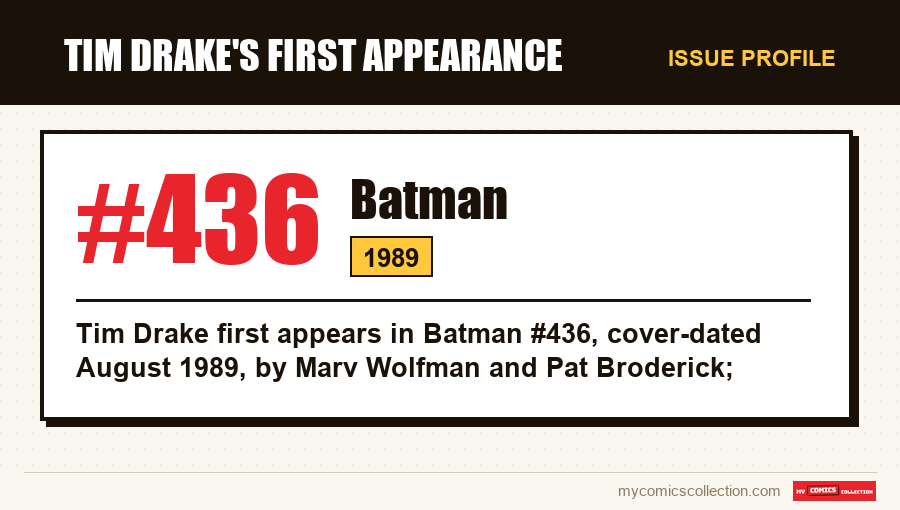
The August 1989 issue of Batman, number 436, is where Tim Drake debuts, as the opener of the Year Three storyline. Marv Wolfman wrote it, Pat Broderick penciled it and John Beatty inked it, under a George Pérez cover. Tim does not wear a Robin costume in this issue. That moment arrives in Batman #442, cover-dated December 1989, when Wolfman, penciler Jim Aparo and inker Mike DeCarlo close the story that makes him the third Robin.
Collectors searching for Tim Drake's first appearance usually land on two different numbers within a few clicks, and the confusion costs people money and time. One number belongs to the character's debut, the other to the debut of the costume. This guide treats Batman #436 as an object: what it contains, who made it, where it sits in the run, and what to look at when a copy is in your hands.
For this page, the creators, the August and December 1989 cover dates and the 1990 and 1991 follow-ups were each matched to published histories of Year Three and of Tim himself; anything unconfirmed is absent, while the inspection routine is our own.
Batman #436 at a glance: cover date, credits and story
The issue carries an August 1989 cover date and is numbered 436 in the long-running first Batman series. It is the first of four chapters, Batman #436 to #439, grouped under the title Batman: Year Three. The cover date for the four chapters runs across August and September 1989, because the book was publishing twice a month at that point.
The credits for the story are short and worth memorizing, because they are the first filter against mislabeled listings. Marv Wolfman is the writer. Pat Broderick is the penciler and John Beatty is the inker. George Pérez drew the cover of #436, the opening chapter. The same publication history also names Wolfman and Broderick as the creative pair behind the character's debut, and that is the pairing most collectors cite when the question of creators comes up.
The storyline's place in the timeline explains why the issue exists. Year Three follows Year One and Year Two as the third story in a sequence about Batman's early years as a crimefighter. It is built on two time frames. One looks back at the origin of the first Robin. The other is set in the 1989 present, where Batman is dealing with the death of Jason Todd. In that thread Dick Grayson comes back to Gotham City, finds the Batcave stripped of anything that recalled Jason, and puts on the Nightwing costume to look for Batman. A parole hearing for the mob boss Anthony Zucco runs through the same chapters.
That is the setting into which Tim Drake is dropped. The issue is not a Tim Drake story; it is a Batman story in which a future Robin makes his first, quiet entrance.
How Tim Drake enters the story
The character's backstory is tied to a performance by the Flying Graysons, the circus act in which Dick Grayson's parents were killed. In the character's established history, Tim was in the audience that night as a boy. That backstory matters to a collector because the debut issue sits inside a story about the first Robin's origin.
What is worth stating plainly is the limit of the verified record. What the published histories of Year Three confirm is that the storyline marks Tim Drake's first appearance and that he later becomes the third Robin. This guide therefore does not describe a scene panel by panel, and you should be skeptical of any listing that does so with great confidence and no citation. For the exact scenes, the issue itself is the primary source.
Read Batman #436 for its role in the larger story, then #437 to #439 to see how the storyline resolves. The story that gives the debut its payoff is the arc that follows, not Year Three.
Who created Tim Drake and why the character was needed
Tim Drake was created by Marv Wolfman and Pat Broderick, who wrote and penciled the debut. Wolfman's credit on both the debut and the issue that gives Tim his costume is the reason his name sits at the center of any reading list about the character. The costume itself has its own credits: the redesigned Robin costume is credited to Neal Adams, and the R logo and staff were designed by Norm Breyfogle.
The editorial problem the character solved is visible in the story around him. Jason Todd, the second Robin, had died, and the Batman of 1989 is shown as a man who has removed every trace of him. Batman without a partner was a different book from the one readers had known, and DC had to decide whether the series would stay in that grief or move through it. Tim Drake is the answer: a teenager whose appeal is his judgment more than his lineage, who joins the story through observation and persistence rather than through a claim of inheritance.
That framing is analysis, not a quotation from anyone at DC. The evidence is the sequence itself: a new character appears in August 1989, and by December 1989 he is wearing the costume.
If you collect by creator, #436 is a natural stop for Wolfman, Broderick and Pérez. If you collect by character, it is the first rung of a ladder that leads through the Robin series to Red Robin.
Why #436 is a key issue, and what it is not
A first appearance is a different kind of key than a death, an origin or a milestone number. It is a bet that the character will matter later, and the bet pays off or does not. In Tim Drake's case it paid off at once and at length. He became the third Robin in Batman #442, starred in a five-issue Robin miniseries from January to May 1991, and went on to carry the first monthly Robin series. Years later he took a new identity in Red Robin #1, cover-dated August 2009.
That longevity is the real argument for the issue's status: a character who anchors series of his own leaves a first appearance that people keep searching for.
There is also a limit to the claim. The issue is a debut and not a showcase. If your goal is to own the story that defines the character, you want the arc that ends in #442. If your goal is to own the earliest printed appearance, you want #436. Those are different goals with different budgets, and many collectors end up owning both. The sections below separate them so you can decide which one you are hunting.
Do you collect this series?
Track what you own, what you are missing and what your collection is worth. 7-day trial.
Start my trial →
First appearance, first Robin, and the numbers people mix up
The single most common mistake is to treat Batman #436 and Batman #442 as interchangeable. They are not. Issue #436, cover-dated August 1989, is Tim Drake's first appearance in any form. Issue #442, cover-dated December 1989, is his first appearance as Robin, written by Wolfman, penciled by Jim Aparo and inked by Mike DeCarlo. A seller who writes "first Robin" on a #436 is mixing the two, and a seller who writes "first appearance" on a #442 is stretching the label.
A second cluster of confusion surrounds Batman #457, the third chapter of the "Identity Crisis" storyline that ran in Batman #455 to #457 from October to December 1990. It has its own printing history: DC put it and the first part of the Robin miniseries into second and third printings after retailers under-ordered at the end of 1990. A second or third printing of #457 is not the same object as the first, so ask which one is on offer. It is not the debut issue of the character.
The Robin miniseries is the third source of mix-ups. The five issues of 1991 were written by Chuck Dixon and penciled by Tom Lyle, with covers by Brian Bolland, and they carry the character's first solo book. They are important and collectible, but a listing that calls Robin #1 a "first appearance of Tim Drake" is wrong. Two sequel miniseries followed, Robin II: The Joker's Wild! from December 1991 to February 1992 and Robin III: Cry of the Huntress from December 1992 to March 1993.
Keep the map simple: debut, #436, August 1989; costume, #442, December 1989; extra printings to watch, #457 and Robin #1. If a listing does not match, ask the seller for scans of the cover and the indicia.
Reprints and collected editions
Batman: Year Three was not collected as a standalone trade paperback. It appears in Batman: The Caped Crusader Vol. 2, and a hardcover Deluxe Edition was announced for August 2025. That tells a reader two things. If you only want to read the story, a collected edition exists and a single issue is not required. If you want the debut as a physical object, the single issue remains the only way to own the original printing.
A practical split works well: buy the collection as the reading copy and keep the single issue bagged, boarded and away from light.
Do not confuse a collected edition's introduction or cover with the original. Reprint covers often differ from the first printing's art, and a book with a different cover is not an alternate cover of the original issue; it is a different product. When a listing shows only a photo of a cover, check the spine, the title page and the copyright line to confirm what you are looking at.
What to check before you buy a copy of #436
For a late-1980s DC issue, condition and the match between the listing and the book matter most. The checks below apply to any copy, raw or graded.
Start with the cover. Look for corner blunting, spine stress lines, color breaks along the spine and any dimpling at the staples. A cover with a clean gloss and an unbroken spine is the target. Then check the staples for rust and for the stress marks that appear when an issue was opened too wide. Then open the book to the centerfold and check that it is attached at both staples, because a detached cover and a detached centerfold are the two most common signs of heavy handling.
Next, look for restoration. Color touch, glue along the spine and trimmed edges are all methods used to make a worn book appear better. A raking-light photo often reveals touch-up that flat light hides.
For graded copies, read the label as a document. Confirm that the series name, issue number and cover date match the book in the holder. A graded copy of the right issue with a damaged case is a different decision than a graded copy of the wrong issue with a perfect case. When a label describes the grade's notes, read them; they often explain why a copy sits where it does.
In 1989 DC distributed both newsstand and direct-market versions of its books, and the two can differ in the barcode area. If you are comparing copies, compare like with like, and ask the seller which version is offered.
The appearances that follow and are worth tracking
Once you hold #436, the order of acquisition tends to follow the character's career. The list below is limited to confirmed appearances and doubles as a reading order.
- Batman #442, December 1989: Tim's first appearance as Robin, written by Marv Wolfman, penciled by Jim Aparo, inked by Mike DeCarlo.
- Batman #443 and #444, January and February 1990: the "Crimesmith" storyline, from Tim's first months in print.
- Detective Comics #618 to #621, July to September 1990: the "Rite of Passage" storyline.
- Batman #455 to #457, October to December 1990: the "Identity Crisis" storyline, with the printing note on #457 discussed above.
- Robin #1 to #5, January to May 1991: the first solo miniseries, by Chuck Dixon and Tom Lyle with covers by Brian Bolland.
- Red Robin #1, August 2009: the debut of the Red Robin identity.
#442 is the costume debut and the logical second purchase. The 1990 storylines fill out his first year in print, and the 1991 miniseries is a self-contained set.
For reading order and for more context on the character's best stories, the guides on this site cover the same ground from a different direction: the best Tim Drake guide ranks the stories, and the Robin key issues page lists the issues across all the wearers. If you are building a Robin shelf, read the Robin key issues page next, and keep the guide to the first Robin in Detective Comics #38 nearby for the other end of the lineage.
Frequently asked questions
Look at Batman #436, dated August 1989 and the start of Batman: Year Three. Marv Wolfman wrote it, Pat Broderick penciled it and John Beatty inked it, and George Pérez drew its cover. His first appearance as Robin comes later, in Batman #442.
No. In #436 he is a new character on the edge of a story about Batman's grief after Jason Todd's death. He becomes Robin in Batman #442, cover-dated December 1989, written by Marv Wolfman, penciled by Jim Aparo and inked by Mike DeCarlo. Listings that merge the two are mislabeled.
Marv Wolfman and Pat Broderick are the creators credited for the debut issue. Wolfman also wrote the issue that gives Tim the costume, and George Pérez drew the cover of #436. The redesigned Robin costume is credited to Neal Adams, and the R logo and staff to Norm Breyfogle.
No. Batman: Year Three has not been collected as a standalone trade paperback, but it appears in Batman: The Caped Crusader Vol. 2, and a hardcover Deluxe Edition was announced for August 2025. Buy the single issue only if you want the original printing of the debut.
Confirm the cover date, the issue number and the creators, then inspect the spine, staples and centerfold for wear and restoration. Ask for a raking-light photo of the cover. On a graded copy, check that the label matches the book. Compare newsstand and direct copies against each other, not across versions.
Holding a copy of Batman #436 or #442 and unsure what you have? Run it through the estimation tool before you list or grade it.
Estimate my comic