Dave Sim announced early on that Cerebus would number exactly three hundred issues, then held on to it for twenty-six years. He even published in advance how his character would end. It is an unparalleled commitment in this medium, and it produced two opposing effects: a construction consistency that few long works reach, and a rigidity which forced the author to keep a promise that his story no longer required.
Announcing the end of a series before having written it is a rare gamble. Holding it over a quarter of a century is even more so, and worth examining for what it teaches.
This article describes that commitment, what it made possible, what it cost, and what a reader or collector can get out of it today.
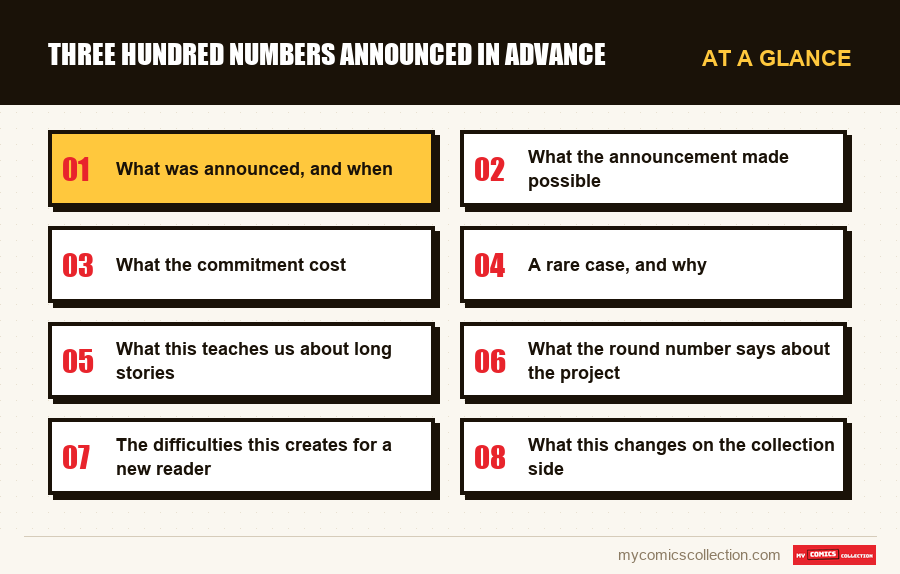
What was announced, and when
The commitment concerned three distinct elements, and confusing them distorts the assessment that we can have of them.
A number. Three hundred numbers, a round number fixed well before the work took its final form. It was not an estimate but a term.
A duration. A monthly publication continues, without interruption, until this term. This is the most restrictive aspect: it was not just a question of finishing, but of finishing at this pace.
An ending. The author made public, well in advance, how his character would end: under what circumstances and in what state. The reader therefore knew where we were going while not knowing how we would get there.
It is this third announcement that most distinguishes this case. A story that discloses its ending renounces a major narrative motive, and you must have a serious reason to do so.
What the announcement made possible
An overall architecture
Knowing your term allows you to distribute: put down early what will be used later, maintain symmetries, make lines converge on hundreds of numbers.
Few long works can afford this, because few know when they will end.
A reader who engages
Following a series with no announced end amounts to betting on its continuation. A well-known term transforms the subscription into a limited investment.
A displaced tension
The end being known, the suspense is no longer about what will happen but about the path. It's a different narrative regime, and it allows for slowness.
A publishing discipline
A public countdown makes each delay visible. This is a constraint that the author imposed on himself and which probably contributed to the regularity of the publication.
What the commitment cost
The drawbacks are real, and they appear especially in the second half of the publication.
A term that no longer fits the story. A work written over twenty-six years evolves. What interested the author in the two hundredth issue was not what interested him in the fiftieth. The number has not changed: forcing a space to be filled or a development to be compressed depending on the case.
An end which constrains the last years. Having announced how the story would end, the author could no longer change it without publicly speaking out. It is a form of voluntary confinement, and it is felt in the last volumes.
A promise that takes precedence over quality. This is the heaviest cost. A free author stops when he has finished telling the story; this had to go up to the announced figure, even when the story no longer had much to say.
The resulting question is legitimate: should we keep the promise at the price of the book? Readers are divided on this, and there is no obvious answer.
What this changes for a reader today. You know, before you begin, that this work has an ending, and you can even know which one without it spoiling anything, since the author himself disclosed it.
This allows a decision that few long works allow: choosing your stopping point knowingly, rather than hoping that the series lasts until an uncertain conclusion.
A rare case, and why
Three conditions must have come together, and their conjunction explains why the experiment was not repeated.
Ownership of the work. An author who writes for a publisher does not decide the length of his series: sales do. Announcing three hundred numbers supposes having the power to keep this commitment, which only complete possession allows.
Production control. Writing, drawing and publishing yourself removes all the intermediaries that might impose interruption. No outside decision could stop the series.
Un modèle économique soutenable. Twenty-six years of monthly publication assumes that the company finances itself over the entire period. One bad period would have been enough to break the promise.
These three conditions are rarely met. This is why commitment is cited as a remarkable fact regardless of the content of the work: and why no one since has attempted the same thing on the same scale.
What this teaches us about long stories
A transposable observation, which goes beyond this particular case.
Most long-running series don't have a planned end. They continue as long as they are sold, which produces a structural consequence: they cannot conclude, only interrupt themselves. An ending must remain possible at all times and never be written.
This explains a widespread frustration among series readers. It's not that authors write endings badly: it's that they can't prepare them, because they don't know when they will arrive.
Conversely, a work that knows its end can build. Effects that rely on duration (an object placed at number twelve which reappears at number two hundred, a symmetry between the beginning and the end) are only possible if we know where we are going.
The price to pay is rigidity. You have to choose: the freedom to adapt its length to the story, or the ability to build over its entire duration. You can't have both, and this case shows exactly what each option gives.
What the round number says about the project
One detail deserves attention: the number chosen is round. It's not the number of numbers that the story demanded, it's a number decided for itself.
This reveals the true nature of commitment. It was not a question of estimating the length of a story but of set yourself a test: and a test is measured in round units, not in necessary units.
This move explains a lot. A work whose end is determined by the story stops when the story is finished. A work whose term is a number must produce enough material to achieve it, which is a constraint of a completely different nature.
We can see this as a conceptual weakness, and the criticism is well-founded. We can also see what made the company possible: an abstract and verifiable objective is better than a vague intention to “finish one day”. The round number was probably what made it possible to get to the end, while ensuring that the ending would not coincide exactly with what the story demanded.
It is a trade-off that no author ever states so clearly, and this case makes it visible because he pushed it to the end.
Collecting this series?
Track what you own, what you are missing and what your collection is worth. 7 day trial.
Start my trial →The difficulties this creates for a new reader
The end is known
It circulates everywhere, and a curious reader will encounter it before having started. It's not detrimental to the story, but it takes away from the effect of discovery.
La pression du chiffre
Knowing that there are three hundred numbers is discouraging. The figure is put forward everywhere, even though it does not correspond to the route that is actually recommended.
A work judged on its promise
Discussions often focus on whether he kept his commitment, rather than what he wrote. This is a shift in the debate.
A final forced part
The last volumes bear the trace of the obligation to go to the end. It's noticeable, and it supports the advice to stop first.
What this changes on the collection side
Commitment has a material consequence that few shows offer, and it's useful to know.
A series without an announced end produces a collection that can never be declared complete: there will always be a following issue, a relaunch, a derivative series. Completeness is a shifting notion.
Here, the number is fixed and known. A collection of three hundred issues is finished, definitively, and no one will publish a three hundred and first. This is a rare comfort for a collector, and it changes the nature of the goal.
This also applies to collections: their number is fixed, the whole will not expand, and shelving sized today will always suffice. On an open series, this planning is impossible.
On the other hand, this finitude removes any prospect of novelty. A completed collection is not continued: which, depending on temperament, constitutes satisfaction or loss of interest.
What to note
Two fields take on a particular meaning here, due to the very fact of the commitment.
Your stated goal. On a finished series, it is worth writing what you are aiming for: the first two arcs, the half, the whole thing. Otherwise, completeness becomes a goal by default, simply because it is achievable, rather than a choice.
This is a trap specific to closed series: their finitude makes exhaustiveness tempting regardless of the desire to read what it contains.
Where you stopped, and why. On a work that the majority of readers do not finish, distinguishing a chosen stop from an abandonment changes what we have. The first constitutes a journey; the second, a series in plan.
These two notes answer a question that the finitude of the work poses more than elsewhere: do I collect because I want to read, or because the account is attainable?
Frequently asked questions
Because knowing your term allows you to build: put down early what will be useful later, create symmetries across hundreds of numbers, make lines converge. This is impossible for a series that doesn't know when it will end, and this explains why most long works cannot conclude, only interrupt.
Much less than we fear, because the story was constructed to be read that way. The tension does not relate to what will happen but to the path that leads to it, which constitutes a different narrative regime, and which notably allows slowness that a classic suspense would prohibit.
In its last part, yes, and it is noticeable. A free author stops when he has finished telling the story; this had to go up to the announced figure, even when the story no longer had much to say. Readers are divided on whether the promise should be kept at the price of the book.
Because three conditions must come together: own the work to have the power to keep the commitment, control production so that no external decision interrupts it, and have an economic model that is sustainable over decades. One bad period would have been enough to break the promise.
This is a trap specific to closed series: their finitude makes exhaustiveness tempting regardless of the desire to read what it contains. It's better to write down your goal before you start (the first two arcs, the half, the whole thing) rather than letting completeness take over by default.
A closed series makes completeness tempting
Writing down your goal before starting prevents the achievable goal from replacing the desire to read.