The Scumbag is the only Rick Remender series where the artist changes every issue, and this is the device of the title rather than an accident of production. A spy comedy whose fate of the world rests on the most loathsome individual there is. For a collector, this reverses the usual logic: the number of a booklet mainly designates which artist drew it, and not its place in the story. This is the only title in its bibliography where the “designer” field must be entered copy by copy.
On all his other series, he practices the unique duet from the first to the last chapter. Here he does exactly the opposite, and in an assumed manner.
This article explains what the title says, what this device produces, and why it concretely changes the way of collecting it.
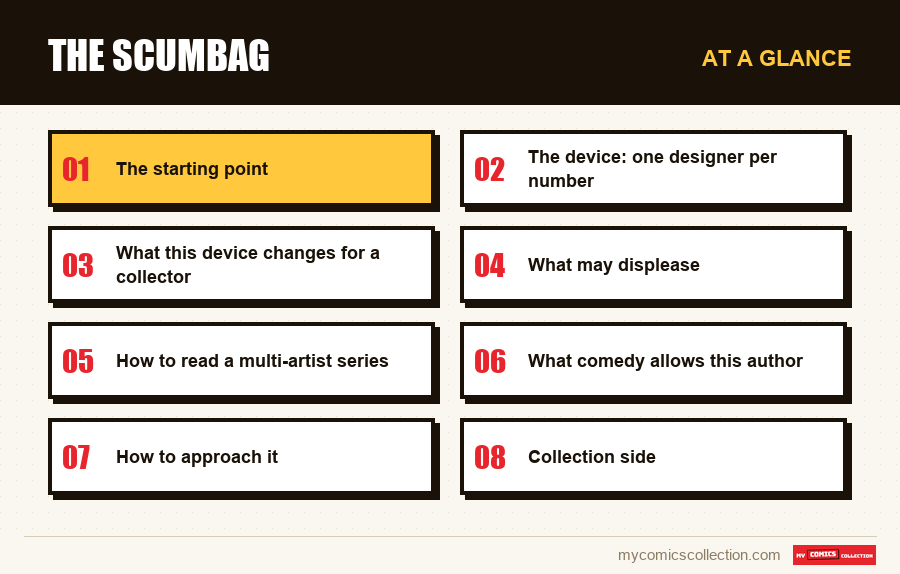
The starting point
Ernie Ray Clementine is a dirty, cowardly individual, permanently drugged and devoid of any redeeming qualities. He seeks nothing, wants nothing, regrets nothing, and has never accomplished anything.
A secret organization recruits him: not despite what he is, but because of it. Its very nullity makes it impossible to anticipate, therefore useful in a conflict where the two camps monitor each other with excessive means.
The story then advances through absurd escalation, chaining together classic spy situations handled from the wrong end. It is the only frankly comic title by its author, and the contrast with the rest of his production is total.
The device: one designer per number
An anthology as much as a series
Each chapter is by a different artist, with styles unrelated to each other. The story continues, but the object completely changes appearance with each issue.
This is what gives the title its main interest, and its main difficulty.
A choice consistent with the subject
A story based on the instability and unpredictability of its protagonist benefits from never offering the same visual surface twice in a row.
Uneven quality, by construction
Some chapters are remarkable, others less so. This is the price of an anthology, and it would be dishonest to pass it over in silence.
No graphics unit
What his other series seek, a single hand that holds the whole, is here deliberately sacrificed. A reader who comes for this will be confused.
What this device changes for a collector
This is where the title stands out from all the rest of its bibliography, and the consequence is very concrete.
On an ordinary series, the number of an issue indicates its place in the story and nothing else. It is acquired to complete, and two copies of different numbers have the same nature.
Here each number is a separate graphic object. We may want a specific chapter because an artist we follow drew it, without worrying about the plot. Two readers may target the same title for unrelated reasons.
The practical consequence is direct. A catalog which records “series X, designed by Y”, sufficient wording on its other titles, becomes entirely false here. The field must be filled in number by number, otherwise the most useful information disappears.
The consequence for searching for a copy. On this title more than any other, the ads are indexed to the name of the designer: a seller highlights the artist, not the screenwriter or the number.
Seek "The Scumbag #4” therefore brings up far fewer offers than searching for the name of the artist concerned. This is true to a degree that none of his other series achieves.
What may displease
Deliberately disgusting humor
The comedy relies heavily on grime, fluids and degradation. It's assumed and coherent, but it doesn't make everyone laugh.
A quality that varies from one chapter to another
The change of artist for each issue mechanically produces inequalities. A reader may love one chapter and be bored by the next.
No character progression
The protagonist does not improve, and this refusal is the very principle of the title. Those who expect developments will be systematically disappointed.
A tone very far from his work
A reader coming through his serious stories will find something unrecognizable here. It's not a variation of register, it's another profession.
How to read a multi-artist series
This format is rare enough that we don't know how to approach it spontaneously, and two reflexes prove counterproductive.
The first is to judge each chapter on the same basis. In an anthology, inequality is not a fault of execution but a property of the format: there are remarkable pieces and ordinary pieces, and it is precisely the gap that makes the whole interesting.
The second is to wait for visual continuity. On an ordinary series, a change of designer creates a break that we feel like a loss. Here the rupture is the very rhythm of reading, and to feel it as such is to fight against the book.
The correct arrangement is to treat each number as a reprise of the same theme by a different performer. What we then follow is no longer just the plot but what each artist does with the same character: and the protagonist, precisely because he is immutable and inert, constitutes an excellent point of comparison from one chapter to another.
What comedy allows this author
It would be easy to treat this title as an unimportant recreation. Two observations contradict this.
The first is that the author's usual mechanism is intact, simply reversed. His gritty stories show someone getting what they wanted and paying for it. Here, a character who wants absolutely nothing is imposed on a mission, and the comedy arises from the fact that he refuses to pay anything: an anti-hero in the strict sense, not morally ambiguous but totally inert.
The second is that comedy authorizes a charge that seriousness would prohibit. The story ridicules both sides of an ideological conflict with equal treatment that a serious register would make heavy or partisan. The stupidity of the protagonist serves as a common measure: no one comes out of it grown.
This does not make this title his best, and there is no obligation to read it to understand his work. But that makes it something other than an interlude: it's the only place where he writes without gravity, and the result illuminates everything else by contrast.
Collecting this series?
Track what you own, what you are missing and what your collection is worth. 7 day trial.
Start my trial →How to approach it
Three recommendations, the first of which avoids most of the disappointments.
Never first. This title gives a completely false image of its author. A reader who starts there and moves on to his fantasy would believe he has changed writer.
In volumes, for the story; by number, for designers. This is the only one of his titles where the two approaches are legitimate and distinct. The volume gives the history, the booklets give the artists.
Without requiring regularity. Accepting straight away that some chapters are less successful completely changes the experience. It's an anthology: we don't judge each piece in the same way.
Collection side
Here we remain in the low price range of his bibliography, but with an operation that has no equivalent anywhere else in his collection.
The first issue remains, as with all its series, the most sought-after object: printed before the series had proven itself, therefore in prudent quantities. This is the only constant it shares with the rest of its bibliography.
Beyond that, the logic diverges. Of his other titles, the following numbers have no tension and are not worth actively searching for. Here, certain chapters can be searched regardless of their rank, depending on the notoriety of the artist who drew them. A late number can therefore be worth more than an early number, which does not happen anywhere else with him.
This does not mean that these copies are expensive: the title remains little followed and the supply abundant. But this means that classification by number does not reflect the order of values, and that we must look at the content of each booklet.
What to record
On this title, one field takes precedence over all others, and it is usually not filled.
The designer, by number. It is the information that distinguishes the examples from each other, directs research, and explains price differences. Reported once for the entire series, it is simply false.
The format. Booklet or bound volume: both have the same title, and the volume removes the information on the artists that the booklet carries.
What a cover, on the first issue. The “variant” label remains silent here, as elsewhere, on the number of copies printed.
What we expect from an inventory is therefore not the same as usual. The right question is no longer “what number am I missing?” » but “which artist am I missing?” », and a simple sequence of numbers is incapable of answering it.
Who to recommend it to
The audience for this title only partially overlaps with that of its author, and it is better to know this before giving this book to someone.
It is suitable for readers who like frankly crude comedy and embrace it, for those who follow cartoonists rather than screenwriters, and for those looking for a non-committal read: you can read three chapters and stop without losing anything.
It is poorly suited, on the other hand, to those who have discovered this author through his serious stories and expect the same thing. The gap is too great to be experienced as a variation: it is another register, exercised with other means, and disappointment would be guaranteed.
It is also poorly suited to those who arrange their readings for visual coherence. A series in which each volume is drawn by a different hand does not satisfy this taste, and nothing in the title will compensate for it.
Frequently asked questions
This is a construction choice, not a production difficulty. A story based on the unpredictability and instability of its protagonist benefits from never presenting the same visual surface twice, and the author has made this rotation the central device of the title.
Absolutely not, and it's even the only one of his titles that you shouldn't read first. The comic tone, the lack of progression of the character and the rotation of the artists make him a separate object, which would give an entirely misleading image of his work.
More legitimately than in any other of his series, yes. Each booklet constitutes an autonomous graphic object by its artist, and acquiring it for this reason alone makes sense even without following the plot. This is the only one of his titles where this approach is justified.
It's possible here, whereas it never happens on his other series. The value of a chapter depends partly on the notoriety of the artist who drew it, and a well-known designer may well intervene late. The rank in the series therefore does not reflect the order of prices.
Both approaches are justified and do not aim at the same thing. The bound volume gives the plot at the best price and stores easily; the booklets preserve the identity of each artist and allow you to target a specific chapter. This is the only title in his bibliography where one could reasonably want both.
One designer per number, therefore one field per number
Entered once for the entire series, it is simply wrong, and the most useful information disappears.