The same stories, reprinted ten years after their publication, wonder starting at $2.49 when the original issues had a gross median of $40.00. As of August 29, 2026, these reprints have a median of $19.87 out of 126 ads, and the least expensive copies explicitly indicate their nature in the title. Content costs three dollars, item costs forty: and it's the same story, printed on the same plates.
This approach is poorly known, and it solves a real problem for those who want to read an ancient period without spending several hundred dollars.
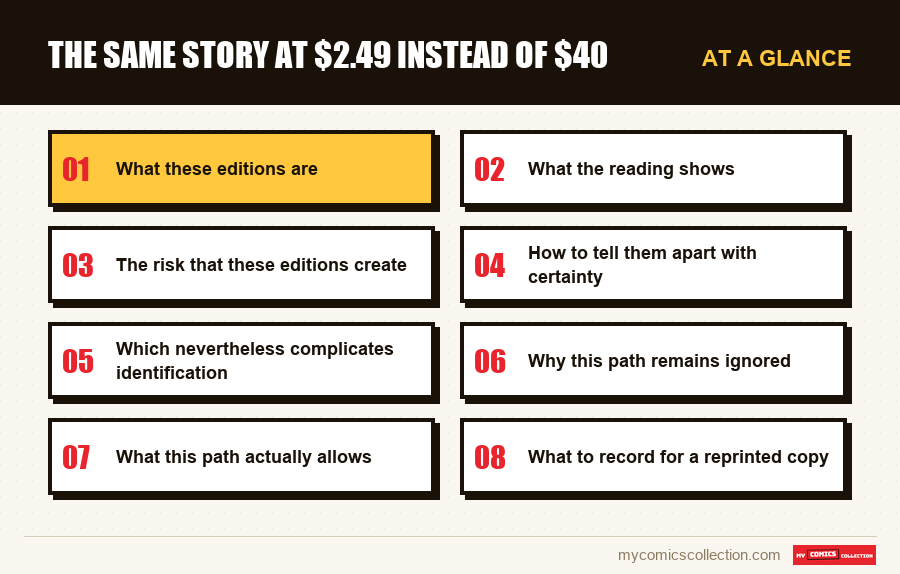
The following describes what exactly these editions are, what the statement shows, the risk of confusion they create when purchasing, how to distinguish them with certainty, and what to note so as not to distort your inventory.
What these editions are
These are neither collections nor facsimiles, and the distinction has practical consequences.
These are booklets, in the same format as the originals. Same number of pages, same presentation, same stapling. They were sold on newsstands like any new issue, at their reprint time.
They take the boards identically. The drawing, the cutting, the dialogues are those of the original publication. What changes is limited to the design: the publisher's logo, sometimes the printed price, occasionally the color of the cover.
They were produced for a specific commercial reason. Republishing a collection that has already been paid for costs much less than producing something new, and makes it possible to occupy sales spaces without mobilizing authors.
It is this last characteristic which explains their abundance. A reprint is not a tribute, it is a performance operation, and it was carried out at comfortable draws: hence the prices observed sixty years later.
What the reading shows
Reprints
126 ads in gross, of $2.49 to $516.60 requested, median $19.87. In certified, only eight proposals, median $99.50.
The original fascicles
Raw median $40.00 out of 135 advertisements, certified median $249.99 out of 45 ads. Twice the price raw, two and a half times certified.
The bottom of the range
A copy described as very damaged and intended for reading wonders $2.49. An ordinary copy of the same reprint, $2.97.
The certified summit
Only eight verified ads. On such a small workforce, the median of $99.50 is an indication, not a measurement.
These are again prices asked on August 29, 2026, gross and certified separately, and not sales made. The query also picks up unrelated issues, which inflates the population without moving the bottom of the range, the only point exploited here.
The figure to remember is not the median but the minimum. At $2.49 or $2.97, a reader accesses the exact content of a booklet, the original of which sells for around forty dollars in ordinary condition, and much more in verified condition.
The ratio is therefore of the order of fifteen to one on the same story. No other access route offers a comparable gap, and it remains largely ignored because these issues do not appear in searches by series name.
The risk that these editions create
Their resemblance to the originals poses a purchasing problem that you need to know before looking.
The cover is almost identical. Same illustration, same title, often same layout. On a small photograph, the difference is a logo and a printed price, both of which are difficult to read.
The number is the same. A reprint of issue three is number three. An inventory line reduced to the title and number therefore does not allow you to know what you own.
Not all sellers are informed. Many clearly indicate the nature of the copy, the titles noted say so, but a booklet inherited or purchased in batches can be offered in good faith as an original.
The financial risk is modest since the difference concerns a few dozen dollars, but the documentary risk is real. An inventory that counts a reprint as an original becomes false and the rest, without anything reporting it later.
This case neatly isolates what the market pays. The story, the drawing and the cutting are strictly identical in the two objects; the only difference is that it was printed in 1966 rather than 1977.
The price difference therefore measures exactly one thing: the age of the print run and the resulting survival rate. It measures neither the quality of the story, nor its editorial rarity, nor its importance: since all of this is common to both copies.
How to tell them apart with certainty
Four checks are enough, and they work even on poor photography.
The publisher's logo on the cover. This is the most reliable sign, because the reprint was published under a company name distinct from that of the original issue. A different logo stands out immediately.
The printed cover price. It increased between the two publication dates. An amount higher than that of the original period denotes an unambiguous reprint possible.
The mention of legal deposit on the inside page. It bears the actual year of printing and not that of creation. This is the safest check, but it requires having the booklet in hand.
The absence of period advertisements. The reprints replace or remove the advertising pages from the initial print run, which is noticeable as soon as you leaf through.
These four points overlap and rarely contradict each other. Two of them are visible in a simple cover photograph, which makes the error avoidable for those who remember to look.
Which nevertheless complicates identification
Some situations resist previous checks.
Partial photographs
An ad that only shows the top of the cover hides the printed price.
Hardly readable logos
On a worn copy or a low definition image, the publisher's mark becomes indecipherable.
Undetailed batches
A set sold by weight may mix originals and reprints without the ad specifying this.
Cropped covers
A cut edge can make the price mention disappear, the only clue visible on certain copies.
A repeated numbering
The reprint retains the original number, making any search by number ambiguous.
Copies without cover
Deprived of its cover, a booklet is no longer linked to one or the other edition without internal examination.
Collecting this series?
Track what you own, what you are missing and what your collection is worth. 7 day trial.
Start my trial →Why this path remains ignored
Fifteen times cheaper access to the same content should be known to everyone. There are three reasons why it is not.
These fascicles do not come up in usual searches. They are listed under the name of the publisher who reprinted them, so a search by character or series name does not bring them up prominently.
The word used to describe them is demeaning. A reprint is spontaneously perceived as a copy, therefore as a second-order object. Nothing in this vocabulary suggests that this is a period fascicle in its own right.
The collection discourse ignores them. The guides are organized around the first publications, which alone build values. An object about which nothing can be said in terms of rating has no place in this discourse, whatever its usefulness.
This results in a fairly large blind spot. A significant part of printed heritage remains accessible for a few dollars, precisely because it does not fall under the logic of scarcity: and this exclusion, which deprives it of market value, is exactly what makes it useful to anyone who wants to read.
What this path actually allows
It is worth describing what these fascicles make possible, because it is not just an economy.
They allow you to read an entire period. Building a series of originals over several years represents a budget that discourages most readers, and the renunciation then concerns the discovery itself. At three dollars per issue, the question no longer arises.
They allow manipulation. A valuable old copy is read with care, sometimes not at all. A reading copy opens flat, can be transported, can be lent: uses that a collector's item prohibits in practice.
They make mistakes inexpensive. Exploring an unknown period means buying things you won't like. At this price point, making a mistake has no consequences, which encourages exploration instead of securing one's choices.
These three effects go in the same direction and are cumulative. They make reprinting the format best suited to the discovery of an old collection., while it is presented everywhere as a last resort.
There remains a counter-intuitive consequence which deserves to be formulated: an informed collector often has an interest in owning both. The original for the object, the reprint for the use: one preserved, the other read, for an additional cost of a few dollars.
What to record for a reprinted copy
The documentation of these fascicles requires explaining what, elsewhere, is self-evident.
The edition to which the copy belongs. Original publication or reprint: this is the field that is most often missing and without which the entire line becomes ambiguous.
The actual year of printing, distinct from the year of the story. The two dates differ by a decade, and confusing one with the other distorts any chronology reconstructed from the inventory.
The name of the publisher appearing on the cover. It differs from that of the initial publication, and it is this which will later allow the object to be found in the catalog.
The clue that made it possible to decide. Logo, printed price, internal mention: noting which one was used allows you to re-examine the conclusion if any doubt appears.
The assumed destination of the copy. A booklet acquired to read and a booklet acquired to be kept do not require the same care; writing it avoids treating a reading copy as a piece to be protected, or the opposite.
Yes for the plates: drawing, cutting and dialogues are those of the original publication. What changes is the design (publisher's logo, printed price, sometimes the color of the cover) and the advertising pages, which are often replaced or deleted. To read, the difference is zero.
Two clues are visible on a cover photograph: the publisher's logo, different from that of the original publication, and the printed price, higher since the reprint is a decade later. A mention of legal deposit on the inside page decides definitively, but requires having the booklet in hand.
Weak and without perspective. Only eight certified advertisements on the August 29, 2026 statement, and a gross median of $19.87 driven up by unrelated booklets. They are objects of use, not of placement, and this is precisely what makes them accessible.
The age of the draw, and nothing else. Story, drawing and cutting being strictly identical in the two objects, the difference can measure neither the quality, nor the editorial rarity, nor the importance of the issue. It isolates a single variable: having been printed eleven years earlier, with the survival rate that this implies.
Because these issues do not come up in searches by series name, because the word “reprint” makes them pass for copies even though they are period objects, and because the collection guides are organized around what builds a rating. An object without a rating has no place in this discourse, even when it is useful.
Original or reprint, does the line say so?
Same title, same number, same cover: without a draw field, an inventory mixes two objects fifteen times apart.